Real vs Fake Green Aventurine: 7 At-Home Tests to Spot Dyed Glass & Quartzite
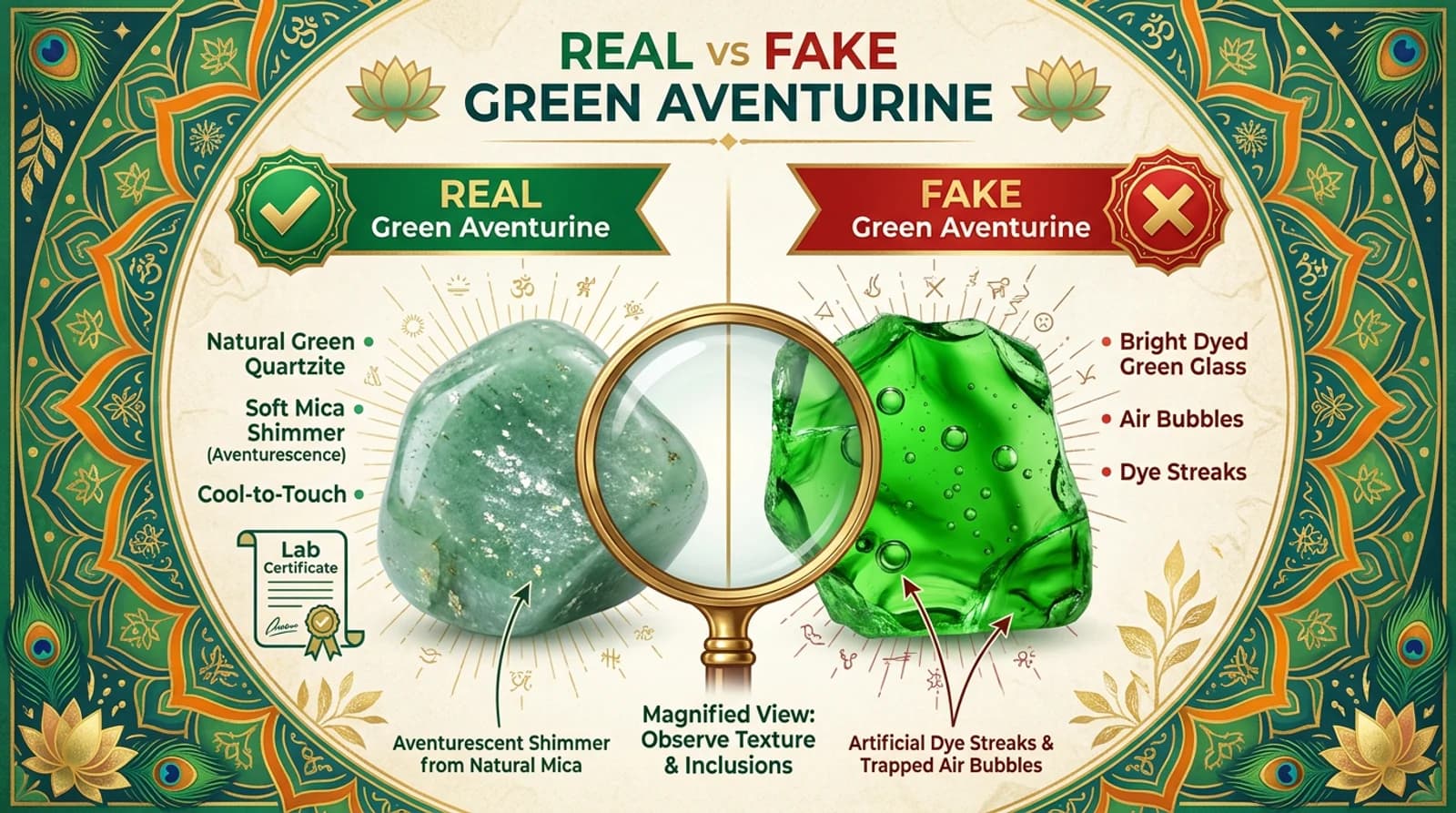
Real green aventurine is a green quartzite coloured by tiny fuchsite (chrome-mica) flecks that give it a soft internal shimmer called aventurescence. Fakes are usually dyed glass or plain green quartzite. You can separate them at home using shimmer, hardness, air-bubble, temperature and dye-streak tests — and confirm with a lab certificate.
What Real Green Aventurine Actually Is
Real green aventurine is a green variety of quartzite — a compact quartz rock — coloured by countless tiny flecks of fuchsite (a chrome-rich mica). Those flecks catch the light and create a soft, glittery sheen called aventurescence. A bracelet is simply 6, 8 or 10mm aventurine beads strung on elastic. Fakes are usually dyed glass or plain dyed quartzite with no real shimmer.
Knowing the material matters because almost every metaphysical claim about green aventurine — the "Stone of Luck & Opportunity," abundance, heart-chakra balance, confidence — is belief- and tradition-based, not proven by clinical science. What you can actually verify is whether the stone is genuine. That is where these tests come in, and it is the one promise we can keep honestly: a real, natural, lab-checked crystal rather than coloured glass.
| Mineral family | Quartzite (microcrystalline quartz) with fuchsite mica |
| What gives the shimmer | Fuchsite/chrome-mica inclusions = aventurescence |
| Mohs hardness | About 6.5–7 (scratches glass and steel) |
| Typical colour | Soft to deep green, slightly mottled, not perfectly even |
| Common fakes | Dyed glass, dyed quartzite, plastic resin beads |
| Feel | Cool to the touch, warms slowly; solid, dense weight |
7 At-Home Tests to Tell Real from Fake
No single test is conclusive on its own — glass can be convincing. Run several and look for agreement. If a bead passes most of these and comes with a viewable lab certificate, you can buy with confidence.
- 1Shimmer (aventurescence) under light
Tilt the bead slowly under a bright lamp or sunlight. Real aventurine shows a fine, sparkly glitter that moves across the surface from many tiny mica flecks. Dyed glass either looks flat and uniform, or has a few coarse, suspiciously regular sparkles (often added glitter or copper).
- 2Colour evenness
Genuine stone is slightly mottled, with gentle variation bead to bead. Fakes are often too perfect — an identical, candy-bright green across every bead with no natural patchiness usually signals dye or glass.
- 3Hardness / scratch test
Aventurine is Mohs 6.5–7, so it scratches glass and resists a steel knife. Gently try to scratch an inconspicuous spot with a steel blade — real stone stays unmarked; soft glass or resin scratches. Do this carefully on one spare bead only.
- 4Air-bubble glass test
Hold the bead to a strong light with a loupe or phone macro. Tiny round air bubbles trapped inside mean it is glass, not stone. Natural aventurine has flecks and cloudy patches, never perfectly round bubbles.
- 5Cool-to-touch temperature
Press the bead to your cheek or lip. Real quartzite feels noticeably cool and warms up slowly. Glass also feels cool but warms faster; plastic/resin feels warm and light almost immediately.
- 6Conchoidal fracture & weight
Stone is dense and heavy for its size; plastic feels light. Any chipped edge on real quartz/quartzite shows a curved, shell-like (conchoidal) fracture, not a clean moulded seam like glass or plastic.
- 7Dye-streak / acetone test
Rub the bead with a cotton pad dipped in acetone or nail-polish remover. If green colour streaks onto the pad, it is dyed. Natural aventurine will not bleed colour. (Skip near the elastic cord — keep the bracelet dry.)
Honest caveat: at-home tests reduce risk but cannot match lab gemmology. Treat them as a first filter, then rely on a per-piece certificate for proof.
Dyed Glass vs Plain Quartzite vs Real Aventurine
The two common imposters behave differently. "Green goldstone" is man-made glass with copper sparkle, sold as aventurine. Plain green quartzite is real rock but dyed and lacking true fuchsite shimmer. Here is how all three compare at a glance.
| Feature | Real Green Aventurine | Dyed Glass / Goldstone | Dyed Green Quartzite |
|---|---|---|---|
| Shimmer | Fine, diffuse aventurescence | Flat or coarse, regular sparkle | Little to none |
| Air bubbles | Never | Often visible under light | No |
| Colour | Mottled, natural variation | Uniform, candy-bright | Even but flat, can bleed dye |
| Hardness | 6.5–7, scratches glass | ~5.5, scratches easily | 6.5–7 |
| Dye streak test | No bleeding | No bleeding (colour is in glass) | May bleed colour |
| Feel & weight | Cool, dense | Cool, can have seams | Cool, dense |
Note the trap: dyed glass will not bleed in the acetone test because its colour is melted in — so you must combine it with the bubble and hardness checks. Dyed quartzite is the opposite: real hardness but bleeding dye. Real aventurine fails neither test.
Green Aventurine vs Jade: Telling Them Apart
Buyers often confuse green aventurine with jade, since both are green and sold as luck stones. They are different minerals at very different price points, and some sellers pass one off as the other. A quick comparison helps you check what you are actually paying for.
| Feature | Green Aventurine | Jade (Jadeite/Nephrite) |
|---|---|---|
| Shimmer | Sparkly aventurescence | Soft, oily/waxy glow, no glitter |
| Translucency | Mostly opaque | Often slightly translucent |
| Typical price | Affordable | Much higher, especially jadeite |
| Texture | Granular, slightly sparkly | Smooth, dense, fibrous |
| Tradition | Stone of Luck & Opportunity | Stone of harmony and protection |
If a low-priced "jade" bracelet sparkles, it is likely aventurine; if a "green aventurine" piece is glassy-smooth with no flecks, question it. Either way, a lab report names the exact mineral so you are not guessing.
Why a Viewable Lab Certificate Beats a "100% Certified" Sticker
Anyone can print "100% certified" or "authentic" on a product page. That is a claim, not proof. A genuine third-party lab certificate is different: it identifies the mineral, records the bead size and weight, and is tied to your specific piece — something you can actually open and read.
| What a real certificate states | Mineral identity (natural aventurine), weight, size, treatment if any |
| Who issues it | An independent gem lab, not the seller alone |
| DivineTatva difference | Viewable Jaipur lab certificate image you can inspect before buying |
| Red flag | "Certified" text with no document you can actually see |
| Buying safety | COD, INR pricing and 7-day returns so you can verify on arrival |
When the certificate is viewable and the brand offers COD and 7-day returns, the risk shifts off you: run the at-home tests when your bracelet arrives, cross-check against the certificate, and return it if anything does not match. That is honesty you can audit, not a badge you have to trust blindly.
Printable Authenticity Checklist (and Care After)
Run through this quick checklist whenever you buy or receive a green aventurine bracelet. A real piece should pass most boxes; certification settles the rest.
- 1Shimmer present
Fine, moving aventurescence under light — not flat or coarse.
- 2Natural colour variation
Slightly mottled green, not identical candy-bright beads.
- 3No air bubbles
Under a loupe, no perfectly round trapped bubbles.
- 4Hardness holds
Scratches glass; a steel blade does not mark it.
- 5Cool and dense
Feels cool to the lip and heavy for its size.
- 6No dye bleed
Acetone pad stays clean (away from the elastic cord).
- 7Certificate matches
Viewable lab report names natural aventurine, size and weight.
Once verified, protect it. Keep your green aventurine bracelet dry — remove it before bathing, swimming, workouts or applying perfume and lotion, and never soak the elastic-strung beads in water or salt water. Cleanse gently with smudge or sound and recharge in moonlight to protect both the shimmer and the cord.
Remember the honest frame: these tests confirm the material, and the luck, abundance and heart-chakra benefits come from Vedic and metaphysical tradition plus belief — not clinical proof. A genuine bracelet is a meaningful, beautiful intention-setting tool, never a substitute for medical, financial or professional advice.
Frequently asked
Last reviewed: 17 May 2026 · Verified by the DivineTatva expert panel
How can I tell if green aventurine is real or fake at home?
Use several tests together. Real green aventurine shows fine moving shimmer (aventurescence), slightly mottled colour, no perfectly round air bubbles, scratches glass at Mohs 6.5–7, feels cool and dense, and does not bleed dye on an acetone pad. Dyed glass shows bubbles and flat colour; dyed quartzite may bleed dye. No single test is conclusive, so look for agreement and confirm with a lab certificate.
What is the easiest test to spot fake green aventurine?
The air-bubble check is quickest. Hold the bead to a strong light with a loupe or phone macro: tiny round bubbles trapped inside mean it is glass, not stone. Pair it with the shimmer test — real aventurine sparkles softly from many tiny mica flecks, while glass looks flat or has coarse, regular glitter. Together these two catch most fakes in seconds.
Does real green aventurine bleed colour in water or acetone?
No. Genuine green aventurine is coloured by natural fuchsite mica, not surface dye, so it will not streak colour onto a cotton pad with acetone. If green comes off, the bead is dyed quartzite or another dyed stone. Note that dyed glass also will not bleed because its colour is melted in — so combine the dye test with the bubble and hardness checks. Keep acetone away from the elastic cord.
Is green aventurine the same as jade?
No, they are different minerals. Green aventurine is a quartzite with sparkly aventurescence and is affordable; jade (jadeite or nephrite) has a soft waxy glow, no glitter, is often slightly translucent, and costs far more. If a cheap "jade" bracelet sparkles, it is likely aventurine; if "green aventurine" is glassy-smooth with no flecks, question it. A lab report names the exact stone.
What does a green aventurine lab certificate prove?
A genuine third-party certificate identifies the mineral as natural aventurine and records details like bead size, weight and any treatment, tied to your specific piece. That is real proof, unlike a printed "100% certified" badge with no viewable document. DivineTatva provides a viewable Jaipur lab certificate image, plus COD, INR pricing and 7-day returns so you can verify the bracelet on arrival.
Are green aventurine bracelet benefits scientifically proven?
No. Benefits like luck, opportunity, abundance, confidence and heart-chakra balance come from Vedic and metaphysical tradition and personal belief, not clinical science. Many wearers report a calmer, more focused, more optimistic feeling consistent with intention, ritual and placebo. Treat the bracelet as a meaningful intention-setting tool, never as a substitute for medical, financial or professional advice.
What is a fair price for a real green aventurine bracelet in India?
Natural green aventurine is an affordable stone, so genuine 6, 8 or 10mm bead bracelets are modestly priced in India. Be cautious of bracelets priced suspiciously low with no certificate — they are often dyed glass or quartzite. Pay a fair price for a certified, viewable-lab piece with COD and returns rather than the cheapest unverified option.
Reviewed by the DivineTatva expert panel
Written and reviewed by DivineTatva's consulting Vedic astrologer. Every piece is lab-certified and energised in our Jaipur atelier. Last updated 31 March 2026.