Real vs Fake Money Magnet Bracelet: How to Spot Genuine Pyrite, Citrine and a Real Lab Certificate
A real money magnet bracelet uses natural, lab-certified stones — pyrite, citrine, tiger eye and green aventurine — that show genuine mineral traits: pyrite has a brassy metallic sheen and noticeable weight, citrine has uneven natural colour, and beads have tiny inclusions, not bubbles. Fakes use dyed glass, plastic, painted resin or heat-treated stone, feel light and look too perfect, and lack a downloadable lab certificate.
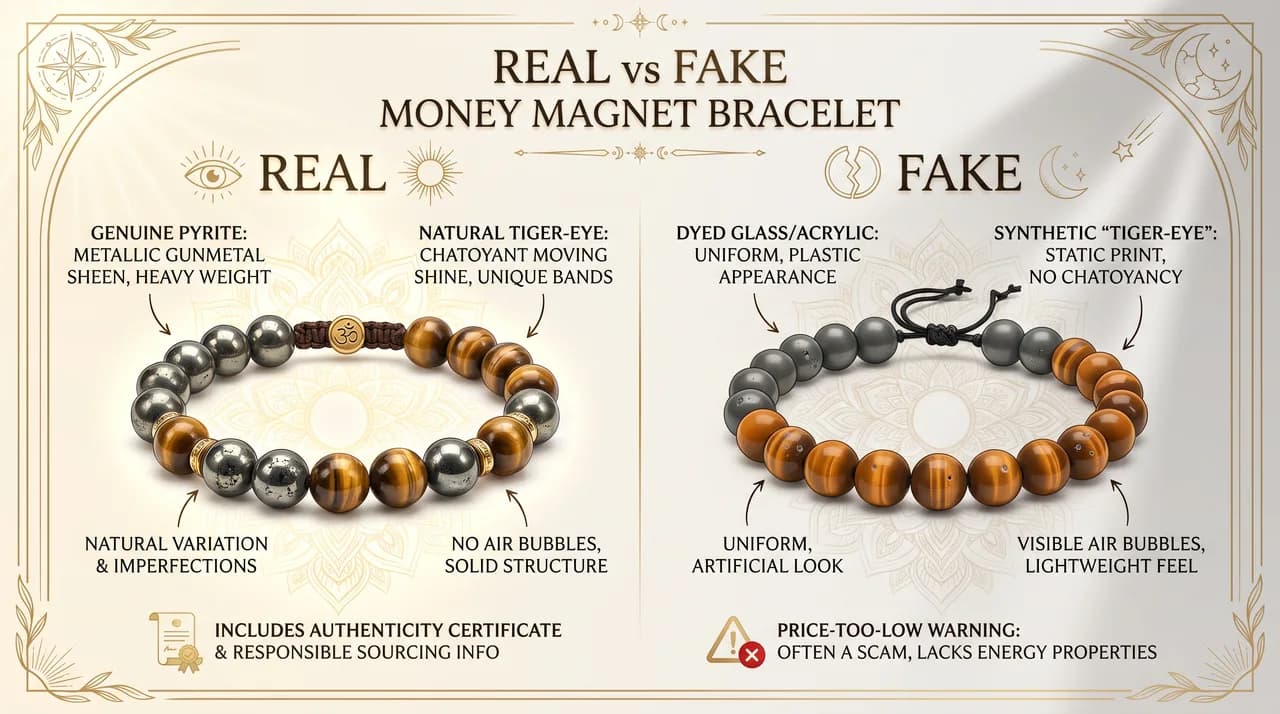
Why real vs fake actually matters
A money magnet bracelet (Hindi: Dhan Akarshak) is a wealth-attraction combo of natural crystals — in the standard build, Pyrite (the hero stone for abundance and opportunity), Citrine (money flow and confidence), Tiger Eye (focus and willpower) and Green Aventurine (luck and new openings). The whole point is that the stones are genuine natural minerals. A bracelet of dyed glass and plastic is just costume jewellery wearing a spiritual label.
Let us be honest about mechanism first. There is no scientific proof that any crystal makes money appear. The credible, evidence-based mechanism is psychological: a daily worn object acts as an intention primer, nudging your reticular activating system to notice opportunities, and reinforcing confidence and follow-through. That, plus a long Vedic cultural tradition, is why people wear it. A bracelet supports your effort — it does not replace it. This is not financial or medical advice.
This matters for authenticity in two ways. First, the psychological priming works best when you trust and value the object — knowing it is real, certified and energised strengthens the effect, while quietly suspecting it is fake undermines it. Second, real pyrite is iron pyrite (FeS2), a genuine mineral with real care needs. A fake will not behave like pyrite, and a seller who fakes the stone will also fake the care advice. Knowing the difference protects both your intention and your money.
How to identify real pyrite
Pyrite is the easiest stone to test because real pyrite has unmistakable physical properties that cheap substitutes cannot fake all at once. Genuine pyrite is nicknamed 'fool's gold' for a reason — it has a bright brassy, metallic-gold lustre, but unlike gold it is hard, brittle and noticeably heavy. Run through these checks before you trust any pyrite bracelet.
- 1Metallic sheen, not painted shine
Real pyrite reflects light like polished metal with a cool brassy tone. Painted or coated fakes look flat, plasticky, or have a uniform gold paint layer that chips at the bead hole.
- 2Heft test (density)
Pyrite is dense (about 5 g/cm3). A genuine pyrite bead feels surprisingly heavy for its size. If the bracelet feels light and hollow like plastic, be suspicious.
- 3Look for natural facets and striations
Natural pyrite often shows tiny geometric facets, cubic structure or fine parallel lines (striations). Glass or resin fakes are perfectly smooth and rounded with no internal structure.
- 4Colour is brass-gold, not yellow-gold
Real pyrite is a pale brassy gold, sometimes with a slight greenish or grey metallic cast. Bright lemon-yellow or orange 'gold' usually means dyed or coated material.
- 5Cool to the touch, warms slowly
Like most genuine stone and metal, pyrite feels cool when you first hold it and warms gradually. Plastic warms almost instantly to skin temperature.
- 6Surface tarnish over time
Real pyrite can develop a slightly darker patina with age and handling because it is a sulphide. A bead that stays flawlessly mirror-bright forever may be coated metal or glass.
Care warning that doubles as an authenticity tell: because real pyrite is iron pyrite (FeS2), it oxidises and corrodes in moisture. Never cleanse a genuine pyrite bracelet with water or salt water — use only dry methods (selenite plate, moonlight, sage or incense smudge, or dry rice). Any seller who tells you to soak the bracelet in water or salt water either does not understand pyrite or is not selling real pyrite. We never recommend water for this reason.
Natural vs dyed and heat-treated stones
Pyrite is hard to fake convincingly, so fakers focus on the coloured stones — especially citrine, which is the second hero of the combo. Natural citrine is genuinely uncommon, so a lot of 'citrine' on the market is heat-treated amethyst or, worse, dyed glass. Heat-treated citrine is still real quartz and is widely accepted, but dyed glass and plastic are outright fakes. Here is how to read each stone.
| Stone | Real / natural look | Common fake or treatment |
|---|---|---|
| Citrine | Pale to warm honey-yellow, often uneven colour, smoky tints, natural inclusions and slight cloudiness | Uniform bright orange-yellow with no variation (often heat-treated amethyst); or dyed glass with air bubbles and over-saturated colour |
| Pyrite | Brassy metallic, heavy, faceted or striated, cool to touch | Gold-painted resin, coated hematite, or light plastic beads |
| Tiger Eye | Silky golden-brown bands that shift (chatoyancy) as you tilt it; bands are slightly irregular | Dyed fibre-optic glass: the 'eye' line is too straight, too bright, and identical on every bead |
| Green Aventurine | Soft translucent green with tiny sparkly mica flecks (aventurescence) inside the stone | Dyed quartz or green glass: flat opaque colour, surface glitter instead of internal flecks, bubbles |
| Colour variation | Natural stone varies bead to bead; dyed fakes are eerily identical in shade. |
| Inclusions vs bubbles | Natural crystal has mineral inclusions, veils or cracks. Round air bubbles inside a clear bead mean glass. |
| Dye in the drill hole | On dyed beads, colour often pools darker around the string hole where dye collected. |
| Temperature | Real quartz and stone feel cool and warm slowly; glass warms faster, plastic fastest. |
| Hardness | Quartz-family stones (citrine, aventurine, tiger eye) resist scratching; plastic scratches easily with a fingernail or pin. |
One honest nuance: heat-treated citrine is not 'fake' in the way dyed glass is. It is real quartz whose colour was deepened by heat, and the spiritual tradition still accepts it. A trustworthy seller simply discloses it. The genuine red flags are dyed glass, painted resin and plastic posing as natural crystal — and a seller who refuses to tell you which is which.
Fake red flags and why ultra-cheap units are suspect
You can usually catch a fake bracelet before it even arrives, just from the listing and the price. Natural, lab-certified stone has a real material cost. When a 'money magnet bracelet' is priced like a keychain, something has been substituted. Watch for these signals.
- 1Price too good to be true
Genuine certified four-stone combos sit around ₹799 and premium six-stone builds around ₹999. Units selling for ₹99–₹199 with 'natural crystal' claims are almost always dyed glass or plastic — the maths does not allow real certified stone at that price.
- 2No certificate offered
If there is no lab certificate and no way to download or verify one, treat the 'natural' claim as unproven.
- 3Beads look too perfect
Flawless, identical, bubble-free, mirror-shiny beads with zero colour variation are a hallmark of moulded glass or plastic, not natural stone.
- 4Air bubbles inside clear beads
Hold citrine or quartz to light. Perfectly round trapped bubbles mean glass, never natural crystal.
- 5Wrong care advice
Listings that say 'rinse in water' or 'soak in salt water' for a pyrite bracelet reveal either ignorance or fake pyrite, since real pyrite corrodes in moisture.
- 6Vague sourcing and stock photos
No mention of stone origin, no real product photos, and copy-pasted spiritual claims with no honest 'supports your effort' caveat.
- 7Magnetic 'pyrite'
Real pyrite is only very weakly magnetic at best. A bead that snaps hard to a magnet may be coated hematite or magnetic metal posing as pyrite.
Ultra-cheap units are suspect for a simple reason: the four stones in a real combo each have a sourcing, cutting, drilling and certification cost, plus the labour of stringing and energising. Strip all of that out and you can hit rock-bottom prices — but only by swapping minerals for dyed glass and skipping the certificate. A low price is not proof of a fake on its own, but a low price plus no certificate plus too-perfect beads almost always is.
What a real lab certificate looks like
A certificate is the single fastest way to settle real vs fake — but only a genuine one. A real gemmological lab certificate identifies the material, not just the marketing name. Fake or fluffy 'certificates' are vague, un-verifiable, or describe the bracelet's spiritual benefits instead of the actual minerals. Here is what a credible certificate contains.
| Identified material | Names each stone by its mineral identity (e.g., natural pyrite, natural/quartz citrine, tiger eye quartz, aventurine quartz) — not just 'money stone'. |
| Natural vs treated disclosure | States whether colour is natural or treated (for example, heat-treated citrine), so nothing is hidden. |
| Bead size, count and weight | Physical specs that match the actual bracelet you received. |
| Issuing lab and date | A named gem-testing laboratory with an issue date and certificate or report number. |
| Verifiable reference | A number or QR you can check, and a downloadable copy you actually receive — not a blurry stock image. |
| Honest scope | Certifies what the stone IS. No real lab certifies that a stone will make you rich — be wary of any 'certificate' that promises wealth. |
DivineTatva bracelets use real lab-certified natural stones with a downloadable certificate, and are astrologer-energised in Jaipur. The certificate proves the material; the energisation and your own daily intention do the rest. Remember the boundary: a certificate guarantees the stones are genuine, not that money will arrive. The bracelet supports your effort and intention — it is not a financial instrument, and this is not financial or medical advice.
Buyer's authenticity checklist
Run any money magnet bracelet — one you own or one you are about to buy — through this final checklist. If it clears all of these, you are very likely holding the real thing.
- 1Heft and feel
Pyrite beads feel heavy and cool; the bracelet does not feel hollow or plasticky.
- 2Pyrite sheen
Brassy metallic lustre with facets or striations, not flat gold paint.
- 3Colour variation
Stones vary bead to bead; nothing is suspiciously identical.
- 4No trapped bubbles
Clear beads show inclusions, not round air bubbles.
- 5Honest treatment disclosure
Seller tells you if citrine is heat-treated, rather than hiding it.
- 6Correct care advice
Dry cleansing only (selenite, moonlight, smudge, dry rice); never water or salt for pyrite.
- 7Downloadable lab certificate
Names the minerals, the lab, a date and a verifiable number — and you actually receive it.
- 8Sensible price
Around ₹799 for the four-stone combo, ₹999 for the six-stone Dhan Yog Plus — not throwaway-cheap.
- 9Honest claims
The seller frames it as support for intention and effort, with no guaranteed-riches promises.
If you want the short version: real pyrite is heavy, brassy and dry-cleaned only; natural stone varies and contains inclusions; fakes are light, too perfect, bubble-filled and uncertified; and a real certificate names the minerals from a named lab. Buy from a seller who certifies the stone, energises it properly, and is honest that the bracelet supports your effort rather than replacing it.
Frequently asked
Last reviewed: 17 May 2026 · Verified by the DivineTatva expert panel
How can I tell if my pyrite bracelet is real or fake?
Check three things at once. Real pyrite is heavy and dense for its size, has a brassy metallic sheen with tiny facets or striations, and feels cool to the touch. Fakes are light, plasticky, perfectly smooth, and often gold-painted (paint chips at the bead hole). A real bracelet also comes with a downloadable lab certificate naming the minerals.
Is heat-treated citrine fake?
No. Heat-treated citrine is real quartz whose yellow colour was deepened by heat — it is widely accepted in the tradition and is not the same as fake. The genuine fakes are dyed glass, painted resin and plastic posing as natural crystal. A trustworthy seller simply discloses whether citrine is natural or heat-treated rather than hiding it.
Why are some money magnet bracelets so cheap?
Because cheap units usually substitute dyed glass or plastic for natural certified stone and skip the lab certificate. Real four-stone combos cost around ₹799 and six-stone builds around ₹999 because genuine minerals carry sourcing, cutting, drilling, certification and energising costs. A ₹99–₹199 'natural crystal' bracelet almost never contains real certified stone.
Can I test pyrite with a magnet?
Somewhat. Real pyrite is only very weakly magnetic, so it should not snap firmly to a household magnet. If your 'pyrite' bead is strongly magnetic, it may be coated hematite or a magnetic metal substitute. Combine the magnet check with the weight, sheen and coolness tests rather than relying on it alone.
What does a real lab certificate for a crystal bracelet look like?
It identifies each stone by its mineral name (natural pyrite, citrine, tiger eye, aventurine), discloses any treatment, lists bead specs, names the issuing gem laboratory with a date and a verifiable certificate number, and is downloadable. It certifies what the stones ARE — it never promises wealth. Vague 'certificates' that describe spiritual benefits are not real lab reports.
Why should I never cleanse a money magnet bracelet with water?
Because it contains pyrite (iron pyrite, FeS2), which oxidises and corrodes in moisture. Water or salt water will damage genuine pyrite over time. Use only dry cleansing methods — a selenite plate, moonlight, sage or incense smudge, or dry rice. Any seller recommending water either misunderstands pyrite or is not selling real pyrite.
How do I spot fake citrine or aventurine?
Look for uniformity and bubbles. Natural citrine has uneven honey tones, cloudiness and inclusions; dyed glass is over-saturated and identical bead to bead with round air bubbles. Real green aventurine has tiny sparkly mica flecks inside the stone; fakes show surface glitter or flat opaque green. Dye also tends to pool darker around the drill hole.
Does it matter if the bracelet is real for it to 'work'?
There is no scientific proof any crystal creates money; the credible mechanism is psychological — intention priming, noticing opportunities, and confidence — plus Vedic cultural belief. That priming works best when you trust and value the object, so a genuine, certified, energised bracelet supports the effect, while quietly doubting a fake undermines it. Either way, it supports your effort and is not financial or medical advice.
Will DivineTatva give me a certificate for my bracelet?
Yes. DivineTatva bracelets use real lab-certified natural stones with a downloadable certificate, and are astrologer-energised in Jaipur, with COD and 7-day returns. The certificate proves the stones are genuine natural minerals; the energisation and your own daily intention and effort do the rest.
Reviewed by the DivineTatva expert panel
Written and reviewed by DivineTatva's consulting Vedic astrologer. Every piece is lab-certified and energised in our Jaipur atelier. Last updated 26 April 2026.