Real vs Fake Rose Quartz: How to Spot Dyed Glass (With Photos)
Real vs fake rose quartz comes down to colour and clarity: genuine rose quartz is a pale, milky, slightly cloudy pink quartz (silicon dioxide), never bright candy-pink. Dyed glass and pink agate fakes look vivid and uniform. Simple home tests plus a named lab certificate confirm a natural stone before you buy.
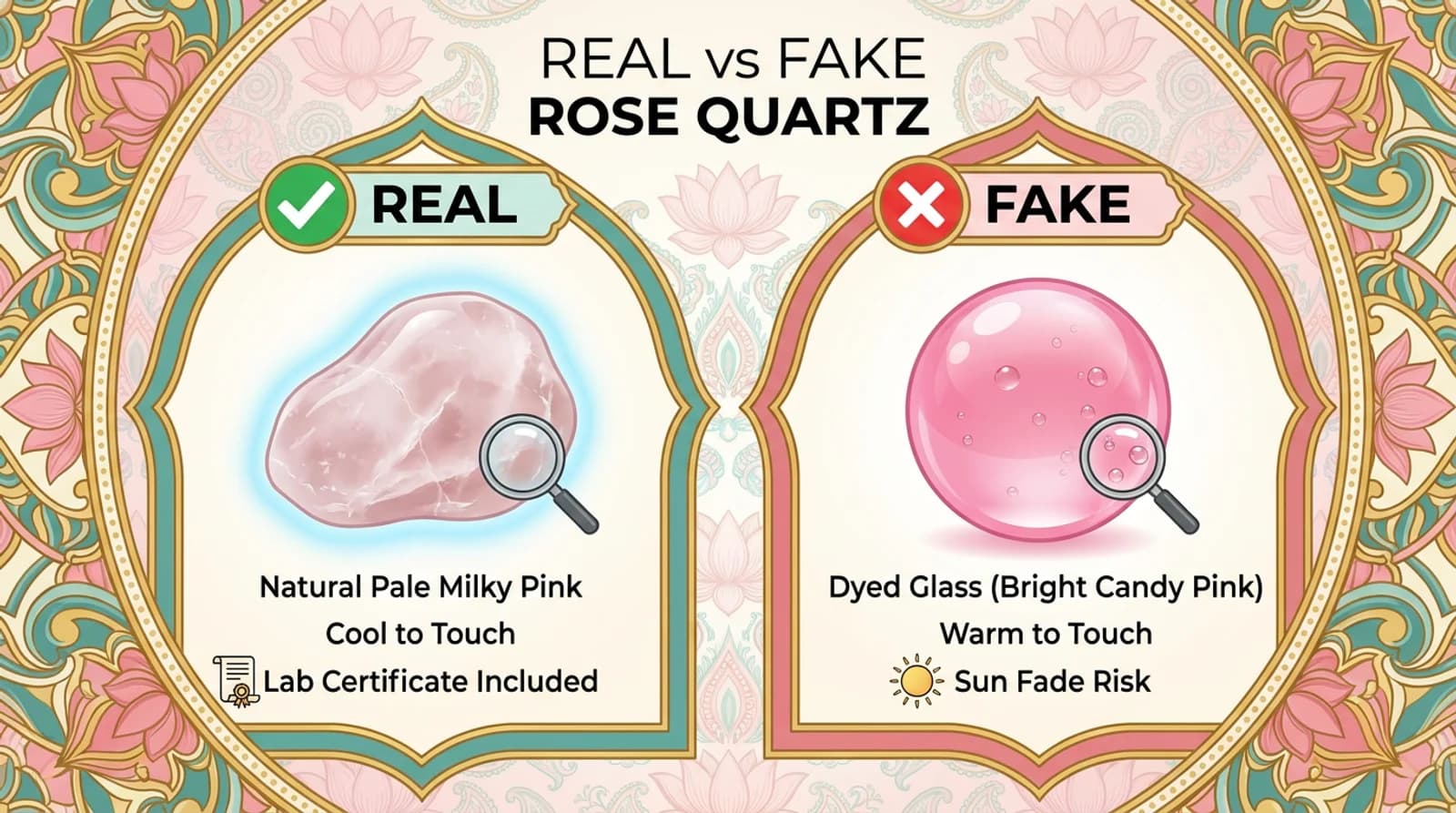
What Real Rose Quartz Actually Looks Like
Real rose quartz is a naturally pink variety of quartz (silicon dioxide) that is pale, milky and slightly cloudy, never bright candy-pink. The colour comes from trace minerals, so genuine beads look soft and a little translucent, often with faint internal cloudiness or wisps. If a 'rose quartz' bracelet looks like uniform bubblegum-pink glass, that vivid evenness is the first warning sign of a fake.
Because the pink is delicate, natural rose quartz can fade in strong, prolonged sunlight. Colour varies bead to bead, and you will often see tiny veils, milky patches or a frosted softness inside the stone. Dyed glass and pink agate imitations, by contrast, tend to be glassy-clear or saturated and identical from bead to bead, the opposite of what nature produces.
| Material | Quartz (silicon dioxide), pink variety |
| True colour | Pale, milky, soft pink, never candy-pink |
| Clarity | Slightly cloudy or translucent, often veiled |
| Hardness | 7 on the Mohs scale (scratches glass) |
| Feel | Cool to the touch, warms slowly |
| Sunlight | Pink can fade with prolonged exposure |
| Chakra link | Anahata (heart) chakra, love and compassion |
Real vs Fake Rose Quartz at a Glance
Most imitations fall into two camps: dyed glass and dyed pink agate or other dyed stone. The quickest tell is honesty of colour. Nature rarely makes a flawless, glowing, candy-pink bead, so over-saturated product photos and perfectly matched beads usually signal a manufactured look rather than a genuine one.
| Clue | Real rose quartz | Dyed glass | Dyed agate / fake stone |
|---|---|---|---|
| Colour | Pale milky pink, varies per bead | Bright, even candy-pink | Strong uniform pink, sometimes banded |
| Clarity | Cloudy, veiled, slightly translucent | Glassy-clear or perfectly even | Opaque, unnaturally consistent |
| Bubbles | None inside the stone | Tiny round air bubbles common | Usually none, but flat banding |
| Temperature | Cool, warms slowly | Warms up quickly in hand | Cool but feels denser |
| Sunlight fade | May gently fade over time | Colour stays fixed | Dye can fade unevenly or rub off |
| Surface | Tiny natural veils, minor flaws | May show mould seams | Dye can pool in cracks |
No single clue is proof on its own. A real stone can occasionally look unusually clear, and a good fake can pass one test. Treat these as a checklist: the more boxes a bracelet ticks toward 'real', and the more it is backed by a named lab certificate, the safer your purchase.
5 Home Tests You Can Do Before You Trust It
These simple checks need no equipment and work on most bracelets at home. They are practical indicators, not laboratory analysis, so use several together and let a lab certificate settle any doubt.
- 1The coolness test
Hold the beads against your cheek or inner wrist. Genuine quartz feels cool and warms slowly. Glass warms up quickly, and plastic feels warm almost at once.
- 2The colour and cloud test
Look closely in daylight. Real rose quartz is pale, milky and uneven bead to bead. Flawless, glowing candy-pink that is identical on every bead points to dyed glass.
- 3The bubble test
Examine each bead under bright light, ideally with a phone magnifier. Tiny round air bubbles trapped inside mean glass. Quartz may have veils and wisps but not spherical bubbles.
- 4The hardness test
Quartz is 7 on the Mohs scale and will lightly scratch ordinary glass, while glass will not scratch quartz. Test gently on a hidden spot or a spare bead, since this can mark softer fakes.
- 5The sunlight and dye test
Rub a damp white cloth firmly over the beads. If pink colour transfers, it is surface dye. Also note that natural pink may gently fade in long sun exposure, whereas fixed glass colour will not.
If a seller refuses to let you inspect beads up close, will not share clear unfiltered photos, or cannot name the lab behind their certificate, treat that as a red flag regardless of how the stone tests.
The Common Fakes and How They Are Made
Knowing what you are up against makes the tests easier to read. Imitation rose quartz is sold widely online, often with heavily edited photos that make the candy-pink look desirable rather than suspicious.
| Dyed glass | Moulded glass coloured pink, may show bubbles and seams; warms fast |
| Dyed agate | Real but cheaper stone dyed bright pink; colour can rub or pool in cracks |
| Plastic / resin | Very light, warm to touch, often too perfect; no cool quartz feel |
| Reconstituted powder | Quartz dust bonded with resin; uniform colour, lacks natural veils |
| Over-edited real stone | Genuine quartz photographed with boosted saturation to look candy-pink |
That last category matters most online: even some genuine bracelets are sold under misleadingly vivid photos. When the real product arrives looking paler and cloudier than the listing, buyers wrongly assume it is fake. A pale, milky, slightly cloudy bracelet is usually the honest one; the candy-pink listing photo is the lie.
Why a Named Lab Certificate Beats a 'Certified' Badge
Home tests build confidence, but they cannot fully separate a good fake from the real thing. A '100% Certified' badge or 'authentic' stamp on a product page proves nothing, because anyone can add that graphic. What actually verifies a stone is a per-order certificate from a named, checkable gemmological lab confirming the material is natural rose quartz, not dyed glass.
| What you see | What it proves | How much to trust it |
|---|---|---|
| '100% Certified' badge image | Nothing; it is just a graphic | Low |
| Generic 'authentic' text | Marketing claim only | Low |
| Unnamed 'certificate' photo | Unverifiable; no issuing lab | Low to medium |
| Named lab certificate per piece | States material as natural rose quartz | High |
| Certificate plus lab you can look up | Independently checkable identity | Highest |
At DivineTatva, every rose quartz bracelet ships with a named, viewable lab certificate confirming the stone is natural rose quartz, and our beads are sourced and strung in Jaipur, Rajasthan's gemstone hub. A certificate you can read and a lab you can name is the difference between trusting a badge and verifying a stone.
Your Before-You-Buy Authenticity Checklist
Run through this short list before paying, especially for COD or online orders. It combines the visual tells, the home tests and the certificate question into one pass.
- 1Check the colour honesty
Favour pale, milky, slightly varied pink over flawless candy-pink. Be sceptical of over-saturated listing photos.
- 2Look for cloudiness, not bubbles
Natural veils and wisps are good signs; round air bubbles mean glass.
- 3Do the cool and scratch tests
Cool-to-touch and able to scratch glass both point to real quartz.
- 4Test for dye
Wipe with a damp cloth; any pink transfer means surface dye.
- 5Demand a named certificate
Insist on a per-piece certificate from a lab you can name and look up, not a badge.
- 6Confirm price, sizing and returns
Check the rose quartz bracelet price in INR, your bead size (6, 8 or 10mm), and clear COD and return terms.
Authenticity is about wellbeing intention, not magic. Rose quartz is traditionally worn for self-love, emotional healing and calmer relationships, and many users report feeling calmer and more open-hearted, consistent with intention and ritual. These benefits are traditional and experiential, not medically proven, so a genuine bracelet is a wellbeing and intention aid, not a treatment or a substitute for medical, financial or professional advice.
Frequently asked
Last reviewed: 17 May 2026 · Verified by the DivineTatva expert panel
Is real rose quartz pink or pale?
Real rose quartz is pale, milky and softly pink, often slightly cloudy and uneven from bead to bead. It is almost never the bright, flawless candy-pink shown in many online photos. That vivid, perfectly uniform pink usually signals dyed glass or an over-edited listing. If your bracelet arrives paler and cloudier than the photo, it is often the honest, genuine stone rather than a fake.
How can I tell if my rose quartz bracelet is real at home?
Use several quick tests together. Genuine quartz feels cool and warms slowly, shows cloudy veils but no round air bubbles, and will lightly scratch ordinary glass. Wipe with a damp white cloth to check for dye transfer. No single test is conclusive, so combine them, and let a named lab certificate settle any remaining doubt before you fully trust the piece.
Does real rose quartz fade in sunlight?
Yes, the natural pink in genuine rose quartz can gently fade with prolonged, strong sunlight, because the colour comes from delicate trace minerals. This is actually a sign of a real stone. To protect it, avoid leaving your bracelet in direct sun for long periods. Dyed glass keeps its fixed colour, while surface dye on fakes may instead rub off or fade unevenly.
What does a 'certified' badge on a rose quartz bracelet really mean?
Often very little. A '100% Certified' or 'authentic' badge is just a graphic anyone can add to a page, and it proves nothing about the stone. Real proof is a per-order certificate from a named gemmological lab you can look up, confirming the material is natural rose quartz, not dyed glass. Always prefer a checkable certificate over a decorative badge.
Why is my rose quartz lighter than the website photo?
Because many sellers boost saturation so the stone looks candy-pink and desirable. Genuine rose quartz is naturally pale, milky and slightly cloudy, so a real bracelet often looks lighter and softer than its listing photo. This is normal and usually a good sign. The over-saturated image is the misleading part, not your stone, provided it passes the coolness, cloudiness and certificate checks.
Does rose quartz actually work?
Rose quartz is traditionally linked to love, compassion and the heart (Anahata) chakra, and many people report feeling calmer, more self-compassionate and more open in relationships when they wear it. These benefits come from Vedic and metaphysical tradition and personal experience, consistent with intention, ritual and placebo, and are not medically proven. Treat a bracelet as a wellbeing and intention aid, not a medical, financial or professional treatment.
How should I care for a genuine rose quartz bracelet?
Keep your rose quartz bracelet dry: remove it before bathing, swimming, perfume or lotion, and wipe with a soft cloth. Recharge occasionally on selenite or under moonlight, and avoid prolonged direct sunlight, which can fade the natural pink. Gentle care preserves both the soft colour and the elastic cord, keeping your certified bracelet looking authentic for years.
Reviewed by the DivineTatva expert panel
Written and reviewed by DivineTatva's consulting Vedic astrologer. Every piece is lab-certified and energised in our Jaipur atelier. Last updated 21 March 2026.