Real vs Fake Tiger Eye: 5 Tests You Can Do at Home
Genuine Tiger Eye is a chatoyant quartz that displays a silky moving band of light when tilted under a single source. Fakes — usually dyed glass or resin — show no focused moving band. Five simple home tests using a phone torch, a steel key, and a magnifier will tell you within two minutes whether your stone is real.
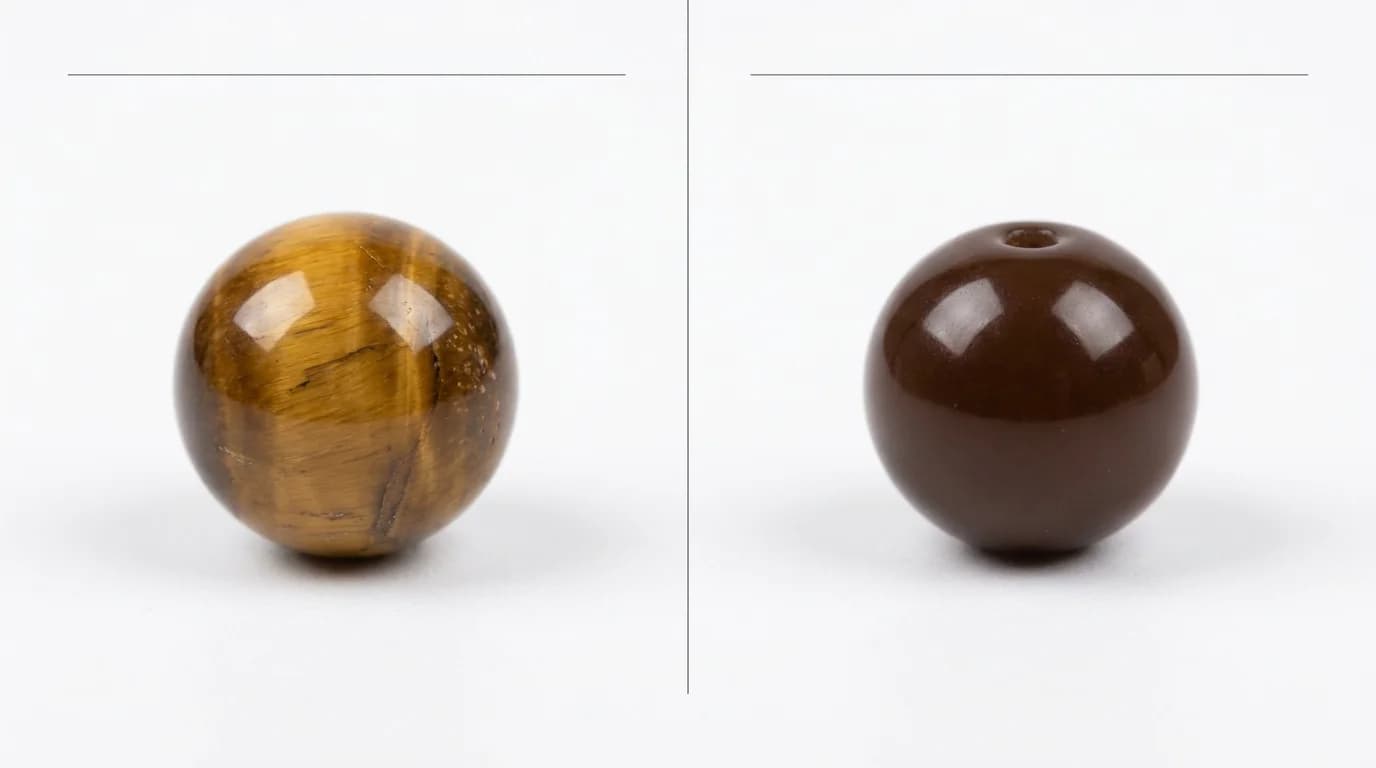
Why Fake Tiger Eye Is Everywhere in India
Tiger Eye is one of the most counterfeited crystals in India. The golden-brown colour is easy to replicate with dyed glass, and most buyers do not know what genuine chatoyancy looks like. Sarojini Nagar, Crawford Market, and hundreds of no-brand Amazon and Meesho listings sell dyed glass beads at ₹100–250 and label them 'original tiger eye stone.' Without a chatoyancy test or lab certificate, there is no visible difference in a product photo.
| Most common fake | Dyed yellow-brown glass — chatoyancy absent or faint shimmer only |
| Second most common | Synthetic resin moulded into bead shape |
| Price of fakes | ₹100–300 for a full bracelet |
| Price of genuine | ₹699–1,299 for lab-certified 8mm natural Tiger Eye |
| Visual difference in photos | Very difficult — chatoyancy does not show in flat product photos |
| Reliable differentiators | Chatoyancy test, scratch test, weight, lab certificate |
Chatoyancy Tilt Test: The Most Reliable Home Test
Hold the bracelet under a single point of light — a phone torch or desk lamp is ideal. Slowly tilt the bracelet from side to side. Watch the surface of each bead. A genuine Tiger Eye bead will display a distinct, silky, luminous band that appears to glide across the surface as you tilt it — exactly like a cat's eye pupil moving. This is chatoyancy, caused by the parallel fibrous silica structure inside the stone. No glass or resin fake reproduces this focused moving band convincingly. If what you see is a flat, uniform glow across the entire bead with no single moving band, the stone is almost certainly not genuine Tiger Eye.
- 1Find a single light source
Turn off overhead lights if possible. Use one phone torch or a pointed desk lamp.
- 2Hold bead at arm's length
Position the bracelet so light hits one bead squarely.
- 3Tilt slowly left to right
Move the bead through about 30–40 degrees of arc, watching the reflection.
- 4Look for a moving band
A genuine bead shows one focused silky band that slides. Fake glass shows a broad, static glow.
- 5Test multiple beads
All beads on a genuine bracelet should show the same effect — though intensity may vary slightly bead to bead.
Scratch Test: Steel Key on Stone (Mohs Hardness)
Tiger Eye is a quartz with Mohs hardness of 6.5–7. A standard steel key or steel nail has Mohs hardness of approximately 5.5. This means a steel key cannot scratch genuine Tiger Eye — but it will easily scratch glass (Mohs 5.5) and resin (Mohs 2–3). Choose an inconspicuous bead (near the clasp). Press the key tip firmly against the bead and drag it across. On genuine Tiger Eye you will see no scratch line — only a grey smear from the key metal itself, which wipes away. On glass or resin, you will see a permanent scratch groove.
| Tiger Eye hardness | Mohs 6.5–7 |
| Steel key hardness | Mohs ~5.5 |
| Glass hardness | Mohs ~5.5 (can be scratched by quartz) |
| Result on genuine Tiger Eye | No scratch — grey smear from metal wipes off |
| Result on glass fake | Visible scratch groove remains |
| Result on resin fake | Deep scratch, may flake |
Magnification Test: Look for the Fibrous Pattern
Tiger Eye forms when crocidolite (blue asbestos) mineral fibres are pseudomorphically replaced by silica. The fibrous pattern is preserved inside the stone. Under 10x magnification — a jeweller's loupe, or even a phone macro lens — genuine Tiger Eye shows parallel, wavy, silky fibres aligned along the length of the bead. Glass fakes show bubbles, swirls, or a uniform glassy interior. Resin fakes may show mould lines or a perfectly smooth, structureless interior.
Cold Touch Test: Genuine Stone Stays Cool Longer
Natural crystalline stone has a higher thermal mass and lower thermal conductivity than glass or resin. Place the bracelet in a cool environment for five minutes, then hold a bead against your cheek or the inside of your wrist. Genuine Tiger Eye (quartz) will feel noticeably cool and will take 30–60 seconds longer to warm to body temperature than a glass bead of the same size. Glass and resin warm up almost immediately on skin contact. This test is less definitive than the chatoyancy test but useful as supporting evidence.
Weight Test: Genuine Quartz Is Heavier Than Glass
Quartz has a specific gravity of approximately 2.65, while common glass ranges from 2.2–2.5. A full bracelet of genuine 8mm Tiger Eye beads should feel noticeably heavier than a bracelet of dyed glass beads of the same diameter. If you have a kitchen scale sensitive to 1 gram, a genuine 8mm Tiger Eye bracelet (18–20 beads) should weigh approximately 28–35 grams. Dyed glass of the same apparent size typically comes in at 20–26 grams.
| Quartz specific gravity | ~2.65 |
| Common glass specific gravity | ~2.2–2.5 |
| Expected weight (8mm, 18–20 beads) | ~28–35g for genuine Tiger Eye |
| Dyed glass equivalent weight | ~20–26g |
| Scale precision needed | ±1g — a basic kitchen scale works |
Genuine Tiger Eye vs Dyed Glass vs Synthetic Resin
| Property | Genuine Tiger Eye | Dyed Glass | Synthetic Resin |
|---|---|---|---|
| Chatoyancy | Clear silky moving band | None or uniform glow | Faint, unfocused shimmer |
| Scratch test | Steel key cannot scratch it | Steel key scratches it | Scratches very easily |
| Temperature | Stays cool 30–60s longer | Warms quickly | Warms immediately |
| Weight (8mm bracelet) | 28–35g | 20–26g | 15–22g |
| Magnification | Fibrous parallel structure | Bubbles/uniform glass | Smooth or swirled |
| Price (genuine market) | ₹699–1,299 | ₹100–300 | ₹50–200 |
| Lab certificate | Available (DivineTatva) | Never provided | Never provided |
| Longevity | Decades with proper care | Fades/chips within months | Cracks, yellows |
Frequently asked
Last reviewed: 17 May 2026 · Verified by the DivineTatva expert panel
What is the easiest way to test if my Tiger Eye bracelet is real?
The chatoyancy tilt test is fastest and needs no equipment. Hold the bracelet under a single light (phone torch) and tilt it slowly. Genuine Tiger Eye shows a distinct silky band of light that moves across each bead, like a cat's pupil. Dyed glass shows a flat, uniform glow with no moving band. This single test catches the majority of fakes sold in India.
Can a steel key scratch genuine Tiger Eye?
No. Tiger Eye is a Mohs 7 quartz. A standard steel key has Mohs hardness of approximately 5.5, which is not hard enough to scratch quartz. On a genuine bead you will see a grey smear (metal transfer) that wipes off cleanly. On dyed glass (Mohs ~5.5) or resin (Mohs 2–3), the key will leave a permanent scratch groove.
Do all real Tiger Eye beads have chatoyancy?
Genuine natural Tiger Eye will always show some chatoyancy under a focused light source — that is what makes it Tiger Eye. However, intensity varies by grade. Lower-grade natural Tiger Eye may have a subtler band. What should never be missing is the focused, moving, silky band effect. A completely flat, static reflection with no band at all is a strong indicator of glass or resin.
Why don't product photos show chatoyancy?
Chatoyancy requires a moving light-and-observer relationship — it is a dynamic optical effect. In flat studio photography, both the stone and camera are stationary, so the band appears at a fixed point and is difficult to capture clearly. This is why photos of real and fake Tiger Eye can look nearly identical. Testing the stone in hand under a moving light is the only reliable way.
Is there a lab test for Tiger Eye authenticity?
Yes. Gemological laboratories (GIA, IGI, and certified Indian gemological labs) can confirm Tiger Eye authenticity via spectroscopy, refractive index (RI ~1.544–1.553 for quartz), and specific gravity. DivineTatva provides a per-piece certificate from a certified gemological lab. Ask any seller for their lab certificate — if they cannot provide one, treat authenticity as unverified.
What is the most common Tiger Eye fake in India?
Dyed yellow-brown glass is by far the most common fake in India. It is manufactured cheaply, polished to a high shine, and sold at ₹100–250 for a full bracelet on marketplaces and in tourist markets. The colour can be identical to genuine Tiger Eye in a product photo, but the chatoyancy is absent — making the tilt test immediately conclusive.
Can I get a refund from DivineTatva if I believe my stone is fake?
DivineTatva offers a 7-day return policy. Every bracelet ships with a per-piece lab certificate — if you have concerns about authenticity, the certificate lists the verifying lab's contact details. We stand behind every piece we sell. If you have performed the chatoyancy test and remain unsatisfied, contact our support team before the 7-day window closes.
Reviewed by the DivineTatva expert panel
Written and reviewed by DivineTatva's consulting Vedic astrologer. Every piece is lab-certified and energised in our Jaipur atelier. Last updated 29 May 2026.