Real vs Fake Dhan Yog Bracelet: How to Identify Original Stones Before You Buy
To identify an original Dhan Yog bracelet, check each of its six stones: Pyrite should feel heavy with a metallic gold lustre, Citrine should show natural (often heat-treated) tonal variation, and Green Aventurine should carry tiny shimmery inclusions. Uniform glassy beads, dyed coatings and zero certification are fake red flags. A genuine piece comes with a per-bead lab certificate carrying a verifiable number.
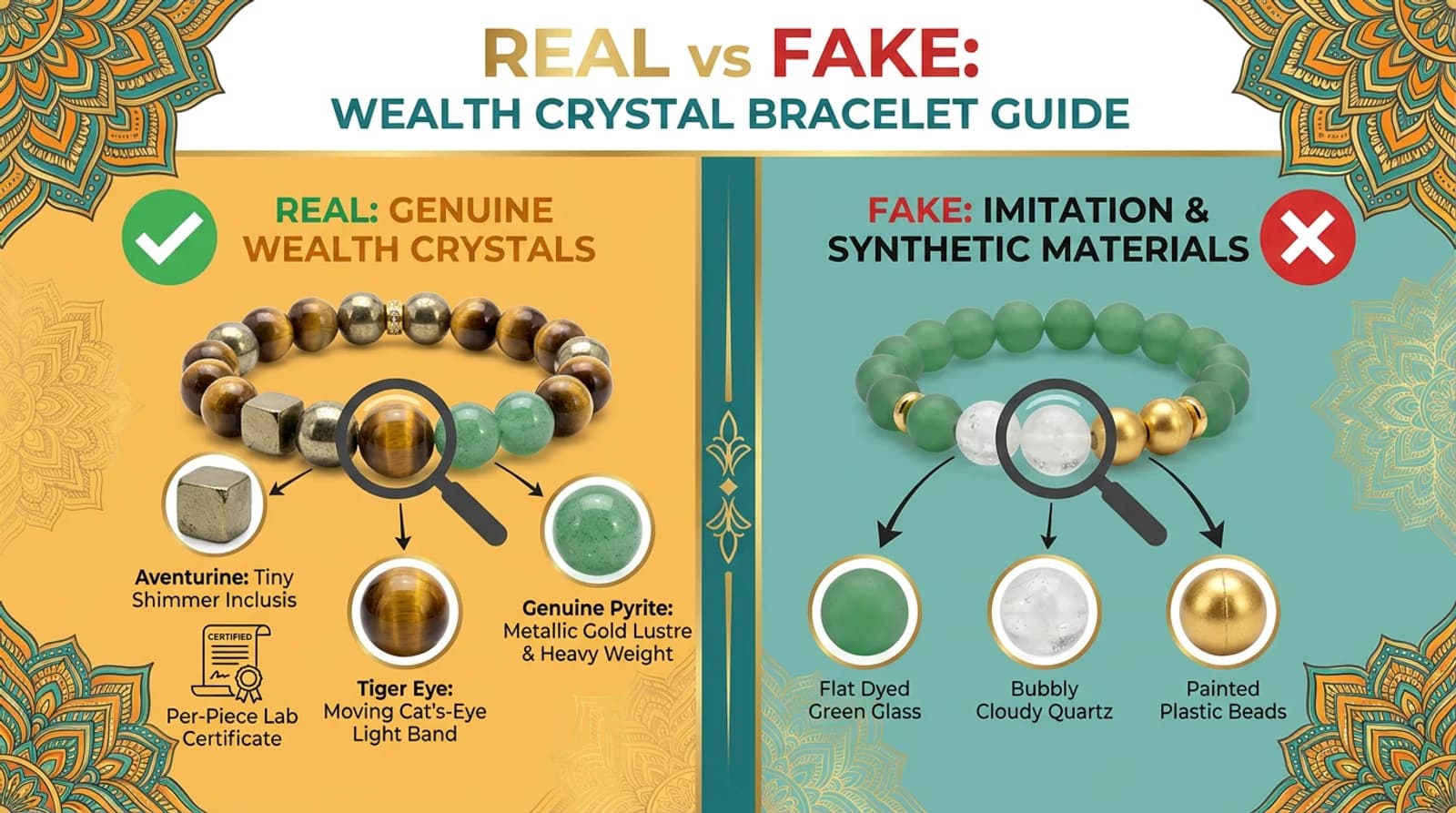
How to identify an original dhan yog bracelet
To identify an original Dhan Yog bracelet, test its six stones one by one. Real Pyrite is noticeably heavy with a bright metallic gold shine; real Citrine shows natural, slightly uneven warmth (much on the market is honestly heat-treated); Green Aventurine has faint glittery inclusions, not flat paint; Tiger Eye shows a moving chatoyant band of light; Green Jade feels cool and dense; and Clear Quartz (Sphatik) is glassy with tiny natural flaws. Perfectly uniform, ultra-bright, suspiciously cheap beads with no certificate are the classic fakes.
The single most reliable check is documentation: a genuine lab-certified dhan yog bracelet ships with a per-piece certificate carrying a verifiable report number tied to a transparent Jaipur sourcing story — something a dyed-glass imitation can never produce. Everything below shows you exactly what to look for before you pay, especially with COD.
The 6 stones — and what each should really look like
A true dhan yog bracelet is a 6-stone prosperity combo, not a single-stone strand. Knowing what each stone genuinely looks and feels like is your first defence, because most fakes swap one or more stones for cheap dyed glass or plastic that only mimics the colour.
| Pyrite | Brassy metallic gold, heavy for its size, mirror-like lustre; tradition: money & abundance. |
| Citrine | Warm pale-to-golden yellow, gentle tonal variation; commonly heat-treated (disclosed honestly); tradition: success & confidence. |
| Green Aventurine | Soft mid-green with tiny sparkling inclusions (aventurescence); tradition: luck & opportunity. |
| Tiger Eye | Golden-brown with a moving silky light band; tradition: focus & willpower. |
| Green Jade | Cool, dense, slightly waxy deep green; tradition: steady growth. |
| Clear Quartz (Sphatik) | Glass-clear with faint natural inclusions; tradition: amplifies the other stones. |
Honest note: these meanings come from Vedic and crystal-healing tradition and belief. There is no peer-reviewed scientific proof that gemstones change your finances. Many wearers report feeling calmer, more focused and more intentional about money — effects consistent with ritual and intention-setting. Treat the bracelet as a faith-and-focus aid, not a guaranteed money machine, and never as a substitute for sound financial advice.
Per-stone authenticity tests you can do yourself
You don't need a lab to catch the obvious fakes. These quick, non-destructive checks work at home or even at the doorstep before you accept a COD parcel.
- 1Weigh the Pyrite in your hand
Real Pyrite is dense and feels heavier than a same-size glass or plastic bead. A light, hollow-feeling 'gold' bead is almost always fake.
- 2Check Pyrite lustre, not just colour
Genuine Pyrite has a hard metallic, mirror-like shine. Dull, painted-gold or flaking surfaces are imitations — and real Pyrite will tarnish slightly over time, which paint never does.
- 3Look into the Citrine, don't just glance
Natural and heat-treated Citrine shows subtle tonal shifts and tiny inclusions. A dead-flat, neon-orange, perfectly uniform bead is usually dyed glass.
- 4Tilt the Aventurine and Tiger Eye to the light
Aventurine should throw faint internal sparkle; Tiger Eye should show a band of light that moves as you rotate it. Painted beads stay flat from every angle.
- 5Feel the Jade and Quartz temperature
Jade and Clear Quartz stay cool to the touch and warm slowly; plastic warms instantly to your skin. Quartz should also have minute natural flaws — a flawless 'crystal' bead is suspicious.
- 6Rub a hidden spot for dye transfer
Gently rub a bead with a damp cloth on an inconspicuous area. Colour that comes off onto the cloth means it's dyed. (Do this sparingly — never soak the bracelet, because Pyrite must stay dry.)
Care caution while testing: this combo contains Pyrite, which oxidises and tarnishes with water and sweat. Cleanse DRY only (selenite plate, moonlight overnight, smudge/incense, sound); NEVER soak in water or salt-water; remove before bathing, swimming and workouts; wipe with a soft dry cloth.
Real vs fake dhan yog bracelet at a glance
| Signal | Original (genuine combo) | Fake / imitation |
|---|---|---|
| Pyrite weight & shine | Heavy, hard metallic mirror lustre | Light, dull or painted gold |
| Citrine colour | Natural variation; heat-treatment disclosed | Uniform neon dyed glass, no disclosure |
| Aventurine / Tiger Eye | Internal sparkle / moving light band | Flat colour from every angle |
| Bead consistency | Slight natural variation between beads | Identical, flawless, factory-perfect |
| Certification | Per-piece lab certificate, verifiable number | Vague 'Lab Certified' badge or none |
| Stone disclosure | Lists all 6 stones + treatments openly | Just calls it 'energised' or 'original' |
| Price | Fair for certified natural stones | Suspiciously cheap, too good to be true |
No single row is proof on its own — fakes can fake one or two signals. Confidence comes from the pattern across all six stones plus real, checkable documentation.
Dyed-bead and listing red flags to avoid
Many 'original vs fake' problems show up in the product listing long before the parcel arrives. Watch for these in any dhan yog bracelet you're comparing, whether it's sold as a money magnet or a 6-stone combo.
- 1'Energised' but no stone names
If the seller won't list all six stones (Pyrite, Citrine, Aventurine, Tiger Eye, Jade, Quartz), assume substitutions.
- 2No mention of heat-treated citrine
Honest sellers disclose that citrine is often heat-treated. Silence usually means dyed glass or undisclosed treatment.
- 3A generic 'Lab Certified' badge
A badge with no report number you can verify is marketing, not proof. Ask which lab and for the certificate.
- 4Flawless, identical beads
Natural stones vary slightly. Perfectly matched, bubble-free, ultra-glossy beads point to glass or resin.
- 5Price far below the market
Six certified natural stones have a real cost floor. A price that seems too cheap usually is.
- 6No clear returns or sizing info
Reputable sellers explain sizing and easy returns/COD. Vague policies often hide quality they can't defend.
Why a per-piece lab certificate beats every badge
Most sellers slap a generic 'Lab Certified' graphic on the listing and hope you don't ask questions. The strongest way to identify an original dhan yog bracelet is a per-piece lab certificate: a document tied to your specific bracelet, carrying a report number you can verify, and listing the actual stones and any treatments (like heat-treated citrine).
| Vague badge | A logo or 'Lab Certified' text with no number — unverifiable. |
| Per-piece certificate | A real report number tied to your bracelet you can check. |
| Sourcing story | Transparent Jaipur sourcing, so you know where stones came from. |
| Treatment disclosure | States openly that citrine is heat-treated — no hidden surprises. |
This is the moat that most ranking competitors simply don't offer. Pairing a verifiable certificate with honest belief-vs-evidence copy — what the tradition says versus what is actually proven — is how you separate a trustworthy seller from one banking on hype. When you can check the paperwork and the stones agree with it, you can buy with confidence, even on COD.
Price, honesty and buying with confidence
A fair dhan yog bracelet price reflects six certified natural stones, honest treatment disclosure and real documentation — not the rock-bottom number of a dyed-glass strand. If a piece is dramatically cheaper than everything else, the saving is almost always coming out of authenticity.
Set honest expectations about results too. The dhan yog combo is worn in Vedic tradition to attract wealth and clear financial blockages, and many people genuinely report feeling more focused, calmer and more disciplined about money. But there is no clinical scientific proof that the stones alter your finances; the value is as a faith-and-intention anchor that supports your own effort. It is not a substitute for medical, financial or professional advice.
Bottom line: verify the six stones with the simple tests above, demand a per-piece lab certificate with a checkable number, watch for dyed-bead red flags, and keep your Pyrite dry. Do that, and you'll know an original dhan yog bracelet from a fake before you ever pay.
Frequently asked
Last reviewed: 17 May 2026 · Verified by the DivineTatva expert panel
How can I tell if my dhan yog bracelet is original or fake?
Check all six stones together. Real Pyrite is heavy with a metallic mirror shine; Citrine shows natural tonal variation; Aventurine and Tiger Eye reveal internal sparkle or a moving light band; Jade and Quartz stay cool, not instantly warm. Flat painted colour, flawless identical beads and no certificate point to a fake. The strongest proof is a per-piece lab certificate with a verifiable report number.
Which six stones should an original dhan yog bracelet contain?
A genuine dhan yog bracelet is a 6-stone prosperity combo: Pyrite (money and abundance), Citrine (success and confidence, usually heat-treated), Green Aventurine (luck), Tiger Eye (focus and willpower), Green Jade (growth) and Clear Quartz or Sphatik (amplifier). If a seller won't name all six stones and instead just calls it 'energised', treat that as a warning sign of substituted or dyed beads.
Is heat-treated citrine fake?
No. A large share of citrine on the market is heat-treated amethyst or smoky quartz, and that is an accepted, widely used practice — not a scam. What matters is honesty: a trustworthy seller discloses the treatment up front. The red flag is undisclosed dyed glass pretending to be natural citrine, or a seller who hides treatment information entirely. Disclosure, not treatment, is the line between honest and dishonest.
Does a 'Lab Certified' badge mean the bracelet is genuine?
Not by itself. A generic badge or logo with no checkable report number is just marketing. A meaningful certificate is per-piece: it names the lab, carries a verifiable report number tied to your specific bracelet, and lists the actual stones and treatments. Always ask which lab issued it and how to verify the number before you trust the claim, especially when buying COD.
Why does the Pyrite in my dhan yog bracelet need dry care?
This combo contains Pyrite, which oxidises and tarnishes when exposed to water and sweat. Cleanse it DRY only — selenite plate, moonlight overnight, smudge or incense, or sound. Never soak it in water or salt-water. Remove it before bathing, swimming and workouts, and wipe it with a soft dry cloth. Good dry care keeps the metallic lustre that also helps you tell real Pyrite from painted fakes.
Does a dhan yog bracelet really attract wealth?
In Vedic and crystal-healing tradition it is worn to attract wealth and clear financial blockages, and many wearers report feeling calmer, more focused and more disciplined with money. Honestly, there is no peer-reviewed scientific proof that gemstones change your finances; the reported effects are consistent with intention-setting and ritual. Treat it as a faith-and-focus aid alongside your own effort, not a guaranteed money machine or financial advice.
What price should I expect for a genuine dhan yog bracelet?
A fair price reflects six certified natural stones, honest treatment disclosure and real per-piece documentation, so it sits above the cost of a dyed-glass strand. Prices vary by bead size and quality, but a listing that is dramatically cheaper than everything else is usually saving money by skipping authenticity. Pay for verifiable certification and transparent sourcing rather than the lowest number you can find.
Reviewed by the DivineTatva expert panel
Written and reviewed by DivineTatva's consulting Vedic astrologer. Every piece is lab-certified and energised in our Jaipur atelier. Last updated 3 May 2026.