Which Hand to Wear a Dhan Yog Bracelet (Men & Women) — Left vs Right Explained
In Vedic and crystal-healing tradition, a dhan yog bracelet is usually worn on the LEFT wrist — the body's "receiving" side that draws wealth energy inward. Right-handed workers and some astrologers prefer the non-dominant wrist for comfort. This is tradition and belief, not a proven rule or scientific fact — wear it where it feels right.
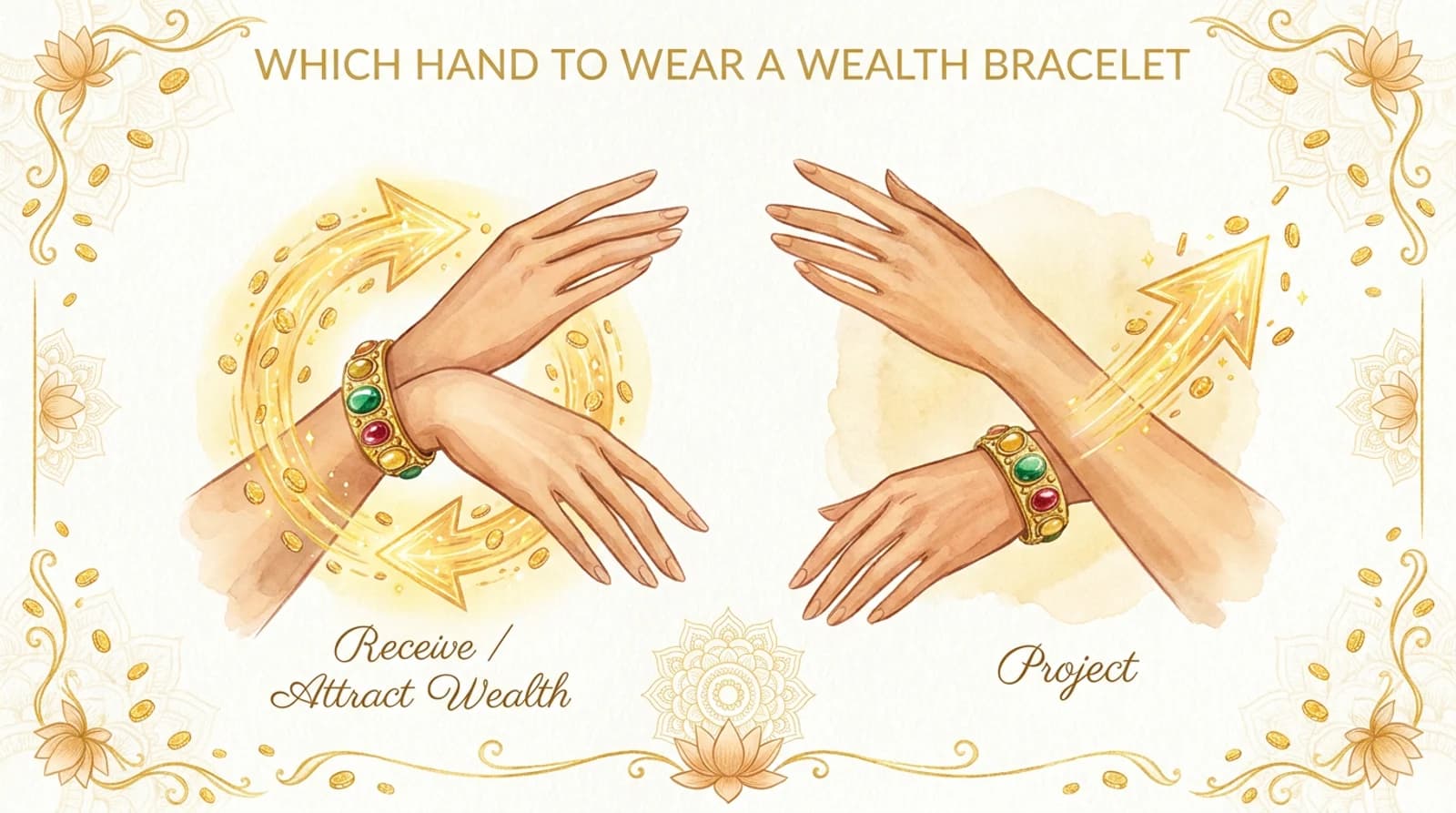
Which Hand Should You Wear a Dhan Yog Bracelet On?
Wear a dhan yog bracelet on your LEFT wrist. In Vedic and crystal-healing tradition the left side is the body's "receiving" or passive side — the side that draws abundance, luck and money energy inward toward you. Since a dhan yog bracelet (a 6-stone money-magnet combo of Pyrite, Citrine, Green Aventurine, Tiger Eye, Green Jade and Clear Quartz) is meant to attract wealth, the receiving wrist is the natural home for it.
The practical exception: if you are left-handed, or your left wrist is busy with a watch or work, the non-dominant wrist is the comfortable, traditional choice instead. None of this is a hard rule or a scientific law — it is guidance from tradition. The bracelet does not stop "working" if you wear it on the right.
| Default wrist | Left (receiving side) |
| Right-handed people | Left wrist — non-dominant and receiving |
| Left-handed people | Right wrist is fine (non-dominant) |
| Men & women | Same guidance — left wrist by default |
| Is this a strict rule? | No — tradition and belief, not proven law |
Why the Left Wrist Is the Traditional Choice
Indian astrology and global crystal healing share a simple idea: the left side of the body receives energy, and the right side gives or projects it. Your left hand is closer to the heart and is treated as the passive, intake channel. Because a dhan yog bracelet is worn to pull wealth and opportunity toward you — not to send energy out — the left wrist lines up with that intention.
| Wrist | Traditional role | Best for |
|---|---|---|
| Left | Receiving / passive / intake | Attracting money, luck, abundance (most people) |
| Right | Giving / active / projecting | Sending energy outward; left-handed wearers use it as their non-dominant wrist |
There is also a plain comfort logic underneath the symbolism. For the right-handed majority, the left wrist is the non-dominant one — it sees less knocking, sweat and friction through the day. That matters here because a dhan yog bracelet contains Pyrite, which tarnishes with moisture, so the calmer wrist protects the stones too.
Does the Hand Differ for Men and Women?
For a dhan yog bracelet, the guidance is the same for men and women: the LEFT wrist by default. You may have heard the older rashi-ratna rule that men wear gemstones on the right hand and women on the left — that convention applies mainly to single astrological gemstones set in rings (like a single ruby or emerald chosen for a planet), not to a multi-stone wealth bracelet meant purely for attracting abundance.
| Dhan yog bracelet for men | Left wrist (or non-dominant wrist) |
| Dhan yog bracelet for women | Left wrist (or non-dominant wrist) |
| Single rashi gemstone ring | Follow your astrologer (often right for men) |
| Bottom line | For this bracelet, left works for everyone |
If a trusted family astrologer has given you a specific instruction based on your birth chart, follow that — personalised guidance always overrides a general article. For everyone else buying a ready-made 6-stone dhan yog combo off the shelf, the left wrist is the safe, traditional default regardless of gender.
Which Day to Wear It and How to Put It On
Friday is the most popular day to first wear a dhan yog bracelet, as it is linked with Venus (Shukra) — the planet of wealth, comfort and luxury. Thursday (Guru/Jupiter, growth and fortune) is another favoured day. Mornings after a bath, on a clean body, are considered the best time. These timings are auspicious customs, not requirements — a bracelet worn on a Tuesday works just as well in practice.
- 1Cleanse first
Before first wear, cleanse the bracelet DRY — a few hours on a selenite plate, overnight under moonlight, or pass it through smudge/incense smoke. Never soak it in water or salt water; the Pyrite will tarnish.
- 2Pick the day
Friday or Thursday morning after bathing is traditional, but any day you can wear it mindfully is fine.
- 3Set an intention
Hold it, breathe, and silently state a clear, specific wealth goal. This focus is the real engine — belief and intention, not magic.
- 4Chant a mantra (optional)
Many wearers chant the Lakshmi mantra "Om Shreem Hreem Shreem Kamale Kamalalaye Praseed Praseed Om Shreem Hreem Shreem Mahalakshmyai Namah" 11 or 108 times to activate it.
- 5Slide it onto the left wrist
Wear it snug but not tight — you should fit one finger underneath. The stretch elastic should not be over-pulled each time, as that shortens its life.
Can You Wear It Every Day? (And the Pyrite Warning)
Yes — a dhan yog bracelet can be worn every day, and many people do, treating it as a constant reminder of their money goals. The one real catch is care, not energy. This combo contains Pyrite, which oxidises and tarnishes with water and sweat. Cleanse DRY only (selenite plate, moonlight overnight, smudge/incense, sound); NEVER soak in water or salt-water; remove before bathing, swimming and workouts; wipe with a soft dry cloth.
| Everyday wear | Yes — safe and common |
| Remove before | Bathing, swimming, gym/workout, washing dishes |
| Cleanse method | Dry only — selenite, moonlight, smudge, sound |
| Never do this | Soak in water or salt water (Pyrite tarnishes) |
| Daily upkeep | Wipe with a soft dry cloth |
Wearing it on your non-dominant left wrist also reduces knocks and sweat exposure, which keeps the Pyrite brighter for longer. If you take it off for a workout or shower, simply place it back on the same wrist afterwards — re-cleansing every single day is not required, only occasional dry cleansing when it feels heavy or after big spending stress.
Tradition vs Proof: What's Real and What's Belief
We want to be straight with you. The left-wrist guidance, the Friday timing and the wealth-attracting claims all come from Vedic tradition and crystal-healing belief — not from peer-reviewed scientific evidence. There is no clinical proof that any gemstone alters energy, money flow or luck. A dhan yog bracelet is a faith-and-intention aid, not a guaranteed money machine.
That said, many wearers genuinely report feeling more focused, confident and motivated about their finances — outcomes consistent with intention-setting, ritual and the placebo-like power of a daily reminder on your wrist. Worn that way, on whichever wrist feels right, it can be a meaningful nudge toward better money habits. It is not a substitute for sound financial, medical or professional advice.
Where this matters most is authenticity. A genuine, lab-certified dhan yog bracelet from a transparent Jaipur source — with a per-piece certificate carrying a verifiable number — gives you real stones and honest disclosure (including that Citrine is often heat-treated). The wrist you choose is tradition; the certificate is the part you can actually verify.
Frequently asked
Last reviewed: 17 May 2026 · Verified by the DivineTatva expert panel
Which hand should I wear a dhan yog bracelet on?
Wear it on your left wrist. In Vedic and crystal-healing tradition the left side is the "receiving" side that draws wealth and luck inward, which suits a money-magnet bracelet. If you are left-handed, the right (non-dominant) wrist is fine. This is traditional guidance and belief, not a strict rule or a scientific fact — the bracelet does not stop working on the other hand.
Is the hand different for men and women?
No. For a 6-stone dhan yog wealth bracelet, both men and women wear it on the left wrist by default. The old rule that men wear gemstones on the right hand applies mainly to single astrological gemstone rings chosen for a birth chart, not to a multi-stone abundance bracelet. If your personal astrologer gave you a specific instruction, follow that instead.
Which day is best to wear a dhan yog bracelet?
Friday is the most popular day, as it is linked with Venus (Shukra), the planet of wealth and comfort. Thursday (Jupiter, growth and fortune) is also favoured. Mornings after a bath are considered ideal. These are auspicious customs, not requirements — wearing it on any day with a clear intention works just as well in everyday practice.
Can I wear a dhan yog bracelet every day?
Yes, you can wear it daily, and many people do as a constant reminder of their money goals. The only real catch is care: the bracelet contains Pyrite, which tarnishes with water and sweat. Remove it before bathing, swimming and workouts, wipe it with a soft dry cloth, and never soak it in water or salt water.
How do I activate a dhan yog bracelet with a mantra?
After dry-cleansing it, hold the bracelet, breathe, and set a clear wealth intention. Many wearers then chant the Lakshmi mantra — "Om Shreem Hreem Shreem Mahalakshmyai Namah" — 11 or 108 times before sliding it onto the left wrist. The focus and intention are the real point; the mantra is a traditional aid, not a guaranteed spell.
Does it really matter which wrist I choose?
Symbolically, yes — tradition favours the left (receiving) wrist for attracting wealth. Practically, it is not make-or-break. There is no scientific proof that wrist choice changes outcomes. Choose the left wrist to honour tradition and because, for right-handed people, it is also the non-dominant wrist that protects the Pyrite from sweat and knocks.
What if my astrologer told me something different?
Always follow personalised astrological guidance over a general article. An astrologer reading your specific birth chart may recommend a particular wrist, day or even a different stone combination for your rashi. This guide gives the safe default for a ready-made dhan yog bracelet bought off the shelf, but tailored advice for your chart takes priority.
Reviewed by the DivineTatva expert panel
Written and reviewed by DivineTatva's consulting Vedic astrologer. Every piece is lab-certified and energised in our Jaipur atelier. Last updated 2 May 2026.