Real vs Fake Moonstone: Adularescence Test & How to Spot Glass
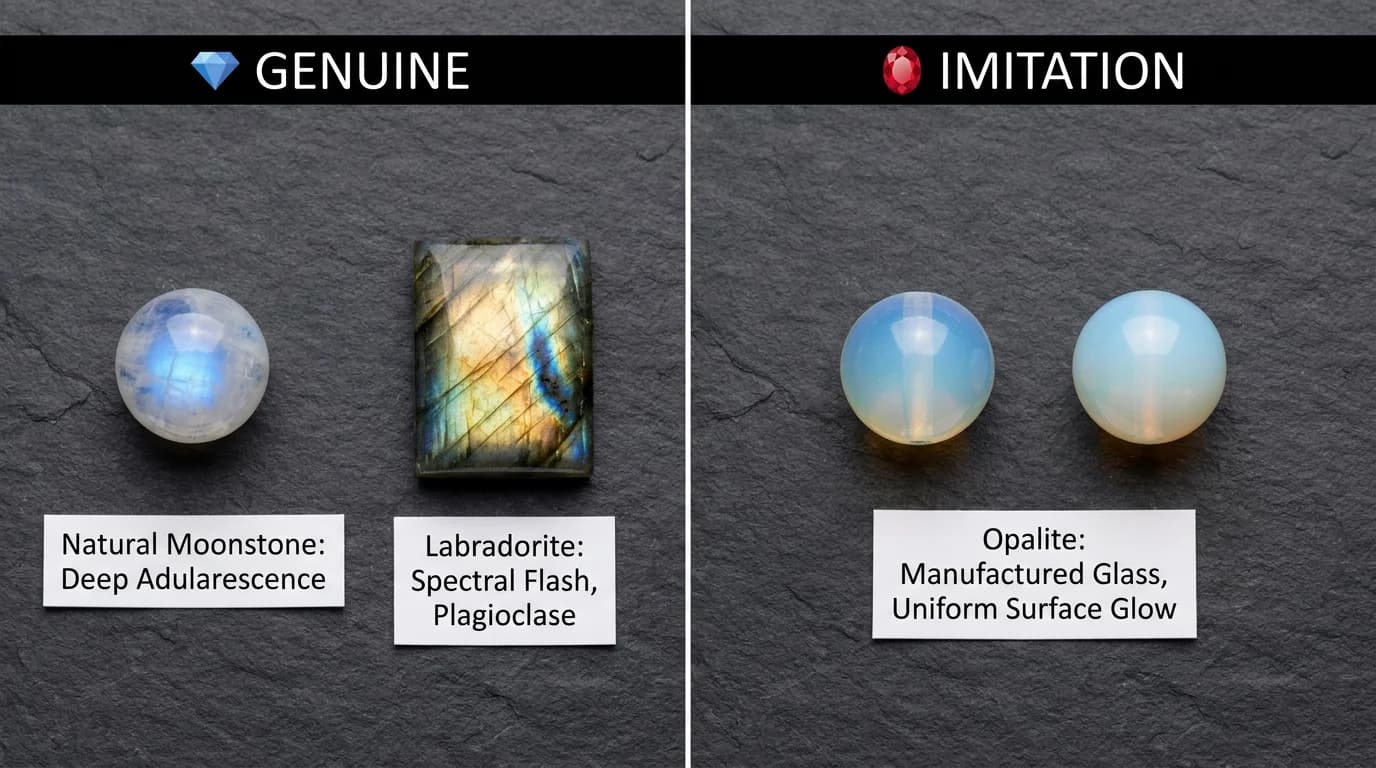
Moonstone is one of the most commonly faked gemstones — opalite glass is sold as moonstone at a fraction of the price but lacks the key marker: a floating, 3D adularescent sheen that moves as you tilt the stone. Genuine moonstone also stays cooler than glass, has a translucent cloud-like depth, and cannot be sold at ₹100 per bracelet without fraud.
Why Moonstone Is One of the Most Faked Gemstones
Opalite — a man-made glass resin — is sold as moonstone across thousands of online listings and local jewellery markets. It costs ₹5–15 per bead to manufacture and looks superficially similar to moonstone under certain lighting. The difference becomes clear under proper examination: genuine moonstone has a 3D floating sheen with depth, while opalite shows a flat surface glow. This guide gives you the tools to test any moonstone bracelet before or after purchase.
The Adularescence Test: Genuine Moonstone's Signature
Hold the bracelet bead under a single-point light source (a phone torch or lamp) and tilt it slowly from side to side. Watch the sheen:
- 1Genuine moonstone
The sheen floats beneath the stone's surface — a blue or white light with visible depth that moves and shifts as you tilt. It looks like moonlight trapped inside the stone.
- 2Opalite glass
The glow sits on the surface and is uniform — it does not move or have 3D depth. It often shows a pinkish-orange tint when backlit, which genuine moonstone does not.
- 3Rainbow moonstone (variety of labradorite)
Shows multiple colours (blue, peach, green) with good 3D depth — this is genuine, just a different variety.
Translucency and Depth: What Genuine Moonstone Looks Like Inside
Genuine moonstone is translucent — not fully transparent, not fully opaque. When held up to light, you can see into it: a milky, cloud-like interior with the adularescent sheen floating within. Opalite glass is often fully transparent (like a glass marble) or uniformly milky with no internal depth variation.
Temperature Test and Hardness Reality Check
| Temperature test | Press bead to your cheek for 10 seconds — genuine stone stays cool longer than glass, which warms to body temperature quickly |
| Mohs hardness | 6–6.5 — a copper coin (Mohs 3.5) cannot scratch genuine moonstone; a steel knife (Mohs 5.5–6.5) barely scratches it |
| Inclusions | Genuine moonstone often has faint inclusions or tiny fracture planes visible under magnification — glass is perfectly uniform |
| Price floor | A genuine moonstone 6mm bead bracelet with real adularescence cannot be sold at ₹100–200 and remain profitable — budget pricing guarantees glass |
| Weight | Stone is denser than glass; a genuine bracelet has noticeably more heft than an opalite one of the same bead count |
How to Test Labradorite Authenticity
Labradorite is less commonly faked than moonstone, but dyed grey stones are sold as labradorite. Key tests:
- 1Directional labradorescence
Genuine labradorite's colour flash appears only from specific angles — not uniformly from all sides. If the stone shows the same colour from every angle, it may be dyed or synthetic.
- 2Unique per bead
Genuine labradorite has unique colour patterns in each bead — no two are identical. Fakes tend to show the same colour in every bead.
- 3Base colour
Genuine labradorite has a dark charcoal to grey base with metallic schiller. Very uniform dark beads with painted-on colour are suspect.
Genuine Moonstone vs Opalite vs Synthetic: Full Comparison
| Test | Genuine Moonstone | Opalite (Glass) | Synthetic/Dyed |
|---|---|---|---|
| Adularescence | 3D floating sheen, moves with tilt | Flat surface glow, no movement | None or painted |
| Translucency | Milky, cloud-like interior depth | Fully transparent or uniform milky | Variable |
| Temperature | Stays cool >10 seconds on cheek | Warms quickly (5–7 seconds) | Warms quickly |
| Inclusions | Faint natural inclusions present | Perfectly uniform, no inclusions | May have bubbles |
| Hardness | Mohs 6–6.5, resists copper scratch | Glass: 5–6, similar but no adularescence | Variable |
| Price | ₹500+ per bracelet minimum | ₹100–300 per bracelet | ₹150–400 |
| Certificate | Lab cert from Jaipur gemology lab | None | None |
Frequently asked
Last reviewed: 17 May 2026 · Verified by the DivineTatva expert panel
Can I identify fake moonstone without a gemology lab?
Yes — the adularescence test is reliable for most fakes. Hold the bead under a single light source and tilt it: genuine moonstone shows a 3D floating sheen that moves; opalite shows a flat uniform glow. Combine this with the temperature test and price check for high confidence.
Is opalite harmful to wear?
No — opalite glass is safe to wear. The issue is misrepresentation: if you paid for genuine moonstone and received glass, you were defrauded. Opalite itself is harmless and some people enjoy it as an affordable ornament.
What is rainbow moonstone? Is it genuine?
Rainbow moonstone is actually a transparent variety of labradorite that shows multi-colour adularescence (blue, peach, green). It is genuine and valuable — just a different mineral than classic moonstone (which is orthoclase feldspar). Both are natural and used in traditional jewellery.
How do I get a lab certificate for my existing bracelet?
You can send individual beads or the full bracelet to a gemology lab in Jaipur (GII or Gemmological Institute of India) for testing and certification. DivineTatva provides lab certificates with all bracelets at purchase.
Does adularescence fade over time?
In genuine moonstone, adularescence does not fade — it's a structural optical property of the feldspar layers, not a surface coating. If your bracelet's sheen fades, it was likely glass or synthetic with a surface treatment.
Reviewed by the DivineTatva expert panel
Written and reviewed by DivineTatva's consulting Vedic astrologer. Every piece is lab-certified and energised in our Jaipur atelier. Last updated 19 June 2026.