Moonstone Labradorite Bracelet: Benefits, Who Should Wear & Real vs Fake
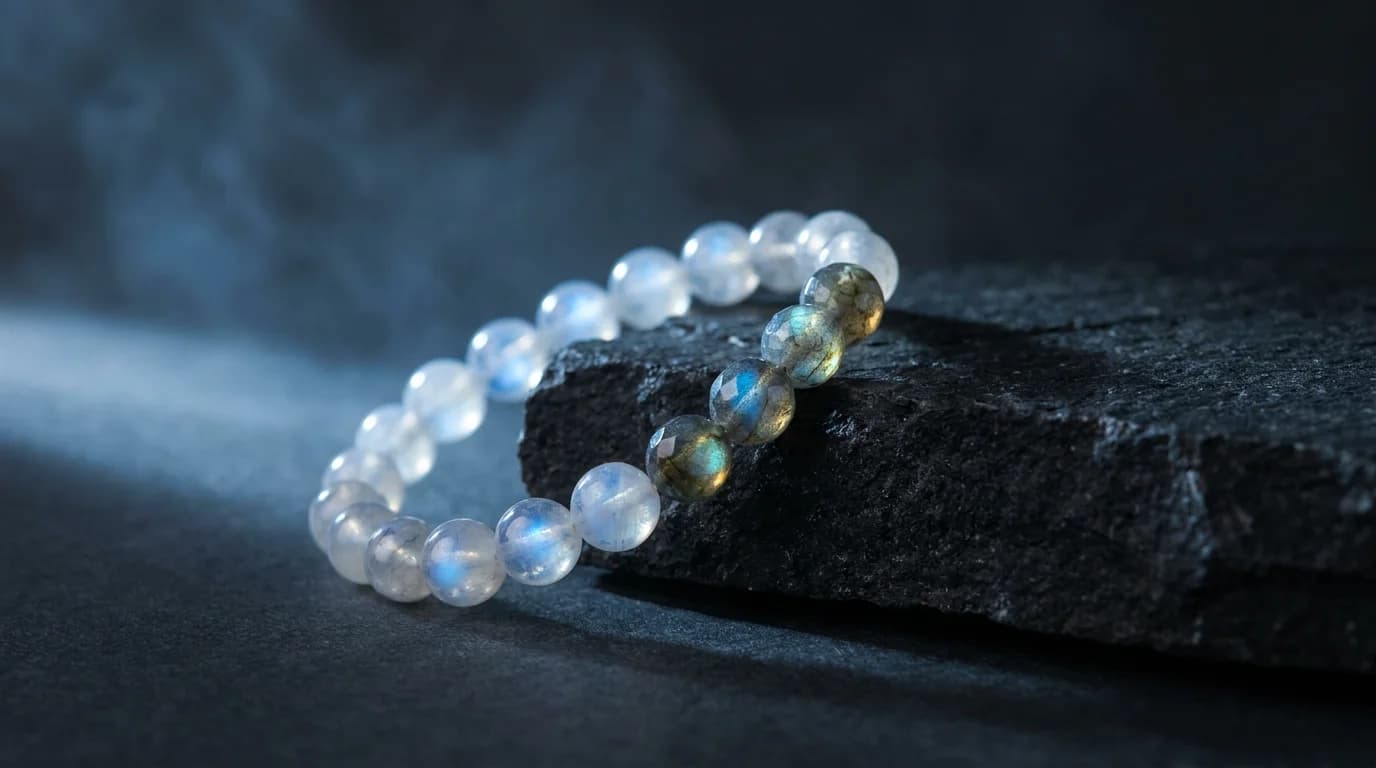
A Moonstone Labradorite Bracelet pairs natural white moonstone — prized for its blue adularescent sheen — with natural labradorite, known for rainbow labradorescence. In Vedic tradition, moonstone channels Chandra (Moon) energy for emotional calm and intuition, while labradorite offers transformation and psychic protection. Worn on the left wrist, this dual-stone bracelet is particularly suited to Cancer, Pisces, Scorpio, and Sagittarius rashis.
- What Is Moonstone & Adularescence?
- What Is Labradorite & Labradorescence?
- Why Combine These Two Stones?
- Benefits of the Dual-Stone Bracelet
- Which Hand to Wear It On
- Rashi Compatibility Guide
- Real vs Fake: How to Test Both Stones
- Does It Work? Honest Vedic Framing
- Care Rules & Recharging
- Sizing & Wearing Tips
- Price Guide
- Why DivineTatva
What Is Moonstone & Adularescence?
Moonstone is a feldspar mineral (orthoclase or adularia) known for adularescence — a floating blue or white sheen that moves as you tilt the stone, like moonlight beneath glass. Natural moonstone is translucent with a soft cloud-like depth. In Vedic astrology, moonstone is associated with Chandra (the Moon) and governed by the Cancer/Kark rashi. It has been used in Indian and Sri Lankan jewellery for over two thousand years.
| Mineral family | Feldspar (Orthoclase) |
| Mohs hardness | 6–6.5 |
| Optical phenomenon | Adularescence (floating blue/white sheen) |
| Vedic planet | Chandra (Moon) |
| Best rashi | Cancer/Kark |
| Origin | India (Rajasthan), Sri Lanka, Madagascar |
| Colour | White, peach, grey with blue sheen |
What Is Labradorite & Labradorescence?
Labradorite is a calcium-rich feldspar that displays labradorescence — a spectral play of colour (blue, green, gold, copper, or violet) that appears in specific lighting directions. Unlike adularescence, labradorescence is directional and each stone shows a unique colour palette. In Vedic crystal tradition, labradorite is associated with Rahu — the planet of mystery, transformation, and the subconscious. It is also called 'the stone of magic' in many esoteric traditions.
| Mineral family | Feldspar (Plagioclase) |
| Mohs hardness | 6–6.5 |
| Optical phenomenon | Labradorescence (spectral colour flash) |
| Vedic planet | Rahu (loosely) |
| Best rashi | Scorpio/Vrishchik, Sagittarius/Dhanu |
| Origin | Canada (Labrador), Madagascar, Finland |
| Base colour | Dark grey to charcoal with rainbow flash |
Why Combine Moonstone and Labradorite?
Moonstone anchors Chandra energy — receptive, intuitive, emotionally calming. Labradorite brings Rahu's transformative edge — dissolving old patterns, awakening psychic awareness, shielding the aura. Together, they create a bracelet that is both emotionally nurturing and energetically protective: calm clarity on the inside, a shield on the outside. The 6mm alternating bead configuration balances both energies without one overwhelming the other.
Benefits of the Moonstone Labradorite Bracelet
| Benefit | Moonstone Contribution | Labradorite Contribution |
|---|---|---|
| Emotional balance | Calms emotional turbulence, supports hormonal cycles | Cuts through emotional fog, enables transformation |
| Intuition | Enhances feminine intuition and inner knowing | Awakens psychic awareness and third-eye clarity |
| Protection | Soft energetic boundary against negative energy | Strong aura shield, blocks psychic interference |
| Sleep & dreams | Promotes restful, calm sleep | Activates and clarifies dream states |
| Self-expression | Opens heart for gentle honest communication | Dissolves self-limiting patterns and old stories |
| Spiritual growth | Connects to lunar cycles and divine feminine | Accelerates spiritual evolution and awakening |
Which Hand to Wear the Moonstone Labradorite Bracelet
Wear on the left wrist. In Vedic crystal tradition, the left hand is the receiving hand — it absorbs energy from the crystals into your body's energy field. Both moonstone and labradorite are receptive, feminine-energy stones; they work best on the left wrist where their energy can flow inward. The right wrist is the projecting hand — suited to protective stones you want to radiate outward, not for crystals you want to absorb.
| Left wrist | Receiving side — absorbs crystal energy into your aura |
| Right wrist | Projecting side — radiates energy outward |
| Both stones | Receptive/feminine energy → left wrist ideal |
| Exception | During full moon meditation you may switch to right to project lunar energy |
Which Rashi Should Wear Moonstone Labradorite Bracelet?
| Rashi | Moonstone | Labradorite | Combined Recommendation |
|---|---|---|---|
| Mesh/Aries | Caution — may over-sedate fire energy | Good — grounds impulsive Mars energy | Wear labradorite dominant, limit moonstone |
| Vrishabh/Taurus | Good — calms Venus stress | Good — expands fixed-sign perspective | Recommended |
| Mithun/Gemini | Good — slows anxious Mercury mind | Excellent — sharpens dual-nature awareness | Highly recommended |
| Kark/Cancer | Excellent — own planet Chandra | Good — opens Cancerian emotional depth | Highly recommended |
| Simha/Leo | Caution — strong feminine energy vs fire Sun | Good — softens Leo pride | Labradorite alone preferred |
| Kanya/Virgo | Good — calms analytical overthinking | Good — dissolves perfectionism | Recommended |
| Tula/Libra | Good — supports Venus balance | Good — enables decisive transformation | Recommended |
| Vrishchik/Scorpio | Good — deepens emotional insight | Excellent — own mystery planet Rahu | Highly recommended |
| Dhanu/Sagittarius | Good — calms restless Jupiter energy | Excellent — expands philosophical mind | Highly recommended |
| Makar/Capricorn | Neutral | Good — softens Saturn rigidity | Labradorite alone preferred |
| Kumbh/Aquarius | Neutral | Good — Rahu rules Kumbh partially | Recommended |
| Meen/Pisces | Excellent — intuitive Pisces amplified | Good — deepens spiritual awareness | Highly recommended |
Real vs Fake: How to Identify Genuine Moonstone and Labradorite
Moonstone is one of the most commonly imitated gemstones. Opalite (glass) is sold as moonstone at a fraction of the price but lacks the 3D adularescence of genuine stone. Similarly, some sellers dye common grey stones to imitate labradorite.
- 1Adularescence depth test (moonstone)
Genuine moonstone shows a floating blue or white sheen that has 3D depth and moves as you tilt the stone. Opalite glass shows a flat surface glow with no movement or depth.
- 2Translucency test (moonstone)
Genuine moonstone is translucent with a milky, cloud-like interior. Opalite is often fully transparent or uniformly opaque.
- 3Temperature test (both)
Genuine gemstones stay cool to touch longer than glass or resin. Press to your cheek for 10 seconds — glass warms faster.
- 4Labradorescence direction (labradorite)
Genuine labradorite's colour flash appears only in specific light angles — not from all sides. Each stone shows a unique pattern. Dyed fakes often show colour from all angles.
- 5Weight (both)
Natural stone is denser than glass or resin imitations. A genuine 6mm bead bracelet should have noticeable heft.
- 6Price reality check
Genuine 6mm moonstone with strong adularescence cannot be sold at ₹100–200. Budget below ₹300 for a full bracelet almost guarantees glass.
Does the Moonstone Labradorite Bracelet Work?
There is no peer-reviewed scientific evidence that wearing moonstone or labradorite directly influences emotions, hormones, or psychic abilities. What Vedic and crystal traditions describe as 'energy' is not measurable by current scientific instruments. However, thousands of wearers report feeling calmer, more emotionally grounded, and more spiritually aware while wearing this combination. The most honest explanation is a convergence of intention, ritual, and the psychological effect of a meaningful object worn close to the body. This is real and valuable — even if the mechanism isn't what traditional descriptions suggest.
How to Care for Your Moonstone Labradorite Bracelet
Wipe with a soft dry cloth — avoid water, chemicals, and ultrasonic cleaners. Both Moonstone and Labradorite are relatively soft (Mohs 6-6.5) and have cleavage planes that can crack under impact or sharp thermal change. Remove before workouts, bathing, and heavy physical work. Recharge under full moonlight monthly — place on a windowsill or outdoors on a full moon night.
Sizing and Everyday Wearing Tips
| Wrist size | Measure with a tape or string; bracelet should slide on with 1cm clearance |
| Bead size | 6mm beads — suitable for most adult wrists |
| Best time to put on | Monday morning (Chandra's day) after bath |
| Can you sleep with it? | Remove before sleep to protect the beads from impact |
| Stacking | Stack with other moon or water-element crystals; avoid fire-element stones like carnelian or sunstone in the same wrist |
Moonstone Labradorite Bracelet Price in India
| Tier | Price Range | Stone Quality | Certification |
|---|---|---|---|
| Budget | ₹200–400 | Opalite glass + dyed plastic | None |
| Mid-grade | ₹500–799 | Genuine but lower grade, faint sheen | Usually none |
| DivineTatva | ₹899–1,699 | Lab-certified natural dual stone, strong sheen | Lab certificate included |
| Premium AAA | ₹2,000+ | High adularescence moonstone + vivid labradorescence labradorite | Gemological cert |
Why DivineTatva for Your Moonstone Labradorite Bracelet
DivineTatva sources natural moonstone and labradorite certified by independent Jaipur gemology labs — not glass or dyed stone. Each bracelet is handstrung on elastic cord, energised by a Vedic astrologer, and shipped with a lab certificate and care card. COD available across India. 7-day no-questions return policy.
Frequently asked
Last reviewed: 17 May 2026 · Verified by the DivineTatva expert panel
Can I wear moonstone labradorite bracelet every day?
Yes — remove before workouts, bathing, or heavy manual work. The Mohs 6-6.5 hardness means both stones can chip under impact. For daily wear, keep it on your left wrist during routine activities and take it off during physical exertion.
Which day is best to start wearing this bracelet?
Monday is ideal — Chandra's day. Wear it after your morning bath, on your left wrist, with an intention for emotional calm and intuition. If Monday is not possible, any full moon night is also auspicious.
Can both men and women wear this bracelet?
Yes. Both moonstone and labradorite have no gender restriction in Vedic tradition, though they are both feminine-energy stones. Men sensitive to emotional energy sometimes prefer labradorite alone, but the combination suits everyone.
Can I wear this bracelet with other crystal bracelets?
Yes — stack with other moon or water-element stones: clear quartz, aquamarine, or blue lace agate. Avoid fire-element stones like carnelian or garnet on the same wrist, as they may conflict energetically.
What does adularescence mean?
Adularescence is the floating blue or white sheen inside genuine moonstone that moves as you tilt the stone. It's caused by light scattering between microscopic feldspar layers. This 3D moving effect is the primary quality marker for genuine moonstone — glass imitations show a flat, non-moving glow.
How do I recharge my moonstone labradorite bracelet?
Place the bracelet on a windowsill or clean outdoor surface on the night of a full moon. Leave it overnight to absorb lunar light. Both stones respond strongly to moon energy. Do not use sunlight for extended periods — UV can gradually affect the labradorite's colour flash.
Will the bracelet break if I drop it?
Both stones have Mohs hardness 6-6.5 and cleavage planes, meaning they can chip or crack on hard impact. Handle with care. The elastic cord is replaceable — DivineTatva offers a restringing service.
Can Aries or Leo wear this bracelet?
With caution. Moonstone's strong feminine/lunar energy can feel over-sedating for Aries (Mars-ruled fire) and Leo (Sun-ruled fire) rashis. Labradorite alone is better for these signs. If you want the combination, wear it only on days when you want to access calmer, more introspective energy.
How do I know my bracelet is genuine?
DivineTatva bracelets come with a lab certificate from a Jaipur gemology lab. You can also do the adularescence test: tilt the moonstone bead under light — genuine stone shows a floating, moving blue or white sheen with 3D depth. Glass shows a flat uniform glow.
Is there a scientific basis for moonstone benefits?
No peer-reviewed study confirms that moonstone directly influences emotions or hormones. The benefits described come from Vedic crystal tradition, not clinical science. Many wearers report feeling calmer and more intuitive — this is likely a combination of intention, mindfulness, and the grounding effect of a meaningful ritual object.
What is the difference between rainbow moonstone and white moonstone?
Rainbow moonstone (actually a variety of labradorite) shows multiple colours in its adularescence — blue, green, peach — and is typically more translucent. White moonstone shows primarily a blue or white sheen. Both are genuine; rainbow moonstone is generally more expensive due to the vivid multi-colour effect.
Can I wear this bracelet during my period?
In Vedic tradition, moonstone is specifically recommended for women during menstrual phases for its lunar-cycle alignment and emotional calming properties. There is no scientific evidence it affects menstrual cycles directly, but many women report it as comforting during this time.
Reviewed by the DivineTatva expert panel
Written and reviewed by DivineTatva's consulting Vedic astrologer. Every piece is lab-certified and energised in our Jaipur atelier. Last updated 18 June 2026.