7 Horses Vastu Painting Meaning: Surya's Chariot & the Prosperity Code
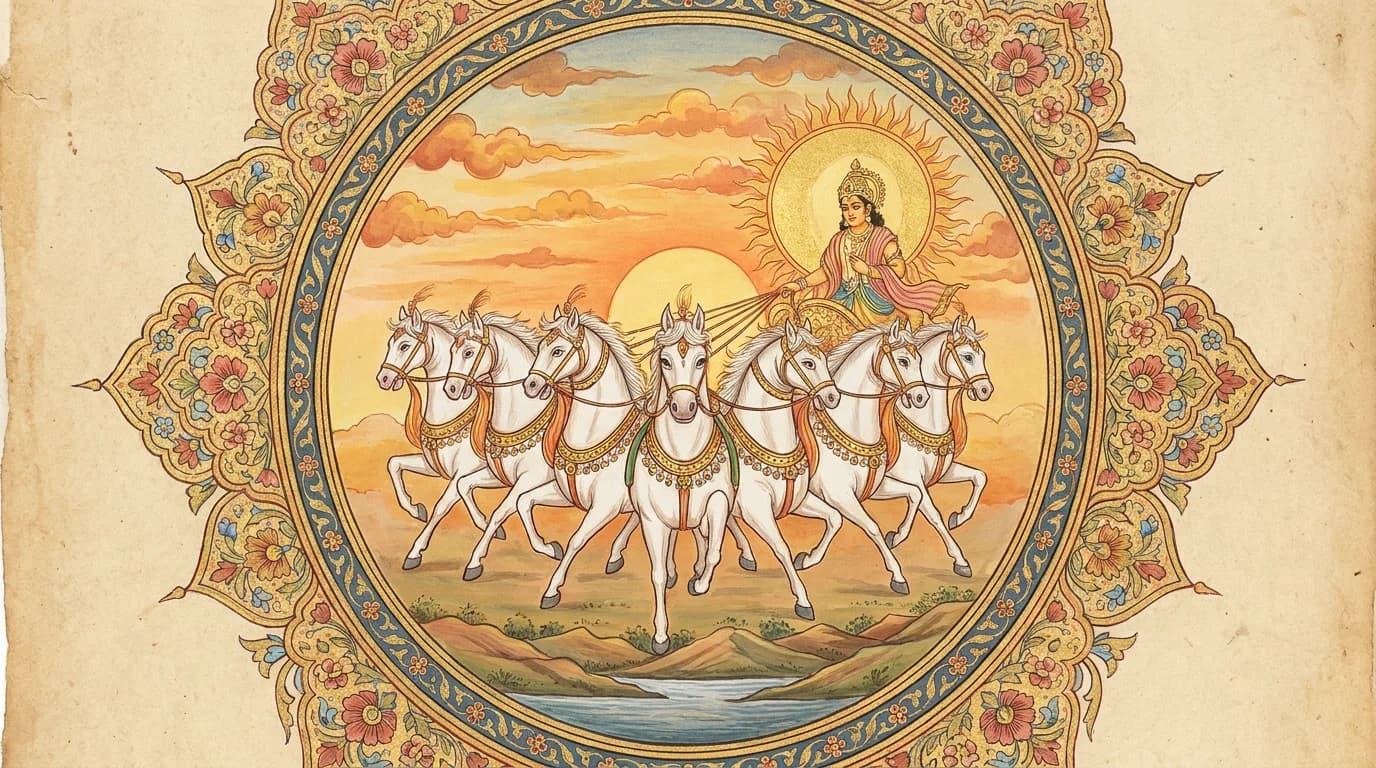
Seven running horses in Vastu Shastra represent Surya's golden chariot — symbol of the complete sun: 7 days, 7 VIBGYOR colours, 7 Vedic musical notes. Paired with pyrite's gold energy, the 7 horses Vastu painting activates Kuber's wealth zone when placed on the North wall with horses facing INTO the room.
Why 7 Horses — Not 6, Not 8?
Seven running horses is one of the most precisely specified symbols in Vastu Shastra. The number is not decorative shorthand for 'many' — it maps directly onto the sacred cosmological structure of 7 in Hindu tradition. Six horses would be incomplete; eight would overflow into Chinese Feng Shui numerology. Seven is the Vedic number of wholeness: it describes the full chariot of the sun, the full arc of the visible spectrum, the full span of a week, and the full ladder of musical harmony. A painting of 7 horses is therefore a visual declaration of completeness in motion — all life domains moving forward together.
| Number | 7 |
| Root tradition | Rigveda — Surya's chariot drawn by 7 horses |
| Vastu zone activated | North wall — Kuber / wealth direction |
| Symbolic completeness | 7 days + 7 VIBGYOR colours + 7 swaras + 7 chakras |
| Critical rule | Horses must face INTO the room — not toward exit |
Surya's Chariot — the Vedic Root of the 7 Horses Symbol
The Rigveda, one of the oldest texts in human history, describes Surya (the sun deity) riding a blazing golden chariot across the sky each day. His chariot is drawn by 7 horses — named in the Puranas as Gayatri, Brhati, Usnik, Jagati, Tristup, Anustup, and Pankti. These are not arbitrary names: each corresponds to one of the 7 chandas (metres) of Vedic poetry, suggesting that the sun's journey literally measures time and rhythm in the universe.
Surya is the most directly visible deity in the Hindu pantheon — the literal source of light, warmth, agriculture, and life. His chariot moving forward is the movement of time, prosperity, and cosmic order (Rta). To display 7 running horses is to invoke Surya's forward momentum — the unceasing energy of the sun that produces abundance by illuminating all possibilities. Pyrite, with its golden metallic lustre, is the mineral most strongly associated with Surya's solar gold energy.
| Source text | Rigveda + Vishnu Purana |
| Deity | Surya — Hindu sun god |
| 7 horse names | Gayatri, Brhati, Usnik, Jagati, Tristup, Anustup, Pankti |
| Chandas meaning | Each horse = one Vedic metrical metre |
| Solar energy in Vastu | Clarity, success, forward momentum, prosperity |
| Pyrite link | Gold lustre = Surya's mineral resonance |
7 Layers of Meaning — Days, Colours, Notes, Chakras
What makes 7 such a potent Vastu symbol is the convergence of multiple independent systems all landing on the same number. This convergence — called 'resonant overlap' in some Vedic schools — is interpreted as confirmation of a deeper cosmic pattern.
- 17 days of the week
Sunday through Saturday — each governed by a Hindu planetary deity. Sunday belongs to Surya (sun) himself. A full week represents continuous, unbroken momentum — the energy embodied by the 7 horses.
- 27 VIBGYOR colours
Violet, Indigo, Blue, Green, Yellow, Orange, Red — the complete visible spectrum. Surya's chariot crossing the sky produces the rainbow. Seven horses therefore represent the full spectrum of possibility and abundance.
- 37 swaras (musical notes)
Sa, Re, Ga, Ma, Pa, Dha, Ni — the complete scale of Indian classical music. Wholeness of sound; all harmonics present. Vastu practitioners associate harmonic completeness with balanced energy flow.
- 47 chakras
Muladhara through Sahasrara — the complete human energy body from root (survival/earth) to crown (spiritual connection). Seven horses activate all energy layers simultaneously.
- 57 sages (Saptarishis)
The seven Vedic sages whose wisdom underpins Hindu scripture. The number 7 in Vedic tradition always implies completeness of wisdom and guidance.
- 67 sacred rivers (Sapta Sindhu)
Ganga, Yamuna, Godavari, Saraswati, Narmada, Sindhu, Kaveri — the seven holy rivers whose waters purify and nourish. Seven horses carry this purifying abundance energy.
- 77 vows of marriage (Sapta Padi)
The seven steps of Hindu marriage represent complete commitment. Seven horses in a new home frame the completeness of domestic intention.
Direction Rule — the Mistake That Reverses the Energy
The single most consequential decision in hanging a 7 horses Vastu painting is the direction the horses face. This is not a minor stylistic preference — Vastu tradition holds that a painting where horses run OUTWARD (toward a door, window, or exterior wall) actively channels energy OUT of the home rather than into it. Many buyers unknowingly hang their painting incorrectly and then wonder why the remedy feels ineffective.
The rule is simple: stand facing the wall where your painting will hang. The horses must be galloping toward you — into the interior of the room. Their forward motion should point inward, as if bringing energy, momentum, and prosperity from the outside world into your space. If the horses face a main entry door, that door must be one through which energy enters — not exits. Verify this before installation; moving a mounted frame is inconvenient and risks chipping pyrite clusters.
| Horse direction | Vastu interpretation | Recommended? |
|---|---|---|
| Facing INTO the room (inward) | Energy, wealth, momentum flow INTO the home | Yes — always |
| Facing toward main entry door (inward entry) | Wealth entering through the front door | Yes — acceptable |
| Facing toward a window | Energy escapes through window | Avoid if possible |
| Facing toward an exit/back door | Wealth and energy channelled out | No — reverse the painting |
| Facing the South wall | Compounded inauspiciousness | Never |
Pyrite + 7 Horses — Why the Combination Is Greater Than Each Part
Pyrite alone is a powerful Vastu crystal for wealth activation — its gold-lustre mineral body resonates with Kuber and Lakshmi energy in the North zone. Seven horses alone carry Surya's forward momentum and completeness. When combined in a single frame, Vastu teachers describe a synergy: pyrite provides the energetic anchor (stability, attraction, earth-grounding), while the horses provide velocity (direction, momentum, all-domain activation). Together they are described as the 'wealth anchor in motion' — stable enough to hold gains, dynamic enough to generate them.
The gold of pyrite echoes the golden chariot of Surya, creating a visually and symbolically unified object. From an aesthetic and psychological standpoint, a genuine pyrite frame with running horses is also a genuinely beautiful piece — the metallic gleam of the crystal, the dynamic energy of the horses, and the warm tones of a quality frame create décor that commands attention and communicates abundance with or without any belief in Vastu tradition.
| Pyrite role | Wealth anchor — ground and attract Kuber energy |
| 7 horses role | Velocity — forward momentum across all life domains |
| Combined effect (Vastu) | Stable abundance + active momentum = sustained prosperity |
| Aesthetic effect | Golden mineral + dynamic horses = abundance-signalling décor |
| Best placement | North wall, living room or home office, eye level |
Vastu vs Feng Shui: 7 Horses Painting Compared
Both Vastu Shastra (Indian) and Feng Shui (Chinese) traditions recommend running horse paintings for prosperity, but they differ on number, direction, and placement zone. Understanding both helps buyers who follow one tradition specifically or who want to honour both in a single home.
| Element | Vastu Shastra | Feng Shui |
|---|---|---|
| Preferred number of horses | 7 (Vedic completeness) | 8 (Chinese prosperity / Ba Gua) |
| Wealth direction | North (Kuber zone) | South-East (Wealth Bagua corner) |
| Running direction | INTO the room / inward | INTO the room / inward (same rule) |
| Symbolism | Surya's chariot — solar completeness | Success, speed, upward mobility |
| Pyrite role | Kuber energy anchor (North) | Wealth crystal (South-East corner) |
| Activation method | Sankalp + dhoop + mantra | Singing bowl + sunlight cleansing |
| Colour preference | Gold / white / brown horses | Any; gold and white most auspicious |
Frequently asked
Last reviewed: 17 May 2026 · Verified by the DivineTatva expert panel
Why are there exactly 7 horses and not 8 or 9?
Seven is the Vedic number of completeness — Surya's chariot is drawn by exactly 7 horses in the Rigveda, mapping onto 7 days, 7 VIBGYOR colours, 7 musical notes, and 7 chakras. Eight is the Chinese Feng Shui prosperity number. For Vastu Shastra, 7 is the correct and complete number.
Which direction should the horses face in a 7 horses Vastu painting?
The horses must face INTO the room — their motion should point inward, toward the room's interior. If they face outward (toward a door or window leading out), Vastu tradition holds that they channel energy outward rather than bringing it in. Always verify direction before fixing the frame permanently.
Can I use a printed 7 horses painting instead of a pyrite frame?
A printed painting carries the visual and symbolic power of the 7 horses motif. Adding genuine embedded pyrite is believed in Vastu Shastra to amplify the remedy's energetic potency significantly — pyrite provides a mineral anchor for the North zone's Kuber energy that a print alone cannot. For a full Vastu remedy, genuine pyrite embedding is recommended.
What colour horses are most auspicious in Vastu?
White or gold horses are considered most auspicious in Vastu Shastra — white symbolises purity and Surya's light, while gold resonates with Lakshmi and Kuber. Running horses in natural brown or bay tones are also fully acceptable. Avoid black or very dark horses for North-zone wealth placement.
Can I place a 7 horses painting in the office?
Absolutely — the North wall of a home office, business cabin, or reception area is one of the most recommended placements in Vastu Shastra. The 7 horses' forward momentum aligned with Kuber's North direction is considered highly potent for business growth, career advancement, and entrepreneurial success.
Does the frame need to be made of a specific material?
Vastu tradition does not mandate a specific frame material, but wood (natural, earthy) and clean acrylic (transparent, light-permitting) are most commonly used by Vastu practitioners. The key requirements are genuine embedded pyrite, horses facing inward, and placement on the North wall — frame material is secondary to these.
Reviewed by the DivineTatva expert panel
Written and reviewed by DivineTatva's consulting Vedic astrologer. Every piece is lab-certified and energised in our Jaipur atelier. Last updated 10 June 2026.