Pyrite Vastu Frame Benefits: 7 Horses Meaning, Placement & What's Real
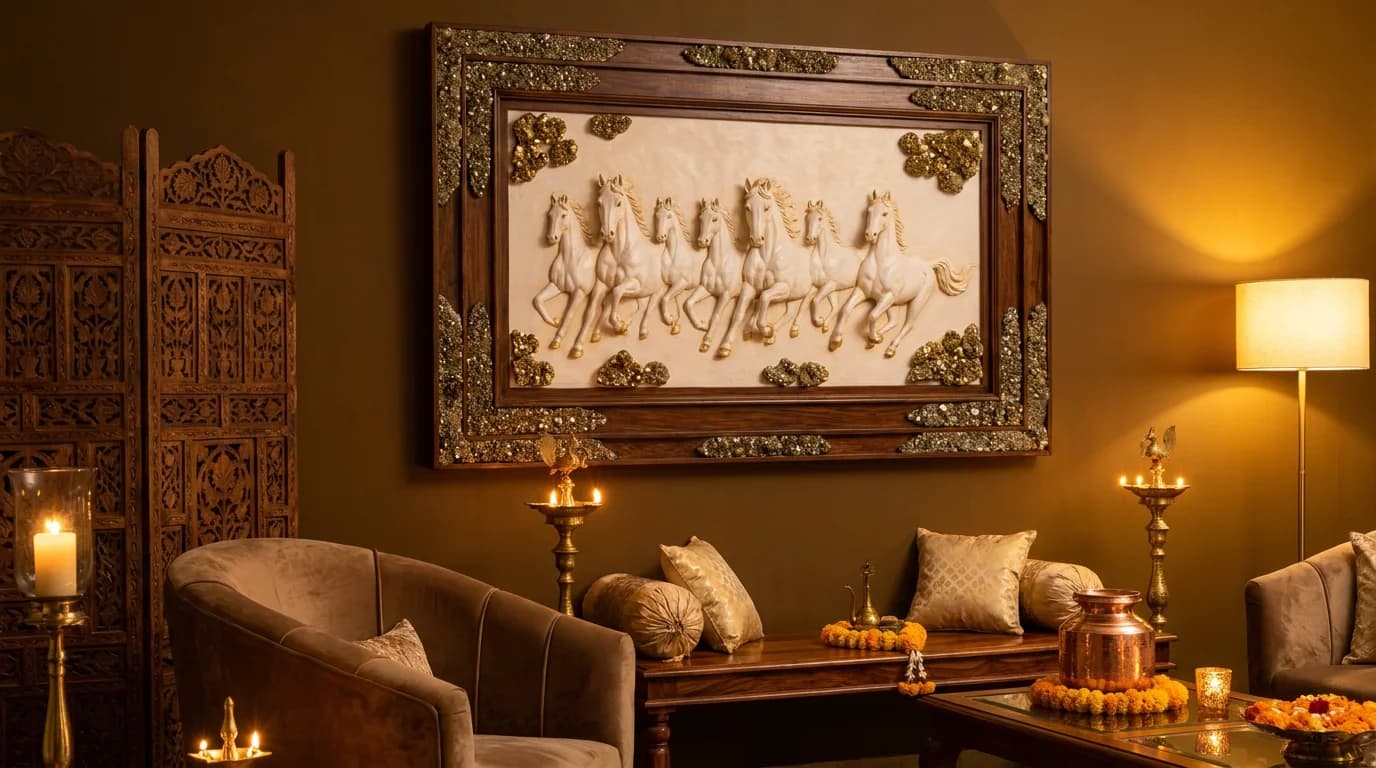
A pyrite Vastu frame combines raw iron-sulphide crystal with the ancient 7-running-horses prosperity motif. Placed on the North wall — Kuber's direction in Vastu Shastra — it is believed to activate wealth energy and remove financial Vastu dosh. Genuine embedded pyrite is key; painted imitations carry no energetic or aesthetic equivalence.
- What Is a Vastu Frame?
- Why Pyrite for Vastu — Lakshmi Energy
- 7 Horses Symbolism — Surya's Chariot
- Where to Place — North Wall & Kuber Direction
- What NOT to Do — Placement Mistakes
- Real vs Fake Pyrite in Frames
- Feng Shui Parallel
- Does It Work? Honest Vastu vs Psychology
- How to Activate — Sankalp & Incense
- Size & Price Guide
- Gift Guide
- The DivineTatva Difference
What Is a Pyrite Vastu Frame?
A pyrite Vastu frame is a wall-mounted decorative object that embeds genuine raw pyrite — an iron-sulphide mineral prized for its mirror-bright metallic lustre — into a wooden or acrylic frame featuring the 7 running horses motif. In Vastu Shastra, the ancient Indian science of spatial energy, such frames are placed on the North wall to activate the Kuber (wealth lord) zone and invite financial abundance. Unlike printed posters or painted imitations, a genuine pyrite frame uses real mineral clusters whose crystalline structure, Vastu practitioners say, amplifies the frame's energetic intention.
Vastu Shastra assigns cardinal directions to specific life domains: North belongs to Kuber, the Hindu deity of wealth and treasurer of the gods. Objects placed in this zone are believed to energise that domain. The 7-horses motif — rooted in Surya (sun) iconography — adds forward momentum and success velocity to the frame's energy signature. Together, pyrite plus horses in the North wall is one of the most recommended Vastu remedies for financial stagnation.
| Mineral | Pyrite (FeS₂) — iron disulphide |
| Crystal system | Isometric / cubic |
| Lustre | Metallic, mirror-bright (hence 'fool's gold') |
| Vastu zone | North — Kuber / wealth direction |
| Primary motif | 7 running horses facing into the room |
| Tradition | Vastu Shastra (ancient Indian spatial science) |
| Honest note | Belief-based practice; no peer-reviewed clinical proof |
Why Pyrite for Vastu — Lakshmi & Kuber Energy
Pyrite has been called 'fool's gold' in geology, but in Vastu Shastra and crystal energy traditions it is revered as the closest mineral approximation of gold's wealth-attracting vibration. Its name comes from the Greek 'pyr' (fire) — strike it against steel and it sparks. Vastu practitioners associate this fire-and-metal quality with Agni (fire element) and the Surya (sun) energy stream, both linked to prosperity, clarity, and forward movement.
In Hindu cosmology, Lakshmi — goddess of wealth — is often depicted with gold. Pyrite's gold-like surface is interpreted as a physical resonance with Lakshmi's energy. Kuber, the North-direction wealth lord, rules material abundance, and pyrite's iron-earth constitution is said to ground and stabilise incoming financial energy rather than letting it scatter. Vastu teachers often call pyrite the 'wealth anchor' of crystal remedies.
From a non-spiritual standpoint, research in environmental psychology suggests that objects associated with abundance — gold tones, sparkling textures, ordered motifs — prime the brain toward confidence and expansive thinking. Whether the mechanism is metaphysical or psychological, users consistently report a shift in their relationship with financial intention after placing a genuine pyrite piece in a prominent North-wall location.
| Sanskrit association | Suvarna-abha (gold-lustred stone) |
| Element (Vastu Pancha Bhuta) | Prithvi (Earth) + Agni (Fire) |
| Deity resonance | Kuber (wealth), Surya (prosperity clarity) |
| Goddess link | Lakshmi — gold-tone resonance |
| Psychological parallel | Gold-tone priming = confidence + abundance mindset |
| Pyrite Vastu tradition | North wall placement for Kuber activation |
7 Horses Symbolism — Surya's Chariot, VIBGYOR & Completeness
The number 7 is one of the most symbolically loaded numbers in Hindu cosmology. Surya, the sun god, rides a golden chariot pulled by exactly 7 horses — named Gayatri, Brhati, Usnik, Jagati, Tristup, Anustup, and Pankti, each representing one of the 7 metres (chandas) of Vedic poetry. The chariot moving across the sky is the source of all light, warmth, success, and time. Seven running horses therefore embody the complete energy of the sun god.
The symbolism does not stop at mythology. Seven maps onto the 7 days of the week (Surya presides over Sunday), the 7 colours of visible light (VIBGYOR — Violet, Indigo, Blue, Green, Yellow, Orange, Red), the 7 swaras (musical notes — Sa Re Ga Ma Pa Dha Ni), and the 7 chakras of the human energy body. Any single horse represents speed and freedom; 7 horses together represent totality — all dimensions of life moving forward in unison.
The critical placement rule: horses must run INTO the room, not toward the exit. A painting where the horses face outward is believed to carry wealth and energy out of the home rather than channelling it in. This is the single most common mistake buyers make when installing 7 horses art.
| Symbolism layer | Vastu / Hindu meaning | Practical implication |
|---|---|---|
| Surya's chariot | Complete solar energy, divine forward motion | Activates success and clarity in the North zone |
| 7 days | Full week cycle, unbroken momentum | Continuous, not intermittent, prosperity flow |
| VIBGYOR (7 colours) | Full visible spectrum, completeness of light | Holistic abundance across all life areas |
| 7 swaras (musical notes) | Harmonic wholeness, creative vibration | Harmony in financial and creative pursuits |
| 7 chakras | Complete energy body activation | Spiritual + material balance |
| Running direction | Horses face INTO room = energy enters | Always verify horses face inward before hanging |
Where to Place Your Pyrite Vastu Frame — North Wall & Kuber Direction
In Vastu Shastra, the North direction is governed by Kuber — lord of wealth and material prosperity. Placing any wealth-activating object on the North wall of your living room or home office is the primary Vastu recommendation. The North wall is particularly potent because it receives the magnetic north energy stream that Vastu Shastra associates with abundance, career, and incoming wealth.
To find true North in your home, use a compass app on your smartphone. Stand at the centre of the room and identify the wall facing magnetic North. This is your primary placement wall. The frame should hang at eye level — between 5 and 6 feet from the floor — so the horses face inward (into the room, not toward any window or door that leads out).
If North wall placement is structurally impossible (blocked by a door, window, or beam), the North-East (Ishaan corner) is the second-best option — it combines Kuber's wealth energy with the spiritual purity of the Ishaan zone. The East wall (Surya's direction) is a valid third choice, especially for creative or career-focused intentions, as Surya energy drives success and recognition.
| Placement | Vastu Rating | Zone lord | Best for | Notes |
|---|---|---|---|---|
| North wall, living room | Excellent | Kuber | Wealth, abundance | Primary recommendation |
| North wall, home office | Excellent | Kuber | Business growth, career | Especially potent for entrepreneurs |
| North-East corner | Very Good | Ishaan / Kuber overlap | Wealth + spiritual clarity | Good if North wall unavailable |
| East wall | Good | Surya | Career success, recognition | Third choice; energise with morning light |
| South wall | Avoid | Yama (death/endings) | — | Opposite of Kuber; not recommended |
| Bathroom / toilet area | Never | — | — | Energy dissipates; inauspicious |
| Above bed (bedroom) | Avoid | — | — | Running horses create restless energy during sleep |
| Dusty storage / dark corner | Never | — | — | Blocked energy; defeats purpose |
What NOT to Do — Placement Mistakes That Negate Vastu Benefits
Incorrect placement is believed in Vastu Shastra to not merely neutralise a remedy's benefit, but in some cases to reverse it. The most common and consequential mistake is hanging 7 horses so they face outward — toward an exit door or window. This is said to drive energy out of the home. Before drilling a single nail, confirm the horses' direction of motion points into the room's interior.
- 1Horses facing outward
The most critical error. Horses must gallop INTO the room. If they face a door or exterior wall, the painting channels energy outward. Check direction before installation.
- 2South wall placement
The South is governed by Yama (the lord of dharma and death in Hindu cosmology) — the opposite of Kuber's abundance energy. Placing a wealth remedy on the South wall is considered inauspicious in Vastu Shastra.
- 3Bathroom or toilet proximity
Water-waste areas carry Apas (water) energy in its stagnant, draining form. Any prosperity symbol near a toilet is believed to have its energy continuously drained. Maintain at least two rooms of separation.
- 4Above the bed
7 running horses carry kinetic, active energy. Vastu practitioners advise against placing dynamic symbols above a sleeping area as they may disrupt rest. Reserve active symbols for living and working spaces.
- 5Dark or dusty corners
Energy objects placed where light and air do not circulate accumulate Tamas (stagnant energy). The frame should be in a well-ventilated, naturally lit area of the North wall.
- 6Exposing to water or moisture
Pyrite is iron-sulphide and oxidises when exposed to moisture, eventually losing its metallic lustre. Never hang near kitchen splash zones, bathroom steam, or open windows in monsoon season.
- 7Placing on the floor
Symbols of prosperity placed below eye level are considered inauspicious in Vastu tradition. The frame should always be elevated — ideally at eye level on the wall.
Real vs Fake Pyrite in Vastu Frames — How to Tell the Difference
The market for Vastu frames is flooded with imitations: painted gold resin, gold-foil paper, iron filings mixed into epoxy, and acrylic 'crystal' coatings. None of these carry the mineral density, natural crystal structure, or tactile authenticity of genuine embedded pyrite. From a Vastu Shastra perspective, the energetic quality attributed to a stone is inseparable from its genuine mineral nature. A painted imitation is simply art — not a crystal remedy.
Five tests you can perform before purchasing or after receiving a frame: (1) Streak test — scratch pyrite on unglazed white ceramic; genuine pyrite leaves a greenish-black streak, not gold. Gold-painted resin leaves no meaningful streak or leaves a soft powdery residue. (2) Lustre — genuine pyrite has a mirror-bright, almost brassy metallic gleam that resin and paint cannot replicate at close inspection. (3) Magnetic test — pyrite is non-magnetic; resin frames sometimes use iron filings for weight and will attract a magnet. (4) Weight — pyrite is very dense (specific gravity ~5.0); a frame with genuine embedded clusters feels noticeably heavy for its size. (5) Lab certificate — reputable sellers like DivineTatva provide a certificate of authenticity confirming mineral composition.
| Feature | Genuine Pyrite Frame | Resin + Iron Filings | Gold-Foil / Painted |
|---|---|---|---|
| Mineral present | Yes — FeS₂ crystal clusters | No — decorative filler | No — surface coating only |
| Streak colour | Greenish-black | Varies / no streak | Gold powder / no streak |
| Magnetic? | No | Often yes (iron filings) | No |
| Weight | Dense, noticeably heavy | Medium | Light |
| Lustre durability | Decades if kept dry | Fades in months | Peels / chips in weeks |
| Lab certifiable? | Yes | No | No |
| Vastu tradition value | Full — genuine mineral energy | None | None |
| Price range (India) | ₹1,099 – ₹5,000+ | ₹400 – ₹900 | ₹200 – ₹500 |
Feng Shui Parallel — Running Horses & Pyrite in Chinese Tradition
Vastu Shastra and Feng Shui are independent spatial-energy traditions — Indian and Chinese respectively — that developed over millennia without direct cross-pollination, yet they converge on several wealth symbols. The running horse is revered in both systems: in Feng Shui, galloping horses represent success, speed, and upward mobility. The number 8 is preferred in Feng Shui (for prosperity), but 7 horses are accepted as a powerful success symbol.
Pyrite appears in Feng Shui as a 'wealth crystal' placed in the wealth corner (the far left corner from the main entrance, per Bagua map — equivalent to South-East in compass Feng Shui). Both systems agree: pyrite amplifies wealth intention, needs to be genuine, and should be kept clean and well-lit. The key difference is directional: Vastu assigns wealth to the North (Kuber), while Feng Shui compass school assigns it to the South-East. In a home where both traditions are respected, the North wall serves Vastu and a secondary pyrite piece in the South-East serves Feng Shui.
| Element | Vastu Shastra | Feng Shui |
|---|---|---|
| Wealth direction | North (Kuber) | South-East (Wood element Bagua) |
| 7 horses meaning | Surya's chariot — solar completeness | Speed, success, upward mobility |
| Pyrite role | Kuber energy anchor, Lakshmi resonance | Wealth crystal, money corner activator |
| Running direction | Into the room (inward) | Into the home / space (inward — same rule) |
| Preferred number of horses | 7 (Vedic completeness) | 8 (Chinese prosperity number) |
| Activation method | Sankalp, dhoop, mantra | Cleanse with singing bowl or sunlight |
Does a Pyrite Vastu Frame Actually Work? Tradition vs Psychology
This is the question that deserves an honest, two-track answer. Track one: Vastu Shastra tradition. Vastu is a 5,000-year-old Indian spatial science codified in texts like the Manasara and Mayamata. It holds that directional energies, elemental compositions, and intention-set objects create measurable shifts in a home's energy field. Practitioners cite thousands of years of application across Hindu temples, royal palaces, and domestic architecture as evidence of its efficacy. The tradition does not require peer-reviewed validation — it predates the concept.
Track two: contemporary psychology and environmental design. No peer-reviewed clinical study confirms that pyrite or a 7-horses painting changes material financial outcomes. What research does support: (a) environmental priming — objects that signal abundance prime the occupant's mindset toward confidence and opportunity-seeking; (b) intention-setting rituals increase follow-through on goals (consistent with sankalp practice); (c) aesthetically coherent, meaningful décor reduces cognitive stress and improves the quality of focused work. Many users report positive outcomes consistent with these mechanisms — call it Vastu, intention-setting, or environmental psychology; the reported experience is genuine.
DivineTatva's position: we respect Vastu Shastra as a living tradition with profound historical and spiritual depth. We are honest that no clinical proof exists for energetic claims. We believe a genuine, lab-certified pyrite Vastu frame placed with clear intention and correct Vastu positioning is a meaningful, beautiful, and symbolically rich object — and that users who engage with it sincerely and consistently report positive energy shifts consistent with intention-setting. It is not a substitute for professional financial or legal advice.
| Claim | Vastu Shastra tradition | Psychology / Environmental design | DivineTatva stance |
|---|---|---|---|
| Attracts wealth | Yes — activates Kuber zone | Indirectly via abundance priming | Belief-based; users report positively |
| Removes Vastu dosh | Yes — pyrite neutralises financial dosh | Ritual reduces anxiety about financial blocks | Tradition-supported; personal experience varies |
| Improves focus/clarity | Yes — Surya energy of pyrite | Bright, ordered décor reduces cognitive clutter | Likely yes via both pathways |
| Requires clinical proof | Not applicable — pre-scientific system | Partially supported | We disclose honestly — no clinical proof exists |
| Safe to use? | Yes | Yes | Yes — no harm; not a substitute for professional advice |
How to Activate Your Pyrite Vastu Frame — Sankalp, Incense & Placement Ritual
Vastu remedies gain their full potency, tradition says, through conscious activation — a deliberate ritual that imprints your specific intention onto the object and formally invites the associated energy into your space. The activation for a pyrite Vastu frame combines physical placement, fire-and-smoke purification, and a clearly spoken sankalp (Sanskrit for 'intention' or 'resolve').
- 1Choose an auspicious day
Dhanteras, Diwali, Akshaya Tritiya, or any Wednesday (Budh — planet of commerce) or Friday (Shukra — planet of prosperity and Lakshmi). Avoid no-moon (Amavasya) for new installations.
- 2Clean the wall and frame
Wipe the North wall clean. Dust the frame with a dry soft microfibre cloth — never water or liquid cleaners on the pyrite. Ensure the wall area is free of cobwebs, dust, and clutter.
- 3Burn loban or dhoop
Light a loban (benzoin resin) or sandalwood dhoop stick and allow the smoke to pass over the frame on all sides. This is the Vastu purification step — smoke dispels Tamas (stagnant energy) and prepares the object and space.
- 4Set your sankalp
Hold the frame with both hands, close your eyes, and speak your financial intention clearly and specifically: not 'I want more money' but a concrete goal — 'I intend to clear my outstanding debt by March 2027' or 'I am building a thriving business that supports my family.' The specificity of sankalp is considered critical in Vedic practice.
- 5Place on North wall at eye level
Fix the frame on the North wall between 5 and 6 feet from the floor. Confirm the horses face inward — into the room, not toward a door or window. Step back and verify alignment and visual balance.
- 6Chant the Lakshmi mantra 108 times
Chant 'Aum Shreem Mahalakshmiyei Namah' (ॠशà¥à¤°à¥€à¤‚ महालकà¥à¤·à¥à¤®à¥à¤¯à¥ˆ नमः) 108 times using a tulsi or crystal mala. This mantra invokes Lakshmi's abundance energy and consecrates the frame to your intention.
- 7Light a ghee diya briefly
Place a small ghee-lamp in front of the frame for a few minutes as an offering. Do not leave any flame unattended. Extinguish with gratitude once the sankalp is complete.
Monthly maintenance: light a dhoop stick near the frame on a Wednesday or Friday, and dust the pyrite with a dry soft brush. Avoid incense ash falling on the pyrite surface. Never expose the frame to water spray, direct monsoon-season humidity, or prolonged direct sunlight — UV can fade pyrite's metallic lustre over time. Care note verbatim: 'Dust the frame surface with a dry soft brush or dry microfibre cloth. Never expose to moisture, water spray, or direct prolonged sunlight (UV can fade pyrite's metallic lustre over time). Do not use liquid cleaners or polishes on the pyrite piece. Handle frame edges carefully to avoid chipping embedded pyrite clusters.'
Size & Price Guide — What You Should Pay for a Genuine Pyrite Vastu Frame in India
Price varies enormously across the Indian market, and the variation is almost entirely explained by whether genuine pyrite is embedded or whether a painted/resin substitute is used. Knowing the price tiers helps you immediately identify suspicious listings.
| Price range | What you typically get | Genuine pyrite? | Certificate? | DivineTatva verdict |
|---|---|---|---|---|
| ₹200 – ₹600 | Printed / painted paper or acrylic frame, gold foil or paint | No | No | Decorative art only — not a Vastu crystal remedy |
| ₹600 – ₹1,000 | Resin frame with pyrite dust or crushed mineral, minimal genuine content | Partial | Rarely | Low authenticity — verify with streak and weight tests |
| ₹1,099 – ₹1,999 | Genuine raw pyrite cluster or quality beads embedded, wooden/acrylic frame, lab cert | Yes | Yes | DivineTatva range — verified genuine, energised, certified |
| ₹2,000 – ₹5,000+ | Large raw cluster centrepiece, premium hardwood frame, artisan finish | Yes | Yes | Premium gifting or feature-wall installation — full potency |
Frame size should be proportional to wall area. For a standard living room feature wall (10–12 ft wide), a frame between 12×16 inches and 18×24 inches is appropriate. Oversized frames on small walls look unbalanced; undersized frames on large walls lose visual and energetic presence. DivineTatva's pyrite Vastu frame (₹1,099, MRP ₹1,999) is sized for standard living room and home office North walls and ships with a lab certificate and activation guide.
Gift Guide — Who Should Receive a Pyrite Vastu Frame & When
A pyrite Vastu frame is one of the most culturally resonant gifts in the Indian gifting tradition — meaningful, auspicious, and practical as home décor. It avoids the perishability of flowers and the impersonality of generic gift cards.
- 1Griha Pravesh (housewarming)
The single most appropriate occasion. A pyrite Vastu frame gifted at a housewarming sets positive financial and energetic intention from day one in the new home. Wrap with red cloth for added auspiciousness.
- 2Diwali / Dhanteras
The festival of Lakshmi and wealth is the natural season for prosperity symbols. A lab-certified pyrite frame is a premium alternative to decorative diyas or sweets — it lasts years.
- 3Business inauguration
For shop openings, office launches, or start-up founders — the North wall of a business premises is the ideal placement and a thoughtful gift from investors, partners, or family.
- 4Wedding gift
A couple setting up a new home benefits from a wealth-activating Vastu piece. Pair with a printed placement guide for extra thoughtfulness.
- 5Akshaya Tritiya
The auspicious 'never-diminishing' day is considered ideal for beginning all prosperity-related investments and placements. A pyrite frame gifted or purchased on Akshaya Tritiya carries additional symbolic weight.
- 6Entrepreneur or self-employed individual
Business owners are the most receptive audience for Vastu wealth remedies. A home office North wall with a pyrite frame and a clear business sankalp is a genuinely popular combination.
The DivineTatva Difference — Jaipur-Made, Lab Certified, Honestly Described
DivineTatva is a Jaipur-based spiritual and crystal e-commerce brand. Jaipur sits at the heart of India's gemstone and mineral trade — Rajasthan produces and processes a significant share of India's crystals and spiritual objects. Our sourcing is local, our quality control is in-house, and our lab certifications are third-party verified.
Every pyrite Vastu frame we ship includes: (1) genuine raw pyrite embedded by hand — not printed, not resin-cast, (2) a lab certificate confirming mineral composition, (3) an activation guide in English and Hindi, (4) packaging designed to prevent chipping of pyrite clusters during transit, (5) COD (Cash on Delivery) available across India — because we understand that trust is earned, not assumed.
We do not make exaggerated claims. We describe our products honestly: Vastu Shastra is a living tradition with thousands of years of application. We respect that tradition deeply. We also respect our customers enough to tell them that no peer-reviewed clinical study confirms energetic claims. What we can confirm: our pyrite is genuine, our frames are Jaipur-made, our customers consistently report positive shifts in energy and intention when they engage with our products sincerely. That is what we stand behind.
| Brand base | Jaipur, Rajasthan |
| Pyrite source | Genuine raw mineral, lab-certified |
| Certificate included | Yes — third-party mineral verification |
| COD available | Yes — pan-India |
| Activation guide | Yes — English + Hindi |
| Honest claims policy | Belief-based tradition; no clinical proof stated |
| Price | ₹1,099 (MRP ₹1,999) |
Frequently asked
Last reviewed: 17 May 2026 · Verified by the DivineTatva expert panel
Which wall should I place a pyrite Vastu frame on?
The North wall is the primary recommendation in Vastu Shastra — North is governed by Kuber, the wealth deity. The frame should hang at eye level with the horses facing into the room. If the North wall is unavailable, the North-East (Ishaan zone) is the second-best option, combining wealth and spiritual energy.
Can I place the pyrite Vastu frame in the bedroom?
Vastu practitioners generally advise against placing running horses above or behind a bed, as the active, kinetic energy of the motif can disrupt restful sleep. A living room or home office North wall is far more appropriate for wealth-focused energy work.
Why do 7 horses specifically represent prosperity?
In Hindu cosmology, Surya (sun god) rides a golden chariot pulled by 7 horses — representing 7 days, 7 VIBGYOR colours, 7 Vedic metres, and 7 musical notes. Seven is the number of completeness. Running horses symbolise forward momentum; combined, 7 horses represent the complete force of the sun moving all life domains forward together.
Is pyrite the same as fool's gold?
Yes — geologically, pyrite (FeS₂) is called fool's gold because miners sometimes mistook it for real gold. But in Vastu Shastra and crystal energy tradition, pyrite is prized precisely for its gold-toned metallic resonance with Lakshmi and Kuber energy. It is a genuine mineral with a long tradition of use as a wealth-activating stone.
How do I know if the pyrite in my frame is genuine?
Perform a streak test: scratch the pyrite on unglazed white ceramic — genuine pyrite leaves a greenish-black streak. Check weight: genuine pyrite clusters are very dense. Check magnetism: pyrite is not magnetic; some fake frames use iron filings that attract a magnet. Best of all, request a lab certificate — DivineTatva provides one with every frame.
Does a pyrite Vastu frame scientifically attract money?
No peer-reviewed clinical study confirms that any crystal or Vastu object directly causes material financial outcomes. Vastu Shastra is a tradition-based practice, not a medical or financial science. That said, environmental psychology research supports that abundance-priming décor and intention-setting rituals improve confidence and goal follow-through. We are honest about this distinction and do not make false promises.
How do I clean and care for the pyrite frame?
Dust the frame surface with a dry soft brush or dry microfibre cloth. Never expose to moisture, water spray, or direct prolonged sunlight — UV can fade pyrite's metallic lustre over time. Do not use liquid cleaners or polishes on the pyrite piece. Handle frame edges carefully to avoid chipping embedded pyrite clusters.
Can I place the frame on the South wall if that is where my décor fits?
Vastu Shastra strongly advises against South wall placement for wealth objects — the South direction belongs to Yama and carries a very different energy signature from Kuber's abundance zone. If structural constraints force a South wall, it is better to select a different room's North wall rather than compromise direction for aesthetic convenience.
What is the best time to install a pyrite Vastu frame?
Vastu tradition recommends auspicious days: Dhanteras, Diwali, Akshaya Tritiya, or any Wednesday or Friday morning. Avoid Amavasya (no-moon day) for new installations. The morning hours — ideally sunrise to noon — are considered most auspicious for activating wealth remedies.
Does the DivineTatva frame come with a lab certificate?
Yes. Every DivineTatva pyrite Vastu frame ships with a third-party lab certificate confirming the mineral composition of the embedded pyrite. This distinguishes our frames from the large number of painted resin or gold-foil imitations sold on Indian marketplaces without any mineralogical verification.
Can I combine the pyrite Vastu frame with other Vastu remedies?
Yes — the pyrite frame works well alongside other Kuber-zone activators: a small Kuber yantra, a Gomti chakra cluster, or a clear quartz tower on the North shelf. Avoid overcrowding the zone. Keep the energy clean, uncluttered, and intentional. Consistency of attention matters more than accumulation of objects.
Is this product suitable for corporate office Vastu?
Absolutely. The North wall of a CEO's cabin, reception area, or conference room is an ideal placement. Corporate Vastu practitioners frequently recommend the 7 horses plus pyrite combination for business premises. The frames are aesthetically professional and carry strong symbolic resonance with growth, momentum, and prosperity.
Reviewed by the DivineTatva expert panel
Written and reviewed by DivineTatva's consulting Vedic astrologer. Every piece is lab-certified and energised in our Jaipur atelier. Last updated 9 June 2026.