How to Spot a Real Pyrite & Black Obsidian Bracelet (Real vs Fake Tests)
A real pyrite bracelet is heavy, metallic-gold and faceted with mirror-bright cube faces; real black obsidian is glassy volcanic stone with cool, sharp conchoidal shine. Fakes use dyed glass, resin or pyrite-coated stone — lighter, plasticky and warm to touch. The surest proof is a per-stone lab certificate, not a vague "AAA+" tag.
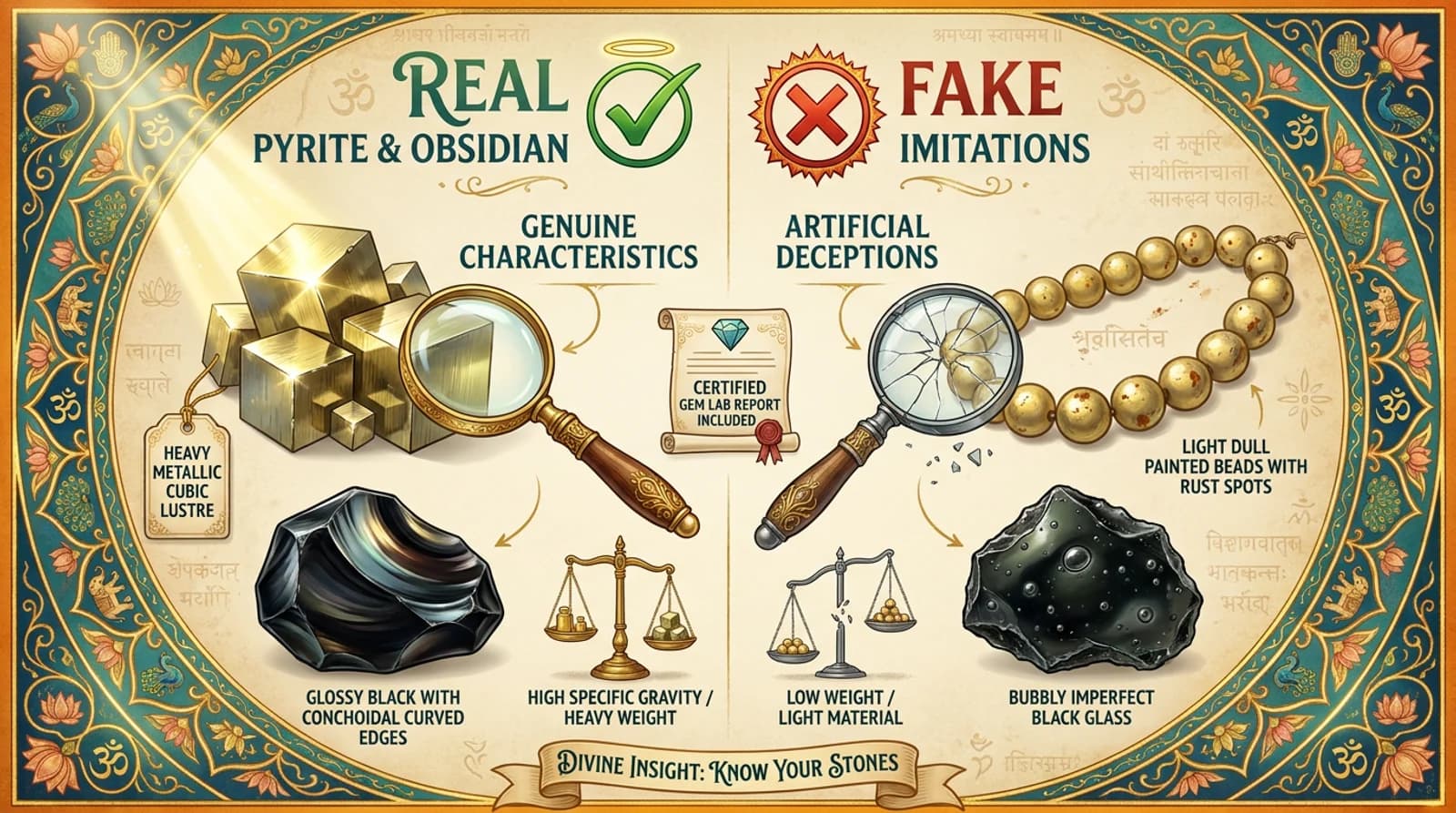
What a Real Pyrite & Black Obsidian Combo Actually Looks Like
A genuine Pyrite Wealth Combo is two natural lab-certified bracelets: golden pyrite (iron sulphide, FeS2) with a heavy, metallic, mirror-like lustre, and black obsidian (natural volcanic glass) with a cool, glassy, conchoidal shine. Real stones feel dense and cool, never plasticky or warm. The single most reliable proof of authenticity is a per-stone lab certificate — not a printed 'AAA+' or 'lab-tested' tag.
Pyrite earns its 'fool's gold' nickname because cheap fakes copy the colour but not the physics. Pyrite is genuinely heavy (specific gravity around 5.0) and its crystal faces flash like polished metal. Obsidian, by contrast, should look like dark glass — because it is glass. Once you know what each material is supposed to do under weight, light and touch, most fakes fall apart in seconds.
| Pyrite is | Natural iron sulphide (FeS2) — a heavy metallic mineral, not metal or plastic |
| Black obsidian is | Natural volcanic glass — glassy, cool, with shell-like (conchoidal) fractures |
| Best authenticity proof | Per-stone lab certificate from a named gemmological facility |
| Weakest 'proof' | Vague tags: 'AAA+', 'lab-tested', 'energised', self-issued cards |
| Belief vs evidence | Wealth & protection are traditional beliefs (Vedic/crystal healing), not clinically proven |
| Care that protects value | Keep pyrite dry; cleanse only on Selenite — never water or salt soak |
5 Simple Tests to Know If Your Pyrite Bracelet Is Real
None of these needs a lab. They use weight, light, edges, heat and the one property fakes can't fake — that real pyrite is iron and will eventually react to moisture. Do them gently; you're inspecting a bracelet, not destroying it.
- 1The weight test
Real pyrite is unusually dense for its size — a beaded pyrite bracelet feels noticeably heavier than a glass or resin bracelet of the same bead count. If it feels light and hollow, be suspicious.
- 2The lustre test
Tilt the beads under light. Genuine pyrite gives a bright, metallic, mirror-like flash — like polished brass or steel. Painted or coated fakes look flat, matte-gold or evenly 'sprayed' with no metallic sparkle inside the stone.
- 3The edge & facet test
Natural pyrite often shows tiny flat crystal faces and brassy cube-like glints; coated fakes are uniformly round and same-coloured all over. Look at the drill holes too — real stone shows greyish mineral inside, not gold paint or a plastic core.
- 4The warmth test
Hold a few beads in a closed hand. Real pyrite (a mineral) stays cool and warms slowly; plastic and resin warm up fast and feel light. This is a quick 'mineral vs plastic' tell.
- 5The moisture/rust tell
You never deliberately wet pyrite (it rusts), but authenticity shows in history: genuine pyrite that has met water tends to dull or develop tiny rust spots over time. A 'pyrite' bracelet that survives water perfectly with zero change is likely coated or fake.
| Heaviest signal | Density — real pyrite feels heavy for its size |
| Brightest signal | Metallic mirror lustre, not flat matte gold |
| Drill-hole check | Grey mineral inside = real; gold paint/plastic core = fake |
| Touch test | Cool and slow to warm = mineral; quickly warm = plastic |
| Honest caution | Do not wet-test on purpose — water rusts genuine pyrite |
Real vs Fake Black Obsidian: Don't Get Sold Black Glass Beads
Black obsidian is natural volcanic glass — so confusingly, the fake (manmade black glass) is also glass. The difference is subtle but checkable. Real obsidian is rarely a perfect, even jet-black; held to strong light at the edges it often shows a deep brownish, smoky or very dark translucency, and may carry faint natural swirls or tiny gas bubbles. Dyed black glass or black onyx substitutes tend to be flatly, uniformly opaque-black with bubble-free perfection that looks too clean.
| Test | Real black obsidian | Fake / substitute |
|---|---|---|
| Edge light | Deep brown/smoky translucency at thin edges | Dead flat black, no translucency, or evenly tinted glass |
| Surface | Glassy with possible faint natural swirls/sheen | Perfectly uniform, sometimes with mould seams |
| Touch | Cool, smooth, sharp glassy feel | Plastic/resin feels warm and lightweight |
| Bubbles | Occasional tiny natural gas bubbles | Many regular bubbles (manmade glass) or none at all (resin) |
| Sound/heft | Solid, glass-like weight | Light, hollow tap = resin or plastic |
A handy combined check: in the Pyrite Wealth Combo, the two bracelets should feel like different materials in the hand — pyrite heavy and metallic, obsidian glassy and cool. If both feel identically light and plasticky, you're likely holding two fakes from the same resin mould.
Common Fakes, Dupes and Marketing Red Flags
Most 'fake' bracelets aren't outright scams — they're cheaper materials sold at genuine-stone prices, or real stone hidden behind claims you can't verify. Knowing the categories helps you read a listing before you buy.
| What's sold | What it really is | Red flag to watch |
|---|---|---|
| 'Golden pyrite' (coated) | Cheaper stone spray-coated gold | Flat matte colour, paint inside drill hole |
| Resin/glass 'pyrite' | Moulded plastic with glitter | Too light, warms fast, no metallic flash |
| 'Black obsidian' (onyx/glass) | Dyed black glass or onyx | Perfectly even jet-black, no edge translucency |
| 'AAA+ certified' | Self-graded marketing term | No gemmological body, no per-stone cert |
| 'Energised / lab-tested' | Unverifiable claim | No named lab, no certificate number |
Two pricing red flags for India: a combo priced far below the cost of genuine certified stone usually isn't genuine certified stone, and marketplace listings (Amazon/Flipkart/Etsy) frequently ship without any charging plate or certificate at all. An honest seller tells you the material, the source and the care — including that pyrite must stay dry — rather than promising guaranteed money or miracle results.
Why a Per-Stone Lab Certificate Beats 'AAA+' Every Time
Home tests build confidence, but they can't be put on record. A per-stone lab certificate can. At DivineTatva our bracelets are certified from our Jaipur gemstone-city facility with a named certificate card, so you're not trusting a marketing adjective — you're holding a document tied to your actual piece. 'AAA+' is a self-issued grade with no governing body; a real certificate names the material, the lab and a reference you can check.
| What a real certificate shows | Stone identity (pyrite / black obsidian), lab name, card/reference detail |
| What 'AAA+' shows | Nothing verifiable — it's a seller's own label |
| Where ours is issued | DivineTatva's Jaipur (gemstone-city) facility, named card |
| Per-stone vs generic | Per-piece certification beats one blanket 'lab-tested' claim |
| Honest framing | A certificate proves material & origin — not that the stone changes your finances |
Be clear on what a certificate does and doesn't do. It verifies that you bought genuine, natural pyrite and black obsidian — the authenticity question this page answers. It does not, and cannot, prove the traditional wealth-and-protection benefits, which come from Vedic and crystal-healing belief, not clinical evidence. We think that honesty is exactly why you should trust the certificate part.
Care So Your Real Pyrite Stays Looking Real
Authenticity isn't only about buying right — it's about not ruining a genuine stone afterwards. Because real pyrite is iron, the very property that proves it's real (it can rust) is also its weakness. The wrong cleansing routine can make a genuine bracelet look fake within weeks.
Pyrite is an iron mineral and will rust if it gets wet — keep the bracelet dry, remove it before bathing, swimming or washing hands, wipe with a soft dry cloth, and cleanse only by resting it on the Selenite plate (never in water or a salt soak). That's why the combo ships with a genuine Selenite charging plate: it lets you recharge both bracelets without moisture. Black obsidian is hardier, but storing the two together on the dry Selenite plate keeps the whole set safe.
| Keep pyrite | Dry — remove before bath, swim, handwash, rain |
| Cleanse method | Rest on the Selenite plate; never water, never salt soak |
| Wipe | Soft dry cloth only |
| Why Selenite plate | Recharges both bracelets without moisture (included in the combo) |
| First wear (tradition) | Many wear it first on a Friday, on the left wrist to 'receive' |
| Honest note | Care preserves the stone, not a guaranteed outcome — not a substitute for professional advice |
Frequently asked
Last reviewed: 17 May 2026 · Verified by the DivineTatva expert panel
How can I quickly tell if my pyrite bracelet is real at home?
Use weight, lustre and touch. Real pyrite feels heavy for its size, flashes a bright metallic mirror-like lustre under light, and stays cool and slow to warm in your hand. Painted or resin fakes look flat-gold, feel light and warm up fast. Check the drill hole too: real stone shows grey mineral inside, while a fake may show gold paint or a plastic core. For certainty, rely on a per-stone lab certificate.
What is the difference between real and fake black obsidian?
Real black obsidian is natural volcanic glass: glassy, cool, often showing deep brown or smoky translucency at thin edges under strong light, sometimes with faint natural swirls or tiny bubbles. Fakes are usually dyed black glass or onyx — flatly, perfectly opaque-black with no edge translucency, or warm, lightweight resin. If a 'stone' is suspiciously even and bubble-free, treat it with caution.
Does 'AAA+' or 'lab-tested' mean a bracelet is certified?
No. 'AAA+' is a self-issued marketing grade with no governing gemmological body behind it, and 'lab-tested' means little without a named lab and a reference you can check. Genuine certification is per-stone, names the material and the facility, and comes with a certificate card tied to your actual piece. Our combo is certified from our Jaipur gemstone-city facility with a named card — that is verifiable in a way 'AAA+' never is.
Can I do a water test to check if pyrite is real?
Please don't deliberately wet pyrite. Pyrite is an iron mineral and will rust or tarnish if it gets wet, so a water 'test' can damage a genuine bracelet. The honest version of the moisture clue is historical: real pyrite that has met water tends to dull or spot over time, whereas a coated fake may shrug off water unchanged. Keep pyrite dry and cleanse it only on the Selenite plate.
Why does the Pyrite Wealth Combo include a Selenite charging plate?
Because pyrite can't be cleansed the usual way. Most crystals get rinsed in water or salt, but that rusts pyrite. A Selenite plate lets you recharge both the pyrite and black obsidian bracelets dry — simply rest them on the plate. Many competitor combos ship no plate at all, or sell Selenite as a separate item; we include a genuine plate so you can care for your set correctly from day one.
Does a real pyrite bracelet guarantee wealth?
No, and any seller who promises that is over-promising. In Vedic and crystal-healing tradition, golden pyrite is linked to wealth, confidence and abundance, and black obsidian to grounding and protection from buri nazar. These are beliefs, not clinically proven effects; many users simply report feeling more focused or motivated, consistent with intention and ritual. A certificate proves the stone is genuine — not that it will change your finances. It is not a substitute for financial or professional advice.
What does the lab certificate actually prove?
It proves material and origin: that your bracelet is genuine natural pyrite and genuine black obsidian, certified per stone from our Jaipur facility with a named certificate card. That is the authenticity question — real versus fake — answered on record, instead of trusting an 'AAA+' tag. It deliberately does not claim any wealth or protection outcome, because those are traditional beliefs rather than proven results.
Reviewed by the DivineTatva expert panel
Written and reviewed by DivineTatva's consulting Vedic astrologer. Every piece is lab-certified and energised in our Jaipur atelier. Last updated 15 April 2026.