Real vs Fake Triple Protection Bracelet: How to Spot Genuine Tiger Eye, Black Tourmaline, Obsidian & Hematite
A real triple protection bracelet uses three genuine stones — tiger eye, black tourmaline or black obsidian, and hematite. The quickest tells: real hematite is heavy and grips a magnet strongly; natural obsidian shows glassy conchoidal chips; dyed howlite "fake tourmaline" shows white veins. The only certain proof, though, is a lab certificate naming each stone.
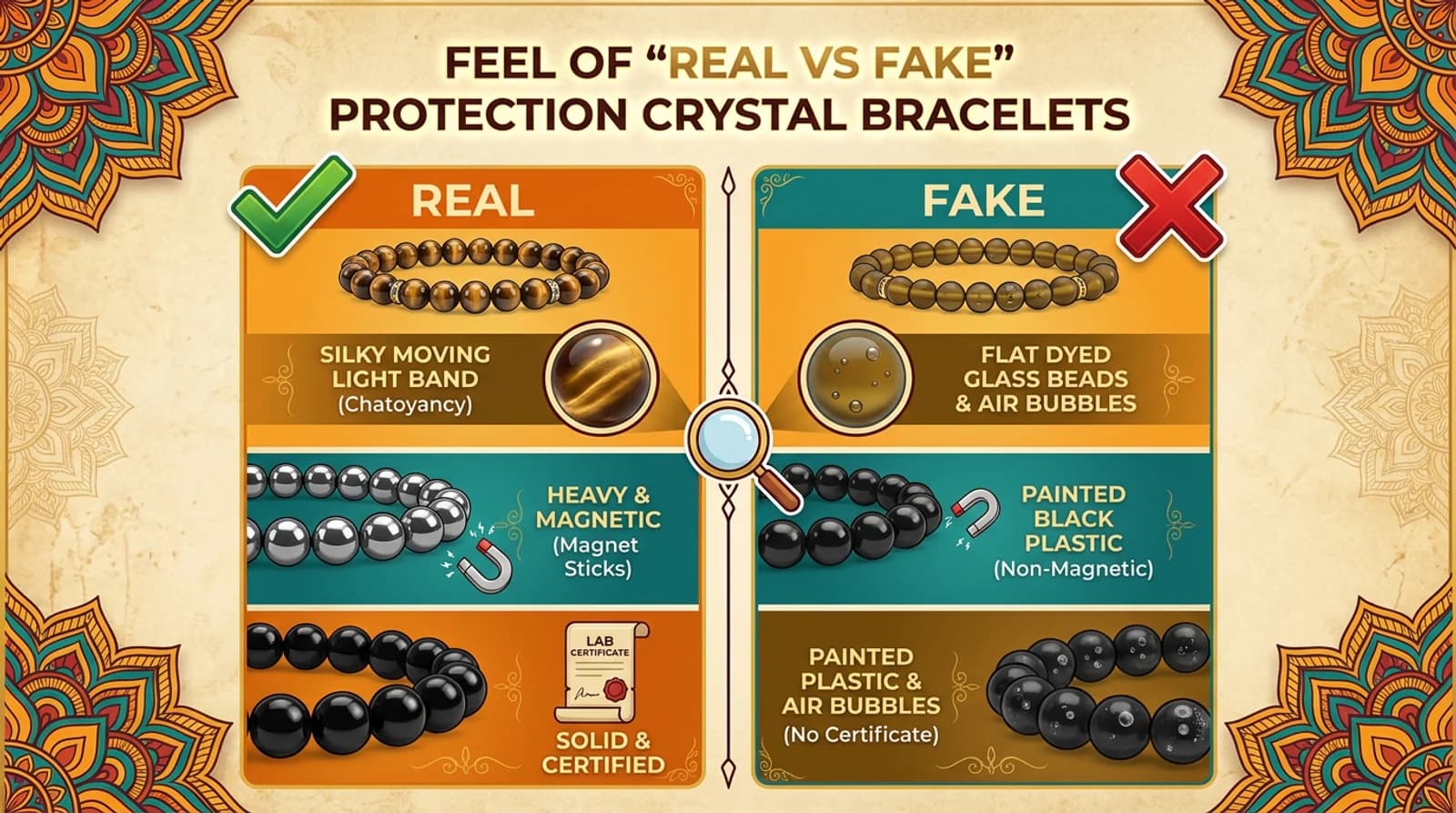
How to tell a real triple protection bracelet from a fake
A real triple protection bracelet combines three genuine stones: tiger eye (golden, shifting chatoyant bands), black tourmaline or black obsidian (the shield stone), and hematite (heavy, metallic-grey, magnetic). Fakes substitute dyed howlite, plastic, or glass. The fastest checks are the magnet test for hematite, the glassy-chip test for obsidian, and looking for tell-tale white veins in dyed stones — but the only definitive proof is a lab certificate.
| Tiger eye (real) | Silky moving light band (chatoyancy) that shifts as you tilt it; warms slowly in hand |
| Tiger eye (fake) | Painted-on 'stripe' that doesn't move; often too uniform and glassy (fibre-optic glass) |
| Black tourmaline (real) | Opaque black with fine lengthwise striations/grooves on the surface |
| Tourmaline (fake) | Dyed howlite or black glass — smooth, sometimes with white vein lines bleeding through |
| Black obsidian (real) | Glass-like, conchoidal (shell-shaped) chips on chipped edges; smooth and cool |
| Hematite (real) | Noticeably heavy for its size, metallic shine, grips a magnet firmly |
| Hematite (fake) | Light, plastic-feel, weak or no magnetic pull |
Honest note: these stones are valued in Vedic and metaphysical tradition for grounding, focus and protection from buri nazar. There is no clinical scientific evidence that any gemstone alters energy; many wearers report calm and confidence consistent with intention-setting and daily ritual. Authenticity here means 'genuine natural stone', not a proven medical effect.
Why fakes flood the triple protection bracelet market
The triple protection bracelet became a bestseller because its meaning is easy to grasp — confidence (tiger eye), shielding (tourmaline/obsidian) and grounding (hematite) on one wrist. That popularity invited shortcuts. Because three different stones must look 'right' together, sellers often colour-match cheap materials so the bracelet photographs well, even when one or more beads are not natural stone.
- 1Dyed howlite stands in for black stones
Howlite is cheap, porous and easily dyed jet-black to imitate black tourmaline or onyx. Tell-tale grey or white vein lines often remain visible.
- 2Glass replaces tiger eye and obsidian
Fibre-optic 'cat's eye' glass mimics tiger eye's shine; plain black glass mimics obsidian. Both lack the natural irregularities of stone.
- 3Resin or hematite-look beads
Light, perfectly uniform 'hematite' beads are often hematine (synthetic) or plastic with a metallic coat that wears off.
- 4No certificate, big claims
The riskiest sign is a listing that promises dramatic results but offers no lab report naming the actual stones.
None of this means every affordable bracelet is fake — it means you should verify rather than trust the photo. The tests below take two minutes; a certificate removes all doubt.
Simple authenticity tests for each stone
You can run these with no special equipment — just a small magnet, good light and your hands. Do them gently, away from water (hematite can rust and tiger eye dislikes soaking).
- 1Hematite — the magnet test
Hold a fridge or hobby magnet near the grey metallic beads. Real hematite is weakly-to-moderately magnetic and tugs noticeably; it also feels surprisingly heavy and cold. A bead that ignores the magnet or feels light is likely hematine or plastic.
- 2Tiger eye — the tilt (chatoyancy) test
Rotate the golden beads under a light. Genuine tiger eye shows a moving silky band of light that slides across the surface like light on satin. A fixed, painted-looking stripe means glass or printed imitation.
- 3Obsidian — the chip & glass test
Natural obsidian is volcanic glass: look at any chipped edge for smooth, curved 'conchoidal' fractures and a deep glassy lustre. Bubbles trapped inside, or a perfectly even surface with mould seams, point to manufactured glass.
- 4Black tourmaline — the striation test
In good light, real tourmaline shows fine parallel grooves running along the bead's length. Dyed howlite is smoother and may reveal faint white/grey veins; rubbing with a cotton pad dampened in acetone can lift dye from a dyed fake (test discreetly).
- 5Overall — temperature & weight
Natural stone feels cool and stays cool briefly when first picked up, and a full beaded bracelet has reassuring heft. Plastic warms instantly and feels too light for its size.
These tests catch most fakes, but they are not foolproof — high-quality glass and well-made imitations can pass a casual look. Treat them as screening, not as a final verdict.
Black tourmaline vs black obsidian: which 'shield' is in your bracelet?
Triple protection bracelets come in two genuine variants, and confusion between them is sometimes mistaken for a 'fake'. Both are authentic shield stones — they simply work differently in tradition. DivineTatva offers both so you can choose, and knowing the difference helps you confirm you received the variant you ordered.
| Aspect | Black Tourmaline variant | Black Obsidian variant |
|---|---|---|
| Tradition / role | Gentle, steady shield — absorbs and grounds negativity | Sharper 'mirror' — reflects negativity and surfaces hidden patterns |
| Often chosen for | EMF / electrosmog, screen-heavy work, everyday buri nazar protection | Deep emotional work, breaking old patterns, strong protection |
| Look | Opaque black, lengthwise striations/grooves | Glass-like, very smooth, deep lustre, conchoidal chips |
| Feel | Stone-textured, matte-to-satin | Glassy and slick, like polished volcanic glass |
| Best for | Beginners and sensitive wearers wanting a softer energy | Those wanting an intense, no-nonsense shield |
Neither is 'better' — tiger eye (confidence/focus) and hematite (grounding/balance) stay constant; only the shield stone changes. If your bracelet's black beads are glassy and smooth, you likely have the obsidian variant; if they're matte with fine grooves, that's tourmaline. Both are correct and genuine.
Why a lab certificate is the only definitive authenticity check
Home tests narrow things down, but they cannot reliably separate top-grade glass from natural stone, or confirm a stone hasn't been heavily treated. A lab certificate can — it identifies each gem material by tested optical and physical properties, so 'tiger eye', 'hematite' and 'black tourmaline/obsidian' are confirmed rather than assumed.
| What a good certificate names | Each stone in the bracelet, by gemmological identity |
| What to look for | An independent or in-house gem lab report, ideally with the order |
| Why it matters | It converts 'looks real' into 'tested real' — your only objective proof |
| DivineTatva standard | Lab-certified stones, Jaipur-made, astrologer-energised (Pran Pratishta) before dispatch |
| Bonus trust signals | Clear stone names on the listing, COD option, real product photos |
This is the single biggest gap in the market: most sellers show pretty photos but provide no verifiable proof. A certificate is what separates an original triple protection bracelet from a lookalike — and it's the reason certified buyers can wear theirs with confidence rather than hope.
Price, COD and seller red flags in India
In India, a genuine certified triple protection bracelet typically sits in a sensible mid-range — not bargain-bin, not luxury. Suspiciously cheap pricing usually means imitation materials, while extreme prices with no certificate are equally a warning.
| Too-cheap pricing | Often dyed howlite, glass or hematine — verify before buying |
| No stone names on listing | Vague 'protection stones' wording hides what you actually get |
| No certificate / no COD | Reputable Indian sellers offer COD and can show authenticity proof |
| Over-promised 'cures' | Honest sellers frame benefits as tradition + belief, not medical results |
| Stock photos only | Ask for real product images of the actual beads and grooves |
A fair price plus a lab certificate, clear stone names, COD and honest framing is the trust stack to look for. Pay a little more for verifiable genuineness rather than gambling on an unverified deal — the certificate is what you're really paying for.
Caring for a real triple protection bracelet (dry cleansing only)
Once you have a genuine bracelet, care matters — partly to keep it beautiful, partly because incorrect advice you'll see elsewhere can damage it. This combo has no pyrite, so it isn't 'destroyed by water' the way pyrite bracelets are, but hematite can rust and tiger eye dislikes prolonged soaking. So skip water and salt-water entirely (a common competitor mistake) and cleanse dry.
- 1Smudge or incense
Pass the bracelet through sage, palo santo or dhoop/incense smoke for 30–60 seconds to cleanse it energetically.
- 2Selenite plate
Rest it on a selenite slab overnight — a dry, gentle way to reset the stones.
- 3Moonlight
Place it on a windowsill under the full or waxing moon to recharge; avoid long harsh sunlight, which can fade tiger eye.
- 4Sound
A singing bowl or bell near the bracelet is an easy, water-free cleanse.
- 5Avoid
No soaking, no salt-water, no shower or swimming. Wipe with a soft dry cloth and store away from moisture to stop hematite rusting.
Cleansing and charging are tradition-and-intention practices, not proven science — but they keep your stones in good condition and many wearers find the small ritual reinforces the bracelet's purpose. Not a substitute for medical or professional advice.
Frequently asked
Last reviewed: 17 May 2026 · Verified by the DivineTatva expert panel
What is the easiest way to check if a triple protection bracelet is real?
Start with the hematite magnet test: real hematite is heavy, cold and grips a small magnet firmly. Then tilt the tiger eye — genuine stone shows a moving silky light band, not a painted stripe. These two checks catch most fakes in under a minute, but a lab certificate naming each stone is the only definitive proof of an original triple protection bracelet.
How can I tell fake tiger eye from real tiger eye?
Rotate the bead under light. Real tiger eye is chatoyant — a silky band of light slides across the surface as you tilt it, like light on satin. Fakes (often fibre-optic glass) show a fixed, uniform 'stripe' that doesn't move, look too perfect, and warm up instantly in the hand. Natural tiger eye stays cool briefly and has subtle colour variation.
Is dyed howlite being sold as black tourmaline?
Yes — howlite is cheap, porous and easily dyed jet-black to imitate black tourmaline or onyx. The give-aways are faint white or grey vein lines bleeding through, a too-smooth surface, and dye that can lift onto an acetone-dampened cotton pad. Real black tourmaline shows fine parallel grooves (striations) along the bead and won't shed colour.
How do I know if it's natural obsidian or just glass?
Natural obsidian is volcanic glass, so look at any chipped edge for smooth, curved 'conchoidal' fractures and a deep glassy lustre. Trapped round air bubbles, perfectly even surfaces, or mould seams indicate manufactured glass. Genuine obsidian feels cool and slick. When in doubt, a lab certificate confirms whether the black beads are obsidian, tourmaline or imitation.
Black tourmaline or black obsidian — which variant should I choose?
Both are genuine shield stones. Black tourmaline is the gentler, grounding choice often picked for EMF/electrosmog and everyday buri nazar protection — good for beginners. Black obsidian is a sharper 'mirror' that reflects negativity and surfaces hidden patterns, suited to deeper emotional work. Tiger eye (confidence) and hematite (grounding) stay the same; only the shield stone changes.
Does a triple protection bracelet really work?
Honestly: benefits come from Vedic and metaphysical tradition and from belief, not from proven science — there is no clinical evidence that gemstones alter energy. Many wearers genuinely report feeling calmer, more grounded and protected from buri nazar, consistent with intention-setting and daily ritual. Wear it as a meaningful support, not a medical cure. It is not a substitute for professional advice.
Why does a lab certificate matter if the home tests pass?
Home tests screen out obvious fakes, but high-quality glass and treated stones can pass a casual look. A lab certificate identifies each material by tested optical and physical properties, so tiger eye, hematite and tourmaline/obsidian are confirmed, not assumed. It's the difference between 'looks real' and 'tested real' — and the single best protection against paying genuine prices for imitation stone.
Reviewed by the DivineTatva expert panel
Written and reviewed by DivineTatva's consulting Vedic astrologer. Every piece is lab-certified and energised in our Jaipur atelier. Last updated 10 April 2026.