Which Hand to Wear a Triple Protection Bracelet — Left or Right? (Indian Tradition Explained)
Wear a Triple Protection Bracelet (Tiger Eye + Black Tourmaline/Black Obsidian + Hematite) on your LEFT wrist to receive and absorb protection, grounding and calm — the most common Indian/Vedic choice. Choose the RIGHT wrist when you want to project confidence and act outward. These are traditional, belief-based conventions, not medical claims.
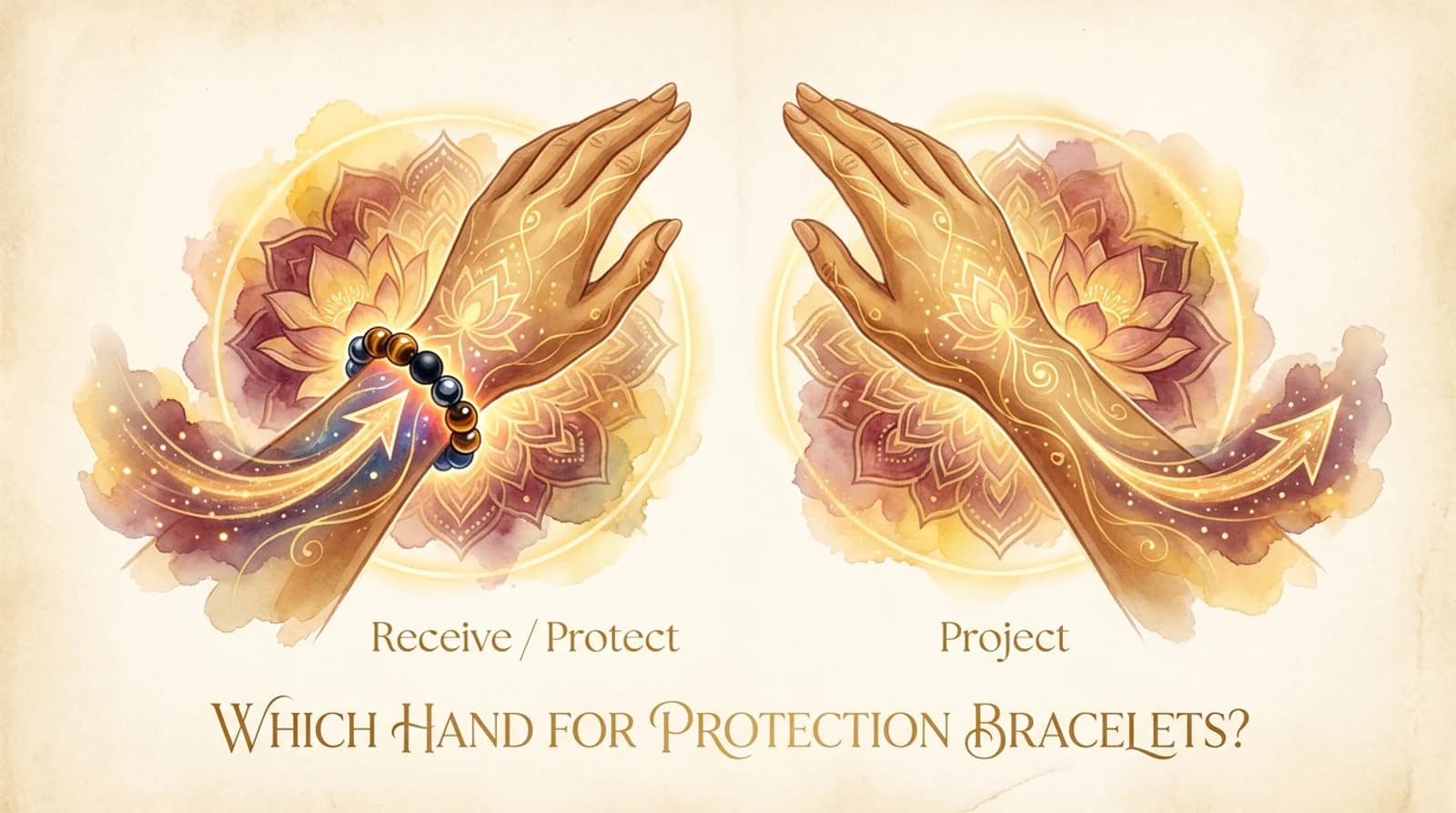
Which Hand Should You Wear It On — Left or Right?
In Indian and Vedic tradition, wear a Triple Protection Bracelet (Tiger Eye + Black Tourmaline or Black Obsidian + Hematite) on your LEFT wrist if your goal is to receive and absorb — protection from buri nazar (evil eye), grounding, calm and emotional balance. Wear it on the RIGHT wrist if you want to project that energy outward — confidence, focus and assertive action. Most wearers choose the left because the trio is primarily a shielding and grounding combo.
| Default choice (protection & grounding) | Left wrist |
| For confidence & projecting outward | Right wrist |
| Most common in India | Left wrist |
| Receiving side in Vedic belief | Left (non-dominant) |
| Giving / acting side | Right (dominant) |
| Can you switch wrists? | Yes — choose by intention |
This is a traditional, belief-based convention — there is no clinical scientific proof that a wrist choice (or the stones themselves) changes your body's energy. Pick the hand that matches your intention and feels comfortable.
Left vs Right Wrist: The Full Comparison
The simplest way to decide is to ask: do you want to TAKE IN energy (protection, calm, grounding) or PUT OUT energy (confidence, drive, presence)? In the Vedic framework the left side is the receiving, intuitive, lunar side and the right side is the giving, active, solar side.
| Factor | Left Wrist | Right Wrist |
|---|---|---|
| Energy direction | Receiving / absorbing | Projecting / giving |
| Best for | Buri nazar shielding, grounding, anxiety, calm | Confidence, focus, leadership, taking action |
| Vedic association | Lunar, intuitive, passive | Solar, active, expressive |
| Tiger Eye effect felt as | Inner stability, settling nerves | Outward courage, drive |
| Hematite effect felt as | Anchoring scattered thoughts | Steady, assertive presence |
| Tourmaline/Obsidian effect | Absorbing negativity coming at you | Holding firm boundaries outward |
| Most popular choice | Yes (default) | Situational |
There is no rule that forbids the right wrist. Students before exams, professionals walking into high-pressure meetings, or anyone who wants to feel more assertive often choose the right. People dealing with stress, crowds, evil eye worry or scattered energy usually choose the left.
Why the Left Wrist Is the Indian/Vedic Default
In Vedic and broader Indian metaphysical thought, the left hand is the receiving channel and the right hand is the giving channel. A protection-and-grounding combo like Tiger Eye, Black Tourmaline/Obsidian and Hematite is mostly about pulling protective, stabilising energy IN and keeping negativity OUT — which maps to the receiving (left) side. That is why most Jaipur astrologers and crystal sellers suggest the left wrist by default.
| Left hand role | Receiving / absorbing energy |
| Right hand role | Giving / projecting energy |
| Why left for this bracelet | It is a shield + grounding trio (you receive protection) |
| Solar Plexus stone | Tiger Eye (confidence, will) |
| Root Chakra stones | Black Tourmaline/Obsidian + Hematite (grounding, safety) |
| Belief status | Traditional convention, not scientific fact |
Remember the trio's purpose: Tiger Eye builds courage and steadies the solar plexus; Black Tourmaline (gentler, EMF/electrosmog focus) or Black Obsidian (a sharper mirror that reflects negativity and surfaces hidden patterns) acts as the shield; Hematite grounds and anchors scattered energy. Worn on the receiving wrist, the wearer is symbolically taking in that protection.
The Dominant-Hand Rule (When Left vs Right Confuses You)
A practical, widely used shortcut: wear the bracelet on your NON-DOMINANT hand. For most people the non-dominant hand is the left, which conveniently aligns with the receiving-side tradition. The non-dominant wrist also moves less, so a beaded bracelet is less likely to knock against desks, keyboards or handlebars — protecting the stones from chips and the hematite from scratches.
- 1Find your non-dominant hand
The hand you do NOT write or eat with. For right-handed people that is the left; for left-handed people it is the right.
- 2Default to non-dominant for protection
This minimises wear-and-tear and matches the 'receiving' idea for grounding and shielding.
- 3Switch to dominant only for projection
If your main goal is confidence, drive or assertiveness, wear it on your dominant (active) hand instead.
- 4Comfort wins ties
If both feel equal, wear it wherever it sits comfortably and you will actually keep it on — consistency matters more than side.
If you wear a watch or other bracelets, you can still stack the Triple Protection Bracelet on the same wrist — just leave a little space so beads do not grind against a metal watch case.
Combining With Kalava (Mauli), Rakhi or a Watch
Many Indian wearers already have a kalava/mauli (the red-and-yellow sacred thread) on one wrist. Traditionally the kalava goes on the RIGHT wrist for men and unmarried girls, and on the LEFT wrist for married women (as tied by a priest during puja). This pairs neatly with the Triple Protection Bracelet, which most people put on the LEFT.
| Kalava (men / unmarried girls) | Right wrist (traditional) |
| Kalava (married women) | Left wrist (traditional) |
| Triple Protection Bracelet (default) | Left wrist |
| Wearing both together | Allowed — different wrists or same wrist |
| Rakhi | Right wrist; bracelet can stay on left |
| Conflict between thread and bracelet? | No — they are believed to work together |
There is no belief-based conflict between a sacred thread and a crystal bracelet; many wear both for layered protection. If the kalava is on your right, putting the bracelet on the left keeps each wrist comfortable and uncluttered. If you prefer everything on one wrist, that is fine too — these are personal and devotional choices, not rigid rules.
How to Wear and Activate It With Intention
- 1Choose your wrist by intention
Left for protection/grounding/calm; right for confidence/projection. When unsure, default to the non-dominant (usually left) wrist.
- 2Cleanse before first wear
Use DRY cleansing only — smudge with incense/sage, rest on a selenite plate, leave in moonlight, or use sound. Never soak this bracelet (hematite can rust; tiger eye dislikes water).
- 3Set a clear intention
Hold it, breathe, and silently state your purpose ('shield me from negativity', 'keep me grounded and confident'). Belief and intention-setting are central to how people experience benefit.
- 4Slide it on the chosen wrist
Wear it snug but not tight. Beads facing skin is a common preference, but there is no strict rule.
- 5Wear consistently
Daily wear keeps it associated with your routine. Re-cleanse weekly or whenever it feels 'heavy', especially after stressful days or crowded places.
- 6Remove for water and heavy work
Take it off before bathing, swimming, gym, dishes or sleeping to protect the hematite from rust and the beads from impact.
DivineTatva bracelets are Jaipur-made and astrologer-energised (Pran Pratishta) before dispatch, with a visible lab certificate so you can verify authenticity. Available in both Black Tourmaline and Black Obsidian variants, for men and women, with COD across India.
An Honest Note: What This Can and Can't Do
The benefits of a Triple Protection Bracelet — and the left-vs-right wrist convention — come from Vedic and metaphysical tradition and from belief. There is NO clinical scientific evidence that gemstones alter your body's energy or that one wrist works better than the other. Many wearers genuinely report feeling calmer, more focused and more protected; this is consistent with the well-documented effects of intention-setting, ritual and the placebo response.
| Evidence basis | Vedic/metaphysical tradition + belief |
| Scientific proof stones alter energy | None |
| Why people still feel benefit | Intention-setting, ritual, calm, placebo |
| Wrong-wrist 'side effects' | None physical; it is a belief choice |
| Medical use | Not a substitute for medical or professional advice |
| Who should be cautious | Anyone using it INSTEAD of needed treatment |
Wear it as a supportive, intention-setting tool — not as medicine. If you are dealing with a health, mental-health or major life issue, please seek qualified professional help. A bracelet is a beautiful daily reminder of your intention; it is not a cure, and no wrist choice changes that.
Frequently asked
Last reviewed: 17 May 2026 · Verified by the DivineTatva expert panel
Which hand should I wear a triple protection bracelet on?
Wear it on your LEFT wrist if you want to receive and absorb protection, grounding and calm — this is the most common Indian/Vedic choice for this shielding trio. Wear it on your RIGHT wrist if you mainly want to project confidence and act outward. When unsure, default to the non-dominant hand (usually the left). It is a belief-based convention, not a medical rule.
Is it bad luck to wear it on the wrong hand?
No. There is no belief that wearing it on the 'wrong' hand causes harm or bad luck, and there is certainly no physical side effect. Left and right simply emphasise different intentions — receiving (left) versus projecting (right). Choose the wrist that matches your goal and feels comfortable. Consistency in wearing it matters far more than which side you pick.
Can men and women wear it on the same hand?
Yes. The left-for-receiving and right-for-projecting logic applies to both men and women. The main gender-linked tradition is the kalava/mauli thread (right wrist for men and unmarried girls, left for married women). The Triple Protection Bracelet itself has no gender rule — most men and women wear it on the left for protection and grounding.
Can I wear tiger eye and hematite together on one wrist?
Yes. Tiger Eye (confidence, focus, solar plexus) and Hematite (grounding, balance, root) are a classic, complementary pairing — that is exactly why they sit together in the Triple Protection trio alongside Black Tourmaline or Black Obsidian. There is no traditional conflict between them. Worn together they are believed to balance courage with steadiness, which is the whole point of the combination.
Should I wear it on my dominant or non-dominant hand?
For protection and grounding, the non-dominant hand (usually the left) is the practical default — it aligns with the 'receiving' tradition and the bracelet gets knocked about less, protecting the hematite from scratches and rust. Switch to your dominant hand only if your primary goal is projecting confidence or assertive action. If both feel equal, comfort and consistency decide it.
Can I wear it with my kalava or rakhi?
Yes, freely. There is no belief-based conflict between a sacred thread and a crystal bracelet; many people wear both for layered protection. Traditionally the kalava sits on the right (men/unmarried girls) or left (married women), so putting the bracelet on the left often keeps each wrist comfortable. You can also stack them on the same wrist if you prefer.
Does the wrist I choose actually make the bracelet work better?
Honestly, there is no scientific evidence that one wrist works better than the other, or that the stones alter your energy at all. The left/right convention comes from Vedic tradition and belief. Many wearers do report feeling calmer or more confident, which is consistent with intention-setting, ritual and the placebo response. Treat it as a supportive intention tool, not a medical treatment.
Reviewed by the DivineTatva expert panel
Written and reviewed by DivineTatva's consulting Vedic astrologer. Every piece is lab-certified and energised in our Jaipur atelier. Last updated 9 April 2026.