Vastu Pyramid: Benefits, Where to Place, Types & How to Use at Home
A Vastu pyramid is a small four-sided pyramid — copper, brass, crystal or resin — placed in a home or office to correct a Vastu dosha (a structural or directional defect) that cannot be physically fixed. Its appeal is entirely practical: you cannot move a toilet out of the north-east or rebuild a south-west kitchen in a rented flat, and the pyramid is the tradition's answer to exactly that constraint. This guide is about what it corrects, where each type goes, and where the claims stop.
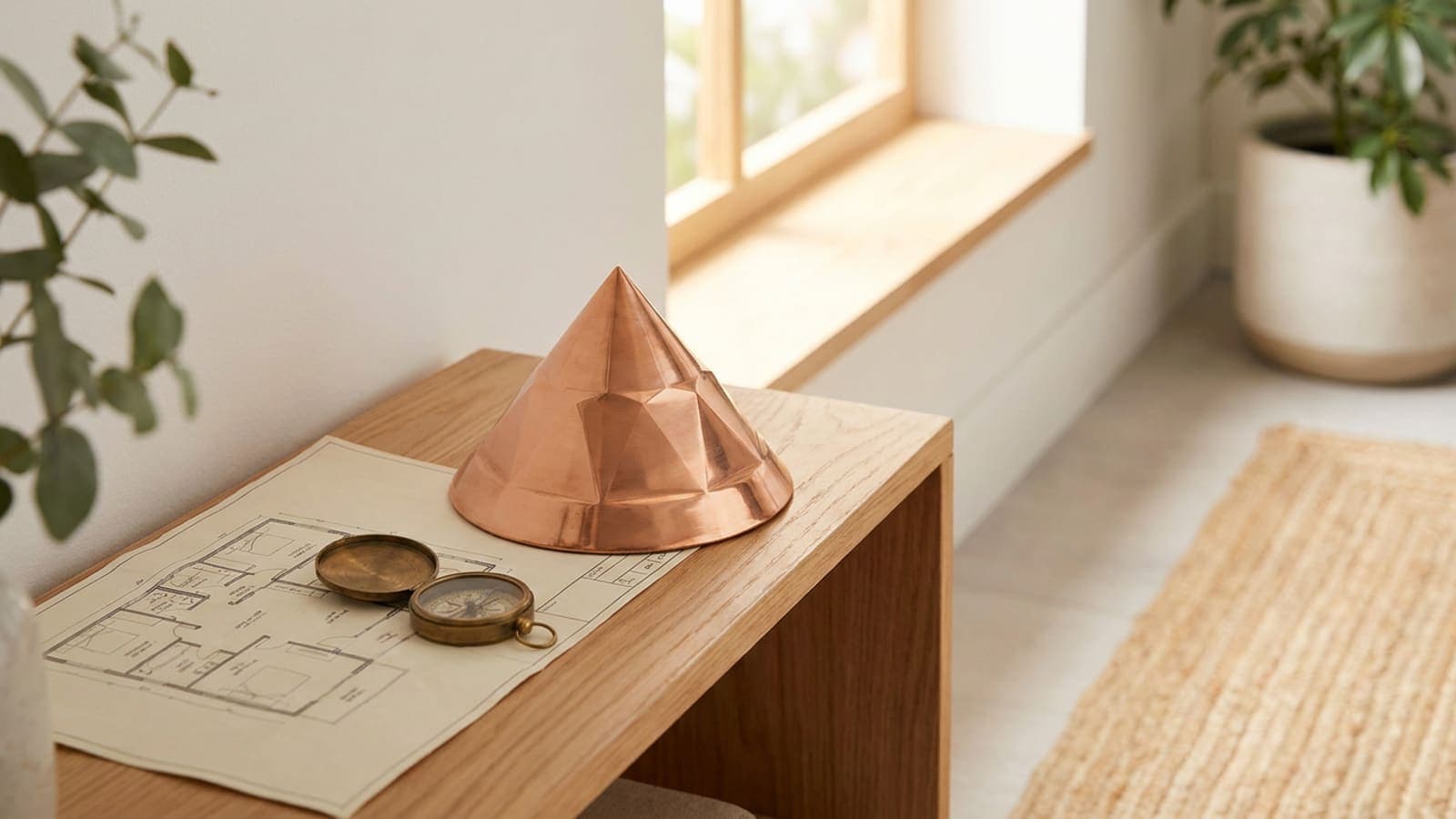
Vastu pyramid — what it is for and where it goes.
A Vastu pyramid is a corrective object, not a decorative one. Vastu Shastra assigns each of the eight directions to a planet and an element, and a defect — a toilet in the north-east, a kitchen in the north, a staircase in the centre — is called a Vastu dosha. Where the defect can be corrected structurally, Vastu says correct it. Where it cannot (rented homes, load-bearing walls, apartment layouts), the pyramid is prescribed as a non-structural remedy placed at the defective zone. The most common single use in Indian homes is the copper pyramid in the north-east for a toilet or storeroom placed there.
| What it is | Four-sided pyramid, square base, in copper / brass / crystal / resin |
| Primary use | Correcting a Vastu dosha that cannot be fixed structurally |
| Most common placement | North-east (Ishaan) — the most defect-sensitive zone |
| Orientation | Base edges aligned to the four cardinal directions, apex up |
| Best day to install | Any Tuesday or Thursday morning; Griha Pravesh muhurat if new home |
| Metal by purpose | Copper = general/health · Brass = wealth · Crystal = clarity/study |
| 9-pyramid set | For multi-zone correction or whole-home installation |
| Honest price band | ₹300–₹1,500 single; ₹1,200–₹4,000 for a 9-pyramid set |
| What it cannot do | Replace structural correction where structural correction is possible |
What a Vastu pyramid actually corrects.
Vastu Shastra maps a building onto a grid called the Vastu Purusha Mandala and assigns each zone a governing element and planet: north-east is water and Jupiter, south-east is fire and Venus, south-west is earth and Rahu, north-west is air and the Moon, and the centre (Brahmasthan) is space and must ideally stay open. A dosha occurs when a room's function contradicts its zone's element — a fire zone used for water storage, a water zone used for a toilet, a heavy structure in the Brahmasthan.
The pyramid's role in this system is geometric. Vastu treats the pyramid form as a stabiliser that concentrates and re-orients the energy of the zone it sits in, so that the defect's effect is reduced rather than the room's function changed. This is why pyramids are placed AT the defect (in or adjacent to the problem room), not in a general 'lucky corner' — a distinction most sellers never explain and most buyers get wrong.
| Zone | Element / planet | Common dosha | Pyramid prescription |
|---|---|---|---|
| North-east (Ishaan) | Water / Jupiter | Toilet, storeroom, heavy furniture, clutter | Copper or crystal pyramid — the most prescribed placement |
| South-east (Agneya) | Fire / Venus | Water tank, borewell, bedroom | Copper pyramid; keep zone bright |
| South-west (Nairitya) | Earth / Rahu | Toilet, kitchen, open/light structure | Brass pyramid — heaviest metal for the heaviest zone |
| North-west (Vayavya) | Air / Moon | Master bedroom, stagnation | Copper or brass pyramid |
| Centre (Brahmasthan) | Space | Staircase, pillar, toilet, heavy weight | Crystal pyramid; keep the area as open as possible |
| North (Kubera) | Water / Mercury | Kitchen, toilet, blocked entry | Brass pyramid — wealth zone |
Types of Vastu pyramid — and which one you actually need.
| Type | Best for | Typical size | Price band | Note |
|---|---|---|---|---|
| Copper pyramid | General correction, health zones, NE/SE | 2–4 inch | ₹350–₹1,200 | The default single-pyramid choice |
| Brass pyramid | Wealth zones (N, SW), heavier corrections | 2–4 inch | ₹400–₹1,500 | Denser; preferred for earth/wealth zones |
| Crystal (clear quartz) | Brahmasthan, study rooms, clarity | 1.5–3 inch | ₹500–₹2,500 | Verify it is real quartz, not glass or resin |
| Amethyst / rose quartz | Bedroom (calm), relationships | 2 inch | ₹600–₹2,000 | Stone-specific rather than Vastu-specific |
| 9-pyramid set | Whole-home or multi-zone correction | Set of 9 small | ₹1,200–₹4,000 | Standard for a full Vastu correction plan |
| Resin / plastic | — | any | ₹80–₹300 | ❌ No standing in Vastu practice; avoid |
The 9-pyramid set is worth understanding rather than defaulting to. It is designed for an astrologer or Vastu consultant's whole-home plan, where each of the eight directions plus the centre gets one unit. If your problem is a single specific defect — the classic north-east toilet — a single correctly-placed copper pyramid is the tradition's prescription, and buying a nine-piece set instead is upselling, not remedy.
Where to place a Vastu pyramid — practical chart.
| Toilet in north-east | Copper pyramid on the floor or a shelf INSIDE or just outside the toilet's NE wall |
| Kitchen in north or north-east | Copper pyramid on the kitchen platform's north-east corner |
| Bedroom in south-east | Copper pyramid on the bedside table nearest the SE corner |
| Staircase in the centre | Crystal pyramid under or beside the lowest step, in the Brahmasthan |
| Main door in a defective direction | Pyramid above the door frame, inside the house, apex up |
| Cash box / almirah | Brass pyramid inside the locker or on top, facing north |
| Study desk | Crystal pyramid on the desk's north-east corner |
| Office / shop cash counter | Brass pyramid on the counter's north side, apex up |
| Rented flat, defect unknown | Single copper pyramid in the north-east of the main living area |
Two placement rules that apply to every case. **Orientation:** the base edges should align to the four cardinal directions and the apex must point up — a pyramid tilted, laid on its side or used as a paperweight is considered inactive. Use a compass (your phone's works) rather than guessing which wall is north. **Height:** place it at or above waist level wherever possible; floor placement is prescribed only for toilet and storeroom corrections.
How to install and activate a Vastu pyramid.
- 1Find the actual direction first
Stand in the centre of the room with a compass and mark the true north-east. Most Vastu mistakes are direction mistakes — people place pyramids in the corner they assume is north-east. Do this before you buy anything.
- 2Clean the zone
The tradition holds that a pyramid cannot correct a zone that is cluttered — clear the defective corner physically first. In practice this step alone does most of the visible work in a home.
- 3Wash and purify the pyramid
Rinse with clean water, then wipe with a cloth dampened in Gangajal or salt water (for metal pyramids only — do not salt-water a crystal pyramid). Dry completely; copper spots if left damp.
- 4Install on Tuesday or Thursday morning
Both days are prescribed for Vastu remedies. If you are moving into a new home, install during the Griha Pravesh muhurat. Light a diya, offer a flower, and state the specific correction you intend — 'this corrects the north-east toilet' rather than a vague wish.
- 5Mantra and maintenance
Om Vastu Purushaya Namah, 21 or 108 times at installation. After that: dust it weekly, re-clean monthly, and re-polish copper when it darkens (tamarind paste or lemon and salt, then dry thoroughly). A blackened, dusty pyramid is treated as dormant in practice.
The five common Vastu pyramid mistakes.
- 1Guessing the direction
By far the most common. A pyramid placed in the wrong corner is not a weaker remedy — in the tradition's own logic it is simply not a remedy at all. Use a compass.
- 2Placing it 'somewhere nice' instead of at the defect
Pyramids go AT the problem zone. A copper pyramid on the living-room mantelpiece does nothing for a north-east toilet three rooms away.
- 3Buying a 9-set for a single defect
The nine-piece set exists for a full-home correction plan. One defect needs one correctly-placed pyramid. This is the most common upsell in the category.
- 4Buying resin or plastic
Vastu prescribes metal (copper, brass) or natural crystal. Painted resin pyramids sold at ₹99 have no standing in the practice — they are decor.
- 5Expecting the pyramid to replace a fixable problem
If the defect CAN be corrected structurally — moving a mirror, unblocking an entrance, clearing the Brahmasthan, relocating a gas stove — Vastu says correct it. The pyramid is for what cannot be moved, not a shortcut around what can.
The honest limits of a Vastu pyramid.
There is no scientific evidence that a small metal pyramid alters the energy of a room, and we will not claim otherwise. What Vastu does contain, underneath the metaphysics, is a body of observed practice about light, air movement, orientation and the use of space — much of which holds up as sensible building sense in the Indian climate. And the ritual has a real, documented effect on the person performing it: clearing a cluttered corner, orienting yourself to your own home with a compass, and stating a specific intention are the kind of small deliberate acts that genuinely change how a space is used and felt.
So: buy a Vastu pyramid as a meaningful corrective ritual for a defect you genuinely cannot fix, and expect the benefit to come from the attention it directs rather than from the metal. Do not buy one instead of fixing a fixable problem, do not buy nine when the tradition prescribes one, and do not let anyone sell you a pyramid as a substitute for a doctor, a lawyer or a plumber.
Vastu pyramid price in India 2026.
| Copper pyramid, 2 inch | ₹350–₹700 |
| Copper pyramid, 3–4 inch | ₹700–₹1,200 |
| Brass pyramid, 3 inch | ₹400–₹1,500 |
| Clear quartz crystal pyramid, 2 inch | ₹500–₹2,500 (verify real quartz) |
| 9-pyramid copper Vastu set | ₹1,200–₹4,000 |
| Resin/plastic (avoid) | ₹80–₹300 |
| DivineTatva brass Vastu pyramid, 3 inch | ₹899 |
| DivineTatva 9-copper-pyramid Vastu set | ₹2,499 |
Buying checks: metal pyramids should feel dense for their size (hollow-cast light ones are usually plated resin), a crystal pyramid should be cool to the touch with natural internal variation rather than perfectly clear with bubbles, and the base should sit flat so it can actually be aligned to the cardinal directions. Anything sold as 'energised' should say by whom and how.
Frequently asked
Last reviewed: 17 May 2026 · Verified by the DivineTatva expert panel
What are the benefits of a Vastu pyramid?
A Vastu pyramid is prescribed to reduce the effect of a Vastu dosha — a structural or directional defect — that cannot be corrected physically, such as a toilet in the north-east or a staircase in the centre of a home. The tradition treats the pyramid form as a stabiliser for the zone it sits in. It is a corrective object for unfixable defects, not a general luck charm.
Where should I place a Vastu pyramid at home?
At the defect, not in a generally 'lucky' corner. North-east toilet → copper pyramid inside or just outside its NE wall. Staircase in the centre → crystal pyramid in the Brahmasthan. Cash box → brass pyramid inside or on top, facing north. Always align the base edges to the cardinal directions with a compass and keep the apex pointing up.
Which direction should a Vastu pyramid face?
The four base edges should align to the four cardinal directions (north, south, east, west) with the apex pointing straight up. Use a compass — guessing the direction is the single most common Vastu pyramid mistake, and a pyramid in the wrong corner is not a weaker remedy but no remedy at all in the tradition's own logic.
Copper, brass or crystal — which Vastu pyramid should I buy?
Copper is the general default, used for health zones and north-east/south-east corrections. Brass is denser and preferred for wealth and earth zones (north, south-west). Clear quartz crystal is used for the Brahmasthan (centre) and study areas. Avoid resin and plastic pyramids — they have no standing in Vastu practice.
Do I need a 9-pyramid Vastu set?
Only for a whole-home or multi-zone correction plan, usually drawn up by a Vastu consultant — one unit for each of the eight directions plus the centre. For a single specific defect like a north-east toilet, the tradition prescribes one correctly-placed pyramid. Selling a nine-piece set for one defect is the most common upsell in this category.
How do I activate a Vastu pyramid?
Clear and clean the defective zone first, rinse the pyramid with clean water and wipe with Gangajal (metal only, never salt-water a crystal), dry fully, then install on a Tuesday or Thursday morning. Light a diya, state the specific correction it is for, and recite Om Vastu Purushaya Namah 21 or 108 times. Dust it weekly and re-polish copper when it darkens.
Does a Vastu pyramid actually work?
There is no scientific evidence that a small metal pyramid alters a room's energy, and we won't claim otherwise. What is real: Vastu contains sensible observed practice about light, air and orientation, and the ritual itself — clearing a cluttered corner, orienting yourself to your home with a compass, stating a specific intention — genuinely changes how a space is used. Buy it as a meaningful corrective ritual, not as a substitute for fixing a fixable problem.
Reviewed by the DivineTatva expert panel
Written and reviewed by DivineTatva's consulting Vedic astrologer. Every piece is lab-certified and energised in our Jaipur atelier. Last updated 23 July 2026.