1 Mukhi Rudraksha: Benefits, Who Should Wear, Real vs Fake & Price
1 mukhi (Ek Mukhi) rudraksha is the single-faced bead — the rarest and most revered rudraksha in classical texts, representing Shiva himself and ruled by the Sun (Surya). It exists in two forms: the round Nepali bead, so rare that almost every one sold online is fake, and the half-moon (ardh-chandrakar) form, which is the authentic, accessible way to wear Ek Mukhi. Knowing the difference is the single most important thing before you buy.
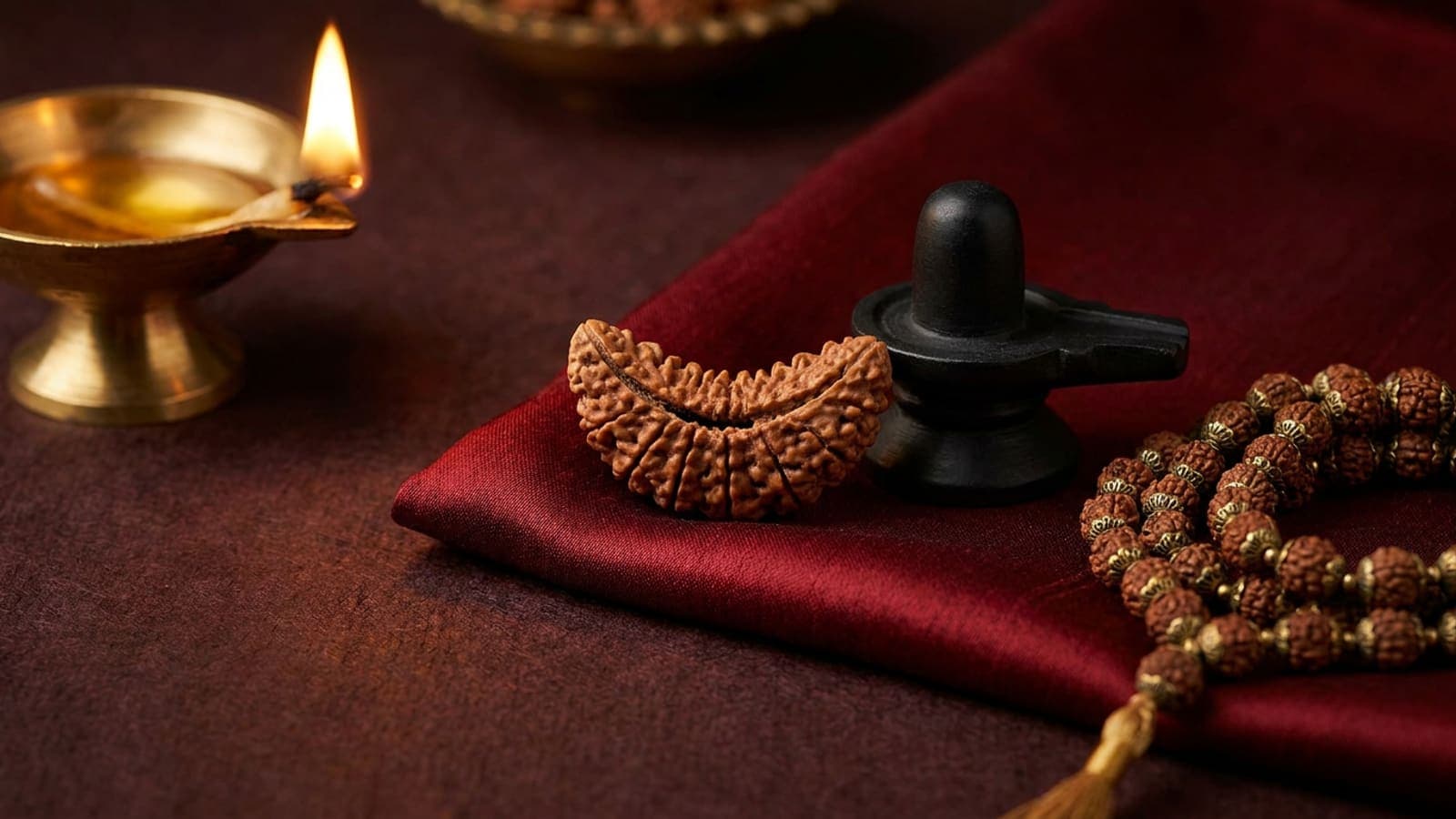
1 mukhi rudraksha — what it is and what the texts actually say.
A 1 mukhi rudraksha is an Elaeocarpus seed with a single natural face (mukhi) — one cleft line running from crown to base. The Shiva Purana ranks it first among all rudraksha: it is described as Shiva himself in seed form, the bead of highest consciousness and moksha (liberation). Its ruling planet is Surya (the Sun) — leadership, willpower, the soul, father, and authority. Because true single-faced formation is a rare botanical event, genuine Ek Mukhi commands both the highest reverence and the highest fraud rate of any rudraksha.
| Ruling deity | Shiva (Ardhanarishvara aspect in some texts) |
| Ruling planet | Surya (Sun) |
| Classical source | Shiva Purana (Vidyeshvara Samhita, ch. 25); Padma Purana |
| Primary prescription | Spiritual focus, leadership, Surya remedies, meditation depth |
| Two forms | Round (Nepal — near-unobtainable) and half-moon (authentic, accessible) |
| Mantra | Om Hreem Namah (108 times); also Om Namah Shivaya |
| Day to wear first | Monday (Somvar) or Sunday (Surya's day), Shukla Paksha |
| Thread | Red or gold thread; gold capping traditional for pendants |
| Honest price range | ₹500–₹3,500 for genuine half-moon; round 'Nepali' listings are almost always fake |
Round vs half-moon 1 mukhi — the fact most sellers hide.
This is the most important section of this guide. The round Nepali 1 mukhi — a spherical bead like a 5 mukhi but with a single face — is so rare that senior rudraksha traders in Nepal report seeing a handful of genuine specimens in a career. Botanically, the Nepali Elaeocarpus ganitrus seed almost always forms multiple compartments; a true single-chamber round bead is a freak event. When one does surface, it trades privately at lakhs of rupees. The round 1 mukhi beads sold online for ₹2,000–₹50,000 with certificates are, with rare exceptions, carved fakes.
The half-moon (ardh-chandrakar, also called kaju-dana for its cashew shape) 1 mukhi is a different, related Elaeocarpus species that genuinely forms a single face in a crescent-shaped seed. Most supply comes through South India (the Rameshwaram tradition) and Himalayan trade routes. It is accepted as authentic Ek Mukhi in mainstream practice — the Shiva Purana describes the bead by its single face, not its roundness. This is the form DivineTatva sells, and the form every honest dealer recommends.
| Parameter | Round (Nepal) | Half-Moon (Ardh-Chandrakar) | Carved Fake |
|---|---|---|---|
| Genuine availability | Near zero — a few per decade | Readily available | Flooding every marketplace |
| Honest price | Lakhs, private sale | ₹500–₹3,500 | ₹300–₹50,000 (sold as round Nepali) |
| Single natural face | Yes (freak formation) | Yes (natural to the species) | Face carved into a 2-5 mukhi or bhadraksh |
| Scriptural validity | Highest per texts | Accepted — face count is what texts specify | None |
| X-ray result | Single seed chamber | Single seed chamber | Multiple chambers behind carved face |
| Common tells | — | Crescent shape, one clean cleft | Carved Om/snake/trishul motifs, too-perfect line |
1 mukhi rudraksha benefits — what the Shiva Purana prescribes.
The Vidyeshvara Samhita of the Shiva Purana states that the single-faced rudraksha is 'Shiva in visible form' and that its wearer attains both bhoga (worldly attainment) and moksha (liberation). The benefits attributed across classical and traditional sources:
- 1Meditation depth and single-pointed focus
The bead's core function in every text is ekagrata — one-pointedness. It is prescribed for serious meditators, japa practitioners and anyone whose sadhana suffers from a scattered mind. The single face is read as the symbol of undivided consciousness.
- 2Surya strengthening — leadership and confidence
As the Sun's bead, Ek Mukhi is prescribed for weak or afflicted Surya in the natal chart: low confidence, poor relations with father or authority figures, lack of recognition at work despite effort. Sun-domain careers — government, administration, leadership roles — are its traditional territory.
- 3Moksha and spiritual acceleration
The Shiva Purana's headline claim: the wearer is released from accumulated karma and progresses toward liberation. This is a spiritual claim, not a measurable one — we state it as the texts state it, without embellishment.
- 4Mental clarity in high-responsibility roles
The traditional wearer profile is the ruler, the ascetic and the head of an institution — people who must decide alone. Modern parallels: founders, senior managers, judges, single decision-makers under pressure.
- 5Traditional health associations of the Sun
Classical sources link Surya to the heart, eyes, bones and vitality, and prescribe Ek Mukhi as a supportive remedy in these domains. This is tradition, not medicine — a rudraksha supports ritual and intention, and is never a substitute for medical treatment.
Who should wear 1 mukhi — and the detachment question answered honestly.
Unlike planetary gemstones, rudraksha has no lagna restriction in classical texts — anyone may wear any mukhi. The practical prescriptions for Ek Mukhi: Simha (Leo) lagna and those with weak natal Sun; people in Surya Mahadasha; serious meditation practitioners; and those in solitary leadership positions. It is worn by men and women equally; the texts make no gender distinction.
The detachment question: a widespread folk belief holds that 1 mukhi makes the wearer renounce family — that householders should avoid it. The classical texts do not say this. The belief likely grew from the bead's association with ascetics and moksha. What practitioners actually report is increased inward focus, which a householder can direct at work and sadhana rather than away from family. Our astrologer panel's position: householders may wear Ek Mukhi; those who find its focus too isolating can pair it with a 2 mukhi (the harmony bead) or shift it from daily wear to meditation-only use.
How to wear 1 mukhi rudraksha — day, mantra and rules.
- 1Choose pendant over bracelet
Ek Mukhi is traditionally worn as a single-bead pendant at the throat or heart, in gold capping or on red thread — not strung in a bracelet where it knocks against other beads. The half-moon shape also sits naturally as a pendant.
- 2First wearing: Monday or Sunday morning, Shukla Paksha
Monday for the Shiva association, Sunday for the Surya association — both are prescribed; choose by your primary purpose (spiritual = Monday, Sun-remedy = Sunday). Waxing fortnight preferred.
- 3Purify and energise
The night before, rest the bead in raw cow's milk for a few hours, then wash with clean water and Gangajal if available. Morning: apply a drop of sandalwood paste, light a diya, and hold the bead in joined palms facing east.
- 4Recite Om Hreem Namah 108 times
This is the specific Ek Mukhi beej mantra given in the Shiva Purana. Om Namah Shivaya is the universal alternative. Repeat the mantra 9 or 108 times whenever re-wearing after removal.
- 5Care rules
Remove before bathing (soap dulls the surface and weakens thread), before sleep if the pendant is on a fragile thread, and during periods of ritual impurity per your family tradition. Oil the bead lightly with coconut or mustard oil once a month to prevent cracking — rudraksha is a seed and dries out.
Real vs fake 1 mukhi — the tests that actually work.
1 mukhi is the most-faked rudraksha in the world. The standard frauds: (1) a 2 or 3 mukhi bead with extra faces sanded off and one line deepened; (2) bhadraksh (a lookalike seed with no ritual standing) carved with a face; (3) beads with Om, trishul, snake or Shivling motifs carved on — no rudraksha grows symbols, ever; (4) 'round Nepali 1 mukhi' with impressive-looking certificates from labs no one can verify.
- 1Reject any bead with carved symbols
A snake, Om, trishul or lingam on the bead is a guaranteed carving. This single rule eliminates the majority of fakes on Indian marketplaces.
- 2Count the internal chambers — X-ray test
The number of faces equals the number of internal seed chambers. A genuine 1 mukhi shows exactly one chamber under X-ray. A carved 3 mukhi shows three chambers behind its single 'face.' This is the definitive test — DivineTatva X-rays every Ek Mukhi and ships the plate with the bead.
- 3Inspect the cleft under a loupe
A natural mukhi line is a deep, slightly irregular cleft that runs continuously from crown to base, with natural grain flowing around it. A carved line is uniform in depth, often V-shaped from a rotary tool, and cuts across the grain.
- 4Be realistic about round Nepali claims
If a seller offers a round Nepali 1 mukhi for ₹5,000, ₹25,000 or even ₹80,000 — the price itself is the tell. Genuine specimens are essentially not in open retail. The honest market is half-moon.
- 5Water test is NOT reliable here
The popular sink-in-water test only rules out light plastic fakes. Carved real-rudraksha fakes and bhadraksh both sink. Do not rely on it for Ek Mukhi.
1 mukhi rudraksha price in India 2026 — the honest numbers.
| Half-moon 1 mukhi, X-ray certified | ₹800–₹2,500 |
| Half-moon 1 mukhi, gold-capped pendant | ₹2,500–₹6,000 |
| DivineTatva half-moon Ek Mukhi (X-ray certified, energised) | ₹1,499 |
| 'Round Nepali 1 mukhi' online listings | ₹2,000–₹80,000 — treat as fake by default |
| Genuine round Nepali (private/collector trade) | Several lakhs; effectively not retail |
| Carved-symbol beads (any price) | ₹0 ritual value — do not buy |
The honest summary: a genuine, wearable, scripturally valid Ek Mukhi costs ₹800–₹2,500 in half-moon form with an X-ray certificate. Anything positioned as a round Nepali bead at consumer prices is a near-certain fake, regardless of the certificate shown — fraudulent labs exist precisely to serve this trade. Pay for the X-ray plate, not the story.
Frequently asked
Last reviewed: 17 May 2026 · Verified by the DivineTatva expert panel
What are the main 1 mukhi rudraksha benefits?
Per the Shiva Purana (Vidyeshvara Samhita), 1 mukhi represents Shiva himself and grants both worldly attainment and liberation. Practically it is prescribed for meditation depth and single-pointed focus, Surya (Sun) strengthening — confidence, leadership, father relations — and for people in solitary decision-making roles. It is the highest-ranked bead in classical rudraksha texts.
Can married people and women wear 1 mukhi rudraksha?
Yes to both. Classical texts place no gender or householder restriction on any rudraksha. The folk belief that Ek Mukhi causes family detachment does not appear in the Shiva Purana — it grew from the bead's association with ascetics. Householders who find its inward focus too strong can wear it only during meditation or pair it with a 2 mukhi.
Is round 1 mukhi rudraksha from Nepal real?
Genuine round Nepali 1 mukhi exists but is a freak botanical event — a handful of specimens per decade, trading privately at lakhs of rupees. Virtually every round 1 mukhi sold online at consumer prices (₹2,000–₹80,000) is a carved fake or bhadraksh. The authentic accessible form is the half-moon (ardh-chandrakar) 1 mukhi at ₹800–₹2,500.
How to check if 1 mukhi rudraksha is original?
Three tests: (1) Reject any bead with carved symbols — Om, snake, trishul, lingam; rudraksha never grows symbols. (2) X-ray — a genuine 1 mukhi has exactly one internal seed chamber; carved fakes show multiple chambers. (3) Loupe — a natural cleft is irregular and grain flows around it; a carved line is uniform and cuts across the grain. The water sink test is NOT reliable for 1 mukhi.
What is the mantra and day for wearing 1 mukhi rudraksha?
Mantra: Om Hreem Namah, 108 repetitions — the beej mantra given in the Shiva Purana. Om Namah Shivaya also works. First wearing: Monday (Shiva) or Sunday (Surya) morning during Shukla Paksha, after purifying the bead in milk and water and applying sandalwood paste. Wear as a pendant on red thread or in gold capping.
What is 1 mukhi rudraksha price in India?
Genuine half-moon 1 mukhi with X-ray certificate: ₹800–₹2,500 (₹2,500–₹6,000 gold-capped). DivineTatva's X-ray certified, energised half-moon Ek Mukhi is ₹1,499. Round 'Nepali' listings at any consumer price should be treated as fake by default — genuine round specimens trade privately at several lakhs.
Reviewed by the DivineTatva expert panel
Written and reviewed by DivineTatva's consulting Vedic astrologer. Every piece is lab-certified and energised in our Jaipur atelier. Last updated 6 July 2026.