Rudraksha Mala Benefits, How to Do Jaap & Real vs Fake: Complete Guide
A Rudraksha Mala is a 108-bead sacred garland of Elaeocarpus ganitrus seeds, revered in Shaivite tradition as the tears of Shiva. Panchmukhi (5-faced) beads are universally auspicious, worn during jaap to count mantras and — per Vedic scripture — to calm the mind, sharpen focus, and invite Shiva's grace.
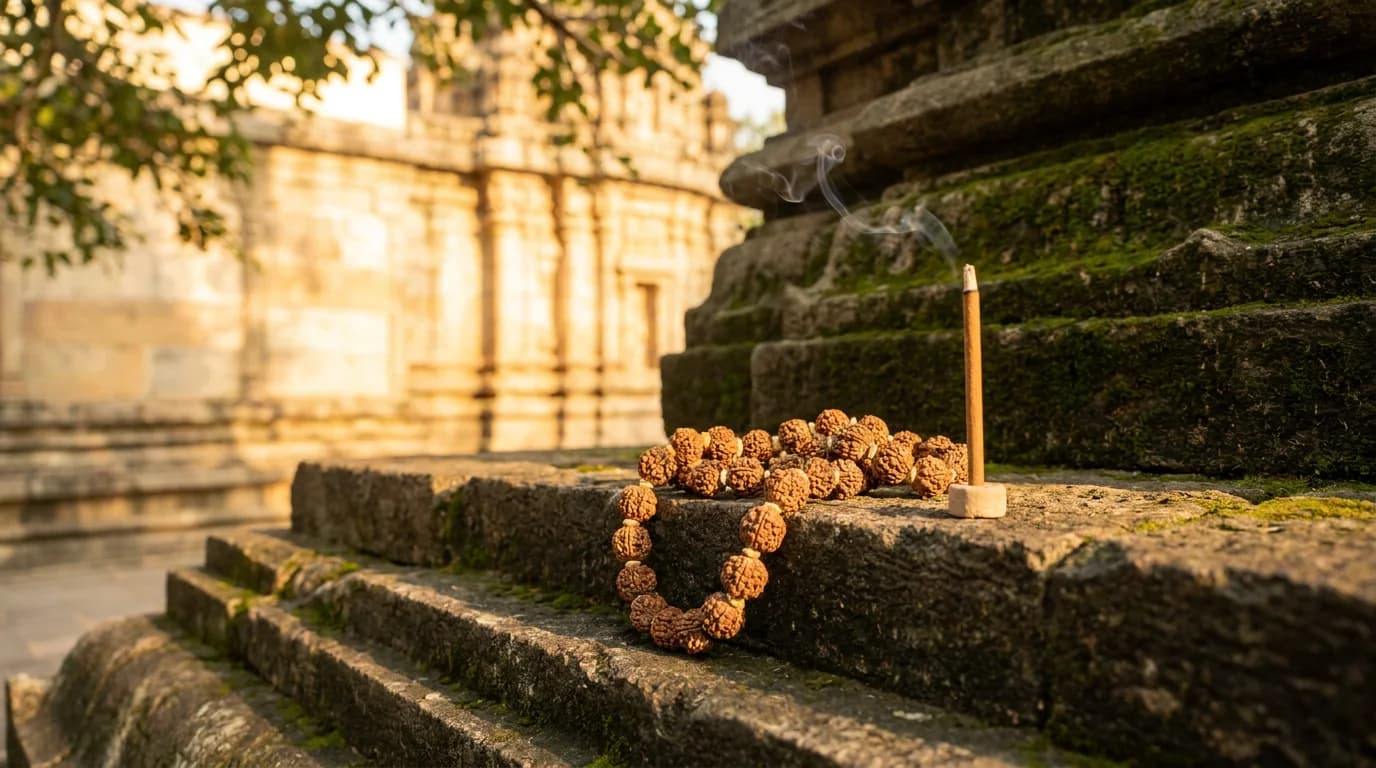
- What Is a Rudraksha Mala?
- Panchmukhi vs Other Mukhi Types
- Siddha Energisation & Pran Pratishta
- Benefits of Rudraksha Mala
- How to Do Jaap
- The Sumeru Bead Explained
- Who Should Wear Rudraksha?
- Real vs Fake Rudraksha Tests
- Care & Oiling Ritual
- Rules & Restrictions
- Rudraksha Mala Price Guide
- The DivineTatva Difference
What Is a Rudraksha Mala?
A Rudraksha Mala is a string of 108 dried seeds from the Elaeocarpus ganitrus tree, native to the Himalayan foothills of Nepal and Uttarakhand, plus one larger Sumeru (or Bindu) bead at the head. Sacred to Lord Shiva and widely used across Shaivite, Shakta, and Vedantic traditions, it serves as a counting tool during mantra recitation (jaap) and — per the Shiva Purana — as a vessel of divine protection and grace.
The word 'Rudraksha' combines 'Rudra' (a name of Shiva) and 'aksha' (eye or tear). Vedic texts describe the seeds as crystallised tears Shiva shed during deep meditation, each bead carrying a specific vibrational quality depending on the number of natural clefts (mukhis) running from top to base. A mala strung on silk or gold wire with 108 beads corresponds to the 108 Upanishads, the 108 names of major deities, and the approximate number of nadis (energy channels) believed to converge at the heart chakra.
| Botanical name | Elaeocarpus ganitrus |
| Primary origin | Nepal (Himalayan foothills), Uttarakhand (India) |
| Bead count | 108 beads + 1 Sumeru/Bindu bead |
| Standard string | Silk or gold-coated wire |
| Governing deity | Lord Shiva (Rudra) |
| Scriptural source | Shiva Purana, Devi Bhagavata Purana, Padma Purana |
| Primary use | Mantra jaap (counting), meditation, daily wear |
Panchmukhi vs Other Mukhi Types: Which One Is for You?
The 'mukhi' refers to the natural cleft lines (faces) on the surface of the seed. Each mukhi count is associated with a specific deity, planet, and quality per Vedic tradition. Panchmukhi (5-faced) is the most common and universally recommended — it corresponds to the Panchabrahma, the five aspects of Shiva (Sadyojata, Vamadeva, Aghora, Tatpurusha, Ishana), and is considered suitable for all people regardless of rashi, gender, or lifestyle.
| Mukhi | Deity / Planet | Best For | Availability |
|---|---|---|---|
| 1 Mukhi (Ek Mukhi) | Shiva / Sun | Liberation, supreme consciousness | Extremely rare — ₹10,000+ |
| 2 Mukhi (Dwimukhi) | Ardhanarishvara / Moon | Relationships, emotional balance | Rare, moderate price |
| 3 Mukhi (Trimukhi) | Agni / Mars | Self-confidence, past-karma release | Common |
| 4 Mukhi (Chaturmukhi) | Brahma / Mercury | Creativity, intellect, speech | Common |
| 5 Mukhi (Panchmukhi) | Panchabrahma / Jupiter | Universal — calm, focus, grace | Most common; all malas |
| 6 Mukhi (Shanmukhi) | Kartikeya / Venus | Willpower, material success | Common |
| 7 Mukhi (Saptamukhi) | Mahalakshmi / Saturn | Wealth, health, remove obstacles | Common |
| 8 Mukhi (Ashtamukhi) | Ganesha / Rahu | Remove obstacles, success | Moderate |
| 9 Mukhi (Navamukhi) | Durga / Ketu | Fearlessness, energy, Shakti | Moderate |
| 10 Mukhi (Dashmukhi) | Vishnu / No planet | Protection, overall wellbeing | Moderate |
| 11 Mukhi (Ekadash) | Hanuman / All planets | Adventure, wisdom, courage | Moderate to rare |
| 12 Mukhi (Dwadash) | Surya (Sun god) | Leadership, vitality, authority | Rare |
| 13 Mukhi (Trayodash) | Indra / Venus | Desire fulfilment, charisma | Rare |
| 14 Mukhi (Chaturdash) | Deva Mani / Saturn | Intuition, protection, moksha | Very rare |
A standard 108-bead mala uses Panchmukhi beads throughout because they are auspicious for everyone and the most accessible genuine Nepali rudraksha. Combination malas (mixing 5-mukhi with select 6 or 7 mukhi at intervals) are also available but carry a higher price.
Siddha Energisation: What Pran Pratishta Means vs an Ordinary Mala
An ordinary Rudraksha Mala is simply strung beads — genuine Elaeocarpus ganitrus seeds, correctly counted and threaded. A Siddha Mala has undergone Pran Pratishta, a Sanskrit term meaning 'establishment of life force'. This is a ritual ceremony in which a trained priest or practitioner performs specific steps to sanctify and energetically consecrate the mala.
- 1Cleansing (Shodhana)
The mala is cleaned with Ganga jal (or pure water) and dried in morning sunlight.
- 2Invocation (Avahan)
The deity — in this case Lord Shiva / Rudra — is invoked with specific Vedic mantras.
- 3Mantra infusion
A minimum of 108 recitations of Aum Namah Shivaya are performed over the mala, one per bead.
- 4Prana Pratishtapana
The priest 'breathes' life into the mala through a final mudra and sankalpa (intention).
- 5Dakshina and sealing
The mala is wrapped in red or yellow cloth to preserve the energisation until it reaches the recipient.
DivineTatva's Siddha Mala undergoes all five steps before dispatch. The energisation does not change the physical bead but — per Vedic tradition — aligns it to the specific vibrational signature of the mantra. Whether you accept the metaphysical claim or not, the ritual is an ancient and meaningful act of intention that many practitioners find adds depth to their sadhana.
| Ordinary mala | Genuine beads, strung — no ceremony performed |
| Siddha mala | Genuine beads + full Pran Pratishta ceremony with 108 mantra recitations |
| DivineTatva standard | Siddha energisation included at no extra cost |
| Certificate | Lab certificate confirming Elaeocarpus ganitrus genus provided |
Benefits of Wearing a Rudraksha Mala
The Shiva Purana and Devi Bhagavata Purana list extensive benefits of Rudraksha — from mental calm and fearlessness to protection from negative energies and acceleration of spiritual progress. These are Vedic traditional claims, not medically proven outcomes. Some preliminary studies suggest rudraksha beads generate a mild bioelectric field; however, no peer-reviewed clinical trials have confirmed health benefits. What many practitioners consistently report is a sense of calm, focus, and groundedness during mantra practice — which is consistent with the effects of regular meditation and japa regardless of the bead material.
| Mental calm | Per Shiva Purana: Panchmukhi rudraksha pacifies an agitated mind; consistent with japa meditation practice |
| Improved focus | Wearing during study or work — user-reported; aligns with mindfulness effect of daily sadhana |
| Stress reduction | Vedic texts prescribe rudraksha for 'chinta' (anxiety); users report tangible reduction with regular jaap |
| Shiva's grace | Per Vedic tradition: continuous wearing keeps the devotee under Shiva's protection |
| Spiritual acceleration | Devi Bhagavata: one who wears rudraksha while reciting mantra gains merit equivalent to deep tapasya |
| Energy balance | Preliminary studies note rudraksha may interact with skin's bioelectric field — not clinically proven |
| DISCLAIMER | Not a substitute for medical or psychological advice. Vedic tradition and user reports, not clinical evidence. |
How to Do Rudraksha Mala Jaap: Step-by-Step
Jaap (or japa) is the meditative repetition of a mantra, one recitation per bead. The mala serves as a counting tool so the mind stays on the mantra rather than on numbers. Here is the traditional method for Panchmukhi Rudraksha Mala jaap.
- 1Choose your time
Brahma muhurta (4–6 am) is considered most potent; evening sandhya (dusk) is second-best. Consistency matters more than perfection — a fixed daily time anchors the practice.
- 2Purify and prepare
Wash hands and face. Sit on a clean asana (woollen or cotton mat) facing north or east. Keep the space quiet and free of distractions.
- 3Hold the mala correctly
Hold in your right hand. Drape over the middle finger. Use your thumb to move each bead toward you. Do NOT use your index finger — in Vedic tradition, the index finger (tarjani) represents the ego and is excluded from jaap.
- 4Find the starting bead
Begin at the bead immediately adjacent to the Sumeru (the large head bead). This is bead number 1.
- 5Recite one mantra per bead
Recite 'Aum Namah Shivaya' (the Panchakshara mantra) — silently or in a low murmur — as you move each bead. One recitation = one bead moved.
- 6Reach the Sumeru — reverse, do not cross
When you reach the Sumeru bead after 108 counts, do NOT cross over it. This is considered inauspicious in Shaivite tradition. Instead, reverse direction and begin the second round going back toward bead 1.
- 7Complete your rounds
Minimum: 1 mala (108 beads) per session. For deeper sadhana: 3, 7, or 11 malas. Keep a count of malas if doing multiple rounds.
- 8Close the session
After jaap, hold the mala to your forehead (third eye) for a moment of gratitude. Store in its red or yellow pouch.
| Primary mantra (Panchmukhi) | Aum Namah Shivaya (Panchakshara) |
| Alternative mantras | Mahamrityunjaya, Aum Namo Bhagavate Rudraya, your Guru-diksha mantra |
| Minimum jaap per day | 1 mala = 108 recitations |
| Deep sadhana | 3, 7, or 11 malas per session |
| Index finger | Never used — represents ego; use middle finger + thumb |
| Sumeru rule | Never cross — always reverse direction at the Sumeru bead |
| Mala storage after jaap | Touch to forehead, then store in pouch — never left on floor |
The Sumeru Bead: What It Is and Why You Never Cross It
The Sumeru (also called Bindu or Meru) is the single large bead at the head of a Rudraksha Mala, making the total count 109 rather than 108. It is not counted in jaap. It serves as the marker that tells you one complete round of 108 is done — and as a symbolic representation of Mount Meru, the cosmic axis of the universe in Hindu cosmology.
Per Vedic tradition, the Sumeru is the 'guru bead' — it represents the guru or the divine itself. Crossing over it during jaap is said to transmit the energy accumulated during the round back outward rather than completing the circuit. The practical instruction: when your thumb reaches the Sumeru, pause, reverse direction, and begin the next round. This keeps the mala's energy loop intact and also serves as a mindful pause between rounds.
| Total beads | 108 + 1 Sumeru = 109 beads on the mala |
| Sumeru counted in jaap? | No — it is the start/stop marker only |
| Symbolism | Mount Meru (cosmic axis); Guru principle |
| What to do at Sumeru | Pause, touch to forehead briefly, reverse direction |
| Why not cross? | Vedic tradition: crossing breaks the energy circuit of the round |
Who Should Wear a Rudraksha Mala? Rashi & Lifestyle Notes
Panchmukhi Rudraksha is the great equaliser of the mukhi family — it is universally recommended for all people. Per the Shiva Purana, the 5-faced rudraksha is under the governance of Shiva himself in the form of Kalagni Rudra and the Panchabrahma, and carries no exclusions for gender, age, rashi, or profession.
| Mukhi | Governing Planet | Best Rashi | Profession / Type |
|---|---|---|---|
| 5 Mukhi (Panchmukhi) | Jupiter (Brihaspati) | All rashis — universal | Students, meditators, everyone |
| 6 Mukhi | Venus (Shukra) | Taurus, Libra | Artists, businesspeople |
| 7 Mukhi | Saturn (Shani) | Capricorn, Aquarius | Those facing financial blocks |
| 8 Mukhi | Rahu | Virgo, Gemini | Those facing obstacles |
| 9 Mukhi | Ketu | Scorpio, Pisces | Spiritual seekers, Shakti sadhana |
| 12 Mukhi | Sun (Surya) | Leo | Leaders, government workers |
| 14 Mukhi | Saturn (Shani) | Capricorn, Aquarius | Intuitive seekers, protection |
Age: children from age 5 can wear Panchmukhi under parental supervision. Elderly wearers are actively encouraged by Vedic tradition. Pregnancy: many Ayurvedic and Vedic texts recommend rudraksha for expectant mothers to maintain calm — consult your traditional healer or Ayurvedic physician. Profession: there is no occupational restriction; doctors, lawyers, non-vegetarians, and people of all faiths have worn Panchmukhi rudraksha without scriptural objection.
Real vs Fake Rudraksha: Four Tests You Can Do at Home + One Lab Test
The rudraksha market in India is flooded with wood beads, plastic imitations, and carved fakes. Here are the five tests in order of reliability — do all five for confidence, not just one.
- 1Float test (basic filter only)
Drop the bead in water. Genuine Nepali rudraksha is dense and sinks; clear plastic or light wood fakes float. IMPORTANT caveat: some genuine rudraksha with a hollow or cracked centre also floats. This test filters out the most obvious fakes but is not conclusive on its own.
- 2Needle test (natural hole check)
Insert a needle through the natural hole. Genuine rudraksha has an organically formed channel with irregular sides you can feel. Fake beads drilled through wood or plastic have a smooth, uniform bore that the needle slides through without any texture.
- 3Mukhi clarity test (magnification)
Examine the faces (clefts) under a 10x magnifier. Genuine mukhis run naturally from the top (crown) to the bottom (base) of the bead with organic irregularity. Carved fakes show straight cut marks, consistent depth, and unnaturally neat lines.
- 4Weight and texture test
Genuine Nepali Panchmukhi rudraksha is hard, dense, and slightly rough to the touch, with a natural woody scent. Plastic fakes feel light and smooth; dyed wood feels lighter and may smell of paint or varnish.
- 5X-ray / lab certificate (definitive)
Only a laboratory test can confirm the species is Elaeocarpus ganitrus. An X-ray shows the internal seed chamber structure — genuine rudraksha has a compartmentalised interior matching the mukhi count. DivineTatva provides a lab certificate with every mala confirming species and mukhi count.
| Type | Origin | Grade | Price Range | Lab Cert? |
|---|---|---|---|---|
| Genuine Nepali Rudraksha | Nepal Himalayan foothills | Premium — larger, well-defined mukhis | ₹700–₹50,000+ per mala | Yes (DivineTatva) |
| Genuine Indonesian Rudraksha | Java, Indonesia | Standard — smaller (4–6mm), genuine but lesser grade | ₹200–₹700 per mala | Rarely |
| Thai Rudraksha | Thailand | Lower grade, often 5–6mm | ₹150–₹500 per mala | No |
| Wood bead fake | Various | Not rudraksha — carved Berberis or similar wood | ₹50–₹300 per mala | No |
| Plastic/resin fake | Factory-made | Not rudraksha — moulded with artificial mukhis | ₹50–₹200 per mala | No |
Care & Oiling: How to Keep Your Rudraksha Mala Alive for Decades
Rudraksha seeds are organic — they can dry out, crack, and lose lustre without basic care. The oiling ritual is both practical (prevents desiccation) and spiritually meaningful (a moment of intentional attention to your practice).
Care note (verbatim from DivineTatva): "Apply one drop of pure til (sesame) or almond oil to the mala beads once a week — rub gently between palms to distribute. Remove before bathing, swimming, or sleeping (unless spiritually instructed to wear continuously). Do not use soap, detergent, or chemical cleaners. Store in the red or yellow cloth pouch provided when not in use. Recite Aum Namah Shivaya during oiling for energetic renewal."
- 1Weekly oiling
One drop of pure til (sesame) or sweet almond oil. Place on your palm, lay the mala across it, close palms together and rub gently in a circular motion for 30 seconds. Every bead should be lightly coated.
- 2Remove before water exposure
Remove before bathing, swimming, or any prolonged water contact. Salt water and chlorinated water are especially damaging to the seed and string.
- 3No chemical cleaners
Never use soap, detergent, sanitiser, or perfume directly on the beads. Chemicals break down the organic surface and can degrade the string.
- 4Storage
Store in the red or yellow cotton/silk pouch provided. Keep off the floor — place on a clean shelf, altar, or in a wooden box.
- 5String inspection
Check the string every 6–12 months. If you see fraying, discolouration, or beads moving loosely, have it re-strung by a specialist. Broken strings are common after 2–3 years without maintenance.
Rudraksha Rules & Restrictions: What's Universal vs Lineage-Specific
Many rules circulate online about rudraksha — some universal, many lineage-specific. We present both categories honestly so you can make an informed choice rather than being unnecessarily restricted.
| Rule | Universal? | Source / Notes |
|---|---|---|
| Do not cross the Sumeru bead during jaap | Yes — universal | Shiva Purana; all Shaivite traditions agree |
| Do not leave mala on the floor | Yes — universal | Sign of disrespect; all traditions agree |
| Do not let others wear your personal mala | Yes — widely accepted | Personal sadhana tool; energetically attuned to you |
| Remove before sleeping | Recommended, not absolute | Practical (tangling, breakage) + many traditions recommend; some traditions allow continuous wear |
| Remove before eating non-veg / drinking alcohol | Lineage-specific, not universal | Some Shaivite lineages require this; Panchmukhi has no absolute scriptural restriction per Shiva Purana |
| Remove before sex / intimacy | Lineage-specific | Some traditions recommend; not universally mandated for Panchmukhi |
| Cannot be worn by menstruating women | Lineage-specific — disputed | Not supported universally; many Shakta traditions encourage continued wearing; personal choice |
| Must recite mantra daily | Recommended for full benefit | Not a hard rule; wearing without mantra is still considered auspicious per Vedic tradition |
Our honest position: Panchmukhi Rudraksha is the most lenient of all mukhi types in terms of rules. If you follow the universal rules (no floor placement, no crossing Sumeru, periodic oiling) and recite Aum Namah Shivaya during your practice, you are respecting both the tradition and the bead. The rest is between you and your lineage or personal belief.
Rudraksha Mala Price Guide: What You're Actually Paying For
Rudraksha mala prices in India range from ₹200 to ₹50,000+ for a 108-bead mala. The variation is not random — it tracks specific quality factors. Here is what each price tier gets you.
| Price Range | Type | Bead Size | Cert? | Energisation |
|---|---|---|---|---|
| ₹200–₹500 | Indonesian rudraksha, small | 4–5mm | No | None |
| ₹500–₹900 | Indonesian or low-grade Nepali | 5–6mm | Rarely | None |
| ₹999–₹2,000 | Lab-cert Nepali Panchmukhi, silk strung | 7–8mm | Yes | Siddha (Pran Pratishta) |
| ₹2,000–₹8,000 | Premium Nepali, larger beads, silver spacers | 8–10mm | Yes | Siddha |
| ₹8,000–₹50,000+ | AAA+ Nepali, extra-large, gold spacers | 10–14mm | Yes | Full ceremony |
Key price drivers: bead size (every millimetre of diameter is rarer and costlier in Nepali rudraksha), mukhi clarity, origin (Nepali consistently outgrades Indonesian on density and definition), string material (silk vs nylon vs gold wire), energisation (Pran Pratishta adds cost), and lab certification. Red flags: any seller offering Ek Mukhi (1-faced) genuine rudraksha for under ₹5,000, or a 108-bead Nepali mala for under ₹400 with 'lab certificate'.
The DivineTatva Difference: Lab Cert, Pran Pratishta & COD
DivineTatva is a Jaipur-based spiritual e-commerce brand that sources Panchmukhi Rudraksha directly from verified Nepali suppliers. Every mala is tested against the float, needle, and mukhi-clarity criteria in-house before a third-party laboratory confirms the species as Elaeocarpus ganitrus. The lab certificate is included with every order.
| Sourcing | Direct from Nepali Himalayan foothills suppliers |
| Testing | Float + needle + magnification in-house; X-ray lab cert from third-party lab |
| Energisation | Full Pran Pratishta with 108 Aum Namah Shivaya recitations — included at no extra cost |
| String | Silk or gold-coated wire (listed on product page) |
| Price | ₹999 (MRP ₹1,999) — Nepali 8mm Panchmukhi 108-bead Siddha Mala |
| Payment | COD available across India; UPI, card, net banking |
| Packaging | Red/yellow cotton pouch + lab cert + care card in every order |
Frequently asked
Last reviewed: 17 May 2026 · Verified by the DivineTatva expert panel
Can anyone wear a Panchmukhi Rudraksha Mala, or is it rashi-specific?
Anyone can wear Panchmukhi rudraksha — it is universally auspicious and has no rashi, gender, or age restrictions per the Shiva Purana. This is what makes it the most popular mala for 108-bead jaap.
How many times should I do jaap with the Rudraksha Mala per day?
One mala (108 beads) per day is the minimum recommended for consistent benefit. For deeper sadhana, 3 or 11 malas per session is traditional. The mantra for Panchmukhi is Aum Namah Shivaya.
What does 'Siddha' mala mean — is it different from a regular mala?
Yes. A Siddha mala has undergone Pran Pratishta — a full ritual energisation with 108 mantra recitations by a trained priest. An ordinary mala is just strung beads with no ceremony. DivineTatva includes Pran Pratishta with every mala at no extra charge.
Is the float test enough to confirm a rudraksha is genuine?
No — the float test is only a basic filter. Some genuine rudraksha with a hollow centre also floats. For real confidence, use the needle test (irregular natural bore), mukhi clarity check under magnification, and ideally a lab certificate confirming Elaeocarpus ganitrus species.
Which oil is best for rudraksha mala care?
Pure til (sesame) oil or sweet almond oil — one drop per week, rubbed gently between palms with the mala. Never use coconut oil (too thick), mineral oil, or perfumed oil directly on the beads. Recite Aum Namah Shivaya during oiling.
Why should I not use my index finger during jaap?
In Vedic jaap tradition, the index finger (tarjani) represents the ego (ahamkara) and is considered inauspicious for mantra counting. The middle finger with the thumb is used instead. This is consistent across most Shaivite and Vaishnava jaap traditions.
Can I wear Rudraksha Mala while eating non-vegetarian food?
Per Shiva Purana, Panchmukhi rudraksha has no specific dietary restriction. Some lineages advise removal; others permit continuous wear. This is a lineage-specific rule, not a universal one. Follow your own tradition or Guru's guidance.
What is the Sumeru bead and why can't I cross it?
The Sumeru (also called Meru or Bindu) is the single large bead at the head of the mala, symbolising Mount Meru and the Guru principle. Per Vedic tradition, crossing it during jaap breaks the energy circuit of the round. Always reverse direction at the Sumeru.
Is Nepali rudraksha really better than Indonesian?
Both are genuine Elaeocarpus ganitrus. Nepali rudraksha is generally larger (8–14mm), denser, with more clearly defined mukhis. Indonesian rudraksha (4–6mm) is also genuine but smaller and lighter — suitable for budget buyers. Nepali is considered superior in traditional Indian markets.
Does DivineTatva offer Cash on Delivery for the Rudraksha Mala?
Yes. DivineTatva offers COD across India for the Rudraksha Mala (₹999, MRP ₹1,999). The order comes with a lab certificate, red/yellow pouch, and care card.
How do I know if my rudraksha mala needs to be replaced?
Replace or re-string when: the string is visibly fraying, beads are moving loosely on the string, or a bead has cracked significantly. Surface micro-cracks from normal use are fine; structural cracks that expose the interior mean the bead should be retired respectfully (buried in soil or placed in a river).
Reviewed by the DivineTatva expert panel
Written and reviewed by DivineTatva's consulting Vedic astrologer. Every piece is lab-certified and energised in our Jaipur atelier. Last updated 14 June 2026.