9 Chakra Bracelet vs 7 Chakra: What the Two Extra Stones Are & Which to Buy
The 9 chakra bracelet is a modern product, not a classical one. The seven-chakra system — Muladhara to Sahasrara — is what the Upanishads and Tantric texts describe. The two extra chakras added in nine-bead versions (usually Earth Star and Soul Star, sometimes Bindu and Hrit) come from twentieth-century Western esotericism, not from Indian scripture. That does not automatically make the bracelet worthless, but it does mean you should know exactly what you are buying and why it costs more.
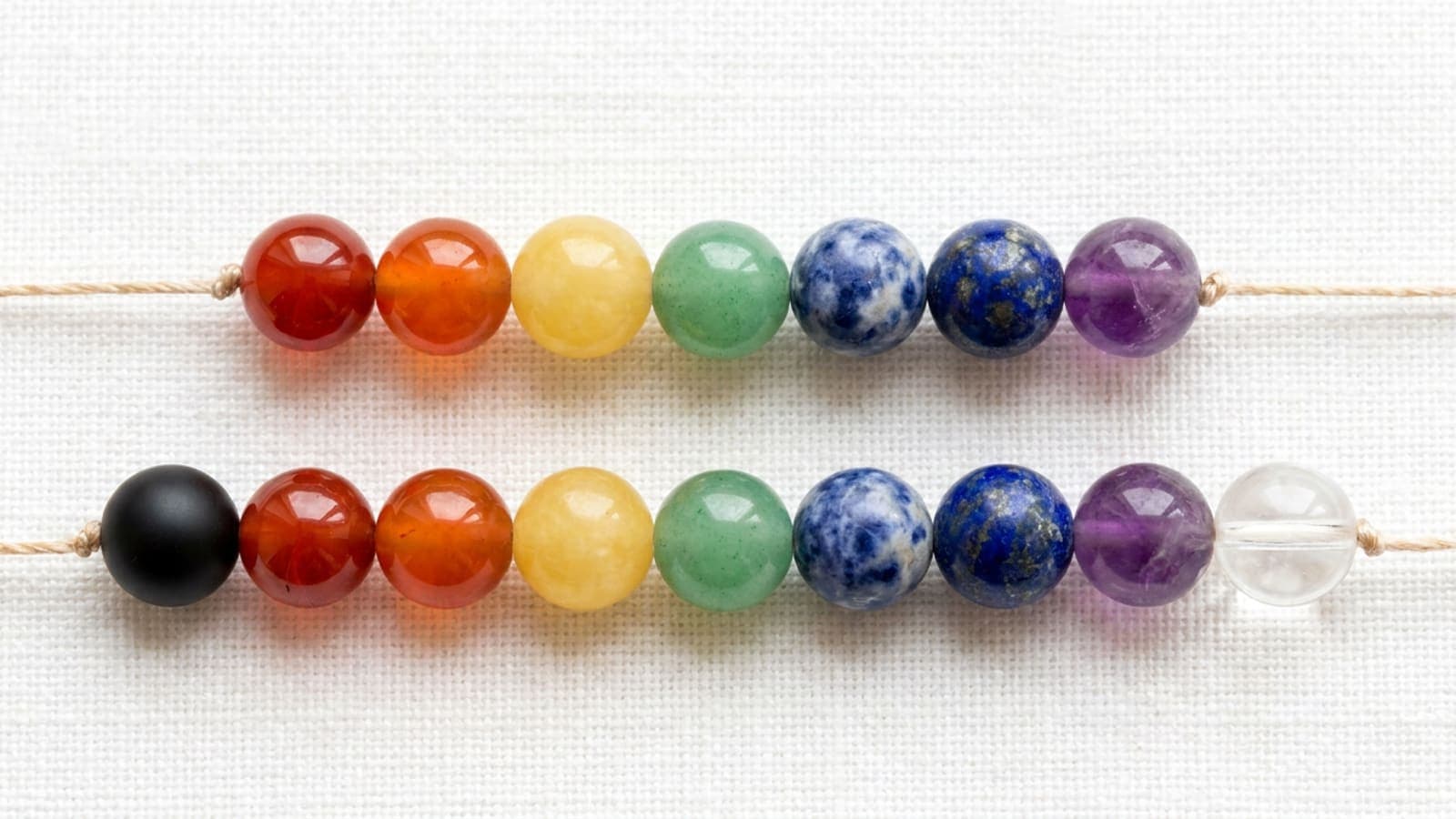
9 chakra bracelet — what it is and whether you need it.
A 9 chakra bracelet adds two beads to the classical seven, representing chakras positioned outside the physical body — most commonly the Earth Star (below the feet, for grounding into the earth) and the Soul Star (above the crown, for higher consciousness). Some Indian sellers instead add Bindu and Hrit, two points that do appear in Tantric literature but are not usually counted among the main chakras. Either way, the nine-chakra model is a modern extension. If you want a bracelet grounded in the Indian classical tradition, seven is the correct number. If you follow a Western energy-healing practice that uses the transpersonal chakras, nine is coherent within that framework.
| Classical count | 7 — Muladhara to Sahasrara (Upanishads, Tantric texts) |
| The 2 extra in most 9-bead versions | Earth Star (below feet) + Soul Star (above crown) |
| Origin of those two | 20th-century Western esotericism, not Indian scripture |
| Alternative Indian pair sometimes used | Bindu and Hrit — real Tantric points, not main chakras |
| Typical extra stones | Black tourmaline / hematite (Earth Star) + selenite / clear quartz (Soul Star) |
| Price difference | ₹150–₹400 more than a comparable 7-chakra bracelet |
| Most common problem | A 7-chakra bracelet with 2 filler beads sold as '9 chakra' |
| Our recommendation | Buy 7 unless you specifically practise a transpersonal-chakra system |
What the two extra chakras actually are.
- 1Earth Star (Vasundhara) — roughly 30 cm below the feet
In the Western transpersonal model this is the anchor point connecting the individual's energy field to the earth. Its stones are the heavy grounding ones: black tourmaline, hematite, smoky quartz or black obsidian. Practitioners who work with it describe it as addressing the feeling of being unrooted or 'not fully arrived' in one's own life — which overlaps considerably with what Muladhara (root) already covers in the classical seven.
- 2Soul Star (Sutara) — roughly 15 cm above the crown
The counterpart above: the point said to connect individual consciousness to something beyond it. Its stones are selenite, clear quartz, moonstone or apophyllite. Again, the described function — transcendence, higher awareness — overlaps substantially with Sahasrara (crown) in the classical system.
- 3Bindu — the alternative Indian addition
Bindu Visarga sits at the back of the head where a traditional shikha tuft is kept. It appears genuinely in Tantric and Nath literature as a nectar point associated with amrita. It is real Indian tradition — but it is not conventionally counted among the main chakra series, so a 'nine chakra' bracelet using it is still a modern construction, just an Indian-sourced one.
- 4Hrit — the second alternative
Hrit or Surya chakra sits just below Anahata and appears in some Tantric systems as the seat of the wish-fulfilling tree (Kalpavriksha). Same status as Bindu: authentically attested, but not part of the standard seven.
Notice the honest problem in the first two: Earth Star duplicates the root chakra's function and Soul Star duplicates the crown's. Within the Western system there is a coherent argument for the distinction — one is inside the body's field, one outside it — but for a buyer whose interest is the Indian tradition, the two extra beads add material cost without adding a function the seven do not already contain.
Does the 9-chakra system have any scriptural basis?
The canonical Indian source for the chakra system is the Sat-Chakra-Nirupana (16th century), which describes six chakras plus Sahasrara — the familiar seven. The Yoga Upanishads and various Tantric texts vary the count and the names, and some list additional minor points, so 'exactly seven' is itself a standardisation rather than an unbroken absolute. What is clear is that no classical Indian source describes chakras located outside the physical body.
Earth Star and Soul Star enter the picture through twentieth-century Western esoteric and New Age writing, which built on Theosophical adaptations of Indian material. That lineage is worth knowing rather than hiding: it means a nine-chakra bracelet is a genuine object within a genuine modern practice, and simultaneously that it is not what a Vedic astrologer or a classical yoga teacher is referring to when they speak of the chakras. Sellers who market 'ancient 9 chakra system' are inventing a history. Sellers who say 'this uses the extended transpersonal model' are being straight with you.
9 chakra vs 7 chakra bracelet.
| Parameter | 7 Chakra | 9 Chakra |
|---|---|---|
| Tradition | Classical Indian — Upanishads, Tantric texts | Modern Western transpersonal model |
| Beads | 7 stones, red→violet spectrum order | 7 + black grounding + white/clear crown stone |
| Colour logic | Clean rainbow sequence, easy to verify at a glance | Rainbow plus two achromatic beads breaking the sequence |
| Functional overlap | None — each chakra distinct | Earth Star overlaps root; Soul Star overlaps crown |
| Typical price | ₹599–₹1,500 (certified natural) | ₹750–₹1,900 (certified natural) |
| Verification difficulty | Easy — wrong sequence is instantly visible | Harder — no fixed sequence buyers can check |
| Astrologer prescription in India | Common | Rare — most Indian astrologers do not use this model |
| Best for | Anyone; the default choice | Practitioners already working with transpersonal chakras |
How to spot a 7-chakra bracelet relabelled as 9.
Because there is no fixed, publicly-known sequence for the nine-chakra version the way there is for seven, it is far easier to sell a padded bracelet as a nine. The common trick: take a standard seven-stone bracelet, add two extra beads of a stone already in the set (a second amethyst, a second clear quartz), and sell it at the nine-chakra premium.
- 1Count the DISTINCT stones, not the beads
A genuine nine-chakra bracelet has nine different materials. Lay it out and count species, not beads. If you see two amethysts or two clear quartz and no black grounding stone, it is a padded seven.
- 2The two extras must be achromatic
Earth Star stones are black or dark brown (tourmaline, hematite, obsidian, smoky quartz). Soul Star stones are white or clear (selenite, clear quartz, moonstone). A 'nine chakra' bracelet that is purely a rainbow with no black and no white bead is not built on the nine-chakra model at all.
- 3Ask which two chakras were added
A seller who works with this model answers instantly: Earth Star and Soul Star, or Bindu and Hrit. A seller who says 'the two extra energy points' or changes the subject added beads, not chakras.
- 4Apply the same authenticity tests as any chakra bracelet
Cool to the touch, bead-to-bead natural variation, no internal air bubbles, no dye lift on an acetone swab, and a lab certificate you can verify online. The nine-versus-seven question is separate from — and secondary to — whether the stones are real at all.
Which one should you actually buy?
| If you… | Buy | Why |
|---|---|---|
| Follow Indian/Vedic tradition | 7 chakra | Nine has no classical Indian basis |
| Were told by an Indian astrologer to wear chakra stones | 7 chakra | That is the system they are referring to |
| Practise Reiki or Western energy healing with transpersonal chakras | 9 chakra | Coherent within the framework you already use |
| Want grounding AND crown work specifically | 7 chakra + separate black tourmaline | Cheaper, and lets you size the grounding stone properly |
| Are buying your first chakra bracelet | 7 chakra | Easier to verify, cheaper, and the standard reference point |
| Are buying a gift | 7 chakra | Universally recognised; nine invites 'what are the extra two?' |
Our position, stated plainly: for the great majority of buyers in India, seven is the right choice — it is the tradition being referred to, it is easier to authenticate, and it costs less. The nine-chakra bracelet is a legitimate object for someone whose practice actually uses the transpersonal model, and a marketing upgrade for everyone else. If you specifically want stronger grounding alongside the seven, buying a 7-chakra bracelet plus a separate black tourmaline bracelet gives you more grounding stone for less money than the two-bead upgrade does.
Frequently asked
Last reviewed: 17 May 2026 · Verified by the DivineTatva expert panel
What is a 9 chakra bracelet?
A bracelet with nine stones — the classical seven chakra stones plus two more representing chakras located outside the physical body: usually Earth Star (about 30 cm below the feet, black tourmaline or hematite) and Soul Star (about 15 cm above the crown, selenite or clear quartz). Some Indian versions instead add Bindu and Hrit, two genuine Tantric points not normally counted among the main chakras.
Is the 9 chakra system mentioned in Indian scripture?
No. The canonical Sat-Chakra-Nirupana and the Yoga Upanishads describe the seven-chakra system, and no classical Indian source places chakras outside the physical body. Earth Star and Soul Star come from twentieth-century Western esoteric writing built on Theosophical adaptations. Sellers marketing an 'ancient 9 chakra system' are inventing a history.
9 chakra or 7 chakra bracelet — which is better?
For most buyers in India, seven. It is the system Indian astrologers and yoga teachers actually refer to, it is easier to authenticate (a wrong colour sequence is instantly visible), and it costs less. Nine is a legitimate choice if you already practise a Western energy-healing system that uses transpersonal chakras — otherwise it is a marketing upgrade.
How do I know a 9 chakra bracelet is not just a padded 7?
Count distinct stone species, not beads — a genuine nine has nine different materials. The two extras must be achromatic: one black or dark (tourmaline, hematite, obsidian) and one white or clear (selenite, clear quartz). A 'nine chakra' bracelet that is purely a rainbow with no black and no white bead is a padded seven. Also ask the seller which two chakras were added; a real answer comes instantly.
How much more should a 9 chakra bracelet cost?
Roughly ₹150–₹400 more than a comparable certified 7-chakra bracelet — that is the honest material cost of two additional natural stones. A '9 chakra' priced at double a 7-chakra is charging for the label, not the stones. And as with any chakra bracelet, anything under ₹300 total is dyed glass regardless of how many beads it has.
Reviewed by the DivineTatva expert panel
Written and reviewed by DivineTatva's consulting Vedic astrologer. Every piece is lab-certified and energised in our Jaipur atelier. Last updated 23 July 2026.