How to Identify a Real 7 Chakra Bracelet: Real vs Fake Authenticity Guide (India)
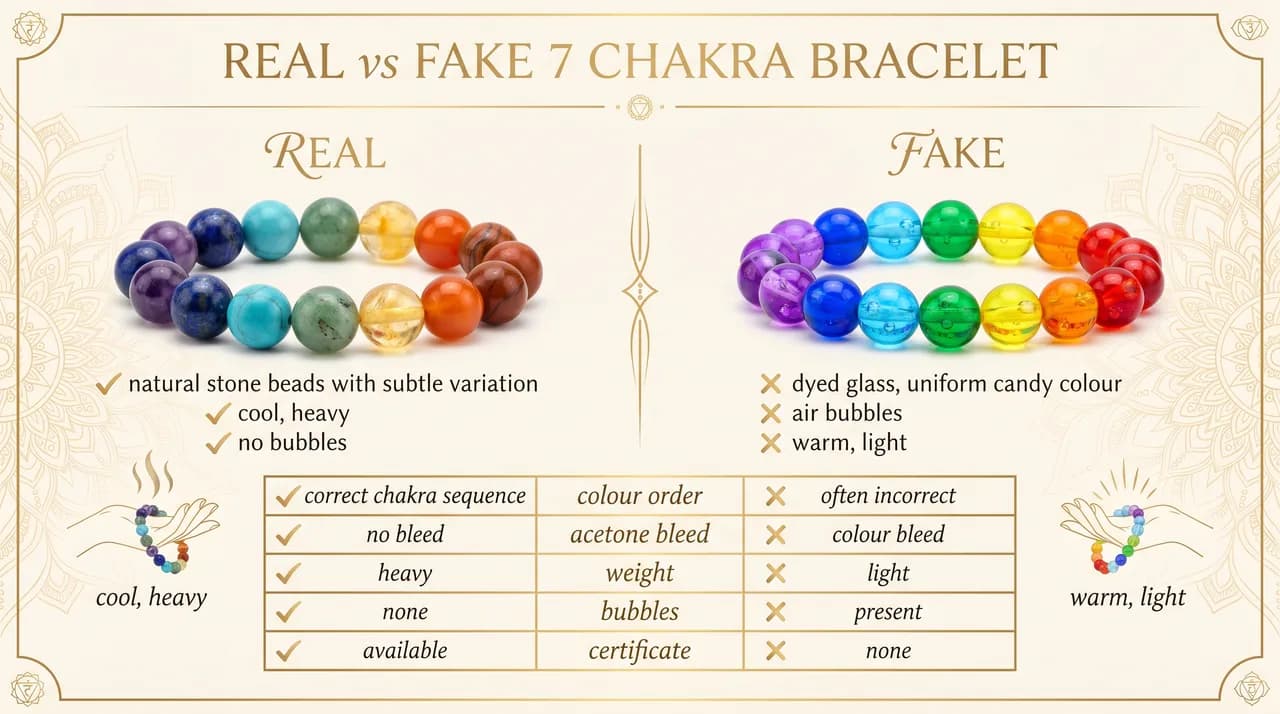
To identify a real 7 chakra bracelet, check the fixed root-to-crown colour order, then run quick tests: real stones stay cool to the touch and feel slightly heavier than plastic or glass. Genuine stones show natural inclusions and an uneven matte-to-vitreous finish; tiny round air bubbles inside a bead mean glass. A clean acetone cotton swab should not lift colour from natural stone. Demand a lab certificate naming each species.
Why fake 7 chakra bracelets flood the India market
A genuine 7 chakra bracelet uses seven different natural gemstones, each cut, drilled and polished separately, then certified and energised. That is expensive to make honestly. A fake uses one batch of cheap glass or dyed howlite, painted or colour-soaked to imitate seven stones, and printed with spiritual claims. On crowded marketplaces and roadside stalls the two can look identical in a thumbnail, which is exactly why dyed-glass copies sell in such volume.
The good news: you do not need a gemmology lab to spot most fakes. Natural stone behaves differently from glass and plastic in ways your eyes, hands and a cotton swab can detect in minutes. The tests below move from the easiest visual check to confirming tests you can do at home, then to the paperwork a serious seller must provide. Run them in order and a fake usually fails within the first two or three.
| Same colour order, wrong materials | Layout can look correct even when every bead is dyed glass — never judge on colour alone |
| Price far below ₹400 | Seven certified AA-grade natural stones cannot be sold profitably at throwaway prices in India |
| No certificate, no species names | A genuine seller can name each of the seven stones and back it with a lab report |
The colour-order check: does the layout even make sense?
Before any physical test, confirm the bracelet follows the fixed root-to-crown sequence. A real 7 chakra bracelet runs in colour order every time: red, orange, yellow, green, blue, indigo, violet. A maker who does not understand the system often scatters the colours randomly or repeats beads — an instant signal the product is decorative, not authentic.
- 1Red — Root (Muladhara)
Red Jasper: opaque brick-red with natural mottling, not a uniform candy red.
- 2Orange — Sacral (Svadhisthana)
Carnelian: warm orange to amber, often slightly translucent with banding.
- 3Yellow — Solar Plexus (Manipura)
Citrine: pale to golden yellow, glassy and semi-transparent.
- 4Green — Heart (Anahata)
Green Aventurine: medium green with tiny glittery mica flecks (aventurescence).
- 5Blue — Throat (Vishuddha)
Sodalite (some sets use turquoise or blue howlite): denim-blue with white veining.
- 6Indigo — Third Eye (Ajna)
Lapis Lazuli: deep blue with gold pyrite specks and white calcite.
- 7Violet — Crown (Sahasrara)
Amethyst (some sets use clear quartz): purple, semi-transparent, often colour-zoned.
Note the legitimate swaps: a real set may use turquoise or blue howlite at the throat and clear quartz at the crown. That is normal and does not make it fake — the colour order stays fixed. What is not normal is seven beads that are all the same glassy material in seven painted shades. Use this check to disqualify the obvious copies, then prove the rest with the hands-on tests.
Hands-on tests: temperature, weight, bubbles, drill-holes & dye-bleed
These five tests separate natural stone from glass, plastic and dyed filler. None requires special equipment — just good light, your hands, and a little acetone (nail-polish remover) on cotton. Do the acetone test last and only on a single bead, because it is the one test that can mark a fake.
- 1Test 2 — Temperature
Hold the bracelet against your cheek or inner wrist. Natural stone draws heat away and feels noticeably cool, staying cool for a few seconds. Plastic warms to skin temperature almost instantly and feels neutral or warm. Glass is cool too, so pair this with the bubble and weight tests.
- 2Test 3 — Weight (heft)
Genuine stone beads have real density and feel reassuringly heavy for their size. Plastic and resin imitations feel suspiciously light and hollow. Compare a 8mm or 10mm stone bracelet in one hand against a plastic bangle in the other — the difference is obvious.
- 3Test 4 — Bubbles = glass
Look through translucent beads (citrine, carnelian, amethyst) under a bright light or phone torch. Tiny perfectly round air bubbles trapped inside mean it is moulded glass, not stone. Natural stone shows irregular inclusions, veils and colour zoning — never neat spherical bubbles. This single test exposes most dyed-glass fakes.
- 4Test 5 — Drill-hole & inclusions
Inspect the drilled hole with a loupe or zoomed phone camera. Real stone often shows tiny chips or a slightly rough rim at the hole and natural internal flaws. If colour is concentrated and darker around the drill-hole, dye has pooled there — a clear sign of dyed stone. Flawless, perfectly even colour throughout usually means glass or plastic.
- 5Test 6 — Acetone dye-bleed (do last)
Dab a cotton swab with acetone or nail-polish remover and rub one bead for a few seconds. On natural, untreated stone the swab stays clean. If the cotton picks up colour, the bead is dyed. Avoid this on amethyst, lapis or turquoise in genuine sets where surface waxing exists, but on a suspected glass fake the dye lifts readily.
A bracelet that stays cool, feels dense, shows irregular natural inclusions instead of round bubbles, has clean drill-holes and does not bleed dye is almost certainly genuine natural stone. A bead that is warm, light, full of round bubbles, dark around the hole and stains the cotton is a dyed-glass or plastic fake. One or two failed tests is enough to walk away.
Lab certificates, AA-grading and what a real seller must state
Home tests confirm the stone is natural; a certificate confirms which stone and to what quality. In India, serious sellers back natural-gemstone jewellery with a lab report. You do not need a separate certificate per bead, but the seller should be able to name all seven species and provide documentation on request — vague 'healing crystal' labels with no species names are a red flag.
| Each stone species by name | e.g. Red Jasper, Carnelian, Citrine, Green Aventurine, Sodalite, Lapis Lazuli, Amethyst — not just 'mixed crystals' |
| Natural vs treated / dyed | Honest reports disclose any dyeing, heating or stabilising; silence usually hides treatment |
| Bead size and count | 8mm or 10mm, seven distinct stones — matches the physical product you receive |
| Issuing lab / authority | A named gemmological lab or in-house QA you can verify, not an anonymous sticker |
AA-grading describes quality within a natural stone — colour saturation, clarity, polish and consistency. AA-grade beads show even, vivid colour, smooth round shaping and minimal cracks, which is what you want for a piece you wear daily. Grading is a quality scale, not a synonym for 'real', so treat 'AA-grade' and 'natural lab-certified' as two separate promises a good seller keeps. DivineTatva uses AA-grade natural stone, lab-certified and energised through Pran Pratishta in Jaipur, with each species named on the listing.
India red flags and a 60-second pre-purchase checklist
Most disappointing bracelets sold in India share the same warning signs. Use this checklist before you pay, online or in a shop. If two or more boxes go unticked, keep looking.
- 1Price too low to be true
Seven certified natural stones, drilled, strung and energised, cannot profitably sell for a throwaway price. Suspiciously cheap usually means dyed glass.
- 2No species names
If the seller cannot tell you it is Red Jasper, Carnelian, Citrine and so on, they likely do not know — or it is glass.
- 3No certificate or QA claim
No mention of lab testing, natural-stone sourcing or quality grading anywhere in the listing.
- 4Perfect, flawless, identical beads
Uniform glassy perfection with zero inclusions across all seven colours points to moulded glass, not natural stone.
- 5Random colour order
Beads not in red-to-violet sequence reveal the maker does not understand the chakra system.
- 6Round bubbles under light
Spotting trapped spherical bubbles in any translucent bead confirms glass — non-negotiable fail.
Honest belief note: no test, certificate or stone grade makes crystals a medical treatment. There is no clinical proof that gemstones heal. A 7 chakra bracelet is a tradition-rooted tool for focus and intention — it supports your own effort and mindfulness, not a substitute for medical care. Authenticity simply ensures you are wearing genuine, certified natural stone rather than dyed glass, so the ritual and the craftsmanship you paid for are real.
Real vs fake 7 chakra bracelet: side-by-side
| Test | Real (natural stone) | Fake (glass / dyed / plastic) |
|---|---|---|
| Temperature | Cool to the touch, stays cool briefly | Plastic warms instantly; neutral |
| Weight | Dense, heavy for its size | Light, hollow feel |
| Inside the bead | Irregular inclusions, veils, colour zoning | Round air bubbles (glass) or flat colour (plastic) |
| Drill-hole | Slight chips; even colour through bead | Dye pooled dark around the hole |
| Acetone swab | Cotton stays clean | Colour bleeds onto cotton |
| Colour order | Fixed red-to-violet, root to crown | Often random or repeated |
| Paperwork | Species named, lab-certified, AA-grade | No certificate, vague 'crystals' |
| Price | Fair for 7 certified stones | Too low to be genuine |
Read the table as a scorecard, not a single pass-fail. A genuine bracelet wins most rows; a fake fails several. The fastest combination to trust is bubbles plus weight plus a named certificate — if a bead is dense, bubble-free and the seller names all seven stones with lab backing, you are almost certainly holding the real thing.
Frequently asked
Last reviewed: 17 May 2026 · Verified by the DivineTatva expert panel
How can I tell if my 7 chakra bracelet is real or fake at home?
Run four quick checks. Hold it to your skin — natural stone stays cool, plastic warms fast. Heft it — real stone feels dense, fakes feel light. Shine a torch through translucent beads — round air bubbles mean glass. Finally rub one bead with acetone on cotton; if colour lifts, it is dyed. Genuine stone passes all four and the colours follow the fixed red-to-violet order.
Do air bubbles always mean a fake chakra bracelet?
Tiny, perfectly round air bubbles trapped inside a translucent bead are a reliable sign of moulded glass, not natural stone. Natural gemstones show irregular inclusions, veils and colour zoning instead. So while not every flaw is a bubble, spotting neat spherical bubbles under bright light is one of the clearest confirmations that a bead is glass rather than genuine crystal.
Is the acetone test safe for real crystals?
On natural, untreated stone, acetone leaves the cotton swab clean and does no harm. Use it on just one bead and avoid scrubbing waxed or surface-treated stones for long. If the cotton picks up colour, the bead is dyed. It is a confirming test, best done last after the temperature, weight and bubble checks have already raised suspicion.
What stones should a genuine 7 chakra bracelet have?
In root-to-crown colour order: Red Jasper (root), Carnelian (sacral), Citrine (solar plexus), Green Aventurine (heart), Sodalite (throat), Lapis Lazuli (third eye) and Amethyst (crown). Some authentic sets swap the throat stone for turquoise or blue howlite and the crown for clear quartz. The materials may vary slightly but the red-to-violet colour order is always fixed.
Does a low price mean a chakra bracelet is fake?
Usually yes. Seven different natural stones, each cut, drilled, polished, certified and energised, carry real cost. A bracelet priced far below the cost of genuine certified stones is almost always dyed glass or plastic. Authentic DivineTatva bracelets are ₹599 for 8mm and ₹799 for 10mm, reflecting AA-grade natural stone and lab certification, not throwaway pricing.
What should a real 7 chakra bracelet certificate say?
It should name each of the seven stone species individually, disclose whether any stone is dyed, heated or treated, state the bead size and count, and identify the issuing lab or quality authority. Vague labels like 'healing crystals' with no species names are a red flag. A trustworthy seller can name all seven stones and back it with a lab report on request.
What is AA-grade natural stone?
AA-grade describes quality within a genuine natural stone — strong even colour, good clarity, smooth round shaping and minimal cracks. It is a quality scale, not proof of authenticity, so treat 'AA-grade' and 'natural, lab-certified' as two separate promises. For a bracelet you wear daily, AA-grade means consistent colour and durable, well-finished beads.
Can a fake bracelet still help with chakra balancing?
Honestly, there is no clinical proof that any crystal, real or fake, heals the body. A 7 chakra bracelet works as a tradition-rooted focus for intention and mindfulness — it supports your own effort, not a medical treatment. That said, buying genuine certified stone means you receive the real craftsmanship and energised piece you paid for, rather than dyed glass misrepresented as natural gemstone.
Reviewed by the DivineTatva expert panel
Written and reviewed by DivineTatva's consulting Vedic astrologer. Every piece is lab-certified and energised in our Jaipur atelier. Last updated 21 April 2026.