Real vs Fake Amethyst Bracelet: 7 Ways to Spot Dyed Glass & Synthetic (with Photos)
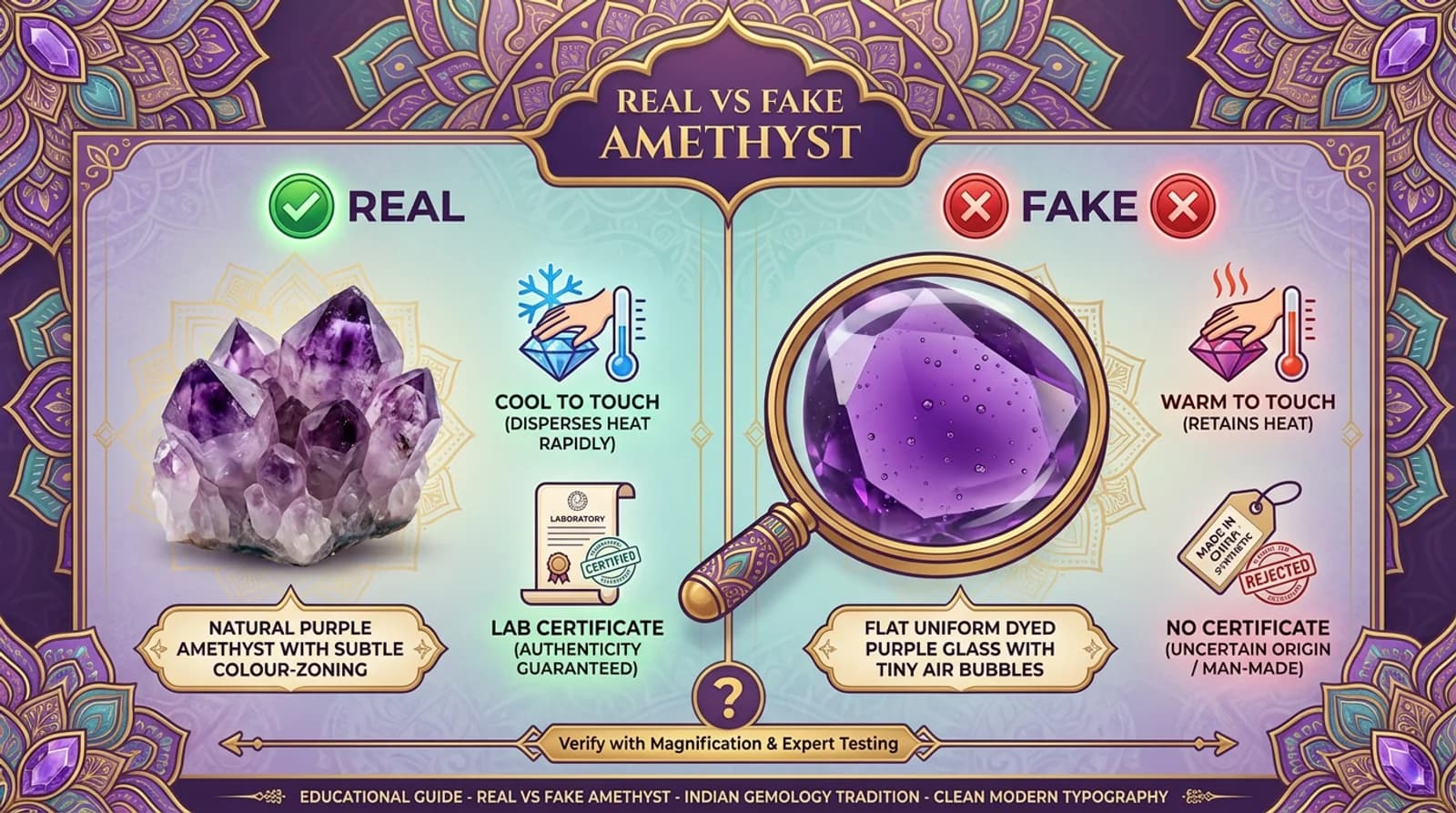
A real amethyst bracelet is strung with natural purple quartz (silicon dioxide) showing subtle colour-zoning, cool-to-touch glassy beads and tiny natural inclusions. Fakes are usually dyed glass or quartz: flat even purple, warm plastic feel, trapped air bubbles and a mould seam. This guide gives seven simple checks plus lab-certificate proof.
What Counts as a Real Amethyst Bracelet
A real amethyst bracelet is a stretch or beaded band strung with natural amethyst — the purple variety of quartz (silicon dioxide), coloured by trace iron and natural irradiation deep in the earth. Genuine amethyst shows subtle colour-zoning and tonal variation rather than one flat, dyed purple, feels cool and glassy to the touch, and carries tiny natural inclusions. Fakes are usually dyed glass, dyed cheaper quartz, or lab-grown synthetic.
In Indian tradition amethyst (often sold as jamunia) is the Third-Eye and Crown chakra stone, linked to Saturn (Shani), worn for calm, focus, sleep and intuition. Those are traditional beliefs and anecdotal experience, not proven medicine — but whatever you wear it for, you want real stone. Here is exactly how to tell.
| Material | Natural amethyst (purple quartz, SiO₂) |
| Colour cue | Subtle zoning, light-to-deep patches |
| Touch | Cool, glassy, slow to warm in hand |
| Hardness | 7 on the Mohs scale (scratches glass) |
| Common fakes | Dyed glass, dyed quartz, synthetic amethyst |
| Real proof | Per-piece third-party lab certificate |
7 Ways to Spot a Fake at a Glance
No single test is foolproof — dyed quartz can pass the hardness test, and good synthetics can pass the eye test. Run several together and a fake usually fails at least one. Here is the full checklist before we go deep on the three that matter most.
- 1Colour-zoning
Look for uneven purple — lighter and deeper patches within a single bead. Flat, identical, uniform purple across every bead suggests dye or glass.
- 2Cold-to-touch
Press beads to your cheek or lip. Real quartz feels distinctly cold and warms slowly; glass warms fast, plastic feels warm immediately.
- 3Bubble check
Under a loupe or phone macro, trapped round air bubbles mean glass. Natural amethyst has angular inclusions or veils, never perfect spheres.
- 4Hardness
Amethyst is Mohs 7 and will lightly scratch ordinary glass. Glass beads (Mohs ~5.5) will not scratch quartz back.
- 5Seam line
A faint mould seam running around a bead is a glass casting tell. Cut-and-polished quartz has no seam.
- 6Sunlight fade
Cheap dyed stone fades unevenly and fast; natural amethyst only softens slightly over long, prolonged direct sun exposure.
- 7Certificate
Ask for a per-piece third-party lab report. A real seller provides one; 'self-certified 100%' badges are not proof.
The Colour-Zoning Test (What the Photos Show)
Colour-zoning is the single most reliable at-home tell, and it is exactly what dyed glass cannot fake convincingly. Natural amethyst grew in layers, so colour concentrates unevenly — you will see a paler band fading into a deeper purple, sometimes a near-colourless zone near the tip of a bead, and slight tone differences from bead to bead. In our macro photos, the real bracelet looks 'alive': each bead is a little different.
Dyed glass and heavily dyed quartz look the opposite — every bead an identical, saturated, flat purple, often slightly too vivid, with colour pooling in surface cracks (a dead giveaway under magnification, where dye gathers in fractures). Hold the bracelet to a window: real amethyst lets light through with visible internal variation; dyed glass glows one even colour.
| Visual cue | Real natural amethyst | Dyed glass / dyed quartz |
|---|---|---|
| Colour spread | Uneven zoning, light-to-deep patches | Flat, identical, saturated purple |
| Bead-to-bead | Subtle tonal variation | All beads look the same |
| In cracks | Colour stays consistent | Dye pools darker in fractures |
| Held to light | Internal variation visible | Even, uniform glow |
| Overall vibe | Looks 'alive', natural | Looks printed or candy-like |
Cold-to-Touch and the Bubble Check
Two fast physical tests catch most glass fakes. First, the temperature test: quartz conducts heat away from your skin, so real amethyst feels noticeably cold when you touch it to your lip or cheek and stays cool for a second or two before warming. Glass warms up quickly; plastic and resin feel warm or 'soft' from the first touch. Do this in a normal-temperature room, not after the bracelet has sat in sun or pocket.
Second, the bubble check. Use a 10x loupe or your phone's macro mode and look inside the beads. Glass is melted and poured, so it traps tiny perfectly round air bubbles — sometimes strings of them. Natural amethyst never has spherical bubbles; instead it may show angular mineral inclusions, feathery veils, or faint internal fractures. Round bubbles = glass, full stop.
| Cold test pass | Cool to lip, warms slowly = likely quartz |
| Cold test fail | Warm/soft instantly = glass, resin or plastic |
| Bubble = glass | Round trapped spheres confirm moulded glass |
| Natural inclusion | Angular, feathery or veil-like, never round |
| Tool needed | 10x loupe or phone macro / close-up mode |
Hardness and the Seam-Line Check
Amethyst sits at 7 on the Mohs hardness scale — harder than ordinary glass (about 5.5) and most steel. The careful version of this test: take an inconspicuous bead and try to gently scratch a piece of scrap glass (not a window or anything you value). Real amethyst will leave a faint scratch on the glass; the glass will not mark the amethyst. A 'gemstone' that scratches easily, chips, or gets marked by glass is not amethyst. Test on one hidden bead only — never gouge the visible face of a piece you might keep.
While you have it close, look for a mould seam — a faint raised line circling the bead where two halves of a glass casting met. Cut-and-polished quartz beads are ground from solid rough and have no seam. A seam, plus round bubbles, plus flat uniform colour, is a complete glass profile. If you would rather not risk any scratch test, skip straight to the certificate — it settles the question without touching the stone.
| Property | Real amethyst | Glass fake |
|---|---|---|
| Mohs hardness | 7 | ~5.5 |
| Scratches glass? | Yes, leaves a mark | No |
| Mould seam | None (cut from rough) | Often a faint seam line |
| Chips/marks easily | No | Yes, softer edges |
| Weight feel | Dense, cool | Lighter, warms fast |
Jamunia, Dyed Quartz and Lab-Grown Synthetics
In India amethyst is widely sold as jamunia (after jamun, the deep-purple fruit) — and genuine jamunia is simply natural amethyst, so the name itself is not a red flag. The traps are three: dyed glass (the cheapest fake, caught by every test above), dyed pale quartz or chalcedony tinted purple (passes hardness but fails the dye-in-cracks and zoning tests), and lab-grown synthetic amethyst (real quartz chemically, but grown in a factory in weeks, not earth-mined over ages).
Synthetic amethyst is the hardest to spot at home because it is chemically real quartz — it will be cold, hard and bubble-free. The honest answer is that only a gemmological lab can separate fine synthetic from natural amethyst with certainty. That is precisely why a per-piece certificate matters: it is the only test that distinguishes natural from synthetic without specialist equipment in your hands.
| Jamunia | Just the Hindi name for amethyst — genuine if natural |
| Dyed glass | Cheapest fake; fails colour, bubble, cold, hardness |
| Dyed quartz | Hard but colour pools in cracks; fails zoning |
| Synthetic amethyst | Real quartz, factory-grown; needs lab to confirm |
| Only sure test | Third-party lab certificate per piece |
Why a Lab Certificate Is the Real Proof
Home tests get you most of the way, but two things — telling natural from synthetic, and proving it to yourself months later — need a document. Most Indian product pages flash a '100% Certified' badge with nothing behind it, or link to a generic external page. At DivineTatva each amethyst bracelet ships from Jaipur with a downloadable third-party lab certificate for that piece, identifying it as natural amethyst. That is the difference between a marketing claim and verifiable proof.
What to expect on price: natural, certified amethyst bracelets in India typically sit in a transparent INR band depending on bead size (8mm is the popular default), clarity and tone — sold free-size on a stretch cord, with COD available. If a 'natural certified amethyst' bracelet is priced like a fashion trinket, treat the certificate, the colour-zoning and the cold test as your safeguards before you buy.
| Trust signal | Self-asserted '100% Certified' | DivineTatva certified amethyst |
|---|---|---|
| Certificate type | Badge only / none | Third-party lab report |
| Per-piece | No | Yes, for your exact bracelet |
| Downloadable | Rarely | Yes |
| Natural vs synthetic | Unverified | Lab-confirmed natural |
| Origin | Often unstated | Jaipur-made, lab-certified |
Frequently asked
Last reviewed: 17 May 2026 · Verified by the DivineTatva expert panel
How can I tell if my amethyst bracelet is real or fake at home?
Run several quick tests together. Look for uneven colour-zoning (real) versus flat uniform purple (fake), touch the beads to your lip — real quartz feels cold and warms slowly — and check under your phone's macro for round air bubbles, which mean glass. Real amethyst is Mohs 7 and lightly scratches glass. No single test is conclusive, so combine them, then confirm natural versus synthetic with a per-piece lab certificate.
Is jamunia the same as amethyst?
Yes. Jamunia is the common Hindi name for amethyst, after the deep-purple jamun fruit. Genuine jamunia is simply natural amethyst — purple quartz coloured by iron. The name itself is not a warning sign; what matters is whether the stone is natural, dyed glass, dyed quartz or lab-grown synthetic. Use the colour-zoning and cold-touch tests, and ask for a certificate to be sure.
Can the cold-touch test alone prove amethyst is real?
No. The cold test reliably catches glass, plastic and resin, because real quartz conducts heat away and feels cool, warming slowly. But synthetic amethyst is chemically real quartz, so it also feels cold. The cold test rules out the cheapest fakes, not factory-grown synthetics. To separate natural from synthetic amethyst you need a gemmological lab certificate — that is the only certain home-friendly proof.
Why is colour-zoning the best test for amethyst?
Because dyed glass cannot fake it convincingly. Natural amethyst grew in layers, so colour concentrates unevenly — paler and deeper purple patches within one bead and slight variation between beads. Dyed glass and dyed quartz look flat and identical, often too saturated, with dye pooling darker inside cracks. Hold the bracelet to light: real stone shows internal variation, while glass glows one even colour.
Does a certificate guarantee my amethyst bracelet is genuine?
A genuine third-party lab certificate, issued for your specific piece, is the strongest proof — it confirms the stone is natural amethyst rather than dyed glass or synthetic. The catch is that a printed '100% Certified' badge or a generic linked page is not the same thing. Insist on a downloadable, per-piece third-party report, as DivineTatva provides with each Jaipur-made amethyst bracelet.
How much should a real certified amethyst bracelet cost in India?
Natural, lab-certified amethyst bracelets sit in a transparent INR band that varies with bead size (8mm is the common default), clarity and colour tone, and are usually sold free-size on a stretch cord with COD available. Prices far below this band are a flag — genuine certified stone with a third-party report costs more than dyed glass trinkets. Treat suspiciously cheap 'natural certified' listings with the home tests above.
Will the scratch test damage my bracelet?
It can if done carelessly, so use it sparingly. Test only on one hidden bead against scrap glass — real amethyst (Mohs 7) marks the glass, not itself. Never gouge the visible face of a bracelet you might keep, and never scratch valuables. If you would rather not risk it, the colour-zoning, cold-touch and bubble checks plus a lab certificate answer the question without touching the stone.
Reviewed by the DivineTatva expert panel
Written and reviewed by DivineTatva's consulting Vedic astrologer. Every piece is lab-certified and energised in our Jaipur atelier. Last updated 16 March 2026.