Amethyst Bracelet in India: Benefits, Real vs Fake, Which Hand & Price (Lab-Certified Guide)
An amethyst bracelet is a free-size stretch or beaded band strung with natural amethyst — the purple variety of quartz (jamunia) coloured by iron. In Indian tradition it's the Third-Eye and Crown chakra stone, worn for calm, focus, sleep and intuition. These are traditional beliefs and user experience, not proven medicine.
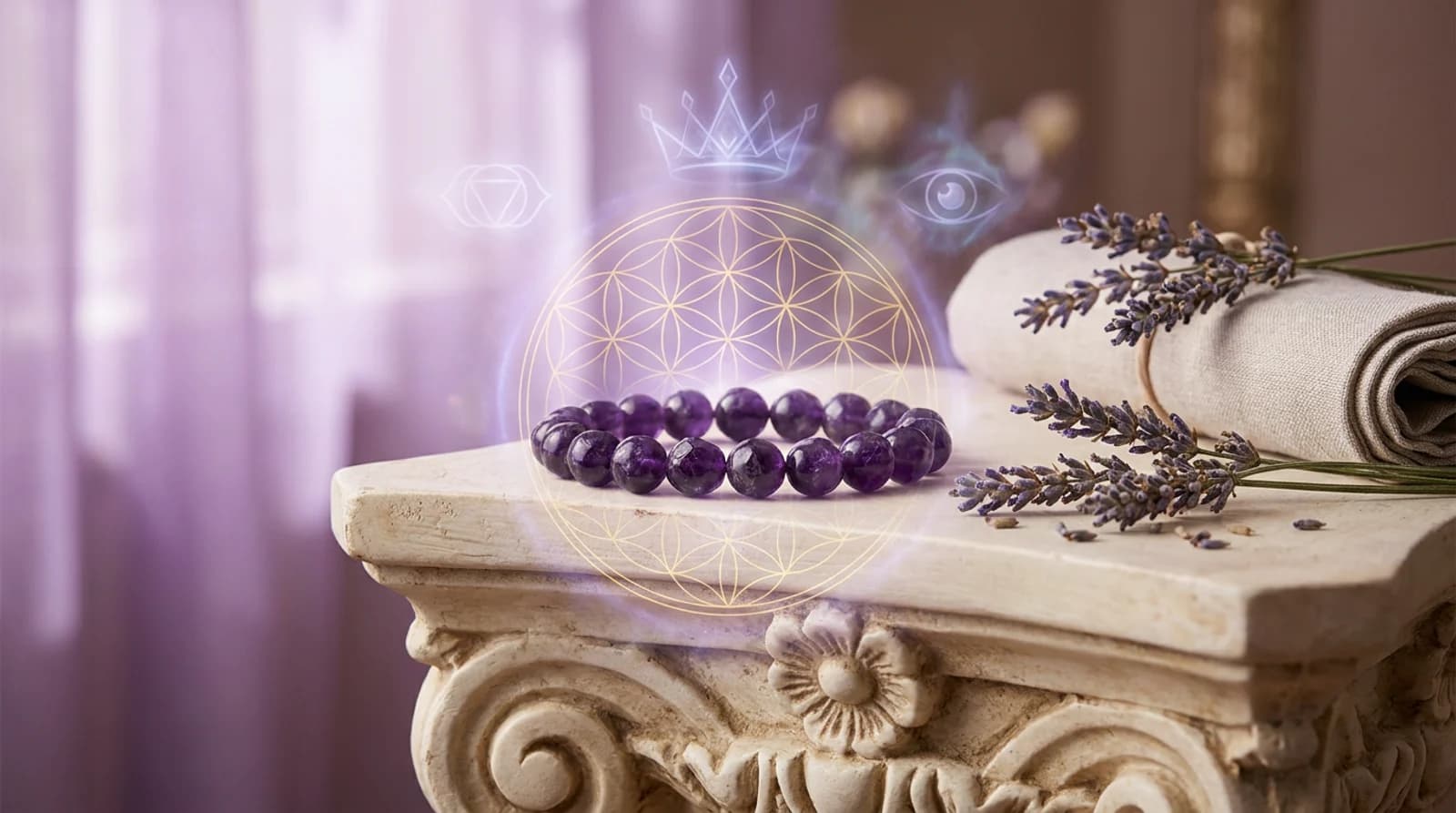
What Is an Amethyst Bracelet? (Quick Definition)
An amethyst bracelet is a free-size stretch or beaded band strung with natural amethyst — the purple variety of quartz (silicon dioxide), known in Hindi as jamunia. It's worn as the Third-Eye and Crown chakra stone for calm, focus, sleep and intuition. Genuine amethyst shows subtle colour-zoning, not one flat dyed purple.
In India it sits in a wide INR price band, comes in 6mm, 8mm and 10mm beads, and stretches to fit most wrists. Honest note: its wellness benefits come from Vedic and metaphysical tradition plus user experience — not clinical proof. It is not a substitute for medical advice.
| What it is | Stretch/beaded bracelet of natural purple quartz (amethyst / jamunia) |
| Mineral | Quartz, SiO2, coloured by iron + natural irradiation |
| Chakra | Third-Eye (Ajna) and Crown (Sahasrara) |
| Planet | Saturn (Shani) |
| Worn for | Calm, focus, sleep, intuition, emotional balance |
| Bead sizes | 6mm, 8mm, 10mm |
| Fit | Free-size elastic stretch (most 6–7.5 inch wrists) |
| Price band (India) | ~₹349 commodity to ₹1,499 lab-certified |
| Evidence | Traditional belief + user reports; no clinical proof |
What Amethyst Is and What It Does
Amethyst is macrocrystalline quartz that turns violet when trace iron in the crystal is altered by natural irradiation deep in the earth. That same chemistry explains why colour ranges from pale lilac to deep grape across a single strand — a fingerprint of natural origin you simply cannot fake convincingly in flat-dyed glass.
In Indian metaphysical tradition, amethyst is the master stone of the upper chakras. It is linked to the Ajna (Third-Eye) chakra, the seat of intuition and clear thinking, and the Sahasrara (Crown), the centre of higher awareness and stillness. It is also associated with Saturn (Shani) — the planet of discipline, patience and slowing a restless mind.
Put those together and you get the bracelet's whole intent: a focus + calm + intuition triad. Wearers reach for it to quiet mental noise, hold attention on a task, and trust their gut — the three reasons amethyst has stayed popular for centuries.
| Mineral family | Quartz (silicon dioxide) |
| Colour cause | Iron impurities + natural irradiation |
| Hindi name | Jamunia (jamun-fruit purple) |
| Mohs hardness | 7 — scratches glass |
| Primary chakras | Third-Eye (Ajna), Crown (Sahasrara) |
| Planet | Saturn (Shani) |
| Core intent | Focus, calm, intuition |
Benefits of Wearing an Amethyst Bracelet
Across Vedic tradition and everyday wearer experience, an amethyst bracelet is reached for to steady the mind. Classical grounding: the Garuda Purana lists purple-violet gems among Shani-pacifying stones; amethyst's Saturn association in Jyotish folk tradition comes from this lineage. None of these are medical claims — they are consistent reports from wearers using the stone with intention, alongside ritual and habit.
- 1Calm & stress relief
The most cited benefit. Wearers describe a settled, less-reactive feeling, especially in high-pressure moments — consistent with the stone's grounding, Saturn-linked reputation.
- 2Better sleep
Often worn or kept bedside for quieter winding-down and fewer racing thoughts before sleep. Popular with people whose minds won't switch off at night.
- 3Focus & concentration
Linked to the Third-Eye chakra, amethyst is a favourite of students and desk workers who want fewer distractions and a clearer head during study or deep work.
- 4Intuition & clarity
Meditators use it to feel more 'tuned in' and to trust their judgement — the Crown-chakra promise of insight and perspective.
- 5Emotional balance
Worn to take the edge off mood swings, overthinking and irritability, helping wearers respond rather than react.
A useful way to read these: tradition supplies the meaning, and the daily ritual of wearing the bracelet supplies the reminder. Many wearers find that combination genuinely helpful — which is exactly why we frame it honestly rather than overpromising.
Does an Amethyst Bracelet Actually Work?
Honest answer: there is no clinical proof that amethyst treats anxiety, insomnia or any medical condition. What you'll find instead is a strong tradition, a large body of personal experience, and a well-understood psychological mechanism — intention, ritual and placebo — that can produce real, felt calm even without the stone doing anything physically.
That doesn't make the experience fake. A daily object you've charged with meaning can genuinely lower felt stress and anchor focus, because it cues a mindset. The bracelet works the way a wedding ring or a lucky pen works: through what it reminds you to be, not through measurable energy fields.
| Aspect | What tradition & wearers report | What evidence shows |
|---|---|---|
| Calm / stress | Settled, less-reactive feeling | No clinical proof; consistent with placebo, ritual & intention |
| Sleep | Quieter mind at bedtime | Anecdotal; no controlled trials supporting it |
| Focus | Fewer distractions, clearer head | Plausibly attention-cueing; not medically established |
| Intuition | Feeling more 'tuned in' | Subjective; not scientifically measurable |
| Overall | Helpful daily anchor | Benefit is real-as-felt, not clinically proven |
Our position: wear it for the meaning, the ritual and the genuine calm many people feel — and never as a replacement for medical, financial or professional advice. If you're managing a health condition, treat the bracelet as a companion to proper care, not a substitute for it.
Real vs Fake Amethyst: How to Spot the Difference
Most disappointing amethyst bracelets aren't amethyst at all — they're dyed glass, dyed quartz or synthetic crystal sold at a 'too good to be true' price. The good news: natural amethyst leaves clues that fakes struggle to copy. Here's the at-home checklist, then why a lab certificate is the only thing that truly settles it.
- 1Look for colour-zoning
Natural amethyst shows uneven purple — patches of deeper and lighter violet within and between beads. Flat, identical, candy-purple across every bead usually means dye or glass.
- 2Feel the temperature
Real quartz feels cool to the touch and warms slowly. Glass and plastic warm up fast and feel 'room temperature' almost instantly.
- 3Hunt for bubbles
Hold beads to light with a loupe. Tiny round air bubbles trapped inside point to molded glass — natural amethyst won't have them (it may show natural veils or feathers instead).
- 4Test the hardness
Amethyst is Mohs 7 and will lightly scratch glass without being scratched by it. A bead that scratches easily is likely glass or plastic. Test discreetly on a single bead.
- 5Question the price
Certified natural amethyst has a floor. Deep, flawless, ultra-cheap 'amethyst' in bulk is a red flag for dyed or lab-grown material.
| Test | Natural amethyst | Dyed glass / synthetic |
|---|---|---|
| Colour | Zoned, tonal, uneven | Flat, uniform, often over-saturated |
| Temperature | Cool, warms slowly | Warms quickly, feels neutral |
| Inclusions | Natural veils/feathers | Round air bubbles (glass) |
| Hardness | Mohs 7, scratches glass | Often softer, scratches easily |
| Proof | Third-party lab certificate | '100% certified' badge with no document |
Home tests narrow it down, but they don't prove species or origin. That's why every DivineTatva amethyst bracelet ships with a per-piece, third-party Jaipur lab certificate you can download — the one trust gap that self-asserted '100% Certified' badges quietly leave open.
Who Should Wear an Amethyst Bracelet
Amethyst is one of the most universally 'safe' stones to wear because it's gentle and works on the upper chakras rather than overloading the body. You don't strictly need an astrologer's permission, but it suits some people especially well — by chakra need, by zodiac and by simple intent.
| Chakra fit | Anyone wanting to balance the Third-Eye or Crown — overthinkers, the mentally scattered |
| Best zodiac | Aquarius and Pisces (traditional birthstone affinity) |
| Also suits | Capricorn & those drawn to Saturn/Shani discipline |
| Saturn logic | Shani-ruled people seeking patience, calm and structure |
| By intent — students | Focus and exam-season calm |
| By intent — anxious sleepers | Quieter, less racy bedtime mind |
| By intent — meditators | Deeper, more 'tuned-in' practice |
If your goal is calmer focus, steadier emotions or a more grounded daily rhythm, amethyst is an easy first crystal. It also pairs well with clear quartz (amplification) or rose quartz (heart-centred calm) for those building a small set. For zodiac fit, amethyst rarely clashes — but if you're combining it with strong Mars/Sun stones for astrological reasons, a quick astrologer check never hurts.
Who Should NOT Wear It — Side Effects & Precautions
This is the part most sellers skip. To be clear up front: amethyst has no proven medical side effects, and any 'side effects' are mild, individual and belief-based. But a few people find it doesn't suit them, and being honest about that builds more trust than pretending it's magic for everyone.
- 1The highly sensitive
A minority of energy-sensitive wearers report feeling spacey, over-stimulated or unusually emotional when they first wear amethyst. If that's you, wear it in short sessions and build up.
- 2Vivid or restless dreamers
Amethyst is linked to dream activity. If wearing it overnight gives you intense dreams or lighter sleep, remove it at bedtime and wear it during the day instead.
- 3During heavy focus on action
Some Saturn-shy people prefer not to wear a 'slowing, grounding' stone before high-energy, aggressive tasks — a personal-preference matter, not a rule.
- 4When to remove it
Take it off during heavy chores, gym sessions, swimming, or contact with chemicals — for the elastic and finish, not for safety.
| Medical side effects | None proven; treat reactions as mild & individual |
| Most common 'too much' sign | Feeling spacey or over-stimulated |
| Night-wear caveat | Possible vivid dreams / lighter sleep for some |
| Simple fix | Shorter wear, day-only wear, or a break |
| Hard medical rule | None — but never replace prescribed treatment |
Bottom line: amethyst is gentle. If something feels off, ease into it or wear it less — there's no danger, just personal fit. And it remains a wellness accessory, never a treatment for any medical, psychological or financial condition.
Which Hand Should You Wear an Amethyst Bracelet On?
In crystal tradition the body has a receiving side and a giving side. The left wrist is the receiving, non-dominant side — wear amethyst here to draw in calm, focus and intuitive energy for yourself. The right (usually dominant) wrist is the projecting side — wear it here to send that steady energy outward into your work and interactions.
| Wrist | Energy direction | Best for |
|---|---|---|
| Left (receiving) | Draws energy inward | Calm, sleep, inner focus, personal healing |
| Right (projecting) | Sends energy outward | Composure in meetings, steady output, public calm |
| Either | Personal preference | Daily wear — comfort and habit win |
For amethyst's signature calm-and-focus purpose, most people choose the left wrist. But this is guidance, not a hard rule: if the right wrist is more comfortable or fits your watch routine, wear it there. Consistency of daily wear matters far more than which hand you pick.
Can You Sleep In It & How Long Until You Notice Effects?
Yes, you can sleep in an amethyst bracelet, and many people do specifically for its calming, sleep-friendly reputation. The only cautions are practical: a stretch cord can snag bedding, and a few wearers get more vivid dreams or lighter sleep. If either bothers you, keep the bracelet on the bedside table or under your pillow instead of on your wrist.
| Sleep in it? | Yes — common for calm; remove if dreams feel intense |
| Bedside alternative | Place on nightstand or under pillow |
| First impressions | Some feel calmer within days |
| Realistic window | 2–4 weeks of consistent daily wear |
| What drives results | Daily ritual + intention, not overnight magic |
On timelines, be realistic. Some wearers notice a subtle settling within the first few days; for most, any benefit builds over two to four weeks of consistent wear as the bracelet becomes a daily anchor. Treat it like a habit, not a switch — and don't expect or demand a dramatic overnight change.
How to Cleanse and Charge an Amethyst Bracelet
Cleansing clears the energy your bracelet has absorbed; charging re-energises it with intention. Amethyst is water-safe for a quick rinse, which makes this easy — but never leave it in prolonged direct sunlight, because strong sun can fade its purple over time. Here's a simple, safe routine.
- 1Rinse under running water
Hold the bracelet under cool running water for 30–60 seconds to clear absorbed energy. Pat dry and keep the elastic cord dry to preserve stretch.
- 2Charge under moonlight
Leave it on a windowsill overnight, ideally on a full moon. Moonlight recharges amethyst without any fade risk — the preferred method for this stone.
- 3Use a selenite plate
Rest the bracelet on a selenite slab for a few hours. Selenite is self-cleansing and gently resets crystals without water or sun.
- 4Sound or smoke
Pass it through sage/incense smoke or the tone of a singing bowl for a quick, dry cleanse between deeper sessions.
- 5Set your intention
Hold the bracelet, breathe, and silently state what you want it to support — calm, focus, sleep. This 'programs' it for you.
| Quick cleanse | 30–60s rinse under running water |
| Best charge | Overnight moonlight / full moon |
| No-water option | Selenite plate or sound/smoke |
| Frequency | Every 1–2 weeks, or after stressful days |
| Avoid | Prolonged direct sunlight (colour fade) |
Sunlight caution worth repeating: a few minutes is harmless, but hours of direct sun can dull amethyst's violet permanently. Moonlight and selenite are the safest charging routes for this particular stone.
Price, Bead Size and Sizing Guide in India
Amethyst bracelet prices in India swing widely, and the gap is mostly about authenticity and certification — not just bead size. A ₹349 bracelet is usually uncertified commodity stock that may be dyed quartz; a ₹1,499 piece typically buys verified natural amethyst with a per-piece lab certificate, better colour and proper stringing.
| Price band | What you usually get | Watch out for |
|---|---|---|
| ₹299–₹499 | Commodity, uncertified, possibly dyed | No certificate, flat colour, bubbles |
| ₹500–₹999 | Mid natural amethyst, basic checks | Self-asserted 'certified' badges |
| ₹1,000–₹1,499+ | Lab-certified natural, good zoning | Confirm the cert is third-party & per-piece |
Bead size is about look and presence, not power. 6mm is dainty and subtle; 8mm is the all-rounder most people choose; 10mm is bold and statement-making. Bigger beads use more stone, so a 10mm strand costs a little more than a 6mm of the same quality.
| 6mm | Delicate, layering-friendly, lighter look |
| 8mm | Most popular all-purpose size |
| 10mm | Bold, statement, slightly higher price |
| Measure your wrist | Wrap a thread/tape around the wrist bone, note cm |
| Add for comfort | Add ~1.5–2 cm to the wrist measurement |
| Free-size fit | Elastic stretch fits most 6–7.5 inch wrists |
To size yourself: wrap a soft tape or thread around your wrist just past the wrist bone, note the measurement, and add roughly 1.5–2 cm for a comfortable bead bracelet. Our free-size stretch design suits most adult wrists, so for the majority there's nothing to calculate.
Care and Longevity: Keeping It Purple and Stretchy
Amethyst is water-safe for a quick rinse, but its purple colour can fade in prolonged direct sunlight — cleanse under moonlight or running water, avoid perfume and harsh chemicals, and keep the elastic cord dry to preserve stretch. Treat the two enemies as sunlight (for colour) and chemicals plus rough wear (for the cord).
- 1Avoid prolonged sun
Don't store or dry the bracelet on a sunny sill for hours. Brief sun is fine; long exposure dulls the violet permanently.
- 2Keep chemicals away
Apply perfume, lotion, sanitiser and hairspray before putting the bracelet on. Harsh chemicals attack both the stone's surface and the elastic.
- 3Mind the elastic cord
Roll it on and off gently rather than yanking. Keep the cord dry after rinsing — repeated soaking weakens stretch over time.
- 4Remove for rough tasks
Take it off for the gym, swimming, cleaning and heavy lifting to avoid abrasion and snapping.
- 5Store it right
Keep it in a soft pouch or box, away from harder gemstones that can scratch it and away from light.
| Water | Safe for quick rinse; dry the cord after |
| Sunlight | Avoid prolonged exposure — fade risk |
| Chemicals/perfume | Avoid — apply cosmetics first |
| Elastic cord | Roll gently, keep dry, don't over-stretch |
| Storage | Soft pouch, away from light & harder stones |
The DivineTatva Difference
Most amethyst listings ask you to trust a '100% Certified' badge with no document behind it. We do the opposite. Every DivineTatva amethyst bracelet is natural, Jaipur-made and ships with a downloadable third-party lab certificate for that exact piece — so authenticity is proven, not promised.
| Certification | Per-piece, third-party Jaipur lab certificate (downloadable) |
| Authenticity proof | On-page real-vs-dyed photos & coldness/bubble tests |
| Honesty | Belief-vs-evidence voice — no overclaiming |
| Convenience | COD + free-size stretch fit across India |
| Intent owned | The full 'Focus, Calm & Intuition' triad |
| Trust signals | Numeric aggregate rating + verified reviews |
You also get one page that does both jobs: it educates (real-vs-fake, which hand, who should and shouldn't wear it, cleansing, sleep) and lets you buy with confidence — instead of scattering that depth across a separate blog. Lab-certified natural amethyst, transparent INR pricing, and an honest voice that tells you what the stone can and can't do.
Ready to wear calm, focus and intuition on your wrist? Choose a certified piece, check its certificate, and start your daily ritual today.
Frequently asked
Last reviewed: 17 May 2026 · Verified by the DivineTatva expert panel
What are the main benefits of an amethyst bracelet?
Traditionally, an amethyst bracelet is worn for calm, better sleep, sharper focus, stronger intuition and emotional balance. As the Third-Eye and Crown chakra stone linked to Saturn, it's reached for to quiet a busy mind. These benefits come from Vedic tradition and consistent wearer experience plus the ritual of daily wear — not clinical proof — so treat it as a wellness companion, never a medical treatment.
Does an amethyst bracelet really work?
There's no clinical evidence that amethyst treats anxiety, insomnia or any condition. What's real is the felt benefit many wearers experience through intention, ritual and the placebo effect — a daily object charged with meaning can genuinely steady focus and mood. So it 'works' as a mindset anchor for many people, but it is not medicine and shouldn't replace professional care.
How can I tell if my amethyst bracelet is real or fake?
Check for colour-zoning (natural amethyst is unevenly purple, not flat candy-purple), coolness to the touch that warms slowly, and the absence of round air bubbles inside the beads. Amethyst is Mohs 7 and lightly scratches glass. Home tests narrow it down, but only a third-party lab certificate truly confirms natural amethyst — which is why we provide one per piece.
Which hand should I wear my amethyst bracelet on?
For drawing in calm, focus and intuition, wear it on your left (receiving, non-dominant) wrist. To project that steady energy outward into work and interactions, wear it on your right wrist. Most people choose the left for amethyst's calming purpose, but this is guidance, not a rule — comfort and consistent daily wear matter more than which hand you pick.
Who should not wear an amethyst bracelet?
Amethyst has no proven medical side effects and suits almost everyone. A small number of energy-sensitive people feel spacey or over-stimulated at first, and some get vivid dreams or lighter sleep when wearing it overnight. If that's you, wear it for shorter periods or during the day only. Any 'side effects' are mild, individual and belief-based — there's no real danger.
Can I wear an amethyst bracelet while sleeping?
Yes — many people sleep in it specifically for its calming, sleep-friendly reputation. The only cautions are practical: the stretch cord can snag bedding, and a few wearers report more vivid dreams. If either bothers you, place the bracelet on your nightstand or under your pillow instead. Otherwise, overnight wear is perfectly fine and a popular way to use it.
How long does it take to see effects from an amethyst bracelet?
Be realistic. Some wearers feel a subtle settling within the first few days, but for most any benefit builds over two to four weeks of consistent daily wear, as the bracelet becomes a mindful anchor. It's a habit, not a switch — don't expect a dramatic overnight change. Pair it with intention and regular wear for the best experience.
How do I cleanse and charge an amethyst bracelet?
Rinse it under cool running water for 30–60 seconds to cleanse, then charge it overnight in moonlight — ideally a full moon. A selenite plate or sage/singing-bowl sound works as a dry, no-water alternative. Cleanse every one to two weeks or after stressful days. Importantly, avoid prolonged direct sunlight while charging, as strong sun can fade amethyst's purple colour.
Will sunlight or water damage my amethyst bracelet?
Amethyst is water-safe for a quick rinse, so brief washing is fine — just dry the elastic cord afterwards to preserve stretch. Prolonged direct sunlight is the real risk: hours of strong sun can permanently dull the purple. Also keep perfume, lotion and harsh chemicals away, and store it in a soft pouch out of light to keep it vivid and stretchy for years.
What's the right bead size and how much does an amethyst bracelet cost in India?
6mm is dainty, 8mm is the popular all-rounder, and 10mm is a bold statement; larger beads cost slightly more. In India, prices run from about ₹349 for uncertified commodity stock to ₹1,499+ for lab-certified natural amethyst. The price gap is mostly about authenticity and certification, not just size — a certificate is what separates genuine natural amethyst from dyed glass.
Which zodiac signs should wear amethyst?
Amethyst is traditionally the birthstone of Aquarius and Pisces, and it also suits Capricorn and others drawn to Saturn (Shani) discipline. That said, amethyst is gentle and rarely clashes, so most people can wear it regardless of rashi. If you're combining it with strong Mars or Sun stones for astrological reasons, a quick check with an astrologer is sensible, but not required for general wear.
Is a jamunia stone the same as amethyst?
Yes. Jamunia is the common Hindi name for amethyst, named after the deep purple of the jamun fruit. So a 'jamunia stone bracelet' and an 'amethyst bracelet' are the same thing — natural purple quartz worn for calm, focus and intuition. Just make sure your jamunia is genuine natural amethyst with a lab certificate, not dyed glass sold under the same name.
Reviewed by the DivineTatva expert panel
Written and reviewed by DivineTatva's consulting Vedic astrologer. Every piece is lab-certified and energised in our Jaipur atelier. Last updated 15 March 2026.
- Real vs Fake Amethyst Bracelet
- Which Hand Should You Wear an Amethyst Bracelet On? Left vs Right Explained
- Who Should NOT Wear an Amethyst Bracelet? Side Effects & Suitability Guide
- Shop the certified amethyst bracelet
- How to Cleanse and Charge an Amethyst Bracelet (Step-by-Step Ritual)
- Does an Amethyst Bracelet Really Work? Honest Benefits vs Evidence
- Amethyst Bracelet Price in India