Which Hand Should You Wear an Amethyst Bracelet On? Left vs Right Explained
An amethyst bracelet is a stretch band of natural purple quartz worn for calm, focus, sleep and intuition. In Indian crystal tradition the left wrist is the receiving side (absorb calm and sleep) and the right or dominant hand projects outward (focus and willpower). The right side for you depends on your goal, not a fixed rule.
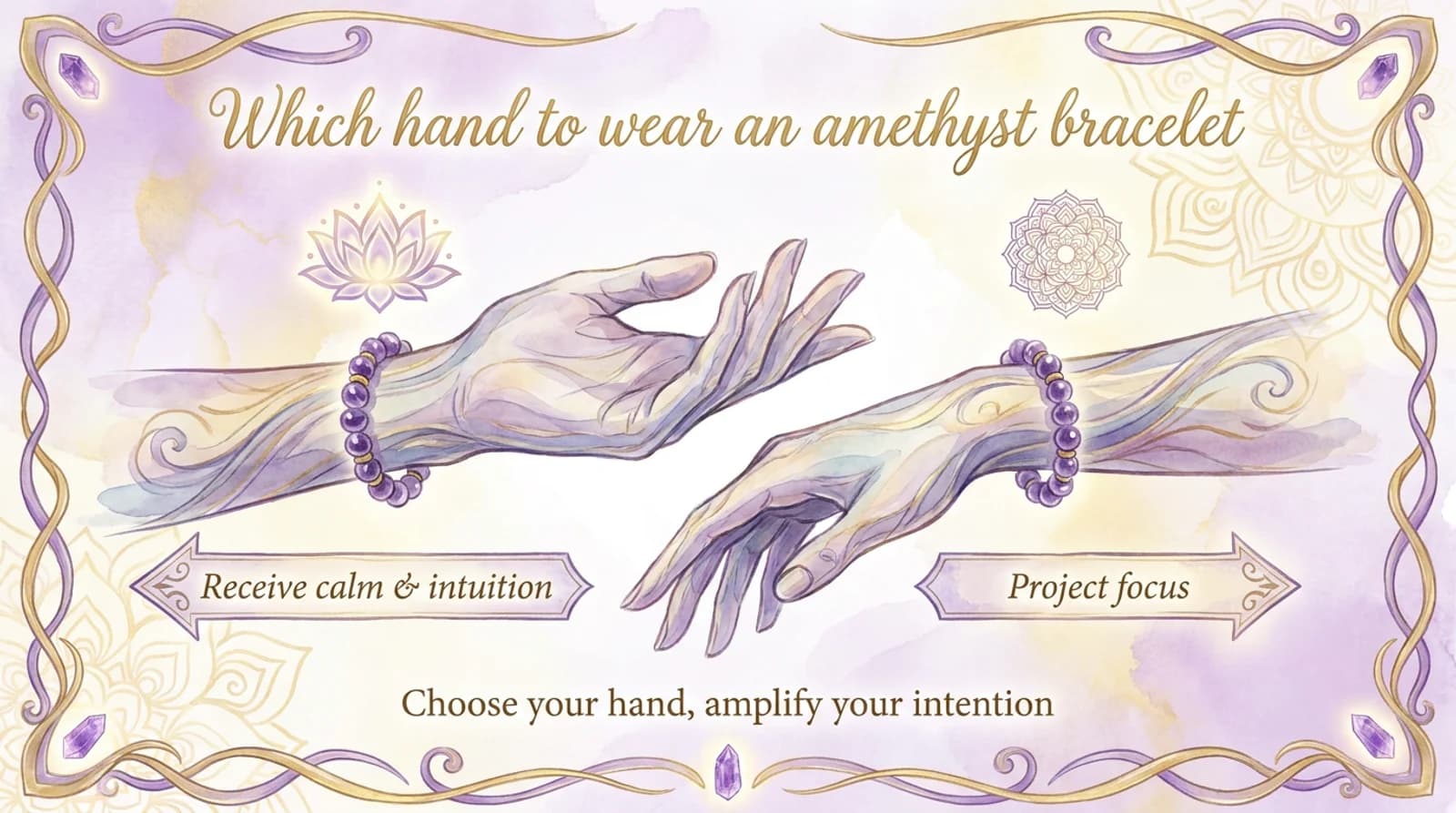
Which Hand Should You Wear an Amethyst Bracelet On?
Wear an amethyst bracelet on your left wrist if you want to receive its calming qualities: better sleep, lower anxiety and emotional balance. Wear it on your right or dominant hand if you want to project outward: sharper focus, willpower and clear decision-making. In Indian crystal tradition the left side is the receiving, intuitive side and the right is the active, giving side, so your goal decides the hand.
This is a belief-based guideline from Vedic and metaphysical practice, not a medical rule. An amethyst bracelet is a wellness and intention tool, not a treatment for any condition. If a particular hand feels more comfortable for everyday wear, that matters more than a rigid rule, because the calm you feel comes largely from the ritual and intention you bring to it.
| Want calm, sleep, anxiety relief | Left wrist (receiving side) |
| Want focus, willpower, drive | Right / dominant hand (projecting side) |
| No strong goal, daily wear | Whichever wrist is comfortable |
| Tradition behind it | Left = receive, Right = give/project |
| Chakra link | Third-Eye (Ajna) & Crown (Sahasrara) |
| Planetary link | Saturn (Shani) |
Left vs Right Wrist: What Actually Differs
The left-versus-right idea rests on a simple energy model used across Indian and Western crystal traditions. The left hand is treated as the passive, receiving side that draws a stone's energy inward, while the right or dominant hand is the active, projecting side that sends your intention outward into the world. Amethyst is mainly a calming, settling stone, so most wearers choose the left wrist by default.
| Aspect | Left Wrist | Right / Dominant Hand |
|---|---|---|
| Energy role | Receiving, absorbing inward | Projecting, giving outward |
| Best for | Sleep, anxiety, calm, intuition | Focus, willpower, decisions |
| Who it suits | Overthinkers, poor sleepers | Students, professionals, drivers |
| When to wear | Evening, bedtime, rest | Workday, study, meetings |
| Comfort note | Usually the non-writing hand | May catch on writing/typing |
Note that for left-handed people the dominant hand is the left, so the projecting side flips. If you are left-handed and want focus, wear it on the left; for calm, wear it on the right. The principle is dominant-hand-projects, non-dominant-receives, rather than a fixed left-equals-calm law. When in doubt, lead with intention and pick the wrist that lets you wear it consistently.
The Chakra and Shani Context Most PDPs Bury
Amethyst is the classic Third-Eye (Ajna) and Crown (Sahasrara) chakra stone. The Third Eye is associated with intuition, clarity and mental focus, while the Crown is linked to calm, perspective and a quiet mind. This is why amethyst is reached for in equal measure to steady racing thoughts and to sharpen concentration, the two ends of the 'Focus, Calm and Intuition' triad.
In Vedic astrology amethyst (jamunia) is connected to Saturn (Shani), the planet of discipline, patience and slow, steady progress. Saturn's lesson is grounding and self-control, which maps neatly onto amethyst's traditional use for emotional balance and resisting impulsive reactions. This is why the stone is often suggested for anxious overthinking and for building calm focus rather than quick, fiery energy.
| Sanskrit / trade name | Jamunia |
| Primary chakras | Third-Eye (Ajna) + Crown (Sahasrara) |
| Planet (Jyotish) | Saturn / Shani |
| Element association | Air / Wind |
| Traditional themes | Calm, focus, intuition, discipline |
| Mineral fact | Purple quartz (SiO2), coloured by iron |
These chakra and planetary links are part of a traditional belief system, not clinical science. There is limited scientific evidence that wearing any crystal changes body or brain chemistry. What users consistently report is a steadier, calmer feeling, an effect well explained by intention, ritual and the placebo response. Treat the chakra-Shani framing as meaningful symbolism, not as medicine.
Pick Your Hand by What You Want
Rather than memorise rules, match the hand to your single most important goal. Wearing the bracelet with a clear intention, and even saying it once as you put it on, is the part most practitioners say matters most. Here is a quick goal-to-hand map for the common reasons people buy an amethyst bracelet in India.
| Your Goal | Hand | Why |
|---|---|---|
| Sleep better / late-night phone overthinking | Left | Receive calm before bed |
| Anxiety, irritability, mood swings | Left | Absorb settling energy |
| Exam / work focus and concentration | Right (dominant) | Project mental drive |
| Self-control, breaking impulsive habits | Right (dominant) | Channel Shani discipline outward |
| Meditation and intuition practice | Left | Open receiving, Third-Eye |
| General everyday wellbeing | Either | Comfort and consistency win |
You can also rotate by routine, left wrist at night for sleep and right hand during the workday for focus, though most people keep it simple and pick one wrist. Pair it with a habit you already have, like putting it on after your morning bath, so you wear it consistently. Consistency and intention do more than the exact wrist you choose.
Daily Wear, Sleep and Combining Stones
- 1Start with a single intention
Hold the bracelet, take one slow breath and silently name what you want, calm or focus, before sliding it on. This sets the ritual that does most of the work.
- 2Wear it through the day
Amethyst is gentle and suits all-day wear. There is no traditional limit on hours, so wear it as long as it stays comfortable.
- 3Sleeping with it is fine
You can wear an amethyst bracelet while sleeping, and many wear it on the left wrist specifically for rest. If the stretch cord or beads feel uncomfortable, keep it on the bedside table near your pillow instead.
- 4Remove for water and chemicals
Take it off for swimming, perfume, sanitiser and harsh cleaning products to protect the colour and the elastic cord.
- 5Combine thoughtfully
Amethyst pairs calmly with clear quartz, rose quartz or moonstone. Avoid stacking it with very high-energy or conflicting rashi stones unless an astrologer guides you.
A common question is how long to see effects. Many wearers describe feeling a little calmer within the first few days, while a steadier mood or sleep pattern is usually noticed over two to four weeks of daily wear. These timelines are anecdotal and vary by person. An amethyst bracelet supports a calm routine; it is not a substitute for medical, financial or professional advice, and persistent anxiety or sleep problems deserve a doctor's input.
Caring for It and Spotting Real vs Fake
Care is simple. Amethyst is water-safe for a quick rinse, but its purple colour can fade in prolonged direct sunlight, so cleanse under moonlight or running water, avoid perfume and harsh chemicals, and keep the elastic cord dry to preserve stretch. A monthly moonlight cleanse, ideally on a full-moon night, is the traditional way to reset and recharge the stone's intention.
Authenticity matters because dyed glass and synthetic purple beads are common online. Genuine amethyst shows subtle colour-zoning, lighter and darker bands within and across beads, rather than one flat, uniform purple. Real stone also feels cool to the touch and warms slowly, while glass warms fast. Hold beads to the light and look for natural tonal variation; perfectly even colour with tiny round air bubbles points to glass.
| Test | Natural Amethyst | Dyed Glass / Fake |
|---|---|---|
| Colour | Subtle zoning, tonal variation | Flat, uniform, often too vivid |
| Temperature | Cool, warms slowly | Warms quickly to skin |
| Inclusions | Natural wisps, slight cloudiness | Round trapped air bubbles |
| Sunlight over time | May gently soften in tone | Colour can wash out or peel |
| Proof | Per-piece third-party lab certificate | Self-asserted '100% certified' badge |
This is where a downloadable, per-piece lab certificate beats a generic badge. Every DivineTatva amethyst bracelet is Jaipur-made and ships with its own third-party certificate confirming it is natural amethyst, so you are not relying on a seller's word or an unrelated external link.
Who Should Wear It, and Who Should Be Cautious
Amethyst is considered a gentle, broadly suitable stone, so almost anyone drawn to calm, focus or better sleep can wear it. In Jyotish it is most often suggested for those linked to Saturn, and for the zodiac signs Capricorn (Makar) and Aquarius (Kumbh), whose ruling planet is Saturn. Others wear it simply for its calming reputation rather than for any rashi rule, which is perfectly fine.
| Best suited zodiac (Jyotish) | Capricorn (Makar), Aquarius (Kumbh) |
| Common wearers | Students, overthinkers, poor sleepers |
| Wear with intention for | Calm, focus, sleep, intuition |
| Use caution / consult first | Strong conflicting rashi stones, astrologer advised |
| Side effects | None proven; stop if skin irritation occurs |
| Not a substitute for | Medical, financial or professional advice |
There is no proven physical side effect from wearing amethyst. A few people are simply sensitive to new stones and report feeling restless or over-stimulated at first; if that happens, wear it for shorter periods and build up. As with any bracelet, stop if you notice skin irritation from the cord or beads. If you are layering stones for a specific astrological goal, a quick check with an astrologer avoids combining conflicting energies.
Frequently asked
Last reviewed: 17 May 2026 · Verified by the DivineTatva expert panel
Which hand should I wear an amethyst bracelet on?
Wear it on your left wrist to receive calm, better sleep and reduced anxiety, since the left is the receiving side in crystal tradition. Wear it on your right or dominant hand to project focus, willpower and discipline. For left-handed people the sides flip, because the rule is really dominant-hand-projects, non-dominant-receives. If you have no strong goal, pick the wrist that stays comfortable for daily wear.
Can I wear an amethyst bracelet while sleeping?
Yes. Amethyst is gentle and is one of the most popular stones to wear at night, usually on the left wrist, for its calming, sleep-friendly reputation. If the stretch cord or beads feel uncomfortable against your wrist, simply place the bracelet on your bedside table near your pillow. Any sense of better rest comes from a calm bedtime ritual, not a proven medical effect.
Does an amethyst bracelet really work, and how long until I see effects?
Many wearers report feeling calmer within a few days, with steadier mood or sleep noticed over two to four weeks of daily wear. These are anecdotal experiences explained by intention, ritual and the placebo response, not clinical proof. There is limited scientific evidence that crystals alter body chemistry. Treat it as a supportive wellness habit, not a substitute for medical or professional advice.
How do I tell if my amethyst bracelet is real or fake?
Genuine amethyst shows subtle colour-zoning and tonal variation rather than one flat, dyed purple. Real stone feels cool and warms slowly, while glass warms fast to the touch. Look through beads at the light: natural wisps and slight cloudiness suggest real amethyst, while perfectly even colour with tiny round air bubbles points to glass. A per-piece third-party lab certificate is the most reliable proof.
How do I cleanse and charge an amethyst bracelet?
Amethyst is water-safe for a quick rinse, but its purple colour can fade in prolonged direct sunlight. Cleanse under moonlight or running water, avoid perfume and harsh chemicals, and keep the elastic cord dry to preserve stretch. A monthly moonlight cleanse, ideally on a full-moon night, is the traditional way to reset the stone. Avoid leaving it in strong direct sun to charge.
Who should wear an amethyst bracelet, and who should avoid it?
Amethyst suits almost anyone seeking calm, focus, sleep or intuition, and in Jyotish it is linked to Saturn and the signs Capricorn (Makar) and Aquarius (Kumbh). It has no proven side effects. A few people feel restless with a new stone at first; wear it for shorter periods if so. If you are combining it with strong conflicting rashi stones, check with an astrologer first.
What is the price of a certified amethyst bracelet in India?
Natural amethyst bracelets in India typically range from a few hundred to a couple of thousand rupees, depending on bead size (8mm is popular), colour grade and certification. A genuine lab-certified, natural piece costs more than dyed-glass lookalikes because you are paying for verified stone and a per-piece certificate. DivineTatva bracelets are Jaipur-made, ship with COD, and include a downloadable third-party certificate.
Reviewed by the DivineTatva expert panel
Written and reviewed by DivineTatva's consulting Vedic astrologer. Every piece is lab-certified and energised in our Jaipur atelier. Last updated 15 March 2026.