Real vs Fake Evil Eye Bracelet: How to Check Glass Quality Before You Buy
There is no 'natural evil eye stone' — the charm is always glass. 'Real vs fake' means quality glass versus cheap plastic. Quality evil eye glass has sharp, defined concentric rings; a perfectly smooth, cool surface; proper weight; and does not fluoresce under UV. Printed plastic beads, blurry rings, lightweight feel and no return policy are the clearest red flags.
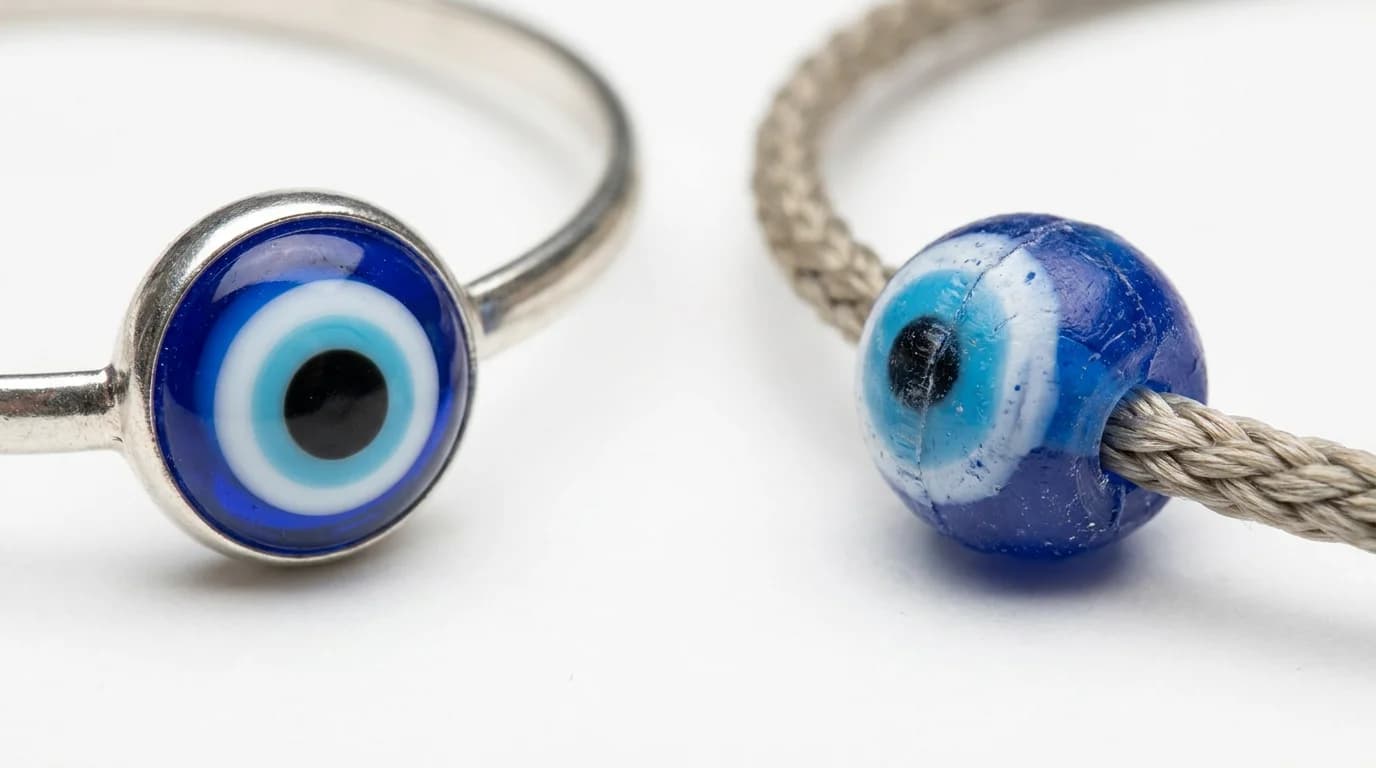
What 'Real vs Fake' Actually Means for Evil Eye Bracelets
When people ask whether an evil eye bracelet is 'real' or 'fake,' they are asking the wrong question in the wrong direction. The evil eye charm is not a gemstone — there is no naturally occurring mineral called an 'evil eye stone.' The charm is a glass bead, specifically a type called lampwork glass, in which layers of coloured glass are applied over a flame to create the concentric ring pattern. So the evil eye charm is always glass by definition — the question is whether the glass is good quality or cheap, and whether the supporting beads are genuine crystal/semi-precious stone or dyed plastic.
A 'real' evil eye bracelet means: quality lampwork glass with sharp concentric ring definition, supporting beads of genuine semi-precious stone or crystal, proper stringing, and — from a Vedic perspective — Pran Pratishtha energisation. A 'fake' one means: printed plastic bead with a photo of concentric rings, cheap dyed plastic supporting beads, and thin string that breaks quickly.
Five Tests to Check Your Evil Eye Bracelet Quality
- 1Concentric ring clarity test
Hold the evil eye charm up to natural daylight or a lamp. Quality lampwork glass has sharply defined rings: a clear dark pupil, a clean white or light-blue iris, and a crisp deep-blue outer ring. The rings should be distinct and non-overlapping. Blurry, bleeding or smudged rings indicate cheap glass or a printed/painted surface on plastic.
- 2Surface smoothness test
Run a clean fingernail lightly across the surface of the charm. Quality glass is perfectly smooth — no ridges, no texture, no rough patches. It should feel glassy and cold. Plastic feels warm and may have slight texture or mould lines. A faint raised ring edge (from the lampwork process) is acceptable; visible ridge lines or a rough, pitted surface are not.
- 3Weight and temperature test
Hold the charm in your palm for five seconds. Quality glass is noticeably heavier than plastic of the same size, and stays cool rather than warming quickly to body temperature. A very light, fast-warming charm is almost certainly plastic or low-density resin.
- 4Supporting bead colour depth test
Tilt the supporting beads (crystal, lapis, onyx or other) in direct light. Genuine semi-precious beads have internal depth — you can see light interacting within the bead, not just coating it. Dyed plastic beads are uniformly surface-coloured with no internal variation. Check also whether colour fades noticeably after a few weeks of wear — genuine stone does not.
- 5UV light test
Use a UV torch (available cheaply online or at stationery shops) and shine it on the evil eye charm in a darkened room. Quality glass does not fluoresce — it remains dark or shows only a very slight blue tint. Cheap plastic or resin filling will often glow white, yellow or green under UV, revealing its synthetic composition.
Red Flags When Buying an Evil Eye Bracelet Online
Online marketplaces are full of evil eye bracelets at ₹50–₹150 that are almost always printed plastic. These are fine as cheap fashion jewellery but should not be relied on as a nazar kavach — blurry rings and lightweight plastic do not meet the reflective-surface standard that traditional practice requires.
| Price under ₹200 | Almost certainly printed plastic or very low-grade glass with no supporting bead quality |
| No return policy | A seller confident in their quality offers returns; no returns on ritual jewellery is a red flag |
| No material description | If the listing does not specify 'lampwork glass' or similar, assume the worst |
| 'Crystal evil eye' | There is no crystal evil eye stone — if the listing claims a crystal focal bead, it is misleading |
| Blurry product photos | Low resolution images often hide poor concentric ring definition — request close-up if unsure |
| No energisation mention | From a Vedic standpoint, an un-energised bracelet is just decorative; energisation matters for ritual use |
| No care instructions | Quality bracelet sellers provide care guidance; the absence suggests a disposable product |
Quality Glass vs Cheap Plastic vs Crystal-Bead Variants
| Feature | Quality lampwork glass | Cheap plastic/printed | Crystal bead variants |
|---|---|---|---|
| Concentric rings | Sharp, defined, layered — visible from any angle | Blurry, printed on surface, fade over time | N/A — no evil eye focal bead; supporting beads only |
| Surface feel | Cool, perfectly smooth, glassy | Warm, sometimes textured, mould lines possible | Varies by crystal type — smooth to faceted |
| Weight | Heavy for size, stays cool | Lightweight, warms quickly in hand | Heavier than plastic; lighter than glass of same size |
| UV fluorescence | None or minimal blue tint | Often glows white or green | Varies by stone; most genuine crystal does not fluoresce |
| Durability | Durable with care; replace if cracked | Scratches and fades within weeks | Durable; some crystals can chip on hard impact |
| Ritual appropriateness | Traditional and recommended for nazar kavach | Not considered effective in tradition (no reflective surface) | Supporting beads add crystal intention; charm still needs quality glass |
| Price range | ₹400–₹1500 for quality | ₹50–₹200 | ₹600–₹3000+ depending on crystal type |
DivineTatva's Quality Standard and Certificate
DivineTatva's Evil Eye Bracelet uses quality-certified lampwork glass for the focal charm. Before each bracelet is dispatched, the concentric ring definition, surface smoothness and bead weight are checked against our quality standard. If a charm does not pass, it is not used. Each bracelet ships with a per-piece quality certificate confirming these checks.
The supporting beads are genuine crystal or semi-precious stone (lapis lazuli, onyx, or crystal quartz depending on variant) — not dyed plastic. You can verify the supporting bead quality yourself using the colour depth test and weight test described above.
Physical care reminder: Wipe the evil eye glass charm and crystal beads with a dry or barely damp soft cloth — do not soak or use harsh cleaners. If the glass charm chips or cracks, replace the bracelet immediately — a damaged nazar kavach is considered spiritually weakened. Cleanse energetically with incense smoke (dhoop/loban) or sound (singing bowl) weekly.
Frequently asked
Last reviewed: 17 May 2026 · Verified by the DivineTatva expert panel
How can I tell if an evil eye bracelet is real glass or plastic?
Three quick tests: (1) Temperature — glass stays cool for longer in your palm; plastic warms up quickly. (2) Weight — glass is noticeably heavier than plastic for the same bead size. (3) Ring definition — quality glass has sharp, layered concentric rings; printed plastic has blurry, fading rings. If you have a UV torch, plastic often fluoresces under UV while quality glass does not.
Is there a natural evil eye stone I should look for?
No. There is no naturally occurring mineral called an 'evil eye stone.' The evil eye charm is always a glass bead — specifically lampwork glass, made by layering coloured glass over a flame. Any seller claiming a 'natural' or 'crystal' evil eye focal bead is either misleading you or using the term incorrectly. The 'real vs fake' question for evil eye is about glass quality versus cheap plastic, not natural stone versus synthetic.
What is lampwork glass in an evil eye bracelet?
Lampwork glass is a glass-bead making technique where soft glass rods are melted over a flame and wound around a mandrel to create layered, patterned beads. The concentric ring pattern of the evil eye charm is created by applying different colours of glass in sequence — dark pupil, white iris, blue outer ring — while the glass is molten and workable. This technique creates precise, deep ring definition that printed or moulded plastic cannot replicate.
Why do cheap evil eye bracelets fade so quickly?
Cheap evil eye bracelets use printed plastic or very thin painted glass. The printed pattern sits on the surface rather than being built into the bead's glass layers. Friction from daily wear, sweat, water exposure and UV light all degrade surface printing quickly — within weeks to months. Quality lampwork glass beads hold their colour and ring definition indefinitely because the design is integral to the glass, not applied to its surface.
Can I trust evil eye bracelets from marketplace sites?
Some sellers on marketplace sites sell genuine quality bracelets; many do not. Key checks: read the material description carefully (should say 'lampwork glass' or equivalent), check for a return policy, look for close-up product photos showing ring definition, and check seller reviews for comments on durability and material quality. DivineTatva sells on its own website with a per-piece certificate and 7-day returns for defective items.
Does the quality of the glass matter for spiritual effectiveness?
In Vedic and folk tradition, yes — the glass charm needs to function as a reflective surface to deflect the malevolent gaze. A blurry, opaque or plastic charm cannot mirror energy effectively. Traditional nazar kavach practice specifies clear, smooth, well-defined glass for this reason. From a psychological standpoint, a visually crisp, beautiful bracelet also holds your attention better than a faded plastic one — which directly affects how well the bracelet anchors your protective intention.
Reviewed by the DivineTatva expert panel
Written and reviewed by DivineTatva's consulting Vedic astrologer. Every piece is lab-certified and energised in our Jaipur atelier. Last updated 3 June 2026.