Karungali Mala Benefits: What Tradition Believes vs What Is Actually Verifiable
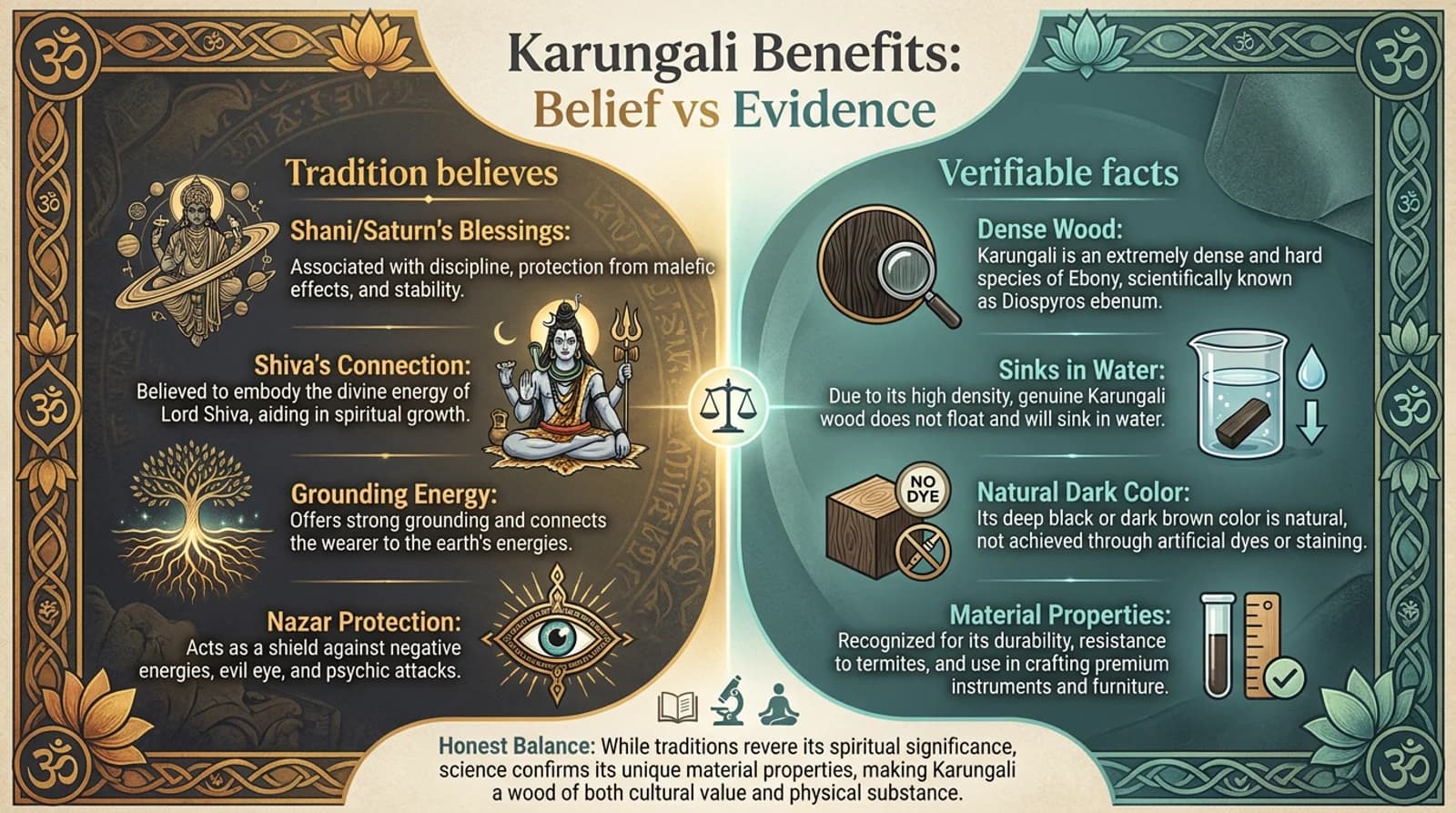
Karungali mala is a 108+1 bead japa mala made from karungali — the Tamil name for genuine ebony heartwood (Diospyros ebenum). Tradition links it to Shani (Saturn) and Lord Shiva for grounding, protection and meditation. Those are beliefs, not proven medicine. What is verifiable: it is dense black ebony that sinks in water, feels cool and bleeds no dye.
What Is a Karungali Mala (and What Does Karungali Mean)?
A karungali mala is a 108+1 bead japa mala made from karungali, the Tamil name for ebony heartwood (Diospyros ebenum) — a dense, naturally black wood. Karungali in English is simply ebony. The same wood is turned into 8mm stretch bracelets. In tradition it is worn as a Shani (Saturn) and Shiva remedy for grounding, protection and meditation; those are beliefs, not medical claims.
The mala has 108 counting beads plus one larger Sumeru (guru) bead that marks the start and end of a round. "Karungali" combines Tamil karu (black) and kali, and the wood is prized precisely because the heartwood is genuinely black through the grain — not surface-dyed. Bracelets typically use 8mm or 10mm beads on an elastic cord so one size fits most wrists.
| Tamil name | Karungali (karu = black) |
| English / botanical | Ebony / Diospyros ebenum |
| Part used | Dense black heartwood |
| Mala count | 108 beads + 1 Sumeru (guru) bead |
| Bracelet sizes | 8mm and 10mm beads, elastic cord |
| Associated planet/deity | Shani (Saturn) and Lord Shiva (belief) |
| Origin | Jaipur-made, lab material-certified |
Belief vs Verifiable Evidence: Read This First
Most karungali pages state spiritual claims as if they were proven facts. We separate the two clearly. On the left are materially verifiable facts about the wood — things you can test or have a lab confirm. On the right are traditional and astrological beliefs that we share honestly but cannot, and do not, prove.
| Claim | Verifiable fact (testable / lab-certified) | Traditional belief (not proven by science) |
|---|---|---|
| It is real ebony heartwood | Yes — dense Diospyros ebenum confirmed by lab certificate | — |
| Sinks in water | Yes — genuine dense karungali sinks; it does not float | — |
| No dye bleed | Yes — does not stain a damp white cloth; colour is natural | — |
| Cool to the touch | Yes — dense wood feels cool, with a faint woody (not chemical) smell | — |
| Calms Shani / Saturn troubles | No clinical proof | Believed to pacify Shani and ease Sade Sati |
| Protects from buri nazar (evil eye) | No clinical proof | Worn for protection from negativity and nazar |
| Grounds and steadies the mind | No clinical proof | Users report calm and focus consistent with ritual and intention |
| Aids meditation | Tactile, quiet counting tool — that much is real | Believed to deepen japa and mantra practice |
Bottom line: you can be certain you own genuine certified ebony. The spiritual benefits rest on Vedic tradition and personal belief — many wearers genuinely report calm, focus and a sense of protection, which is consistent with intention, ritual and the placebo response. A karungali mala is not a substitute for medical, financial or professional advice.
Traditional Karungali Mala Benefits, Honestly Framed
Here is what the Vedic and Tamil Siddha traditions associate with karungali. We present these as beliefs people hold and benefits wearers report — not as guaranteed or medically proven outcomes.
- 1Shani (Saturn) remedy
Black is the colour linked to Shani, so karungali is traditionally worn to pacify Saturn's influence during Sade Sati and dhaiya. A belief-based practice, not a guaranteed astrological fix.
- 2Grounding and stability
The dense, cool, heavy feel of ebony is said to feel steadying. Wearers often report calmer, more grounded focus — consistent with intention and ritual.
- 3Protection from negativity and nazar
Worn for protection from buri nazar (evil eye) and negative energy. A cultural belief, not a measurable shield.
- 4Meditation and japa
108 beads plus a Sumeru bead make it a genuine counting tool. The tactile rhythm can genuinely support a steadier mantra practice.
- 5Connection to Lord Shiva
Associated with Shiva and ascetic practice, valued by devotees for daily sadhana.
Does it "work"? Honestly: there is no clinical proof that any mala changes health, wealth or fate. What is real is that a daily ritual with a beautiful, certified object can support focus, intention and a sense of calm. Wear it for tradition and practice, not as a promised cure.
How to Verify YOUR Karungali Mala Is Real (Only Tests That Work)
Original karungali is dense ebony heartwood, and that gives you a few reliable at-home checks. Use these. Ignore the milk-soak, ghee-soak and "energy" tests some sellers promote — they prove nothing about the wood and can damage it.
- 1Water-sink test
Does original karungali sink in water? Yes. Drop a loose bead in a glass; genuine dense ebony sinks. Light, hollow or filler beads tend to float. (Don't soak a strung mala — test one spare bead and dry it.)
- 2No-colour-transfer rub
Rub the beads on a damp white cloth. Real karungali is naturally black and bleeds no dye. Colour streaks on the cloth mean dyed or painted wood.
- 3Smell check
It should smell faintly woody, not of paint, chemicals or strong perfume. A chemical smell suggests coating or treatment.
- 4Cool, dense feel
Genuine ebony feels cool and noticeably heavy for its size. Warm, light, plastic-feeling beads are a red flag.
- 5Ask for the certificate
The most reliable proof isn't a home test — it's a lab material certificate confirming Diospyros ebenum, with a batch number you can verify.
| Test | Reliable? | Why |
|---|---|---|
| Water sink | Yes | Density is a real physical property of ebony |
| White-cloth rub | Yes | Detects added dye on fake or low-grade wood |
| Smell | Yes | Flags chemical coatings and treatments |
| Lab certificate | Best | Confirms the species, not just the colour |
| Milk / ghee soak | No | Proves nothing; damages and stains the wood |
| "Energy" / pendulum test | No | Not measurable or repeatable |
Care while testing and after: karungali is ebony wood, so keep it dry — wipe with a soft cloth and occasionally a drop of coconut or sesame oil to nourish the beads; never soak in water and avoid soap, perfume or chemicals, and store in a cotton pouch.
Who Can Wear It, How to Wear It and Which Hand
Karungali has no rashi or gender restriction. Anyone — men and women — can wear a karungali mala or bracelet. Women can absolutely wear it; there is no traditional bar. The combo of a 108+1 mala for japa and an 8mm bracelet for daily wear is popular because it covers both practice and everyday protection.
| Who can wear it | Anyone — no rashi or gender restriction; women included |
| Mala — how to wear | Around the neck or hold for japa; roll beads toward you, one per mantra |
| Sumeru bead rule | Don't cross it — at the guru bead, turn the mala and reverse direction |
| Bracelet — which hand | Left wrist (the receiving side) is traditional; either hand is fine |
| Mala which hand for japa | Hold and turn beads with the right hand, draped over the middle finger |
| How many days to wear | No fixed rule; many begin on a Saturday (Shani's day) and wear daily |
| Combo | 108+1 mala for practice + 8mm bracelet for daily wear |
There is no mandatory waiting period or "number of days" before benefits — that is belief, not a rule. A simple, honest start: wear it with clean hands, set your intention, and if you do japa, complete rounds of 108 turning the mala at the Sumeru bead rather than crossing it.
Side Effects, Price and COD Across India
Are there karungali mala side effects? For almost everyone, no. It is inert wood worn on the skin or held for japa — there is nothing pharmacological about it. The only realistic issues are practical, and easily avoided.
- 1Rare skin sensitivity
As with any wood or elastic cord, a very small number of people may notice mild irritation. Remove it if you see redness.
- 2Water and chemical damage
The "side effect" most people actually hit is to the mala, not themselves — water, soap and perfume dry out and dull ebony. Keep it dry and lightly oiled.
- 3No guaranteed outcomes
The honest caution: don't expect it to fix health, money or relationships. It supports ritual and focus; it is not a substitute for medical, financial or professional advice.
| Karungali bracelet (8mm) | Affordable everyday price tier, in INR |
| Karungali mala (108+1) | Mid tier; price reflects bead size and certification |
| Mala + bracelet combo | Best value for practice plus daily wear |
| Certification | Jaipur lab material certificate with batch number and QR verification |
| Payment | Cash on Delivery (COD) available across India |
| Pricing | Consistent, transparent INR pricing — no render glitches |
Every DivineTatva karungali piece ships from Jaipur with a per-piece lab material certificate (batch number and QR verification), at consistent INR pricing, with COD available across India — so you pay for verified ebony, not a vague "certified" badge.
Frequently asked
Last reviewed: 17 May 2026 · Verified by the DivineTatva expert panel
What is karungali in English?
Karungali is the Tamil name for ebony — specifically the dense black heartwood of Diospyros ebenum. "Karu" means black. So a karungali mala is simply an ebony-wood mala. The wood is naturally black through the grain, not surface-dyed, which is one reason genuine karungali sinks in water and bleeds no colour onto a damp white cloth.
What are the real benefits of a karungali mala?
Verifiably, you get a genuine, certified, dense ebony counting tool that feels cool and grounding and supports japa. Traditionally, it is believed to pacify Shani (Saturn), aid meditation and protect from negativity and nazar. Those spiritual benefits are beliefs, not medically proven outcomes — many wearers report calm and focus consistent with ritual and intention.
Does original karungali sink in water?
Yes. Genuine karungali is dense ebony heartwood, so a real bead sinks rather than floats. Test one spare loose bead, not your strung mala, then dry it. Pair this with a rub on a damp white cloth — real karungali bleeds no dye. Avoid milk or ghee soak tests; they prove nothing and damage the wood.
Which hand should I wear a karungali mala or bracelet on?
A karungali bracelet is traditionally worn on the left wrist, considered the receiving side, though either hand is fine. For japa with the 108+1 mala, hold and turn the beads with your right hand, draped over the middle finger, and reverse direction at the Sumeru (guru) bead rather than crossing it.
Can women wear a karungali mala?
Yes. There is no rashi, caste or gender restriction on karungali. Women and men can both wear the mala or bracelet, including during a Shani period. It is inert ebony wood worn for tradition, grounding and meditation — there is no traditional rule barring anyone from wearing it.
Are there any side effects of wearing karungali?
For almost everyone, no — it is inert wood with nothing pharmacological about it. Rarely, sensitive skin may react to the wood or elastic cord; remove it if you see irritation. The bigger risk is to the mala: water, soap, perfume and chemicals dull ebony, so keep it dry, lightly oiled and stored in a cotton pouch.
How much does a karungali mala cost and is COD available?
Pricing is in INR and depends on whether you choose the 8mm bracelet, the 108+1 mala, or the value combo. DivineTatva keeps pricing consistent and transparent, and Cash on Delivery (COD) is available across India. Every piece ships from Jaipur with a lab material certificate carrying a batch number and QR verification.
Reviewed by the DivineTatva expert panel
Written and reviewed by DivineTatva's consulting Vedic astrologer. Every piece is lab-certified and energised in our Jaipur atelier. Last updated 14 May 2026.