How to Test if Your Karungali Mala Is Real or Fake: 5 Verifiable Home Tests (and 2 to Ignore)
Karungali (Tamil for ebony heartwood, Diospyros ebenum) is dense black wood made into 108+1 bead malas and bracelets. To test if yours is original, check five verifiable signs: it sinks in water, leaves no dye on a damp white cloth, feels cool, smells faintly woody, and is heavy for its size.
What an original karungali mala actually is
An original karungali mala is a string of 108+1 prayer beads turned from genuine ebony heartwood — Karungali is the Tamil name for Diospyros ebenum, the same tree the English word "ebony" describes. Authentic karungali is the dense black core (heartwood) of the tree, not the pale outer sapwood, and not dyed softwood, resin or plastic pretending to be black wood.
Because it is dense heartwood, real karungali has a set of physical properties you can verify yourself at home — it is heavier than ordinary wood, sinks in water, feels cool to the touch, smells faintly of wood rather than chemicals, and will not bleed black dye onto a damp cloth. These are material facts about the wood, separate from the traditional Shani (Saturn) and Shiva beliefs attached to it, which we cover honestly elsewhere.
| English name | Ebony heartwood |
| Botanical name | Diospyros ebenum |
| Tamil name | Karungali (karungali malai) |
| Part used | Dense black heartwood, not sapwood |
| Mala count | 108 beads + 1 Sumeru (guru) bead |
| Common bracelet | 8mm round stretch bead |
| Genuine smell | Faint woody — never chemical or perfumed |
5 verifiable tests for an original karungali mala
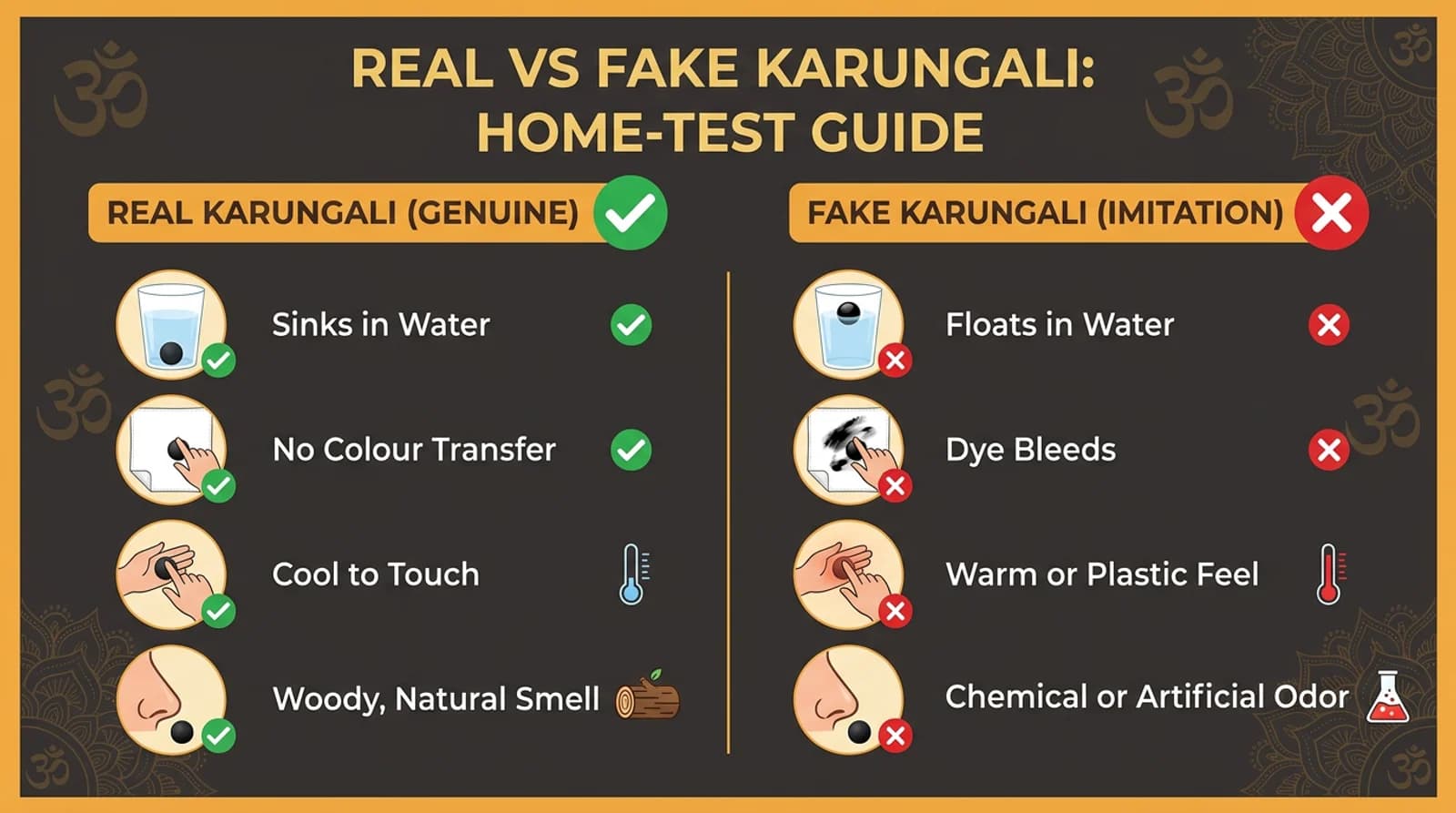
These five tests check the material itself, so you do not have to take any seller's word on trust. Do them gently on a single bead first. None of them harm a genuine mala, and together they are hard for a dyed or fake piece to pass.
- 1Water-sink test
Drop one bead (or the Sumeru bead) into a glass of plain water. Dense ebony heartwood is heavier than water and sinks. Light dyed softwood, hollow or plastic beads tend to float or bob. Remove and dry the bead afterwards — see the water-sink section below for the honest caveats.
- 2No-dye-bleed rub
Dampen a clean white cotton cloth and rub a bead firmly for 15-20 seconds. Real karungali is naturally black all the way through and leaves no colour. A black or grey smear means the bead was dyed to imitate ebony.
- 3Cool-to-touch test
Hold beads against your cheek or inner wrist. Dense wood draws heat from your skin and feels noticeably cool at first, then slowly warms. Plastic feels room-temperature or slightly warm and warms up almost instantly.
- 4Smell test
Warm a bead by rubbing it between your palms, then smell it. Genuine karungali gives a faint, dry, woody scent. A strong chemical, paint or sweet perfumed smell points to dye, coating or scented fake material.
- 5Density and weight test
Real ebony is one of the densest woods, so a genuine bead feels surprisingly heavy and solid for its size, with a hard "click" when two beads tap together — not the light, dull, hollow feel of plastic or low-density wood.
Pass all five and you almost certainly have genuine ebony heartwood. Fail the dye-bleed or smell test and you should ask your seller for a lab material certificate before wearing it as a remedy.
Does original karungali sink in water? Yes — with honesty
Yes — genuine karungali is dense ebony heartwood and normally sinks in plain water, which is why "does original karungali sink in water" is the single most searched authenticity test. It is a good first check. But we will be honest where most sellers are not: the water-sink test is useful, not magical, and it should never be your only test.
Air bubbles clinging to a freshly carved bead, sealing wax or oil coatings, and the surface tension on a very small light bead can occasionally make a real bead hesitate or a clever fake float oddly. Some dense dyed hardwoods can also sink. That is why we pair the sink test with the no-dye-bleed cloth rub and the smell test — material that sinks AND leaves no colour AND smells of wood, not chemicals, is the combination a fake struggles to fake.
| Bead type | In water | On white cloth | Smell |
|---|---|---|---|
| Genuine karungali (ebony heartwood) | Sinks | No colour transfer | Faint woody |
| Dyed softwood | Often floats | Black/grey smear | Often chemical |
| Dense dyed hardwood | May sink | May smear | Varies |
| Plastic / resin imitation | Floats or bobs | No transfer but feels warm | Plastic / sweet |
Read the table across, not down a single column. A bead is convincingly real only when it behaves like genuine karungali on all three checks at once.
2 popular tests you should ignore
Two tests circulate widely online and on competitor pages. Neither proves whether your wood is real ebony, and one can actually damage your mala. We list them so you can stop worrying about them.
- 1The milk or ghee soak "test"
Soaking beads in milk or ghee is a puja-style purification ritual, not a material test. It tells you nothing about whether the wood is ebony, and soaking karungali in any liquid — including milk, ghee or water — works against its care needs. Karungali is ebony wood, so keep it dry — wipe with a soft cloth and occasionally a drop of coconut or sesame oil to nourish the beads; never soak in water and avoid soap, perfume or chemicals, and store in a cotton pouch.
- 2The subjective "energy" or vibration test
Claims that a real mala will feel warm, tingly, vibrate or "shift your energy" the moment you hold it are subjective and unverifiable. Belief and intention are real parts of how people use a mala, but a feeling cannot tell dyed softwood from ebony heartwood. Use the five material tests for authenticity, and keep belief for your practice — not for QC.
Honest bottom line: verify the material with sight, weight, water and smell. Use ritual for meaning, not for testing.
Verifiable facts vs traditional belief
We separate what you can physically verify about karungali from what tradition believes about it. Both matter, but mixing them is how buyers get misled. Here is the honest split.
| Claim | Status | How you'd know |
|---|---|---|
| It is dense ebony heartwood | Verifiable fact | Weight, density, lab certificate |
| It sinks in water | Verifiable fact | Water-sink test |
| It does not bleed dye | Verifiable fact | Damp white-cloth rub |
| It feels cool, smells woody | Verifiable fact | Touch and smell tests |
| It is a Shani / Shiva remedy | Traditional belief | Vedic / metaphysical tradition |
| It grounds and protects from nazar | Traditional belief | Belief, intention, ritual |
| It guarantees luck, health or money | Not claimed | No scientific proof exists |
Many wearers report feeling calmer, more grounded or more focused while using karungali for japa — outcomes consistent with intention, ritual and the placebo response. We share the traditional Shani and protection beliefs because they are part of the culture, without claiming clinical proof. A karungali mala is a devotional and meditative aid, not a substitute for medical, financial or professional advice.
Why a lab certificate beats a badge
Home tests are strong, but they are presumptive — they tell you the wood behaves like ebony. A lab material certificate is the one check that confirms it on paper. This is where vague "Govt. Certified" or self-branded "AstroGrade" labels fall short: they name no lab, no test and no batch.
Every DivineTatva karungali mala and bracelet ships from Jaipur with a per-piece lab material certificate carrying a visible certificate image, a batch number and a QR code you can scan to verify the record. You get to run all five home tests AND hold the paperwork — belt and braces. If a seller cannot show a specific, scannable certificate, treat the price as the product and test rigorously before wearing it as a remedy.
| What to demand | Named lab + per-piece certificate |
| On the certificate | Material, batch number, QR verify |
| Red flag | Only a vague badge or no document |
| DivineTatva ships | Jaipur-made, lab-certified, QR-verifiable |
| Your home tests | All 5 still apply — verify both ways |
Buying and caring for a genuine karungali mala
Once you have verified the material, buying is simple. We offer the certified 108+1 bead mala and the 8mm karungali bracelet individually or as a mala-and-bracelet combo, with transparent INR pricing and Cash on Delivery (COD) available across India. No render-bug prices, no COD ambiguity — what you see is what you pay.
Care keeps a genuine mala genuine. Karungali is ebony wood, so keep it dry — wipe with a soft cloth and occasionally a drop of coconut or sesame oil to nourish the beads; never soak in water and avoid soap, perfume or chemicals, and store in a cotton pouch. Treated this way, real ebony beads deepen to a soft black sheen over years of japa.
| Mala format | 108 + 1 Sumeru bead |
| Bracelet | 8mm round stretch |
| Combo | Mala + bracelet available together |
| Pricing | Transparent INR, no hidden bug |
| Payment | COD across India |
| Certificate | Per-piece, QR-verifiable |
| Care | Dry wipe, light coconut/sesame oil, cotton pouch |
Frequently asked
Last reviewed: 17 May 2026 · Verified by the DivineTatva expert panel
How do I test an original karungali mala at home?
Run five quick material tests. Drop a bead in water — genuine ebony heartwood sinks. Rub it on a damp white cloth — real karungali leaves no dye. Hold it to your skin — it feels cool, then warms slowly. Rub and smell it — it should smell faintly woody, never chemical. Finally, weigh it in your hand — dense ebony feels heavy and solid for its size. Passing all five together is the reliable sign.
Does original karungali sink in water?
Yes — genuine karungali is dense ebony heartwood, so it normally sinks in plain water. It is a useful first test, but not a standalone one. Air bubbles, oil coatings or surface tension can occasionally make a real bead hesitate, and some dense dyed hardwoods also sink. Pair the sink test with the no-dye-bleed cloth rub and the smell test for a trustworthy result.
Is the milk or ghee soak a real authenticity test?
No. Soaking beads in milk or ghee is a puja-style purification ritual, not a material test — it tells you nothing about whether the wood is real ebony. It can also harm your mala. Karungali is ebony wood and must be kept dry; never soak it in any liquid. Use sight, weight, water-sink, dye-bleed and smell tests for authenticity, and keep ritual for your practice.
What does karungali mean in English?
Karungali is the Tamil name for ebony heartwood, botanically Diospyros ebenum. "Karungali" and "ebony" refer to the same dense black wood; "karungali malai" simply means karungali mala in Tamil. An original mala is turned from the tree's black heartwood core, not the pale outer sapwood and not dyed or plastic imitation, which is what the home tests help you confirm.
Can a fake karungali mala pass the water test?
Sometimes a dense dyed hardwood can sink, which is exactly why the water test alone is not enough. A genuine bead must sink AND leave no colour on a damp white cloth AND smell of wood rather than chemicals. Fakes rarely pass all three at once. If a sinking bead smears dye or smells chemical, it is not genuine ebony heartwood — ask for a lab certificate.
Why does a lab certificate matter if home tests work?
Home tests are strong but presumptive — they show the wood behaves like ebony. A per-piece lab material certificate confirms it on paper, with a named lab, batch number and a QR code you can scan. Vague "Govt. Certified" or self-branded grades name no lab or test. Every DivineTatva karungali piece ships from Jaipur with a scannable certificate, so you can verify both ways.
Will a real karungali mala give me guaranteed results?
No, and we will not claim it does. In Vedic and metaphysical tradition karungali is linked to Shani (Saturn) and Lord Shiva, grounding and protection from negativity or nazar. Many wearers report feeling calmer or more focused during japa — consistent with intention, ritual and placebo. There is no clinical proof of guaranteed outcomes. A mala is a devotional aid, not a substitute for medical, financial or professional advice.
Reviewed by the DivineTatva expert panel
Written and reviewed by DivineTatva's consulting Vedic astrologer. Every piece is lab-certified and energised in our Jaipur atelier. Last updated 14 May 2026.