Real vs Fake Kuber Potli: How to Identify a Genuine One Before You Buy
The market is flooded with cheap, incomplete Kuber Potlis sold at ₹99 or less. Here is exactly what to check to ensure you are buying a genuine, properly assembled ritual bag.
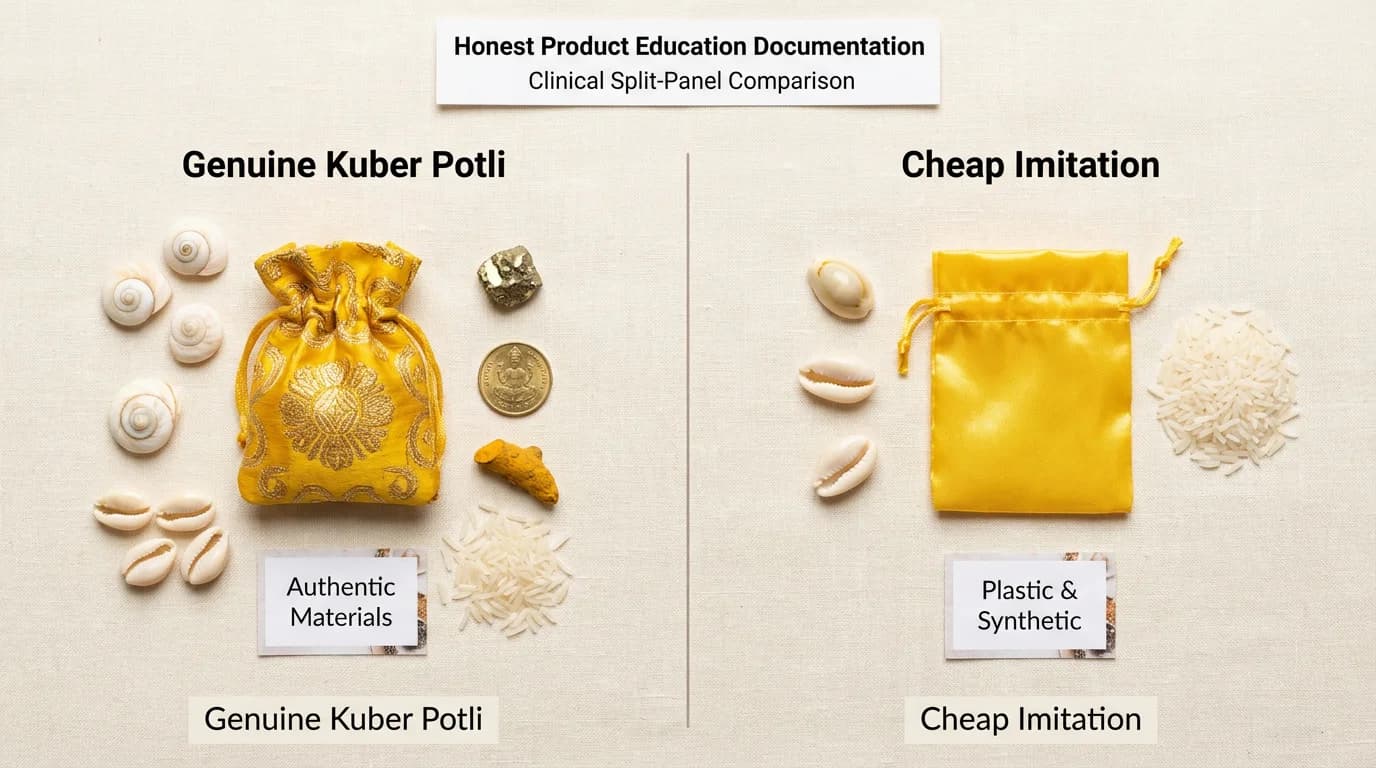
Why Fakes Are Widespread
Kuber Potlis are one of the most widely counterfeited ritual objects in India's online market. At ₹99–₹149, many listings on mass marketplaces contain plastic Gomti chakras, synthetic fabric, incomplete ingredient lists (often missing pyrite, akshata, or the Lakshmi coin), and no energisation whatsoever. Because the bag is sealed, the buyer cannot verify the contents before purchase — which makes it the perfect product for corner-cutting sellers.
Genuine vs Imitation: Item-by-Item Comparison
| Item | Genuine | Cheap Imitation |
|---|---|---|
| Potli fabric | Natural silk — smooth, slightly lustrous, cool to the touch | Polyester or synthetic — shiny in a plastic way, warmer to touch, pills easily |
| Gomti Chakra | Natural calcite disc from Gomti/Dwarka river — off-white, slightly rough, has natural markings | Moulded white plastic or resin — perfectly smooth, uniform, no natural variation |
| Cowrie shells | Natural shells — cream/ivory, varying sizes, small natural opening visible | Plastic shells — identical sizes, no opening, unnaturally white or coloured |
| Lakshmi coin | Brass or copper coin — heavy, slightly oxidised, embossed detail | Thin tin or aluminium — very light, may be painted rather than embossed |
| Pyrite chip | Natural pyrite — metallic gold lustre, irregular shape, heavy for its size | Often absent, or substituted with a painted pebble or golden-coloured plastic bead |
| Turmeric | Real haldi — yellow-orange, strong turmeric smell when potli is first opened | May be absent, or a yellow synthetic powder with no scent |
| Akshata (rice) | Unbroken whole rice grains, sometimes with vermilion tinge | Often absent entirely in cheap potlis |
| Red thread | Thick cotton Mauli thread — firmly tied | Thin nylon or absence of thread; bag simply tied with a ribbon |
| Energisation | Puja-performed before dispatch; seller can describe their process | None; straight off assembly line with no ritual involvement |
How to Check the Silk Quality
Real silk has a particular feel: smooth but not slippery, slightly cool against the skin, and with a natural sheen that shifts as the light changes. If the fabric looks uniformly shiny like a plastic bag — especially under indoor lighting — it is almost certainly polyester.
A simple home test (burn test) can confirm silk vs synthetic: pull a loose thread and hold it to a flame. Silk burns like hair — it chars slowly and smells of burning hair. Polyester melts and beads up, burning faster with a chemical smell. Do not burn the potli itself — only a spare loose thread.
How to Identify a Genuine Gomti Chakra
A real Gomti Chakra is a naturally occurring calcite disc. It will be off-white to cream in colour, slightly rough or matte on one side, with natural variations in size, shape, and surface markings. No two genuine Gomti Chakras are perfectly identical.
A fake Gomti Chakra is almost always perfectly round, uniformly smooth on both sides, bright white, and feels slightly hollow or very light. It may have a moulded line around the centre. If every Gomti Chakra in a batch looks identical, they are plastic. Natural stones always vary.
Natural vs Plastic Cowrie Shells
Genuine cowrie shells (Cypraea moneta) have a narrow slit-like opening on the underside with fine 'teeth' visible along the edges. The outer surface is ivory-cream with subtle natural patterns. Shells vary slightly in size. When you hold one, it is heavier than you'd expect for its size — the calcium shell has real density.
Plastic cowrie shells are identical in size, have no opening slit (the underside is flat or has a moulded ridge), are very lightweight, and may be bleached bright white or dyed in odd colours. If the shells in your potli feel like hollow plastic toys, they are not genuine.
Questions to Ask the Seller Before Buying
- 1What are the exact nine items inside?
A genuine seller will be able to list all contents. Vague answers like 'various sacred items' are a red flag.
- 2Is the Gomti Chakra natural or resin?
The correct answer is 'natural calcite from the Gomti or Dwarka river.' Any mention of resin, ceramic, or plastic means it is not genuine.
- 3What fabric is the bag made from?
The answer should be 'natural silk' with details on whether it is raw, mulberry, or art silk. 'Silk-like fabric' or 'satin' typically means polyester.
- 4Is it energised? What puja was performed?
A credible seller will describe a specific puja process. 'It is naturally energised' is not a meaningful answer.
- 5Where is it sourced or made?
Jaipur, Varanasi, and Mathura are centres of genuine ritual product making. Mass factories in other regions are more likely to cut corners on materials.
Frequently asked
Last reviewed: 17 May 2026 · Verified by the DivineTatva expert panel
Why do fake Kuber Potlis still sell so well?
Because the bag is sealed, buyers cannot verify contents before purchase. At ₹99, buyers assume they are getting a ritual object but receive a decorative bag with plastic items. The ritual significance is absent, but the buyer may not know what a genuine potli should feel like.
Can I open a potli to check the contents before activating it?
Yes, you can check contents before you seal and activate the potli. Once it is activated (tied and ritually closed), you should not open it. So verify before the activation ritual.
Is a ₹449 potli genuinely better than a ₹99 one?
In most cases, yes — the difference reflects real material costs. Natural silk, genuine Gomti chakra, natural cowrie shells, real pyrite, and actual turmeric and rice are all more expensive than plastic equivalents. A ₹449 potli with all genuine items is better value than a ₹99 one with plastic substitutes.
What should I do if I already bought a fake potli?
You can retire it respectfully (immerse in water or bury in soil) and replace it with a genuine one. There is no spiritual harm from having owned an inauthentic potli — you simply did not have the intended ritual object.
Are all expensive Kuber Potlis (₹1,000+) automatically genuine?
No. High price does not guarantee quality. Some sellers charge inflated prices for potlis with the same cheap materials. Always ask about specific contents and material sources, regardless of price.
Reviewed by the DivineTatva expert panel
Written and reviewed by DivineTatva's consulting Vedic astrologer. Every piece is lab-certified and energised in our Jaipur atelier. Last updated 21 June 2026.