Kuber Potli Benefits: What's Inside, Where to Keep & How to Activate
A Kuber Potli is a sealed ritual bag filled with nine sacred items linked to Lakshmi and Kuber — India's divine patrons of prosperity. Here is everything you need to know, explained clearly.
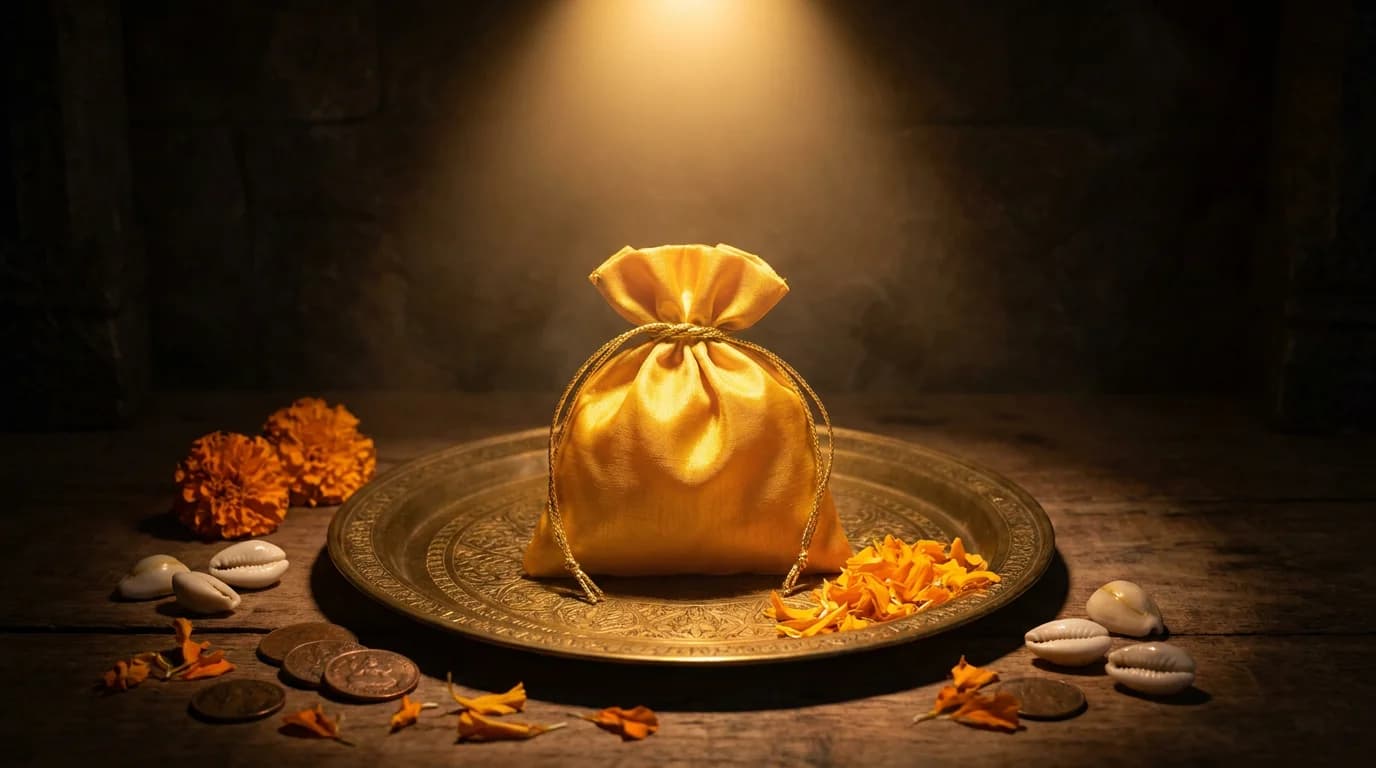
What Is a Kuber Potli — and what does it actually do?
A Kuber Potli is a small ritual bag — traditionally yellow or red silk — filled with nine items sacred to Goddess Lakshmi and Lord Kuber, the Hindu deity of wealth. It is kept in a cash drawer, locker, or wallet as a continuous devotional symbol of financial well-being, activated once during Pran Pratishta and renewed annually on Dhanteras or Akshaya Tritiya.
| Contents | 9 items: cowrie shells, Gomti Chakra, Lakshmi coin, pyrite, turmeric, red chilli, betel nut, clove, yellow mustard |
| Ruling deity | Kuber (north guardian, treasurer of the gods) + Lakshmi |
| Classical source | Rigveda (Kuber as lord of wealth); Atharvaveda (prosperity rituals) |
| Where to keep | North or north-east corner of cash locker, cash drawer or home safe |
| Activation day | Thursday (Brihaspativaar) or Dhanteras / Akshaya Tritiya |
| Renewal | Annually on Dhanteras — old potli immersed in flowing water |
| Price (DivineTatva) | ₹449 — 9 items, yellow silk, Pran Pratishta energised |
| What it is NOT | Not a magic charm; a physical sankalp anchor for prosperity intention |
Who Is Kuber — God of Wealth in Hindu Mythology?
Kuber (also spelled Kubera) is one of the Ashtadikpalas — the eight guardian deities who protect the eight cardinal directions. He guards the North, and in Hindu cosmology he is also the treasurer of the gods (Deva Koshadhyaksha). The Rigveda references him as lord of wealth, and later Puranas describe him as half-brother to Ravana and a devotee of Shiva who earned his divine status through rigorous penance.
Kuber is depicted as a pot-bellied figure holding a bag of gold coins (nidhi) in one hand and a jewel vessel in the other. He is often shown riding a man (indicating dominance over material obsession) and is flanked by Riddhi and Siddhi — prosperity and accomplishment. He governs the nine nidhis, or cosmic treasuries of abundance.
In practice, worshipping Kuber is considered complementary to Lakshmi puja. While Lakshmi brings the flow of wealth, Kuber is said to guard and preserve it. Together they represent earning and saving — a balance that underpins the ritual purpose of a Kuber Potli.
What's Inside: Every Item and What It Does
Each item in a genuine Kuber Potli has a distinct Vedic association. Below is what a nine-item DivineTatva potli contains and why each ingredient matters.
| Item | Vedic Significance |
| Cowrie shells | Currency of Lakshmi; used in ancient Indian trade |
| Gomti Chakra | Disc-shaped stone from the Gomti river; symbol of Vishnu's Sudarshana Chakra |
| Lakshmi coin | Embossed image of Goddess Lakshmi |
| Turmeric (Haldi) | Purifying agent used in every Hindu ritual |
| Rice / Akshata | Unbroken rice grains mixed with vermilion; offered in all yagnas |
| Pyrite chip | Iron sulphide with golden lustre; called 'Fool's Gold' |
| Red thread (Mauli) | Sacred thread tied at rituals; worn on wrist or tied around yantras |
| Yellow silk potli | Yellow is Kuber's colour; silk is a pure, non-animal-harming fibre |
| Red silk lining / red potli variant | Red is Lakshmi's colour in tantric tradition |
The combination of these items creates a self-contained ritual ecosystem. The cowrie and coin invite wealth; the Gomti chakra protects it; turmeric and akshata purify the space around it; pyrite amplifies the intention; and the red thread seals all of it inside the silk vessel.
Where to Keep Your Kuber Potli
Placement is the most important practical aspect of a Kuber Potli. Because it is associated with Kuber — guardian of the North — and Lakshmi — who resides in clean, elevated spaces — the bag must be kept somewhere respectful, clean, and ideally in the northern or northeastern zone of your home or business.
| Location | Vastu Rating | Notes |
|---|---|---|
| Cash drawer or cash box | Excellent | Most traditional placement; potli is in direct contact with money |
| Bank locker or home safe | Excellent | Ideal for long-term wealth protection; quiet and undisturbed |
| Wallet (inner pocket) | Very Good | Keeps wealth intention with you at all times; replace if wallet is crowded |
| Puja room / altar shelf | Very Good | Appropriate if you do not have a cash drawer; elevates the ritual status |
| Office desk drawer (north side) | Good | Connects to Kuber's directional domain; keep drawer tidy |
| Wardrobe shelf (north wall) | Moderate | Acceptable if cash drawer unavailable; ensure the shelf is clean |
| On the floor | Not Acceptable | Disrespects the divine energy; never place on the floor |
| Dusty shelf or corner | Not Acceptable | Stale, neglected energy contradicts the intention of the potli |
| Bathroom or kitchen countertop | Not Acceptable | Impure zones; avoid entirely |
The core rule is simple: keep the potli where money lives or where you make financial decisions. A cash drawer, locker, or wallet are all excellent choices. Avoid anywhere that feels neglected, dirty, or low to the ground.
How to Activate on Thursday with the Kuber Mantra
Thursday (Guruvar) is the auspicious day for Kuber puja in Hindu tradition. It is also the day of Brihaspati (Jupiter), the planet governing wealth, wisdom, and expansion in Jyotish astrology. Activating your Kuber Potli on a Thursday — ideally during the evening puja hour — aligns the ritual with the strongest planetary support.
- 1Cleanse yourself and your space
Take a bath, wear clean clothes (yellow or white preferred). Wipe the area where you will do the puja with a damp cloth and let it dry.
- 2Set up a small puja space
Place a yellow or red cloth on a clean surface. Light a ghee diya (lamp) and an incense stick — sandalwood or rose is ideal.
- 3Hold the potli in both hands
Cup the Kuber Potli in your joined palms. Close your eyes and set your sankalp — a clear, positive financial intention. Be specific: what you want to attract, protect, or grow.
- 4Chant the Kuber mantra 11 times
Aum Yakshaya Kuberaya Vaishravanaya Dhanadhanyadhipataye Dhanadhanyasamriddhim Me Dehi Dapaya Svaha. Chant slowly and with focus. 11 repetitions is the minimum; 108 is the traditional full count.
- 5Offer flowers and/or turmeric
Place a few marigold petals or a pinch of turmeric near the diya as an offering to Lakshmi and Kuber.
- 6Place the potli in its permanent location
After the puja, place the potli directly into your cash drawer, locker, or wallet. Do not leave it unplaced overnight.
- 7Maintain silence for a few minutes
Sit quietly for 2–3 minutes after placing the potli. This seals the sankalp and gives the intention time to settle.
The Kuber mantra translates roughly as: 'O Yaksha, O Kuber, O Vaishravana, Lord of wealth and grain — grant me prosperity and abundance.' Repeating it is an act of devotion, not a command. Approach it with humility and gratitude.
Does It Actually Work? An Honest View
We believe in being straightforward with our customers: a Kuber Potli is a devotional and ritual item. It is not a financial product. It does not guarantee income, investment returns, or debt relief. No sacred object can replace prudent financial planning.
What a Kuber Potli does offer is real, even if it is not transactional. Ritual creates intention. When you activate a potli and place it in your cash drawer, you are making a conscious, repeated commitment to your financial life. Psychologists call this 'priming' — the act of surrounding yourself with symbols that reinforce a mindset. For millions of Indians, keeping a sacred object in the cash box is a daily reminder to think carefully about money, to spend honestly, and to remain grateful for what is already there.
Many customers tell us that the potli changed something subtle — not their bank balance overnight, but their relationship with money. They became slightly more disciplined, slightly more aware. Whether that comes from Kuber's grace or from the ritual of setting an intention is a matter of personal faith. We respect both interpretations.
Our honest recommendation: buy a Kuber Potli as a meaningful devotional object, not as a financial shortcut. Use it alongside — not instead of — practical wealth-building habits.
Annual Renewal on Dhanteras and Akshaya Tritiya
The Vedic tradition recommends renewing the contents of a Kuber Potli once a year. Two auspicious days are ideal for this: Dhanteras (the first day of Diwali, dedicated to wealth and Lord Dhanvantari) and Akshaya Tritiya (the 'undying third' — considered the most auspicious day of the Hindu calendar for starting financial endeavours).
Renewal does not mean simply buying a new potli. It means respectfully retiring the old one — immersing it in flowing water or a river if it is worn out — and activating a fresh one with the same mantra and sankalp ritual. Think of it as an annual review: you revisit your financial intentions, acknowledge what has manifested, and reset your aspirations for the coming year.
If the potli is in good condition after a year — the silk is clean, the contents are dry and intact — you can simply refresh it by opening the puja ritual again without replacing the bag. The important thing is the annual act of conscious renewal.
Care Instructions
Keep the potli in your cash drawer, locker, safe, or wallet — never on the floor or in a dusty corner. Replace the potli contents annually on Dhanteras or Akshaya Tritiya for renewed energy. Do not open or disturb the potli unnecessarily — the sealed intention (sankalp) is part of its ritual power. If the bag gets wet or damaged, respectfully immerse in flowing water and replace.
Price and Value
The DivineTatva Kuber Potli is priced at ₹449 (MRP ₹799). At this price, you receive a hand-filled nine-item potli sourced from Jaipur, energised before dispatch, and packaged to keep the contents secure and clean.
Cheaper potlis available on mass marketplaces typically contain plastic Gomti chakras (not genuine calcite from the Gomti river), synthetic silk, and incomplete ingredient lists. The price difference between ₹99 and ₹449 reflects real material quality — genuine cowrie shells, a natural pyrite chip, real Gomti chakra, and actual silk fabric rather than polyester.
A Kuber Potli at ₹449 is also an honest price. We do not inflate MRP to manufacture a false discount. The savings from MRP reflect genuine festival pricing and direct-to-customer fulfilment from our Jaipur workshop.
Frequently Asked Questions
See the FAQ section below for answers to the most common questions about the Kuber Potli.
Frequently asked
Last reviewed: 17 May 2026 · Verified by the DivineTatva expert panel
Can I keep a Kuber Potli in my home if I am not Hindu?
Yes. The Kuber Potli is a cultural and devotional object, not a religious requirement exclusive to Hindus. Many people across faiths keep it as a symbol of positive financial intention. Respect for its traditional meaning is all that is required.
How many cowrie shells should be in a Kuber Potli?
Traditionally, 11 cowrie shells are considered auspicious, though some potlis use 7 or 21. What matters more than the exact number is that the shells are genuine (natural cowrie, not plastic) and that the overall potli contains all the key items.
Should I open the Kuber Potli to see what is inside?
No. Once sealed and activated, the potli should not be opened. The sealed state is part of the ritual — the sankalp (intention) is believed to reside within the closed bag. Opening it is said to disturb the energy. If you want to verify contents, check before the activation ritual.
What day is best to buy and activate a Kuber Potli?
Thursday (Guruvar) is the traditional day for Kuber puja. Dhanteras and Akshaya Tritiya are also highly auspicious. That said, any day when you are in a calm, positive frame of mind and can perform the ritual with full attention is acceptable.
Can I keep more than one Kuber Potli?
Yes. It is common to keep one in the home cash box and one in the office or business premises. Some people also keep a small potli in their wallet. There is no traditional restriction on multiples, as long as each is placed respectfully and activated with its own sankalp.
What happens if I accidentally drop the Kuber Potli on the floor?
Pick it up immediately, apologise to the deity (a simple 'sorry' with folded hands is enough), and place it back in its designated spot. If it falls on a particularly dirty area or becomes visibly soiled, it is advisable to respectfully retire it and replace it with a new one.
Can women keep a Kuber Potli during menstruation?
Traditional texts vary on this. In modern practice, most households follow their own family customs. If your household tradition involves not touching ritual objects during menstruation, keep the potli undisturbed in its usual place — it requires no daily handling.
Is pyrite the same as gold?
No. Pyrite (iron sulphide) is called 'Fool's Gold' because of its metallic golden appearance, but it has no monetary gold content. In the context of a Kuber Potli, pyrite is used symbolically — its golden energy is said to amplify prosperity intentions, not provide financial return.
How do I retire an old Kuber Potli?
The traditional method is to immerse the potli in a flowing body of water — a river or stream — with a prayer of gratitude. If that is not possible, you can bury it in soil or place it respectfully in a floral arrangement that will be composted. Do not throw it in regular rubbish.
Does DivineTatva energise the potli before shipping?
Yes. Each DivineTatva Kuber Potli is assembled and energised at our Jaipur workshop before dispatch. We perform a collective puja on Thursdays for all potlis being shipped that week. However, we also encourage customers to perform their own personal activation — your own sankalp makes the object specifically yours.
Reviewed by the DivineTatva expert panel
Written and reviewed by DivineTatva's consulting Vedic astrologer. Every piece is lab-certified and energised in our Jaipur atelier. Last updated 19 June 2026.
- Kuber Potli Benefits: Per-Item Vedic Significance Explained
- Where to Keep a Kuber Potli: Vastu-Approved Placements
- How to Activate a Kuber Potli: Step-by-Step Ritual Guide
- Real vs Fake Kuber Potli: How to Spot the Difference
- What Is a Gomti Chakra? The Sacred Stone Inside Your Potli
- Kuber Potli Price in India: What You Get at Every Tier