Real vs Fake Pyrite Anklet: Scratch, Streak & Magnetism Tests
The pyrite jewellery market has significant fakes — dyed resin, gold-painted glass, and the visually similar mineral chalcopyrite. Five simple tests, none requiring a lab, will tell you whether your anklet is genuine iron sulfide or an expensive imposter.
Why Fake Pyrite Is So Common
A real vs fake pyrite test is essential because genuine natural pyrite is far cheaper than gold yet carries a 'gold-like' visual appeal that makes counterfeiting profitable. Common imposters include: dyed golden resin beads (Mohs ~1.5, weightless, no streak), gold-painted glass beads (magnetic or not, very light), and chalcopyrite — a different copper-iron sulfide that looks similar but has distinct mineralogical properties. Lab certification is the only guaranteed proof; physical tests are your practical safety net.
Streak Test: The Most Reliable Home Test
Scrape a bead firmly across the back of an unglazed porcelain tile (bathroom tiles work — use the rough back face, not the glazed front). The powdered mineral left behind is the streak, and it reveals the stone's true colour independent of surface coating.
| Genuine pyrite streak | Greenish-black or brownish-black — this is diagnostic |
| Chalcopyrite streak | Black — similar to pyrite but no green tint |
| Gold streak | Golden yellow — would only appear on actual gold |
| Glass bead streak | White or colourless — glass leaves a white powder or no mark |
| Resin/plastic bead streak | White, may smear — very soft material |
| Surface-painted beads | Colour comes off unevenly on first pass — reveals white/grey base beneath |
Hardness Test: Copper Coin vs Pyrite
The Mohs hardness scale rates minerals from 1 (talc) to 10 (diamond). Genuine pyrite is 6–6.5. A copper coin is Mohs 3.5. If you press a copper coin edge firmly against a bead and drag it, it cannot scratch genuine pyrite — the coin will slide. Resin (Mohs ~1.5) and glass (Mohs ~5.5) will show a visible scratch. A steel nail (Mohs ~6.5) can just barely scratch pyrite; a piece of quartz (7) will scratch it cleanly.
| Pyrite Mohs | 6–6.5 — copper coin (3.5) cannot scratch it |
| Chalcopyrite Mohs | 3.5–4 — copper coin scratches it easily |
| Glass Mohs | ~5.5 — copper coin may scratch lightly |
| Resin/plastic Mohs | ~1.5–2 — fingernail scratches it |
| Gold Mohs | 2.5 — even a copper coin scratches gold easily |
Magnetism Test: Pyrite Is NOT Magnetic
Hold a strong neodymium magnet (available from any hardware store) close to the bead. Genuine pyrite is non-magnetic — it will not be attracted or repelled. If the bead snaps toward the magnet, you have iron filings embedded in resin, magnetite, or a magnetic metal core. A weak response may occur in some pyrite due to trace inclusions but should be minimal — significant attraction is a red flag.
Density Test: Pyrite Is Surprisingly Heavy
Pyrite has a specific gravity of 4.9–5.2 — roughly twice the density of glass and four times that of resin. A handful of genuine 8mm pyrite beads will feel noticeably heavier than you expect for their size. This is a subjective but reliable test once you have handled genuine pyrite. If your anklet feels light and rattles easily, it is likely resin or glass.
Crystal Structure: Cubic Faces Under Magnification
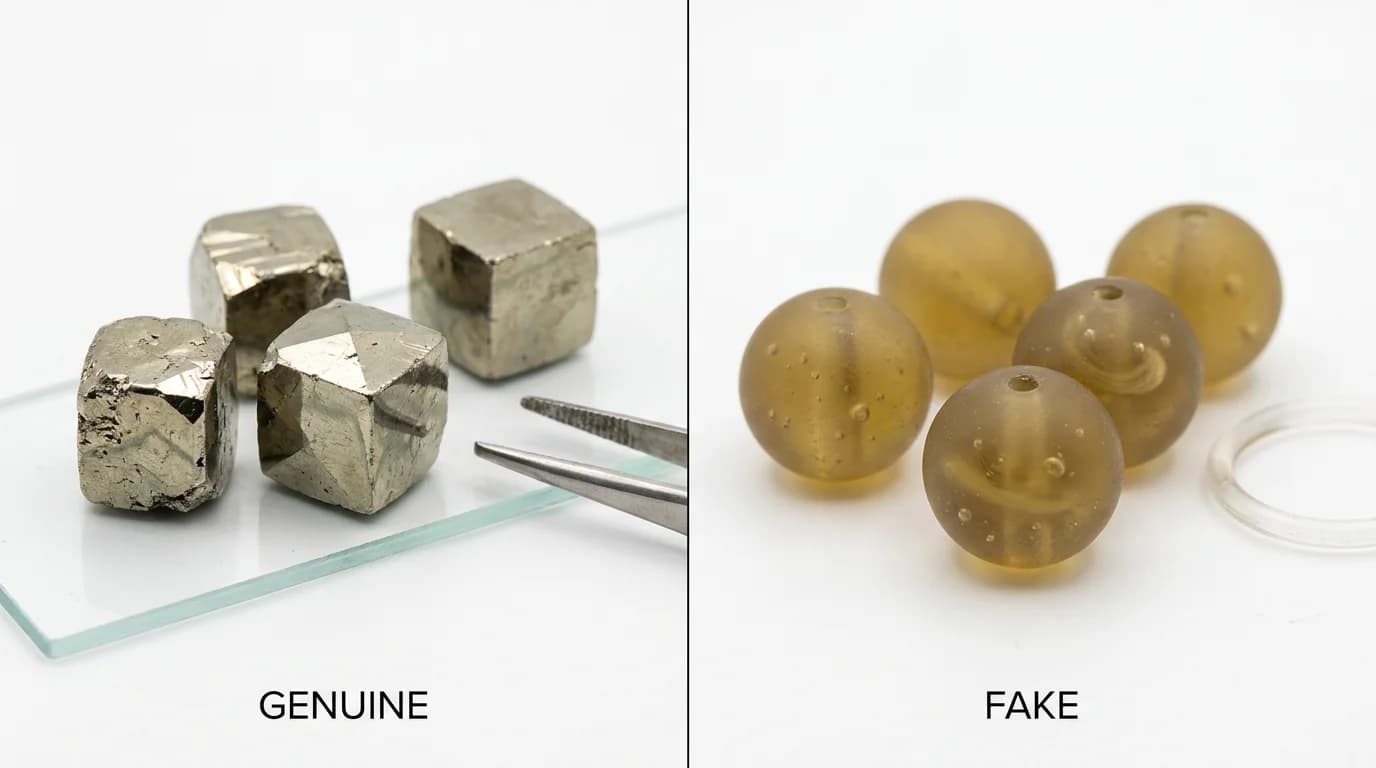
Pyrite crystallises in a cubic system — under a magnifying glass or phone macro lens, you will see flat faces, sharp right-angle edges, and a metallic mirror-like lustre on each facet. The surface has a natural variation of lighter and darker gold areas. Fakes show: bubbles or flow lines (glass), mould seams or a plasticky sheen (resin), or an unnaturally uniform satin finish (painted metal).
Pyrite vs Chalcopyrite vs Glass/Resin: Quick Reference
| Property | Real Pyrite | Chalcopyrite | Glass Bead | Resin Bead |
|---|---|---|---|---|
| Colour | Pale brass-yellow, metallic | Iridescent brass, often rainbow tarnish | Uniform gold-painted | Uniform golden |
| Streak | Greenish-black | Black | White/colourless | White, smears |
| Mohs hardness | 6–6.5 | 3.5–4 | ~5.5 | ~1.5–2 |
| Magnetic? | No | No | No (unless painted on iron) | Sometimes (if iron added) |
| Specific gravity | 4.9–5.2 (heavy) | 4.1–4.3 (heavy) | ~2.5 (light) | ~1.1–1.4 (very light) |
| Crystal faces | Cubic, flat, sharp | Irregular, tarnished iridescence | No crystal structure | No crystal structure |
| Lab certifiable? | Yes — FeS₂ confirmed | Yes — CuFeS₂ confirmed | No | No |
Frequently asked
Last reviewed: 17 May 2026 · Verified by the DivineTatva expert panel
What is the quickest single test for fake pyrite?
The streak test is fastest and most diagnostic. Scrape the bead across unglazed porcelain tile. Genuine pyrite leaves a greenish-black streak. Glass leaves white, resin smears white, and nothing else produces pyrite's specific greenish-black signature. You need only one tile and 10 seconds.
Is chalcopyrite the same as pyrite?
No. Chalcopyrite (CuFeS₂) is a copper-iron sulfide; pyrite is pure iron sulfide (FeS₂). Chalcopyrite often shows iridescent rainbow tarnish, has Mohs hardness of only 3.5–4 (a copper coin scratches it), and streaks black rather than greenish-black. In Vedic gem therapy they have different properties — chalcopyrite should not be sold as pyrite.
Can I trust an anklet sold as 'natural pyrite' without a certificate?
Trust but verify. Many legitimate sellers supply genuine pyrite without formal certification, but a lab certificate is the only confirmation that is independent of seller claims. At DivineTatva, every pyrite piece ships with a third-party mineralogical certificate — you should not have to guess.
My pyrite anklet is slightly magnetic — is it fake?
Very slight magnetic response is possible in natural pyrite containing trace inclusions of pyrrhotite (a magnetic iron sulfide). Significant attraction to a magnet — bead snapping toward it — is a red flag. Test with the streak and hardness tests to confirm. If it also streaks greenish-black and resists a copper coin scratch, it is almost certainly genuine pyrite with minor inclusions.
Will the hardness test damage my anklet?
Not if done correctly. Press a copper coin firmly but do not gouge. On genuine pyrite at Mohs 6–6.5, the coin will leave no mark on the bead — only a copper smear (from the coin) that wipes off. On a fake, you will see a scratch in the bead material itself.
Does pyrite's lustre fade over time?
Genuine pyrite does not fade the way painted fakes do — its metallic lustre comes from the mineral structure itself, not a surface coating. However, oxidation from moisture contact causes blackening and dullness. If the colour is fading uniformly (like paint peeling or washing off), your piece is likely coated resin or painted glass, not natural pyrite.
Reviewed by the DivineTatva expert panel
Written and reviewed by DivineTatva's consulting Vedic astrologer. Every piece is lab-certified and energised in our Jaipur atelier. Last updated 6 June 2026.