Pyrite Anklet Benefits, Which Ankle to Wear & How to Keep It Golden
Everything you need to know before buying a pyrite anklet: what it is, why the ankle matters in Vedic tradition, how to wear it for abundance, which rashi suits it best, how to tell real from fake, and the one care rule that keeps it golden.
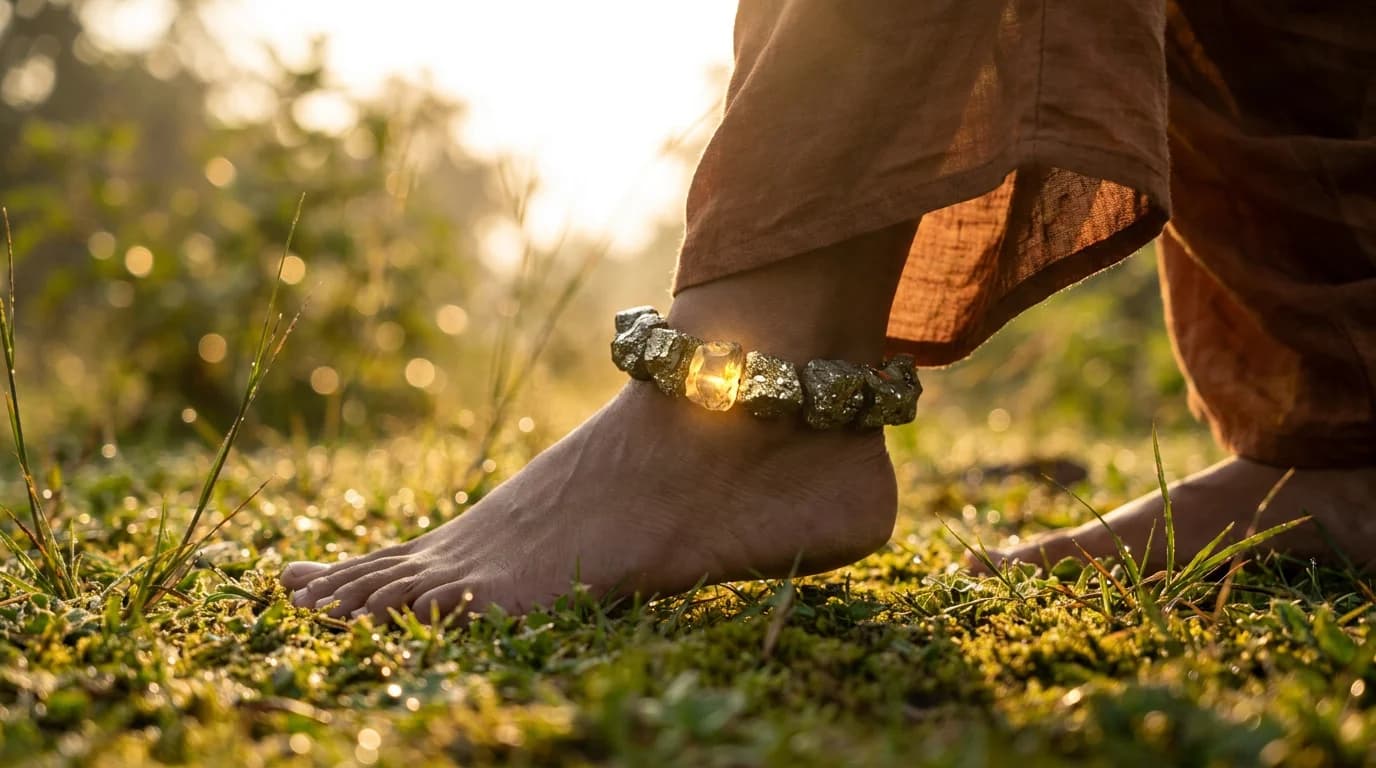
- What Is Pyrite (Fool's Gold)?
- Why the Ankle? Root Chakra & Earth Element
- Wealth & Abundance Benefits
- Left vs Right Ankle
- Rashi Compatibility (All 12 Signs)
- Real vs Fake Pyrite Tests
- Side Effects & Who Should Avoid
- Does It Work? Science vs Vedic Belief
- Critical Moisture Care
- Sizing & Fit Guide
- Anklet vs Bracelet: Which to Choose?
- Price Guide & What Lab-Certified Means
- The DivineTatva Difference
What Is Pyrite (Fool's Gold)?
Pyrite is an iron sulfide mineral (FeS₂) with a naturally cubic crystal structure that produces a bright, gold-coloured metallic lustre. Known as Fool's Gold because 18th-century miners mistook it for real gold, pyrite ranks 6–6.5 on the Mohs hardness scale — harder than a copper coin, softer than quartz. In Vedic gem therapy it is associated with the Sun and Mars, used as an affordable energetic substitute for gold when worn with intention.
| Chemical formula | FeS₂ (iron disulfide) |
| Crystal system | Cubic — often forms perfect cubes in nature |
| Colour | Pale brass-yellow with metallic lustre |
| Mohs hardness | 6–6.5 |
| Specific gravity | 4.9–5.2 (noticeably dense in hand) |
| Streak colour | Greenish-black on porcelain tile |
| Chakra association | Root (Muladhara) and Solar Plexus (Manipura) |
| Planet association | Sun (Surya) and Mars (Mangal) |
Why the Ankle? Root Chakra & Earth Element
In classical Vedic body mapping, the feet and ankles are the seat of the Muladhara (root) chakra and govern the Prithvi (earth) element. Wearing a grounding crystal like pyrite at the ankle is believed to anchor earth energy directly into the body's lowest energy centre, strengthening stability, security, and material manifestation. This is why traditional Indian women wear silver anklets (payal) — the ankle is already a culturally validated zone for energetic ornament.
Pyrite's golden-iron energy at the root chakra is said to bridge the earth element with Solar Plexus confidence, making it distinct from wearing pyrite at the wrist, which sits closer to the Heart chakra. Healers who work with both placements generally describe ankle pyrite as 'quieter but deeper' — oriented towards long-term financial stability rather than quick-acting willpower.
Wealth & Abundance Benefits
Pyrite is the most widely recommended crystal for abundance and financial intention-setting across both Western crystal healing and Indian Vedic gem traditions. Practitioners attribute its effectiveness to the iron-sulfide structure's ability to hold and reflect solar (yang) energy. Commonly cited benefits when worn as an anklet include enhanced motivation and action-taking around financial goals, reduction of fear-based money blocks, and a sense of grounded material confidence.
- 1Grounded abundance mindset
Root chakra activation is said to replace anxiety about money with a stable, earthy confidence — the foundation before wealth can accumulate.
- 2Willpower and follow-through
Solar Plexus resonance is linked to persistence and the ability to act consistently on financial goals rather than just setting intentions.
- 3Shielding from energy drain
Pyrite's metallic reflective surface is traditionally used as a 'mirror' to deflect negative or draining energies from the body's lower field.
- 4Career momentum
Particularly favoured by those in business, sales, and entrepreneurship who need sustained drive rather than explosive bursts.
- 5Attracting opportunity
The Vedic 'like attracts like' principle associates gold-coloured stones with drawing gold-class opportunities and people.
- 6Study and mental sharpness
Some practitioners recommend pyrite anklets during exam seasons for grounded mental clarity, linking earth-element stability with focused cognition.
Important honesty note: DivineTatva presents these as traditional Vedic and crystal healing beliefs, not as medically or scientifically validated outcomes. No crystal can substitute for financial planning, professional advice, or consistent effort.
Left vs Right Ankle: Which Side for Wealth?
In Vedic and most South Asian spiritual traditions, the left side of the body is the receiving channel — it absorbs energy from the earth, the universe, and the surrounding environment. The right side is the projecting channel — it sends your energy outward into the world. For abundance work, the left ankle is therefore recommended as the primary placement: you are receiving earth's grounding energy and drawing material abundance toward you rather than projecting it away.
| Left ankle | Receiving channel — draws earth energy, abundance, and stability inward |
| Right ankle | Projecting channel — sends grounded confidence outward into career/business |
| Both ankles | Permitted for balance but traditionally one stone is worn to maintain directional intention |
| Traditional payal placement | Bilateral silver, but energetic crystals are generally kept unilateral |
| Recommended for abundance | Left ankle — the most common Vedic guidance for pyrite |
Pyrite Anklet Rashi Compatibility — All 12 Signs
Pyrite's planetary rulership under Sun and Mars makes it strongly favourable for fire signs and earth signs ruled by these planets. Water signs — particularly Scorpio and Cancer — are advised to consult an astrologer before wearing, as the Sun-Mars energy can amplify rather than balance their native emotional intensity. The table below reflects classical Vedic jyotish guidance; personal birth charts may modify suitability.
| Rashi (Sign) | English | Ruling Planet | Pyrite Fit | Notes |
|---|---|---|---|---|
| Mesh (मेष) | Aries | Mars | Best | Mars-ruled — pyrite amplifies native drive and financial boldness |
| Vrishabh (वृषभ) | Taurus | Venus | Good | Earth sign grounding aligns well; supports material stability |
| Mithun (मिथुन) | Gemini | Mercury | Moderate | Mental energy boost for business ideas; don't overdo |
| Kark (कर्क) | Cancer | Moon | Caution | Sun energy can conflict with Moon sensitivity; test for 3 days |
| Simha (सिंह) | Leo | Sun | Best | Sun-ruled — natural affinity, boosts leadership and abundance |
| Kanya (कन्या) | Virgo | Mercury | Good | Earth-element resonance supports practical financial action |
| Tula (तुला) | Libra | Venus | Moderate | Useful for career decisions; balance with rose quartz |
| Vrishchik (वृश्चिक) | Scorpio | Mars/Ketu | Caution | Mars amplification can intensify Scorpionic intensity; consult astrologer |
| Dhanu (धनु) | Sagittarius | Jupiter | Good | Jupiter-Mars synergy supports expansion and wealth goals |
| Makar (मकर) | Capricorn | Saturn | Best | Earth sign + Saturn discipline = pyrite's strongest manifestation base |
| Kumbh (कुंभ) | Aquarius | Saturn/Rahu | Moderate | Stabilising for Rahu-influenced natives; use with caution if Rahu is strong |
| Meen (मीन) | Pisces | Jupiter | Moderate | Grounds Piscean dreaminess; useful for financial follow-through |
Real vs Fake Pyrite: 5 Tests You Can Do at Home
The market for pyrite jewellery contains significant quantities of dyed resin, gold-painted glass, and the visually similar mineral chalcopyrite sold as pyrite. Five simple tests — no lab required — will distinguish genuine pyrite from imposters.
- 1Streak test
Scrape the stone firmly across an unglazed porcelain tile (the back of a bathroom tile works). Genuine pyrite leaves a greenish-black streak. Fool's gold impostors like chalcopyrite streak black; glass and resin leave white or no streak.
- 2Hardness test
Try to scratch the bead with a copper coin (Mohs 3.5). Genuine pyrite at Mohs 6–6.5 will not be scratched — the coin slides off. Resin and glass fakes are softer and will show a scratch mark.
- 3Magnetism test
Hold a strong neodymium magnet near the bead. Genuine pyrite is NOT magnetic. If the bead is attracted, you have iron filings, magnetite, or a fake. (Note: pyrite may have trace magnetic response but not significant pull.)
- 4Weight/density test
Pyrite has a specific gravity of 4.9–5.2 — noticeably heavier than glass (2.5) or resin (1.1–1.4). A handful of genuine pyrite beads will feel surprisingly dense for their size. If the anklet feels light, be suspicious.
- 5Visual inspection
Natural pyrite has cubic crystal geometry visible under magnification — flat faces, sharp angles. Fakes often show bubbles (glass), mould lines (resin), or an unnaturally uniform colour without the mineral's characteristic brassy variation.
Side Effects & Who Should Exercise Caution
Pyrite anklets are generally safe physical ornaments, but a handful of practical and traditional concerns are worth knowing before purchase.
| Rust and blackening | Pyrite (iron sulfide) oxidises rapidly when exposed to moisture — sweat, water, or humidity — turning black and eventually forming rust-coloured iron oxide on the skin. This is the stone's chemistry, not a defect. Prevention: never wear during exercise, bathing, or in humid conditions. |
| Skin staining | Oxidation can leave a temporary yellow-brown or green tinge on the ankle skin. This washes off with soap and water and is not harmful. |
| Energy sensitivity | Some users report heightened restlessness or vivid dreaming in the first 1–2 weeks, attributed in crystal healing to the stone's activation energy. If this is disruptive, wear for shorter periods initially. |
| Ankle discomfort | Beaded anklets with a fixed circumference may feel tight if ankles swell in heat. Size correctly and remove if uncomfortable. |
| Astrology caution | Cancer and Scorpio rashis are traditionally advised to test for 3–7 days before committing to daily wear (see Rashi section). |
| Not a medical device | Pyrite anklets are cultural and ornamental objects. Do not substitute for medical, financial, or psychological professional advice. |
Does It Work? Science vs Vedic Belief — Our Honest View
Science does not validate the metaphysical claims made about pyrite or any crystal. No peer-reviewed study has demonstrated that wearing a mineral changes financial outcomes, chakra energy, or measurable health parameters. The effects reported by users — increased confidence, motivational clarity, a sense of being 'more grounded' — are consistent with well-understood psychological phenomena: the placebo effect, intention-setting, and the behavioural changes that follow deliberately adopting a symbol of commitment.
The Vedic tradition, by contrast, operates from a first-principles framework in which matter carries vibrational qualities (gunas) that interact with the body's subtle energy field (pranamaya kosha). Within that framework, pyrite's iron-sun-mars correspondence is internally consistent and has been practised for centuries. DivineTatva's position: both perspectives are honest. We supply lab-certified natural pyrite for those who choose to work within the Vedic belief framework, and we will never claim outcomes we cannot substantiate.
Moisture Care: The One Rule That Keeps Your Pyrite Golden
Wipe with a soft dry cloth only — never soak or expose to water, sweat, or perfume spray. Pyrite (iron sulfide) oxidises rapidly in moisture, turning black and forming rust. Remove before bathing, swimming, exercising, or sleeping. Polish gently with a dry chamois cloth to restore natural golden lustre. Recharge on a selenite plate monthly.
| Why pyrite rusts | FeS₂ reacts with water and oxygen to form iron hydroxides and sulfuric acid — the same process that rusts iron, but faster due to sulfur. |
| Speed of damage | A single 30-minute gym session with the anklet on can begin the blackening process. Recovery is difficult once deep oxidation sets in. |
| Storage | Store in a sealed pouch away from bathroom humidity. A silica gel sachet in the storage box extends lustre significantly. |
| Cleaning | Dry chamois or soft microfibre only. Never ultrasonic cleaners, steam cleaners, jewellery dip, or water rinse. |
| Recharging | Place on a selenite plate overnight once a month. Avoid sunlight charging (UV degrades bead threading over time). |
Sizing Your Pyrite Anklet
Measure your ankle circumference with a soft tape at the narrowest point (just above the ankle bone). Most Indian women's anklets are designed for 20–24 cm circumferences. DivineTatva's standard pyrite anklet fits 20–23 cm with the included extension chain. For reference, a comfortable anklet should sit just above the ankle bone with 1–1.5 cm of ease — loose enough to slide one finger underneath but not so loose it slips over the heel.
| XS (slim ankle) | 18–20 cm — measure carefully, may need custom order |
| Standard (most women) | 20–23 cm — covered by DivineTatva's extension chain |
| Large | 23–26 cm — extension chain + one additional link, request at checkout |
| Measuring tip | Measure in the evening when ankles are at their largest (heat causes slight swelling) |
| Bead size | 8mm — substantial enough to be visible but light enough for all-day wear (when conditions permit) |
Pyrite Anklet vs Bracelet: Which Should You Choose?
Both placements are valid in Vedic and crystal healing practice, but they serve different energetic purposes. Choose based on your primary intention.
| Factor | Pyrite Anklet | Pyrite Bracelet |
|---|---|---|
| Primary chakra | Root (Muladhara) — earth, stability, survival | Solar Plexus (Manipura) — willpower, action, confidence |
| Energy quality | Slow, deep, long-term abundance building | Fast, active, motivational bursts |
| Best for | Financial stability, property, grounded security | Business negotiation, quick decisions, career momentum |
| Visibility | Discreet — suitable for conservative workplaces | Visible — signals intention publicly |
| Traditional basis | Payal tradition — ankle ornaments are ancient in India | Western crystal healing influence; less Vedic precedent |
| Moisture risk | Higher — ankles sweat more and are closer to ground contact | Moderate — easier to remove before washing hands |
| Verdict | For deep, earthy wealth intention and root chakra work | For daily confidence and active manifestation |
Pyrite Anklet Price in India 2026 & What Lab-Certified Means
The Indian market for pyrite jewellery spans a wide price range, and price alone is not a reliable authenticity indicator. Here is an honest breakdown of what different price points typically deliver.
| Price Range | Typical Quality | Lab Certificate | DivineTatva Verdict |
|---|---|---|---|
| ₹100–₹299 | Dyed resin, gold-painted glass, or very low-grade chips | None | Avoid — not natural pyrite |
| ₹300–₹499 | Genuine pyrite possible but sourcing unverified, no certification | Rarely | Risk purchase — authenticity unclear |
| ₹500–₹699 | Natural pyrite, basic quality control | Sometimes | Acceptable entry tier |
| ₹699–₹1,299 | Lab-certified natural pyrite, quality beads, proper threading | Yes | DivineTatva tier — recommended |
| ₹1,300–₹2,500 | Premium grade, larger beads, sterling silver findings | Yes | Premium tier for serious practitioners |
| ₹2,500+ | Exhibition/collector grade or gold-filled findings | Yes | Luxury segment |
DivineTatva's pyrite anklet at ₹699 (MRP ₹1,299) sits at the entry of the lab-certified tier — the minimum price point at which you can be confident the stone is natural pyrite and has passed third-party mineralogical verification. Each piece ships with a printed lab certificate.
The DivineTatva Difference
DivineTatva is a Jaipur-based spiritual jewellery brand with lab certification at its core offering. Every natural stone piece ships with third-party mineralogical verification. We publish honest Vedic-vs-science frameworks in our learning content because we believe customers deserve both the traditional wisdom and the factual context to make their own choices. COD available across India.
- 1Lab certification on every piece
Third-party mineralogical certificate shipped with each anklet — not a branded card, an actual test report.
- 2Jaipur sourcing with traceability
Pyrite sourced from verified Indian mineral suppliers with documented provenance, not imported bulk unknowns.
- 3Honest content
We tell you what science says AND what Vedic tradition says — and clearly distinguish the two.
- 4COD across India
Cash on delivery available — buy, inspect, pay. No upfront trust required.
- 5Care-forward packaging
Every anklet ships in a moisture-sealed pouch with a care card and a silica sachet — because moisture is pyrite's enemy.
Frequently asked
Last reviewed: 17 May 2026 · Verified by the DivineTatva expert panel
Can I wear a pyrite anklet every day?
Yes, with one firm rule: remove it before any contact with water, sweat, or perfume. Daily wear in dry conditions — at a desk, in air-conditioning, during leisure — is fine. Wear it during exercise, cooking, bathing, or outdoor heat and oxidation begins quickly. Many practitioners remove it overnight as well.
Which ankle should I wear my pyrite anklet on?
The left ankle is traditionally recommended for abundance and wealth intentions in Vedic practice. The left side is considered the receiving channel — it draws earth energy and material abundance toward you. The right ankle is the projecting channel, better suited if your intention is to broadcast grounded confidence outward into career or business.
How do I know if my pyrite anklet is real?
Perform the streak test (greenish-black on porcelain), hardness test (copper coin cannot scratch Mohs 6–6.5 pyrite), and weight test (pyrite is noticeably dense). Best assurance is a third-party lab certificate. DivineTatva ships a mineralogical certificate with every pyrite anklet.
My pyrite anklet is turning black. What happened?
Blackening is iron sulfide oxidation — the chemical reaction between pyrite's iron content, moisture (sweat or water), and oxygen. It is irreversible once deep. Prevent it by removing the anklet before any activity that causes sweating or moisture exposure. Wipe with a dry cloth after every wear session.
Is pyrite anklet good for all rashi?
Pyrite suits Aries, Leo, Capricorn, and Taurus best, given Sun-Mars rulership and earth-sign compatibility. Gemini, Virgo, Sagittarius, and Pisces find it useful in moderate use. Cancer and Scorpio rashis should test for 3–7 days and ideally consult a Vedic astrologer before committing to daily wear.
Can men wear a pyrite anklet?
Absolutely. Pyrite has no gender association in Vedic gem therapy — it is governed by Sun and Mars, both considered masculine planets, making it arguably more aligned with traditional male energy archetypes. Cultural norms vary, but there is no spiritual restriction. Choose the left ankle for receiving abundance.
Does pyrite anklet attract money?
Within Vedic and crystal healing belief systems, pyrite is the most widely recommended stone for wealth manifestation — its iron-sun-mars signature is linked to drawing financial opportunity and building material confidence. Science does not validate this claim. We believe in honest disclosure: many users report increased motivation and confidence that correlates with better financial outcomes, which is consistent with what psychology calls the intention-setting effect.
What size pyrite anklet should I buy?
Measure your ankle circumference at the narrowest point above the ankle bone. DivineTatva's standard size with extension chain fits 20–23 cm, covering most Indian women comfortably. Measure in the evening when ankles are at their largest. Contact us for custom sizing if you fall outside this range.
How do I recharge a pyrite anklet?
Place the anklet on a selenite charging plate overnight, ideally once a month. Avoid water cleansing (pyrite oxidises), salt cleansing (abrasive to beads), or prolonged direct sunlight (degrades threading). Selenite is the safest and most widely recommended medium for pyrite.
What is the difference between pyrite and gold?
Real gold (Au) is a pure element with Mohs hardness 2.5 and specific gravity 19.3. Pyrite (FeS₂) is a sulfide mineral with Mohs 6–6.5 and specific gravity 4.9–5.2. Gold streaks gold-yellow; pyrite streaks greenish-black. Gold is ductile and bends without shattering; pyrite is brittle and chips. Gold does not oxidise; pyrite blackens in moisture. They share a golden appearance — the only real similarity.
Can I wear pyrite anklet and bracelet together?
Yes — many practitioners wear both. The anklet addresses root chakra grounding while the bracelet engages solar plexus confidence. If you are new to crystal work, start with one piece for 1–2 weeks before adding the second, so you can clearly observe each stone's effect before combining.
Reviewed by the DivineTatva expert panel
Written and reviewed by DivineTatva's consulting Vedic astrologer. Every piece is lab-certified and energised in our Jaipur atelier. Last updated 5 June 2026.