Turquoise (Firoza, फ़िरोज़ा) Bracelet: Benefits, Who Should Wear It, Real vs Fake and Price in India
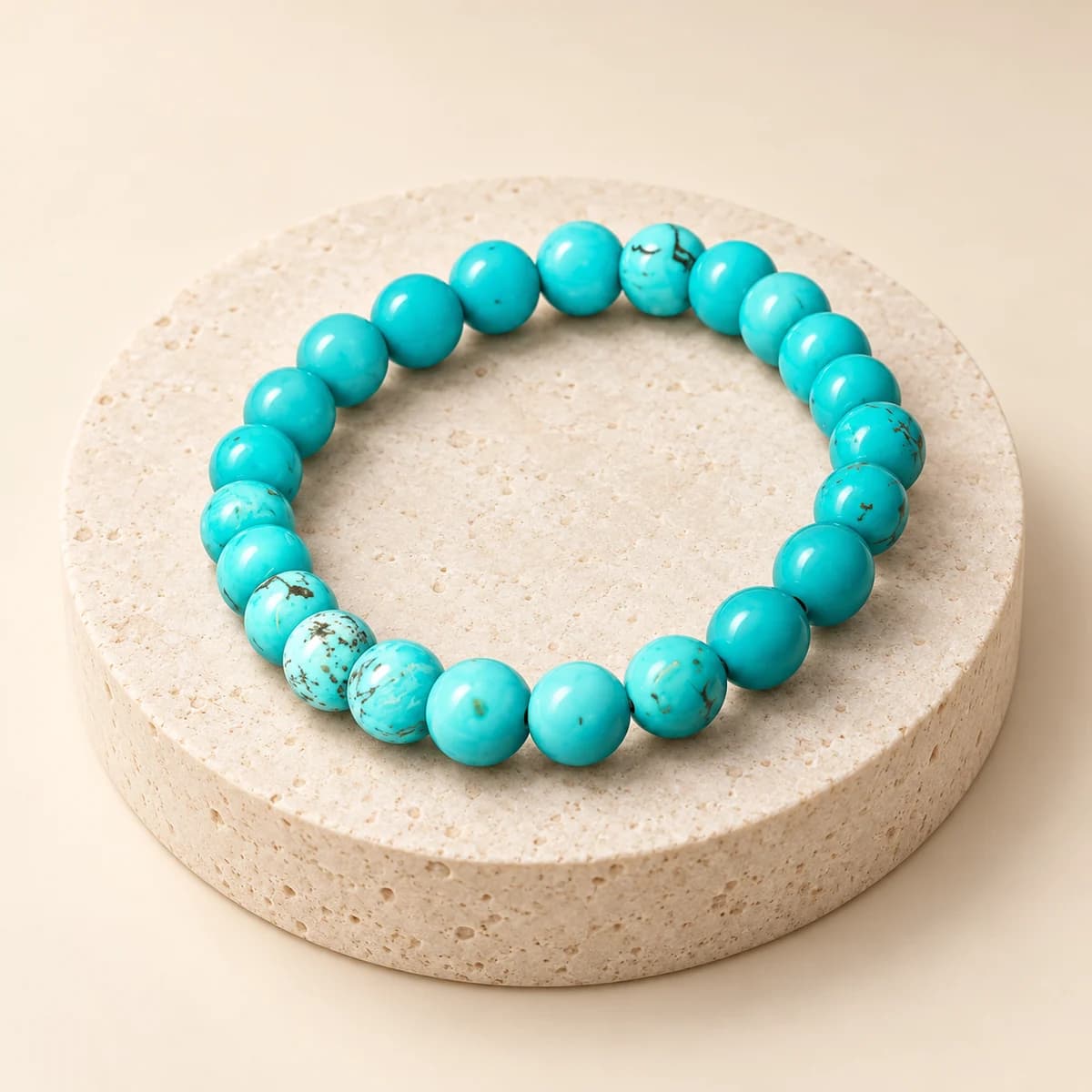
A turquoise bracelet is a stretch band of polished 8 mm turquoise beads, the sky-blue stone that has been used in jewellery for centuries. Tradition links it with clear speech and the throat chakra, so it is worn for communication and honest self-expression. To check it is real, rub a hidden spot with an acetone-dipped cotton bud, since blue dye on the bud means dyed howlite or magnesite. Our lab-certified 8 mm bracelet costs ₹849.
Quick answer
| Hindi name | Firoza (फ़िरोज़ा) |
| What it is (mineral) | Turquoise, a copper-aluminium phosphate mineral |
| Colour | Sky blue to blue-green, often with darker veins |
| Chakra (crystal tradition) | Throat |
| Planet | Often linked to Jupiter (Guru) in popular Indian astrology; some astrologers link it to Venus or Saturn |
| Traditionally worn for | Clear speech, communication and honest self-expression |
| Best wrist and day | Left wrist; Thursday (Jupiter) in popular practice. Some sellers suggest Friday |
| Hardness (Mohs) | 5–6 |
| Our price | ₹849, lab-certified, Cash on Delivery |
Traditional benefits
| Traditional benefit | What people mean by it |
|---|---|
| Clear speech | Speaking your mind clearly and calmly |
| Throat chakra (crystal lore) | Balance in expression and communication |
| Honest self-expression | Saying what you mean with confidence |
| Good fortune | A traditional sign of luck and protection in several cultures |
| Focus while speaking | Staying on point in meetings, classes and presentations |
These are beliefs passed down in crystal lore and in several cultures. There is no scientific evidence that turquoise has any physical effect on the body or the mind.
Who should wear it
Turquoise is tied to the throat chakra in crystal lore and to Jupiter in popular Indian astrology, so it is often chosen by people whose work depends on speech and writing. If you want a bolder, warmer stone for confidence, carnelian may suit you better. If you want a softer, quieter stone, howlite is a common alternative.
- 1Teachers and trainers
People who speak for a living and want a reminder to speak clearly.
- 2Writers and content creators
Words and expression are the focus, so turquoise fits a daily writing routine.
- 3Sales and client-facing professionals
People who talk with customers all day and value a clear, honest voice.
- 4Students and public speakers
Often chosen before a speech, debate or interview as a good-luck piece.
How to wear it
- 1Which hand
The left wrist is the common custom, as the left hand is the receiving hand in Indian tradition. Wear it on whichever wrist is comfortable.
- 2Which day
Thursday is tied to Jupiter in popular practice. Friday is the start day our product page suggests, and either is a common choice.
- 3First-wear ritual
Pass the bracelet through incense smoke or rest it on a selenite plate. Sit quietly for a minute and set one clear intention for how you want to speak.
- 4Care
Keep it away from water, oil, perfume and sweat. Turquoise is porous and can change colour, so take it off before swimming, bathing, or using lotion or perfume.
Real vs fake: 4 checks
- 1Test with acetone
If the seller allows, rub a hidden spot with a cotton bud dipped in acetone. Blue dye coming off means the stone is dyed howlite or magnesite.
- 2Look at the veins
On dyed howlite the dark veins look sunken, and the colour collects in cracks.
- 3Check the look
Real turquoise has a waxy lustre and slight colour variation. Perfectly even sky-blue at a very low price is a warning sign.
- 4Ask the seller
Ask whether the stone is natural, stabilised or reconstituted. Honest sellers say, and the lab report should name the material.
Common fakes are dyed howlite or magnesite, plastic, and reconstituted turquoise powder bound in resin. Be honest about treatments: most affordable turquoise is stabilised (hardened with resin), which is a recognised treatment but is not the same as natural, untreated stone.
Price in India
| Type / grade | Typical price in India | Notes |
|---|---|---|
| Stabilised or reconstituted | ₹400–₹1,500 | The most affordable turquoise; ask the seller which it is |
| Our 8 mm lab-certified bracelet | ₹849 | Lab report included; Cash on Delivery |
| Natural, untreated turquoise | Several times more than the range above | Costs much more; the lab report should name the material |
Our 8 mm turquoise bracelet is ₹849, and every bracelet comes with a lab report. You can pay Cash on Delivery, and shipping is free on orders above ₹999.
Before you buy
A turquoise bracelet suits people who want a sky-blue, traditional piece for speaking, writing or teaching, and who are happy to treat it as a personal ritual. Before you pay, ask whether the stone is natural, stabilised or reconstituted, and check that the price fits that answer.
Frequently asked
Last reviewed: 17 May 2026 · Verified by the DivineTatva expert panel
Turquoise bracelet ke fayde kya hain?
Parampara mein ise saaf bolne, apni baat kehne aur communication behtar karne ke liye pehna jata hai. Yeh vishwas par aadharit hai, vaigyanik saboot nahi.
Turquoise bracelet kis haath mein pehnein?
Bahut log ise left wrist par pehente hain, kyunki Indian parampara mein left haath ko lene wala haath mana jata hai. Jis haath mein aap aaram se pehen sakein, wahi sahi hai.
Can I wear a turquoise bracelet daily, or while sleeping or bathing?
Yes, you can wear it daily. Take it off while bathing, swimming, or using lotion and perfume, since turquoise is porous and can change colour. Wearing it while you sleep is a personal choice.
Can turquoise be worn with other stones?
Yes. Clear quartz is a sensible pairing, since both are clean-looking stones that suit almost any outfit.
Does a turquoise bracelet really work?
Honestly, there is no scientific evidence that turquoise improves speech or any physical state. People wear it as a reminder to speak honestly and clearly, and that is a personal belief.
How do I check my turquoise bracelet is real?
Ask the seller whether the stone is natural, stabilised or reconstituted, and check the lab report. At home, a cotton bud dipped in acetone should not pick up blue dye from a hidden spot, since dyed howlite or magnesite will.
Reviewed by the DivineTatva expert panel
Written and reviewed by DivineTatva's consulting Vedic astrologer. Every piece is lab-certified and energised in our Jaipur atelier. Last updated 25 October 2026.