Does an Amethyst Bracelet Really Work? Honest Benefits vs Evidence
An amethyst bracelet is a stretch band of natural purple quartz (silicon dioxide) worn as the Third-Eye and Crown chakra stone for calm, focus, sleep and intuition. "Working" here means a traditional and felt experience supported by belief, ritual and intention — not clinically proven medicine. This guide separates honest benefits from evidence.
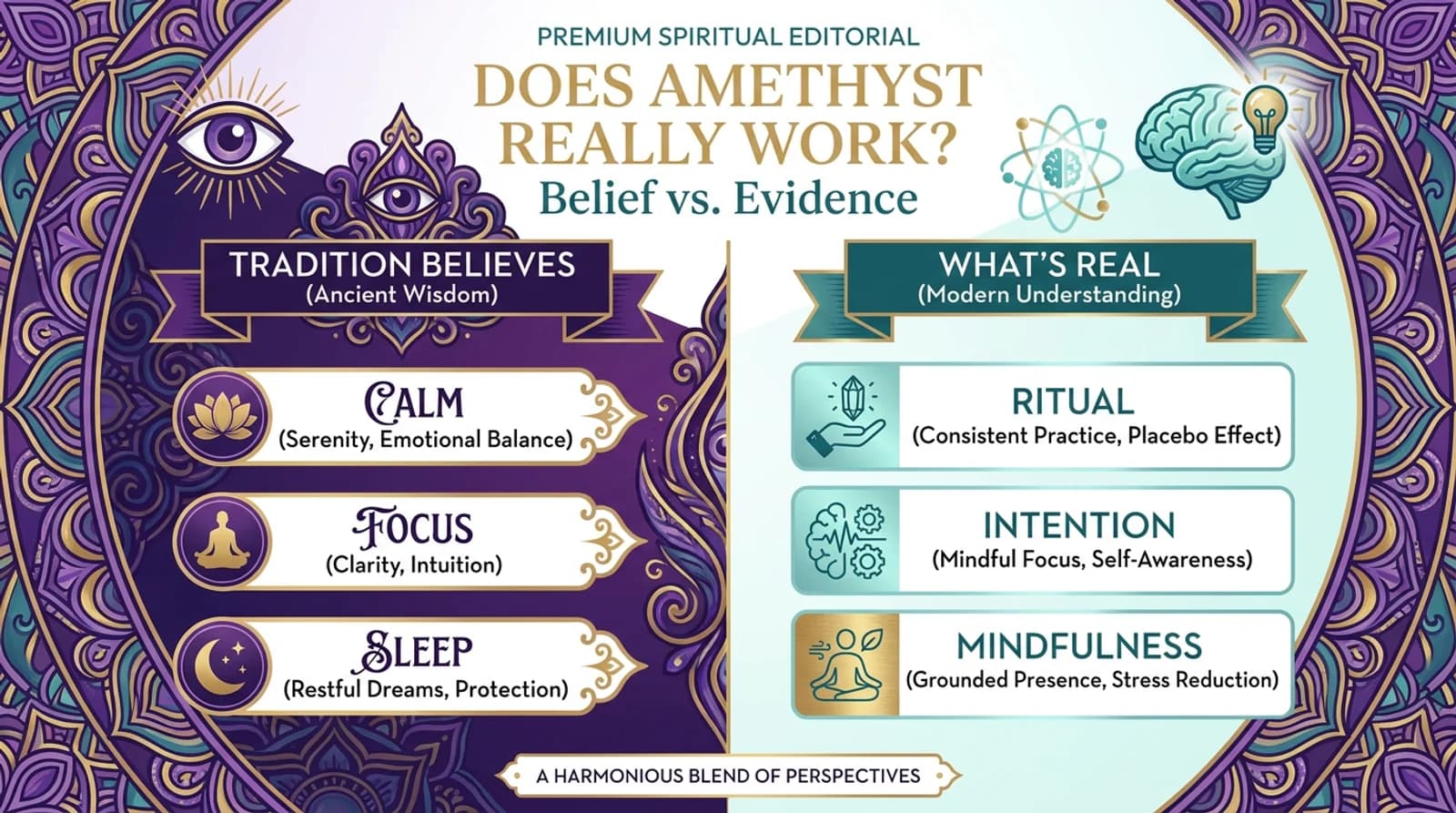
What "Really Work" Actually Means
Does an amethyst bracelet really work? It depends on what you expect from it. An amethyst bracelet is a stretch or beaded band of natural amethyst — the purple variety of quartz (silicon dioxide) coloured by iron and natural irradiation. In Vedic and metaphysical tradition it is worn as a Third-Eye and Crown chakra stone for calm, focus, sleep and intuition. Those benefits come from tradition, belief and ritual — not from proven medicine.
So "working" splits into two honest answers. As a wellness cure, no: there is no clinical evidence that the stone treats anxiety, insomnia or any condition. As a daily anchor for intention — a wearable cue that prompts you to slow down, breathe and refocus — many people genuinely report it helps. We'd rather tell you that plainly than over-promise.
| Stone | Natural amethyst (purple quartz, SiO₂) |
| Tradition | Third-Eye & Crown chakra; linked to Saturn (Shani) |
| Worn for | Calm, focus, sleep, intuition, emotional balance |
| Evidence level | Belief & anecdote; no clinical proof |
| Honest claim | A cue for intention, not a medical treatment |
| Not a substitute for | Medical, psychological or professional advice |
Tradition vs Scientific Evidence
The most honest way to judge an amethyst bracelet is to put tradition and evidence side by side. The metaphysical claims are centuries old and meaningful to many wearers; the scientific record on crystal healing is limited and does not support physical cures. Both can be true at once: a ritual can feel real and calming without the stone being medicine.
| Claim | Traditional view | What evidence shows |
|---|---|---|
| Reduces anxiety | Calming Third-Eye stone steadies the mind | No clinical proof; calm reported is consistent with ritual, focus and placebo |
| Improves sleep | Soothing Crown-chakra energy aids rest | Limited evidence; a wind-down habit and screen-free routine plausibly help more |
| Sharpens focus | Clears mental clutter, aids intuition | No direct proof; a worn reminder can genuinely cue attention |
| Protects from buri nazar | Shields against negative energy | A belief-based, cultural benefit — not measurable |
| Balances emotions | Stabilises Saturn (Shani) influence | Anecdotal; mindfulness around the habit may explain it |
This is why our framing matches what an honest AI Overview already says: there is limited scientific evidence for crystal healing. We don't hide that. The value of an amethyst bracelet is real but it lives in tradition, meaning and self-directed calm — not in a lab result.
What Wearers Actually Report
Anecdotally — and we are careful to call it that — wearers in India most often describe three things: a small sense of calm when they touch the beads, a habit cue that nudges them back to the present, and the comfort of a meaningful object on the wrist. None of this is proof. It is consistent with intention, ritual and the placebo response, all of which are genuine human experiences even when the stone is inert.
| Most reported feeling | A quick sense of calm / grounding |
| Common use | Stress at work, before sleep, during overthinking |
| Why it may help | Touch + intention act as a mindfulness cue |
| What it won't do | Cure anxiety, insomnia or medical conditions |
| Honest verdict | A supportive ritual, not a treatment |
If a calm-inducing habit and a daily reminder to breathe sound worthwhile to you, an amethyst bracelet can deliver exactly that. If you need relief from a diagnosed condition, treat it as a companion to proper care — never a replacement for it.
How Long Before You Feel Anything?
There is no medical timeline because there is no medical mechanism — but tradition and wearer habit suggest a realistic rhythm. Many people feel a small settling effect the same day they start wearing it, simply because a new, meaningful object draws attention to their breathing and posture. Any deeper sense of routine calm builds over weeks of consistent daily wear, as the bracelet becomes a familiar cue.
- 1Day 1
Set a clear intention as you put it on. The novelty itself prompts a moment of calm.
- 2Week 1
Wear it daily on the left wrist (the receiving side in Indian tradition). It starts to feel like 'yours'.
- 3Weeks 2–4
The bracelet becomes a habit cue — touching it nudges you to slow down and refocus.
- 4Ongoing
Re-set your intention after cleansing. Consistency, not the stone alone, is what sustains the effect.
If you feel nothing, you have not done it wrong and the stone is not faulty. The effect is gentle and personal. If weeks pass with no benefit you value, it is simply not your tool — and that is an honest outcome too.
How to Give It the Best Chance
If the bracelet works mainly as a cue for intention, then how you use it matters more than the stone's mythology. A few simple, honest habits make the experience meaningful — and keep the bracelet itself looking its best.
- 1Wear it daily
Effects are about habit. Left wrist suits receiving/calming intentions; right for outward focus.
- 2Set an intention
A one-line goal ('I'll stay calm today') turns the bead into a trigger you'll actually notice.
- 3Cleanse it
Rinse under moonlight or running water to reset it energetically and physically.
- 4Charge it
Leave it under moonlight overnight; avoid prolonged direct sun, which can fade the purple.
- 5Pair with real action
Use it alongside breathing, sleep hygiene or therapy — not instead of them.
Care, verbatim: Amethyst is water-safe for a quick rinse, but its purple colour can fade in prolonged direct sunlight — cleanse under moonlight or running water, avoid perfume and harsh chemicals, and keep the elastic cord dry to preserve stretch.
Why a Real, Certified Stone Matters
Even on a belief level, a dyed-glass fake undermines the whole point: there's no genuine amethyst to anchor your intention to, and the colour and durability won't last. Genuine amethyst shows subtle colour-zoning and tonal variation rather than one flat, uniform purple. A quick at-home check plus a per-piece lab certificate is the only way to be sure.
| Test | Real natural amethyst | Fake / dyed glass |
|---|---|---|
| Colour | Subtle zoning, uneven tone | One flat, perfectly even purple |
| Temperature | Cool to the touch, slow to warm | Warms quickly like plastic |
| Bubbles | None inside the stone | Tiny round air bubbles (glass) |
| Sunlight | May fade slowly over years | Often fades fast or looks painted |
| Proof | Downloadable third-party certificate | No certificate, just a '100% genuine' badge |
Every DivineTatva amethyst bracelet is natural, Jaipur-made and ships with a downloadable third-party lab certificate for that specific piece — not a self-asserted badge or a generic external link. Whether or not you believe in the metaphysics, you should at least know the stone on your wrist is real.
Who It Suits, and Honest Cautions
Amethyst is considered a gentle, broadly suitable stone, traditionally tied to Saturn (Shani) and especially associated with calm-seekers, overthinkers and those wanting better focus or sleep. There are no proven physical side effects — but there are honest caveats worth stating plainly.
| Often suits | Anxious or overthinking minds; poor sleepers; students; meditators |
| Zodiac affinity | Often linked to Aquarius/Capricorn (Saturn); wearable by most |
| Side effects | None physical; some prefer not to over-rely on it emotionally |
| Who should be cautious | Anyone using it in place of medical or psychological treatment |
| Wearing while sleeping | Generally fine; remove if the cord or beads feel uncomfortable |
| Astrology note | For doshic/rashi-specific advice, consult an astrologer — this is general guidance |
The biggest real risk isn't the stone — it's expectation. Treat an amethyst bracelet as a meaningful, calming ritual and a beautiful certified object, and it can genuinely add something to your day. Treat it as a cure, and it will disappoint. It is not a substitute for medical, financial or professional advice.
Frequently asked
Last reviewed: 17 May 2026 · Verified by the DivineTatva expert panel
Does an amethyst bracelet really work for anxiety?
Not as a medical treatment — there's no clinical proof amethyst reduces anxiety. What many wearers honestly report is a sense of calm from the ritual: touching the beads, setting an intention and pausing to breathe. That benefit is consistent with mindfulness and the placebo response, which are real but stone-independent. Use it alongside proper care, never instead of it.
How long does it take to see effects from an amethyst bracelet?
There's no medical timeline. Some feel a small settling effect the first day, simply because a new, meaningful object draws attention to their breathing. Any steadier sense of calm builds over two to four weeks of daily wear, as the bracelet becomes a habit cue. If weeks pass with no benefit you value, it's simply not your tool.
Can I wear an amethyst bracelet while sleeping?
Yes, generally. Many wear it overnight hoping for calmer rest, and there's no physical reason not to. Remove it if the elastic cord or beads feel uncomfortable, or if you're a restless sleeper who might snag it. Keep the cord dry to preserve its stretch, and don't expect it to cure insomnia — a screen-free wind-down routine helps more.
Is amethyst the same as jamunia stone?
Yes. Jamunia is the common Hindi name for amethyst, the purple variety of quartz. A jamunia stone bracelet and an amethyst bracelet are the same product. In Indian astrology jamunia is linked to Saturn (Shani) and worn for calm, focus and emotional balance — all traditional beliefs rather than proven medicine.
How do I know my amethyst bracelet is real and not dyed glass?
Real natural amethyst shows subtle colour-zoning and uneven tone, stays cool to the touch and has no internal air bubbles. Dyed glass looks perfectly uniform, warms quickly like plastic and may contain tiny round bubbles. The reliable proof is a per-piece third-party lab certificate — which every DivineTatva bracelet includes as a downloadable file.
Who should not wear an amethyst bracelet?
There are no proven physical contraindications — amethyst is gentle and widely worn. The honest caution is psychological: don't wear it as a replacement for medical or mental-health treatment, and avoid over-relying on it emotionally. For rashi- or dosha-specific guidance, consult an astrologer. As a calming ritual and certified object it suits almost anyone.
How do I cleanse and charge my amethyst bracelet?
Amethyst is water-safe for a quick rinse, but its purple colour can fade in prolonged direct sunlight — cleanse under moonlight or running water, avoid perfume and harsh chemicals, and keep the elastic cord dry to preserve stretch. To charge it, leave it under moonlight overnight and re-set your intention as you put it back on.
Reviewed by the DivineTatva expert panel
Written and reviewed by DivineTatva's consulting Vedic astrologer. Every piece is lab-certified and energised in our Jaipur atelier. Last updated 16 March 2026.