Real vs Fake Black Obsidian: 6 Tests to Spot Genuine Stone vs Molded Glass (India Guide)
Black obsidian is natural volcanic glass formed when lava cools too fast to crystallise; fakes are usually molded black glass or dyed stone. You can separate real from fake at home using six checks — conchoidal fracture, cool-touch, trapped bubbles, weight, hardness and the hematite magnet test — before trusting any lab certificate.
What Black Obsidian Actually Is (and Why Fakes Exist)
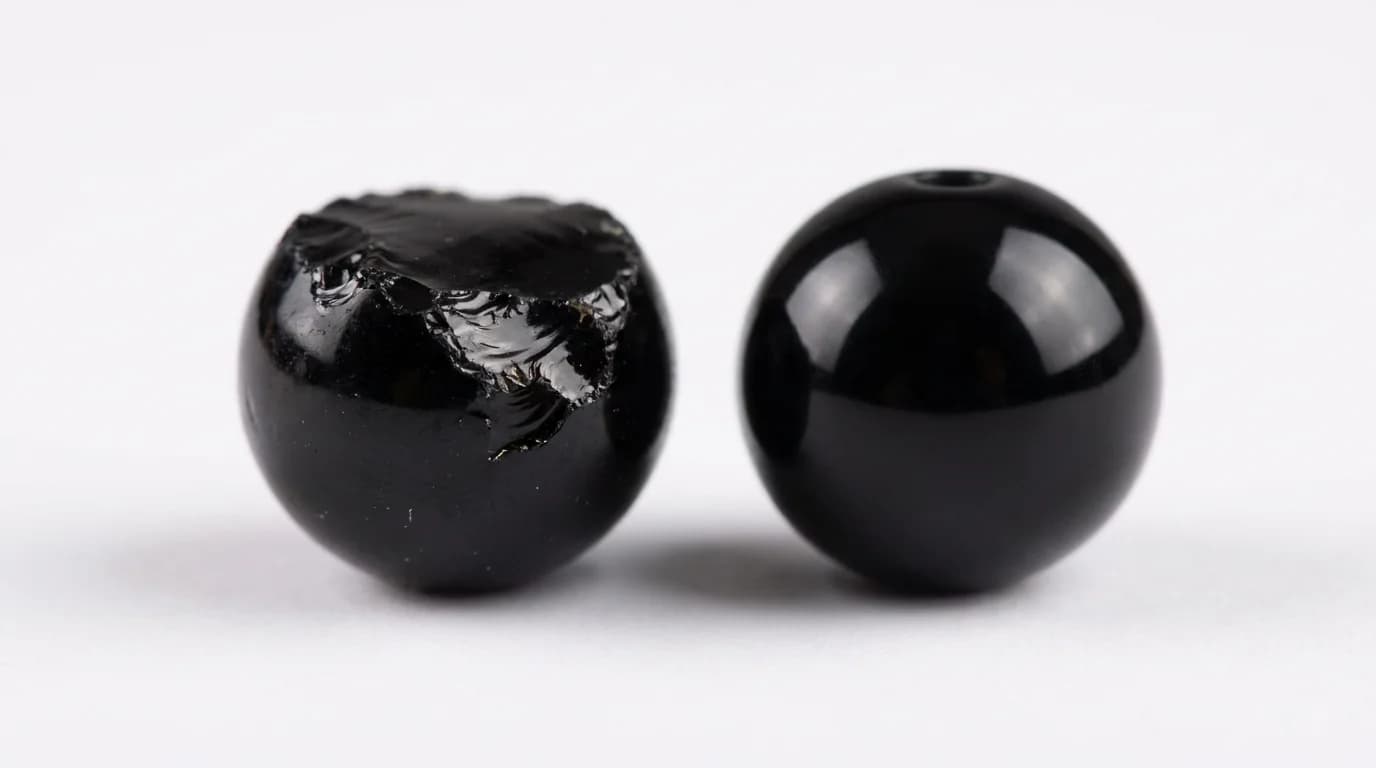
Black obsidian is a natural volcanic glass — formed when felsic lava cools so quickly that mineral crystals never get the chance to grow. That glassy, non-crystalline structure is exactly why genuine obsidian breaks with a smooth curved fracture and feels cool, glossy and slightly imperfect in the hand. It is not a gemstone in the crystal sense; it is solidified glass from the earth.
Because real obsidian is essentially glass, it is unusually easy to imitate. The most common fake is plain molded black glass poured into bead molds, which is why authenticity testing matters more here than for almost any other protection stone. In this two-stone bracelet, obsidian is paired with hematite, a heavy iron-oxide stone — and hematite has its own simple magnet test that glass and plastic imitations always fail.
| Material | Natural volcanic glass (amorphous, non-crystalline) |
| Formed by | Rapid cooling of silica-rich lava |
| Hardness | About 5 to 5.5 on the Mohs scale |
| Feel | Cool to the touch, glassy, glossy sheen |
| Fracture | Conchoidal — smooth, curved, shell-like |
| Most common fake | Molded black glass beads |
| Paired stone here | Hematite (heavy, weakly magnetic iron oxide) |
One honest note before the tests: people wear a black obsidian and hematite bracelet for grounding, shielding from negative energy and buri nazar, and calming an overactive mind. Those are traditional Vedic and feng-shui beliefs, not clinically proven medical effects. What you can verify objectively is the material — and that is what this guide is about.
6 Tests to Tell Real Black Obsidian From Molded Glass
No single test is foolproof on its own — molded glass can pass one or two checks. Run several together. If a bead fails two or more of these, treat it as suspect. None of these tests damage a genuine bracelet.
- 1Conchoidal fracture test
Look closely at any chipped edge or the drill hole under bright light. Real obsidian fractures in smooth, curved, shell-like ridges (conchoidal fracture). Molded glass beads show flat seams, mold lines and a perfectly uniform surface instead. This is the single most reliable visual tell.
- 2Cool-touch test
Hold a bead against your cheek or inner wrist. Genuine obsidian and hematite both feel distinctly cool and take a moment to warm up, because glass and iron conduct heat away from your skin. Plastic and resin imitations feel room-temperature or warm almost immediately.
- 3Bubble test
Hold the bead to a torch or sunlight and inspect for tiny round air bubbles inside. Mass-produced glass beads often trap perfectly spherical bubbles from molding. Natural obsidian can rarely contain irregular gas inclusions, but neat, uniform round bubbles strongly suggest manufactured glass.
- 4Weight and density test
Real obsidian has a solid, substantial heft for its size; hematite is noticeably heavy because of its iron content. Plastic or resin fakes feel suspiciously light. A genuine obsidian-and-hematite bracelet should feel reassuringly weighty on the wrist.
- 5Hardness scratch test
On an inconspicuous bead, a steel knife or needle (Mohs about 5.5) will barely mark genuine obsidian and will not easily scratch it. Soft resin or acrylic scratches readily. Do this gently and only if you must — it is a last-resort confirmation.
- 6Hematite magnet test
Bring a small magnet near the grey metallic hematite beads. Genuine hematite gives a gentle, real tug. Glass, plastic and dyed-stone imitations do nothing. This is covered in detail in the next section.
| Test | Genuine black obsidian / hematite | Molded glass or plastic fake |
|---|---|---|
| Fracture | Smooth, curved conchoidal ridges | Flat seams, mold lines, uniform |
| Touch | Cool, slow to warm | Warm or room-temperature fast |
| Bubbles | Rare, irregular if any | Neat round bubbles trapped inside |
| Weight | Solid, heavy heft | Suspiciously light |
| Scratch (Mohs ~5.5) | Resists a steel blade | Scratches easily |
| Magnet (hematite) | Real gentle tug | No response |
Is Your Hematite Real? The Magnet Test
Hematite is an iron-oxide mineral, so genuine natural hematite is weakly magnetic — a small magnet brought close gives a soft but real tug. This is the easiest single authenticity check on the whole bracelet, and the one no glass or plastic imitation can fake. Hold a fridge magnet near the grey metallic beads: a gentle pull means iron is present.
One important nuance for India's market: a lot of shiny grey 'hematite' beads sold cheaply are actually magnetic hematite (also called hematine) — a synthetic, strongly magnetic reconstituted material that snaps hard to a magnet and even sticks bead-to-bead. Natural hematite tugs gently; if your beads slam together magnetically like tiny magnets, they are the synthetic version, not natural stone.
| Natural hematite | Gentle tug toward a magnet |
| No magnetism at all | Likely glass, resin or dyed stone |
| Very strong snap, beads stick together | Synthetic magnetic hematite (hematine) |
| Streak test (on unglazed tile) | Real hematite leaves a reddish-brown streak |
The reddish-brown streak is a useful backup: rubbing real hematite on the rough back of a ceramic tile leaves a rust-coloured mark, because it is iron oxide. We cover the magnet and streak tests step by step in our dedicated hematite guide linked below.
Common Fakes Sold in India (and How They Slip Through)
Most authenticity problems in India are not malicious — they are mislabelled glass sold as stone, or strongly magnetic synthetic hematite passed off as natural. Knowing the usual substitutes makes them easy to catch with the tests above.
| Sold as | What it often really is | Quickest way to catch it |
|---|---|---|
| Black obsidian beads | Molded black glass | Look for mold seams; check for round bubbles |
| Black obsidian | Black-dyed onyx or agate | No conchoidal fracture; very uniform colour |
| Black obsidian | Black tourmaline (mixed up) | Tourmaline shows striations, not glassy sheen |
| Natural hematite | Synthetic magnetic hematine | Beads snap hard and stick to each other |
| Natural hematite | Painted grey plastic | No magnet response; feels light and warm |
A price that looks too good to be true usually is. A genuine lab-certified black obsidian and hematite bracelet in India typically runs higher than a ten-rupee street bead strand for a reason — real material, real testing and honest sizing all cost more than molded glass.
How to Read a Lab Certificate (and Spot a Fake Badge)
A '100% certified' or 'lab-verified' badge on a product image means nothing on its own — anyone can paste a graphic. Real proof is a per-piece or per-batch certificate from a named gemmological lab that you can actually see and cross-check. At DivineTatva we show a sample certificate on-page and name the testing, so the claim is verifiable rather than decorative.
- 1A named testing lab
A genuine certificate carries the name and contact details of an identifiable gemmological laboratory, not just a generic logo.
- 2Material identification
It should state the material — natural obsidian, natural hematite — rather than a vague 'genuine crystal' line.
- 3A unique reference number
Real certificates carry a report or reference number you can quote when you contact the seller or lab.
- 4Honest scope
A trustworthy certificate confirms what the stone IS. It will never certify spiritual results, rashi suitability or 'energy charge' — those are belief, not lab-measurable facts.
Treat any certificate that promises healing, luck or guaranteed protection as a marketing document, not a lab report. Genuine gemmological testing speaks only to material and identification.
Buying and Caring for Your Bracelet in India
Once you have confirmed your bracelet is genuine, sizing and care decide how long it stays that way. Buy by wrist measurement, not 'free size only', and follow stone-specific care — hematite in particular needs to stay dry.
| Bead sizes | 8 mm (slimmer) or 10 mm (bolder, popular for men) |
| Sizing | Measure your wrist; choose by bead count, not one-size-fits-all |
| Pricing in India | Transparent INR pricing; premium-but-fair, not 70%-off framing |
| Buying perks | COD available, free India shipping, clear returns |
| Cleanse | Monthly with moonlight, sage or selenite |
| Avoid | Salt water, harsh chemicals, soaking |
Care for the hematite carefully: Keep this bracelet dry — hematite contains iron and can develop surface rust if soaked, so avoid wearing it in the shower or pool and never cleanse it in salt water; wipe with a soft dry cloth and cleanse with moonlight, sage or selenite instead.
Finally, the honest frame: a real black obsidian and hematite bracelet is worn in Vedic and feng-shui tradition for grounding, protection from negative energy and buri nazar, and a calmer mind, often linked with Shani (Saturn) and the root chakra. Many wearers report feeling steadier and more focused, consistent with intention and ritual. These are beliefs and traditions, not a substitute for medical, financial or professional advice — but the authenticity of the stone itself is something you can, and should, verify.
Frequently asked
Last reviewed: 17 May 2026 · Verified by the DivineTatva expert panel
How can I tell if my black obsidian is real or just glass?
Run several tests together. Genuine black obsidian shows smooth curved (conchoidal) fracture at chips or drill holes, feels cool and takes a moment to warm, and has a solid weight. Molded glass fakes show flat mold seams, trapped round bubbles and feel light or warm fast. If beads fail two or more checks, treat them as molded glass rather than natural obsidian.
Is my hematite real? What does the magnet test show?
Bring a small magnet near the grey metallic beads. Natural hematite is iron oxide, so it gives a gentle, genuine tug. No response at all suggests glass, resin or dyed stone. A very strong snap where beads stick to each other means synthetic magnetic hematite (hematine), not natural stone. A reddish-brown streak on unglazed tile is a useful backup confirmation.
Why is real black obsidian sometimes confused with black tourmaline?
Both are popular black protection stones in India, but they are different materials. Obsidian is glassy volcanic glass with a smooth sheen and conchoidal fracture. Black tourmaline is a crystalline mineral that shows lengthwise striations or grooves along the bead and a slightly less glassy look. If you see striations rather than a glass-like surface, it is tourmaline, not obsidian.
Does a black obsidian and hematite bracelet actually work?
In Vedic and feng-shui tradition the pairing is worn for grounding, shielding from negative energy and buri nazar, and a calmer mind, often linked with Shani (Saturn) and the root chakra. Many wearers report feeling steadier and more focused, consistent with intention, ritual and placebo. These are belief-based traditions, not clinically proven cures, and not a substitute for medical or professional advice.
What does a real lab certificate prove, and what can't it prove?
A genuine gemmological certificate from a named lab confirms the material — that the stone is natural obsidian or natural hematite — and carries a unique reference number you can verify. It cannot certify spiritual results, rashi suitability or 'energy charge', because those are belief, not lab-measurable. Any certificate promising healing, luck or guaranteed protection is marketing, not testing.
How do I care for the hematite so it doesn't rust?
Keep this bracelet dry — hematite contains iron and can develop surface rust if soaked, so avoid wearing it in the shower or pool and never cleanse it in salt water. Wipe it with a soft dry cloth and cleanse monthly with moonlight, sage or selenite instead. Also keep it away from harsh chemicals, perfumes and prolonged soaking to protect both stones.
What is the price of an original black obsidian bracelet in India?
A genuine, lab-certified black obsidian and hematite bracelet costs more than cheap street-bead strands because it uses real material, real testing and honest sizing. Be wary of prices that look too good to be true or heavy 70%-off framing. At DivineTatva we keep INR pricing transparent, offer COD and free India shipping, and show a sample certificate so you can verify what you pay for.
Reviewed by the DivineTatva expert panel
Written and reviewed by DivineTatva's consulting Vedic astrologer. Every piece is lab-certified and energised in our Jaipur atelier. Last updated 5 April 2026.