Is Your Citrine Heat-Treated Amethyst? Natural vs Treated, Honestly Explained
Most "citrine" bracelets sold today are heat-treated amethyst — still genuine quartz, but their golden colour is baked in a kiln, not formed in the earth. Naturally yellow citrine is rarer and pricier. This guide shows you how to tell them apart, why both are "real," and what we actually sell.
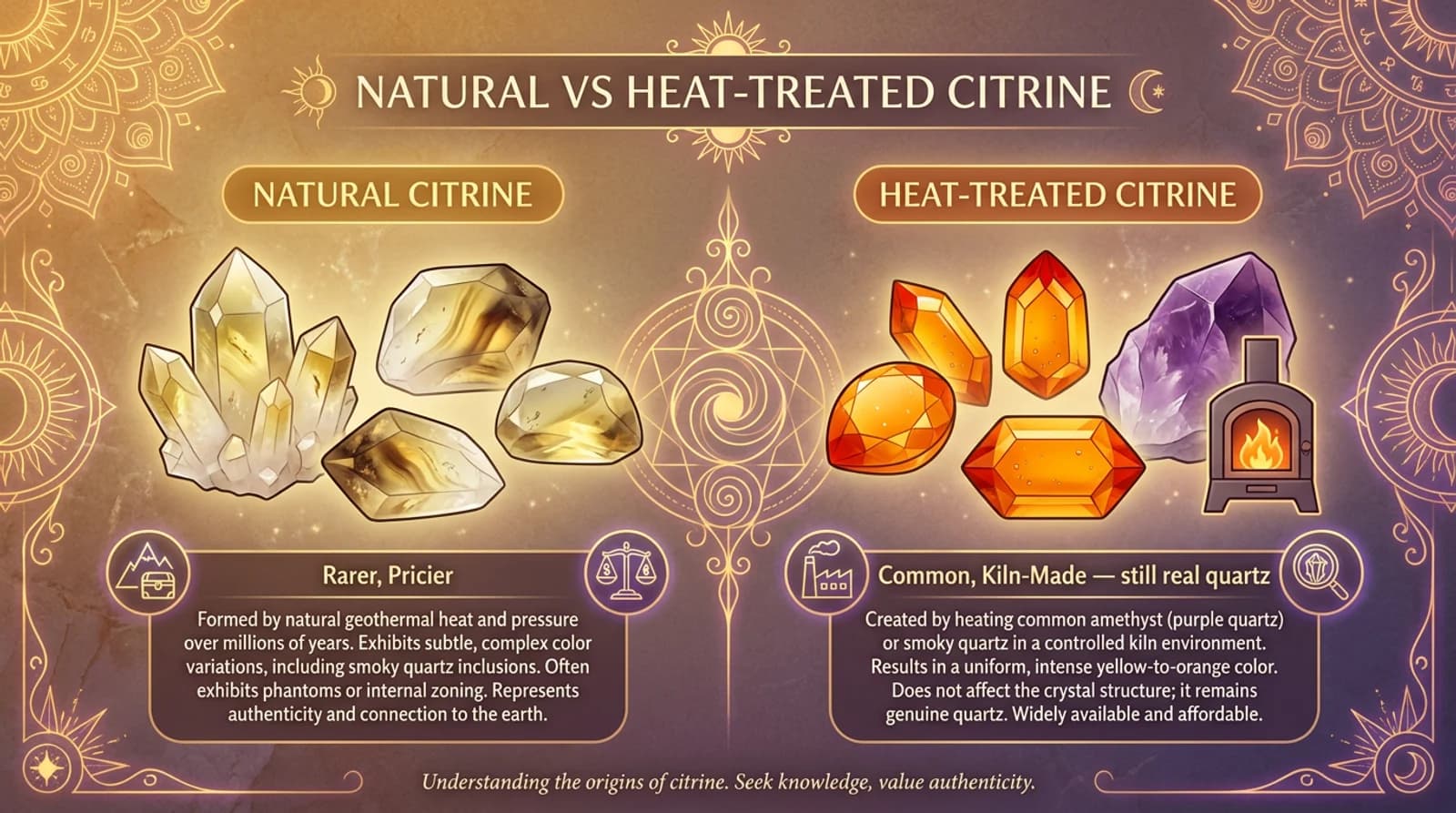
Natural vs heat-treated citrine, in plain words
Citrine is a yellow-to-golden variety of quartz, long called the "stone of abundance" or "merchant's stone." Natural citrine gets its colour from trace iron over geological time. Heat-treated citrine is amethyst (purple quartz) baked in a kiln until it turns golden. Both are real quartz; only the source of the colour differs.
Here is the honest part most sellers skip: the large majority of affordable "citrine" on the market — beads, tumbles and bracelets alike — is heat-treated amethyst. Genuinely natural, untreated yellow citrine is comparatively rare, which is why it costs more. Neither is fake; the difference is how the golden colour came to be.
| Mineral | Both are quartz (silicon dioxide) |
| Natural citrine colour | Pale lemon to honey, from trace iron over time |
| Heat-treated colour | Golden to deep amber/orange, made in a kiln |
| Common name | Stone of abundance, merchant's stone |
| Chakra (tradition) | Solar plexus (Manipura) |
| Planet (tradition) | Jupiter / Guru |
| Hardness | Mohs ~7 (durable for daily wear) |
Why heat-treated citrine is still "real"
Heat treatment does not turn amethyst into glass or plastic. It is still natural quartz that grew in the earth — heat simply shifts how its iron content reads as colour, the same chemistry that happens when amethyst sits near volcanic heat underground. So a heat-treated citrine bracelet is real quartz, just not naturally yellow quartz. The dishonest move is not the treatment; it is hiding it.
On the belief side, traditions link citrine to the solar plexus chakra, to Jupiter, to confidence, clarity and prosperity. These are culturally meaningful, faith-based associations, not medically proven effects. Many wearers report feeling calmer, more focused or more motivated — outcomes consistent with intention, ritual and the placebo response. Treat your bracelet as supportive ritual, not a substitute for medical, financial or professional advice.
| Question | Natural citrine | Heat-treated citrine |
|---|---|---|
| Is it real quartz? | Yes | Yes |
| Colour source | Natural, trace iron | Kiln heat applied to amethyst |
| Typical hue | Soft lemon, smoky-honey | Bright golden, amber, reddish base |
| Rarity | Less common, pricier | Widely available, affordable |
| Honest to sell? | Yes, if disclosed | Yes, if disclosed as treated |
| Tradition / belief use | Same associations | Same associations |
How to tell natural from heat-treated (and from fakes)
You can spot most tells at home, though only a lab gives certainty. Natural citrine tends to be a softer, more even lemon-to-honey shade. Heat-treated citrine often shows very bright, saturated gold or amber and frequently a whitish or reddish-brown tint near the base of the bead — a classic kiln signature. Dyed glass or fake "citrine" gives itself away differently.
- 1Look at colour zoning
Heat-treated citrine often has uneven colour — clearer near the tip, more concentrated or whitish at the base. Natural citrine is usually more uniform and gentle in tone.
- 2Watch for too-perfect orange
Intensely uniform deep-orange or reddish beads are usually heat-treated (sometimes from dark amethyst). Nature rarely produces that even, fiery saturation.
- 3Check for bubbles
Tiny round air bubbles inside a bead mean dyed glass, not quartz at all. Real citrine may have natural veils or feathers, never spherical bubbles.
- 4Test temperature
Real quartz feels cool to the touch and warms slowly. Glass and plastic warm up fast in the hand.
- 5Beware sun-fade
Genuine citrine holds colour well in daily life but can fade with prolonged direct sun. Cheap dyed pieces fade fast and unevenly — a tell, and a reason never to leave any citrine baking in sunlight.
- 6Ask for the lab report
The only sure answer. A real certificate names the lab, a report number and whether the stone is natural or treated.
| Soft, even lemon-honey | Likely natural citrine |
| Bright gold with whitish/reddish base | Likely heat-treated amethyst |
| Round air bubbles inside | Dyed glass — not real |
| Warms instantly in hand | Glass or plastic |
| Named lab + report number | Verifiable; trust it |
The price difference, explained transparently
Because natural untreated citrine is rarer, it costs more than heat-treated. Both are legitimate; you are paying for natural origin, not better "energy." Below are honest indicative ranges for an 8mm certified citrine bracelet in India. Exact pricing depends on bead size, clarity, colour grade and certification. All DivineTatva prices are in INR with COD and free shipping, and a stated return window.
| Type | Indicative 8mm bracelet (INR) | Why this price |
|---|---|---|
| Heat-treated citrine (certified) | ₹450 – ₹1,200 | Real quartz, abundant supply, golden colour kiln-made |
| Natural citrine (certified) | ₹1,500 – ₹4,000+ | Rarer untreated quartz, softer natural hue |
| Uncertified "citrine" | ₹150 – ₹400 | Often dyed glass or unverified — buyer beware |
If a seller advertises "100% natural citrine" at a heat-treated price, be sceptical — either the label or the price is wrong. We name the treatment and the lab so you can judge value honestly, rather than relying on vague "AAA-quality" or "authenticity-badge" claims with no lab body named.
What DivineTatva actually sells
We state on every product page whether the citrine is natural or heat-treated — something we have not seen competitors do. Most of our citrine bracelets are honestly described as heat-treated citrine (real quartz, golden colour kiln-made); where we stock genuinely natural citrine, it is labelled as such and priced accordingly. You always know what you are buying before you add to cart.
Every bracelet ships with a real Jaipur lab certificate carrying a report number and a downloadable copy — not an unverifiable badge. Our citrine is Jaipur-made and can be astrologer-energised on request. We never invent reviews, never over-promise wealth, and clearly separate tradition from evidence so you can make a confident, informed choice.
| Treatment disclosed? | Yes — natural or heat-treated stated on PDP |
| Certificate | Real Jaipur lab report + number, downloadable |
| Bead sizes | Commonly 8mm; other sizes on request |
| Payment | COD available, free shipping |
| Returns | Stated return window at checkout |
| Energising | Astrologer-energised on request |
Care, cleansing and the sunlight myth
Citrine is durable but its golden colour can fade with prolonged sun exposure, so cleanse it briefly under moonlight, selenite or a quick water rinse and avoid leaving it in direct sunlight; keep it away from harsh chemicals, perfume and water while bathing. This corrects the common — and damaging — advice to "charge citrine in the sun," which can dull both natural and heat-treated stones over time.
Traditionally many wear citrine on Thursday (linked to Jupiter) and on the left wrist for receiving abundance, though either wrist is fine — it is a personal, belief-based choice, not a rule. Set a clear intention as you put it on. Cleanse gently every couple of weeks or after intense days.
- 1Cleanse briefly
Moonlight overnight, selenite contact, or a quick water rinse — keep it short.
- 2Avoid prolonged sun
Never leave citrine in direct sunlight for hours; colour can fade.
- 3Protect from chemicals
Remove before perfume, sanitiser, swimming and bathing.
- 4Set an intention
On wearing, focus on your abundance or clarity goal as ritual, not magic.
- 5Wipe and rest
Pat dry with a soft cloth; store away from harder gems to avoid scratches.
Frequently asked
Last reviewed: 17 May 2026 · Verified by the DivineTatva expert panel
Is most citrine actually heat-treated amethyst?
Yes. The large majority of affordable citrine sold today — including most bracelets — is amethyst heated in a kiln until it turns golden. It is still genuine quartz, just not naturally yellow quartz. Naturally coloured citrine is rarer and costs more. The honest test of a seller is whether they disclose the treatment; we always state natural or heat-treated on the product page.
Is heat-treated citrine real or fake?
It is real quartz, not fake. Heat treatment only changes how the stone's iron reads as colour — the same thing nature does with underground heat. It is not glass, plastic or dye. A heat-treated citrine bracelet is a genuine quartz bracelet with a kiln-made golden colour. "Fake" would mean dyed glass or another material entirely, which is a different thing we test against.
How can I tell natural citrine from heat-treated at home?
Natural citrine is usually a soft, even lemon-to-honey shade. Heat-treated citrine often looks very bright gold or amber with a whitish or reddish tint near the base of the bead. Round air bubbles inside mean dyed glass, not quartz. Glass also warms instantly in the hand. For certainty, rely on a lab certificate that names the lab and states natural or treated.
Why does natural citrine cost more?
Because it is rarer. Naturally yellow citrine forms slowly in the earth and is far less common than amethyst, which can be heat-treated into citrine cheaply and in volume. You pay more for the natural origin, not for stronger "energy" — both types carry the same traditional associations. An honest certified natural 8mm bracelet typically runs higher than a heat-treated one in India.
Does a citrine bracelet really attract money?
Citrine's link to abundance, prosperity and confidence comes from Vedic and metaphysical tradition and belief, not clinical proof. Many wearers report feeling more motivated, calm or focused — outcomes consistent with intention, ritual and the placebo response. Treat it as a supportive, meaningful practice that may strengthen your own mindset, not as a guaranteed financial outcome or a substitute for sound advice.
Which hand and day should I wear a citrine bracelet?
Traditionally the left wrist is the receiving side, so many wear citrine on the left to invite abundance, and Thursday is favoured for its link to Jupiter (Guru). These are belief-based customs, not strict rules — either wrist is fine, and any day works. What matters more is wearing it consistently and setting a clear intention. Choose what feels right and comfortable for you.
How do I care for and cleanse my citrine bracelet?
Citrine is durable but its golden colour can fade with prolonged sun exposure, so cleanse it briefly under moonlight, selenite or a quick water rinse and avoid leaving it in direct sunlight; keep it away from harsh chemicals, perfume and water while bathing. Ignore advice to "charge it in the sun" — that can dull the colour over time. A gentle cleanse every couple of weeks is plenty.
Reviewed by the DivineTatva expert panel
Written and reviewed by DivineTatva's consulting Vedic astrologer. Every piece is lab-certified and energised in our Jaipur atelier. Last updated 26 March 2026.