Real vs Fake Citrine Bracelet: 6 Tests to Spot Genuine Stone (India Guide)
A citrine bracelet is a stretch or beaded wrist band of citrine — a yellow-to-golden quartz called the "merchant's stone" of abundance. The catch: most market "citrine" is heat-treated amethyst, and some pieces are dyed glass or plastic. This India guide gives 6 tests to tell genuine, natural and treated stones apart.
What a citrine bracelet actually is
A citrine bracelet is a stretch or beaded wrist band made from citrine, a yellow-to-golden variety of quartz long called the "stone of abundance and wealth" or the "merchant's stone." In Vedic and metaphysical tradition it is linked to the solar plexus chakra, to Jupiter (Guru) and Thursday wear, and to prosperity, confidence and clarity.
Two honest truths shape everything that follows. First, most commercial "citrine" is heat-treated amethyst — still genuine quartz, but its golden colour is produced in a kiln, not by nature. Naturally yellow citrine is rarer and pricier. Second, some cheap "citrine" bracelets are not quartz at all — they are dyed glass or plastic. The tests below separate all three.
| Mineral | Quartz (silicon dioxide), yellow-to-golden variety |
| Hardness | Mohs ~7 — durable, scratches glass |
| Common bead sizes | 6mm, 8mm, 10mm (8mm most popular) |
| Tradition | Solar plexus chakra, Jupiter/Guru, Thursday |
| Belief use | Abundance, business growth, confidence, clarity |
| Care flag | Colour can fade in prolonged direct sunlight |
Real citrine, dyed glass or plastic?
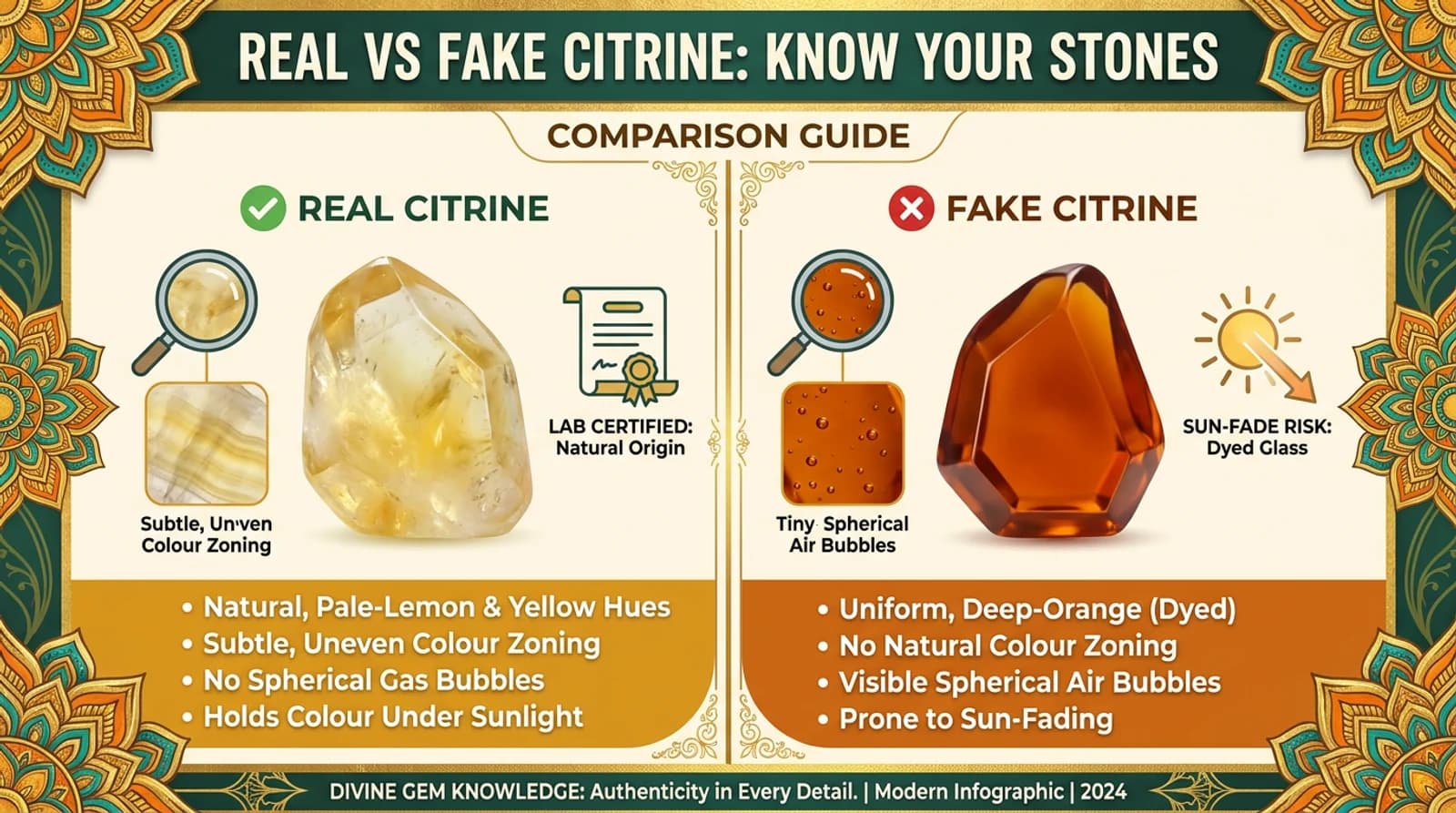
Before you worry about natural-versus-treated, rule out outright fakes. The most common counterfeits sold as cheap "citrine" bracelets are dyed glass, resin or plastic. These have no relationship to quartz and give themselves away on a few quick checks you can do at home or at the counter.
| Tell | Genuine citrine (quartz) | Dyed glass / plastic fake |
|---|---|---|
| Colour | Pale lemon to honey-amber; often uneven | Uniform, intense orange — too perfect |
| Bubbles | None inside the bead | Tiny round air bubbles trapped inside |
| Temperature | Cool to the touch, warms slowly | Plastic warms instantly, feels light |
| Weight | Dense, has heft for its size | Plastic feels suspiciously light |
| Hardness | Mohs ~7, scratches glass | Glass scratches; plastic dents |
| Seam line | None | Moulded glass may show a faint seam |
If a bracelet shows trapped bubbles, a moulding seam, plastic lightness or an impossibly uniform neon-orange colour, treat it as a fake regardless of any "100% certified" tag on the listing. A genuine stone earns trust through the structured tests in the next section, not through a badge.
6 tests to spot a genuine citrine bracelet
No single test is conclusive on its own, but run these six together and you will reliably separate real citrine from glass, and get strong clues about natural versus heat-treated origin. None require a lab — only good daylight, patience and honesty about what you see.
- 1Colour-zoning check
Look closely in daylight. Natural citrine is usually a soft, slightly uneven pale-yellow to honey, sometimes with smoky hints. Heat-treated amethyst-citrine tends to a strong reddish-orange, often concentrated near the bead tips — sharp colour zoning at the ends is a classic kiln tell.
- 2Sunlight-fade test
Genuine citrine's colour can fade with very prolonged sun exposure; dyed glass usually will not fade evenly because its colour is surface dye. This is a slow test, not a parlour trick — never bake your bracelet to "prove" it. Use it only as supporting context, and never as routine care.
- 3Bubble and inclusion check
Hold a bead to the light. Real quartz may show natural veils or tiny fractures but never round air bubbles. Perfect clarity plus trapped round bubbles equals glass.
- 4Temperature and weight
Quartz feels cool and dense and warms slowly in your hand. Plastic feels warm and light almost immediately. Compare a bead against a known glass object for weight.
- 5Scratch / hardness clue
Citrine is Mohs ~7 and will lightly scratch glass; glass and plastic will not scratch quartz. Do this on a hidden spot or a spare bead, never the show face of your bracelet.
- 6Certificate cross-check
Finally, match the stone to paper. A real Jaipur lab certificate states the species, whether it is natural or heat-treated, and carries a report number you can verify. A vague "AAA / 100% certified" badge with no lab named is not a test result — it is marketing.
Score it honestly: if a bracelet passes the physical tests but the seller cannot tell you whether it is natural or treated, you simply have an untraceable real quartz — fine to wear, but not what a "natural citrine" price should buy.
Natural vs heat-treated citrine — both are real quartz
Here is the line most sellers blur: heat-treated citrine is not "fake." It is genuine quartz (amethyst) that has been heated until it turns golden — a permanent, stable colour change. It is real, wearable and affordable. What is dishonest is selling treated stone at natural-citrine prices, or refusing to disclose the treatment at all. Disclosure is the whole point.
| Feature | Natural citrine | Heat-treated (amethyst origin) |
|---|---|---|
| Is it real quartz? | Yes | Yes |
| Colour origin | Formed in the earth | Produced in a kiln |
| Typical colour | Pale lemon to soft honey | Strong reddish-orange, zoned tips |
| Rarity | Rarer | Very common in the market |
| Price | Higher | Lower / budget-friendly |
| Should be disclosed? | Yes | Yes — always |
DivineTatva states on each product page whether a stone is natural or heat-treated citrine. Both are legitimate; you simply deserve to know which you are buying and to pay the right price for it. If a competitor never mentions treatment, assume the stone is heat-treated and priced as if it were not.
Why a Jaipur lab certificate beats a '100% certified' badge
A graphic that says "100% Certified" or "AAA Quality" proves nothing — no lab is named, no report exists, nothing can be checked. A genuine lab certificate is a different object entirely: it identifies the species, discloses treatment, and carries a unique report number tied to your specific piece.
| Lab body named | Yes — a real Jaipur gem laboratory |
| Report number | Unique, verifiable per piece |
| Treatment disclosed | States natural or heat-treated |
| Downloadable copy | Yes — keep it with your order |
| What a badge gives you | An unverifiable graphic, no report |
When you compare two bracelets at similar prices, the deciding factor is verifiability. A certificate you can read and cross-check — with the treatment stated in plain words — is worth more than any number of confident-sounding badges. Ask one question of any seller: "What is the report number and which lab issued it?" The answer tells you everything.
Price tiers, 8mm sizing and honest care
Citrine bracelet price in India varies mainly by whether the stone is natural or heat-treated, by bead size and clarity, and by whether a real lab certificate is included. Treated-citrine bracelets are budget-friendly; certified natural citrine costs more because it is genuinely rarer. Beware prices that look like natural-citrine quality at treated-citrine cost — something has usually been left unsaid.
| Tier | Typical stone | What you pay for |
|---|---|---|
| Entry | Heat-treated, 6–8mm | Affordable everyday wear, disclosed treatment |
| Mid | Better-clarity treated or mixed | Cleaner beads, certificate included |
| Premium | Certified natural citrine | Genuine rarity, full lab report |
Sizing: 8mm is the most popular all-round bead — substantial but not heavy. Measure your wrist and add a little ease for a stretch fit. For wear, tradition favours the left wrist (the receiving side) and Thursday, Jupiter's day, though these are belief-based customs, not rules.
Care, stated honestly: citrine is durable but its golden colour can fade with prolonged sun exposure, so cleanse it briefly under moonlight, selenite or a quick water rinse and avoid leaving it in direct sunlight; keep it away from harsh chemicals, perfume and water while bathing. Ignore any "charge it in the sun" advice — for citrine that risks fading the very colour you paid for.
The wealth promise: belief vs evidence
The "stone of abundance" name comes from Vedic and metaphysical tradition, not from clinical research. There is no medical or scientific proof that a citrine bracelet attracts money, grows a business or changes your finances. What people consistently report is feeling calmer, more focused and more confident — effects well explained by intention, ritual and the placebo response, all of which are real and useful in their own right.
Worn this way, a citrine bracelet is a meaningful, supportive ritual and a beautiful piece of certified quartz — not a substitute for medical, financial or professional advice. Buy it for the tradition, the craft and the verified authenticity, set honest expectations, and you will never feel misled.
| Traditional claim | Abundance, wealth, confidence, clarity |
| Evidence status | Belief-based; no clinical proof |
| What users report | Calm, focus, motivation (intention/ritual) |
| Honest verdict | Supportive ritual, not financial advice |
Frequently asked
Last reviewed: 17 May 2026 · Verified by the DivineTatva expert panel
How do I tell a real vs fake citrine bracelet at home?
Use several checks together. Real citrine is cool, dense quartz with uneven pale-to-honey colour and no internal bubbles; it scratches glass (Mohs ~7). Fakes are dyed glass or plastic — uniform neon-orange, light, warm to touch, often with trapped round bubbles or a moulding seam. Then cross-check against a real lab certificate with a report number, not a vague badge.
Is most citrine really heat-treated amethyst?
Yes. Most commercial citrine is amethyst heated until it turns golden — still genuine quartz, just coloured in a kiln rather than by nature. It is real and wearable, not a fake. Naturally yellow citrine is rarer and costs more. The honest issue is disclosure: a trustworthy seller tells you which one you are buying. DivineTatva states natural or heat-treated on every product page.
Does a citrine bracelet actually attract money?
There is no medical or scientific proof that citrine attracts money or grows a business. The "merchant's stone" reputation comes from Vedic and metaphysical tradition. Many wearers report feeling more confident, calm and focused — consistent with intention, ritual and placebo. Treat it as a supportive, meaningful ritual and a certified quartz piece, not a substitute for financial or professional advice.
Which hand should I wear a citrine bracelet on?
Tradition favours the left wrist, considered the receiving side, so a citrine bracelet worn for abundance and confidence usually goes on the left. Thursday — Jupiter's (Guru's) day — is the customary day to begin wearing it. These are belief-based customs rather than fixed rules, so wear it on whichever wrist is comfortable; consistency and intention matter more than side.
What is the price of a citrine bracelet in India?
Price depends mainly on whether the stone is natural or heat-treated, plus bead size, clarity and whether a genuine lab certificate is included. Heat-treated citrine bracelets are budget-friendly; certified natural citrine costs more because it is rarer. Be cautious of listings priced like premium natural stone while staying silent about treatment — that silence usually hides heat-treated quartz.
Why is a lab certificate better than a '100% certified' badge?
A "100% certified" or "AAA" badge names no lab and links to no report, so nothing can be verified. A real Jaipur lab certificate identifies the species, discloses whether the stone is natural or heat-treated, and carries a unique report number tied to your piece, with a downloadable copy. Always ask a seller for the report number and issuing lab.
How should I cleanse and care for a citrine bracelet?
Citrine is durable but its golden colour can fade with prolonged sun exposure, so cleanse it briefly under moonlight, selenite or a quick water rinse and avoid leaving it in direct sunlight; keep it away from harsh chemicals, perfume and water while bathing. Ignore generic "charge it in the sun" advice — for citrine, long sun exposure risks fading the very colour you bought it for.
Reviewed by the DivineTatva expert panel
Written and reviewed by DivineTatva's consulting Vedic astrologer. Every piece is lab-certified and energised in our Jaipur atelier. Last updated 26 March 2026.