Citrine Bracelet (Stone of Abundance & Wealth): Benefits, Real vs Heat-Treated, Price in India & Lab-Certified Buyer's Guide
A citrine bracelet is a stretch or beaded wrist band of citrine — a yellow-to-golden quartz long called the "stone of abundance" or "merchant's stone." Tradition links it to wealth, confidence and the solar plexus chakra. Honest note: most market "citrine" is heat-treated amethyst — still real quartz, but kiln-coloured, not naturally yellow.
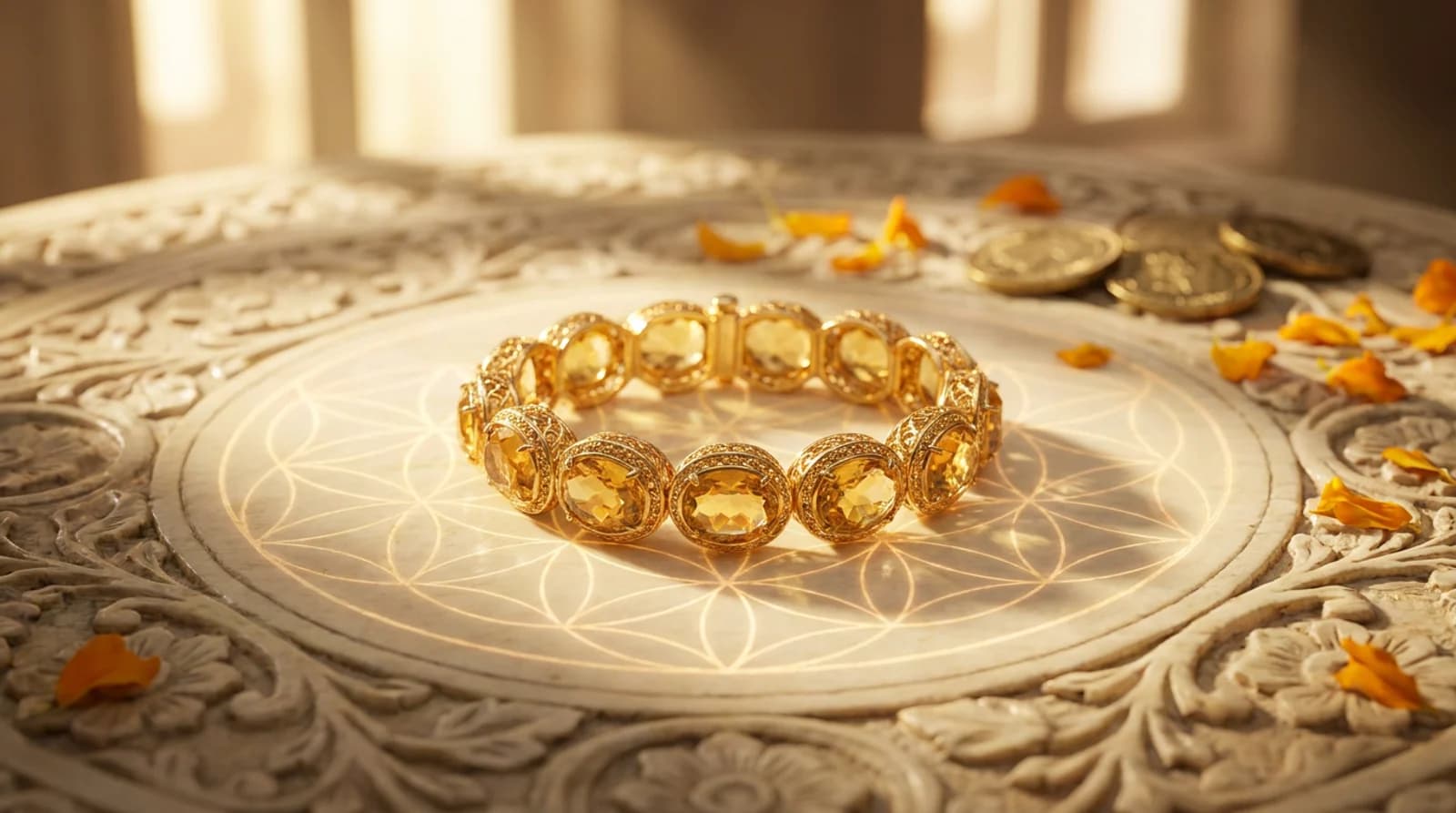
- What Is a Citrine Bracelet
- Natural vs Heat-Treated Citrine
- Real vs Fake Citrine Test
- Benefits: Belief vs Evidence
- Does It Really Attract Money?
- Who Should Wear It
- Side Effects, Honestly
- Which Hand to Wear It
- Best Day & Activation
- Cleanse & Charge (Care)
- Price in India & Sizing
- The DivineTatva Difference
- FAQs
- Shop Certified
What a Citrine Bracelet Actually Is
A citrine bracelet is a stretch or beaded wrist band made from citrine, the yellow-to-golden variety of quartz. For centuries it has been called the "stone of abundance and wealth" or the "merchant's stone," worn by traders and business owners as a symbol of prosperity, confidence and clarity. It is one of the most popular crystal bracelets in India for exactly this reason.
Here is the honest part most sellers skip: the vast majority of "citrine" on the market is not naturally yellow. It is heat-treated amethyst — genuine quartz whose golden colour was produced in a kiln, not by the earth. Both are real quartz and both are sold legitimately worldwide, but naturally yellow citrine is rarer and pricier. Knowing which one you are buying is the whole point of this guide.
| Material | Citrine — yellow/golden quartz (SiO₂) |
| Common names | Stone of abundance, merchant's stone, success stone |
| Tradition | Wealth, confidence, solar plexus chakra, Jupiter (Guru) |
| Mohs hardness | ~7 (durable for daily wear) |
| Most market stock | Heat-treated amethyst (kiln-coloured), not natural citrine |
| Honest status | Belief-based metaphysical claims; not medically proven |
These prosperity and confidence associations come from Vedic and metaphysical tradition and from belief — they are culturally meaningful, not clinically proven. Treat a citrine bracelet as a supportive ritual and intention anchor, not a substitute for medical, financial or professional advice.
Natural vs Heat-Treated Citrine
Amethyst and citrine are the same mineral — quartz — coloured differently by iron and natural radiation. When purple amethyst is heated to roughly 470–560°C, it turns golden, orange or reddish-brown. That heated stone is then sold as "citrine." It is still real quartz, so it is not technically a fake; it is simply treated, and an honest seller tells you so in writing. Almost no competitor does.
| Tell | Natural citrine | Heat-treated amethyst |
|---|---|---|
| Colour | Pale lemon to soft honey, often subtle | Deep orange to amber, sometimes reddish |
| Bead tips | Even, muted tone | Whitish base with concentrated orange/red tips |
| Colour zoning | Soft, smoky, uneven natural zoning | Very uniform, saturated, "too perfect" |
| Rarity & price | Rarer, costs more | Common, more affordable |
| Authenticity | Genuine natural quartz | Genuine quartz, but kiln-coloured |
A quick visual rule: if every bead is an identical, intense orange with whitish bases and slightly reddish tips, it is almost certainly heat-treated. Natural citrine tends to be paler, softer and a little uneven, with gentle smoky zoning. Neither is "bad" — but they are not the same value, and you deserve to know which you are paying for.
DivineTatva states the treatment status in writing on every product page. Where a bracelet is natural citrine, we say so and the Jaipur lab certificate confirms it; where a piece is heat-treated quartz, we disclose that too, with honest pricing to match. No guessing, no poetic cover-ups.
Real vs Fake Citrine: Hands-On Tests
"Real vs fake" and "natural vs heat-treated" are two different questions. Heat-treated citrine is still real quartz. A genuine fake is something pretending to be quartz entirely — dyed glass, plastic, or stained low-grade crystal. Here is how to separate all three at home before trusting any certificate.
- 1Check colour zoning
Natural quartz shows soft, uneven colour and faint smoky zones. Flawless, candy-uniform orange across every bead suggests dye or heavy treatment.
- 2Watch for fade
Real citrine can gently fade with prolonged strong sunlight — a sign of natural quartz. Dyed glass usually does not fade the same way, but may show colour pooling in cracks.
- 3Look for bubbles
Tiny round air bubbles inside a clear bead mean glass, not quartz. Natural quartz has irregular inclusions and veils, never perfect spheres.
- 4Feel the temperature
Quartz feels cool and warms slowly. Plastic feels warm and light almost instantly.
- 5Test the hardness
Quartz is Mohs ~7 and resists scratching by a steel knife. Glass scratches more easily; plastic far more so. Test gently on one bead only.
- 6Demand a report number
A real Jaipur lab certificate names the lab and carries a report number you can verify — unlike a vague "100% Certified" or "AAA" badge that names no lab at all.
A printed badge proves nothing. A certificate with a named lab body and a traceable report number — like the one DivineTatva includes with every bracelet — is the difference between a claim and proof.
Citrine Bracelet Benefits, Honestly Separated
Citrine carries a long list of traditional benefits. We will not pretend they are clinically proven — instead, here is a clean split between what tradition and belief claim, and what is actually verifiable. Both columns have value; honesty just means not blurring them.
| Claim | Tradition / belief | What's verifiable |
|---|---|---|
| Attracts wealth & abundance | Merchant's stone for prosperity and business luck | No evidence stones move money; intention may aid focus |
| Boosts confidence & drive | Solar plexus chakra, Jupiter energy, self-belief | Wearing a meaning-charged item can genuinely lift mindset |
| Mental clarity & positivity | "Stone of the sun," dispels negativity | Placebo and intention effects on mood are real, useful |
| Beautiful daily wear | Auspicious golden glow | True — affordable, durable, attractive natural quartz |
| Heals the body | Said to support digestion, energy | No clinical proof; not a medical treatment |
The fair summary: a citrine bracelet is an attractive, affordable, durable natural quartz. The wealth and confidence effects belong to Vedic and metaphysical tradition and to belief. Crucially, intention and ritual effects on your own mindset are real and useful — a daily cue to act with focus and confidence is not nothing. Just don't expect the stone to do the work for you.
Does a Citrine Bracelet Really Attract Money?
Short, honest answer: no crystal can deposit money into your account. There is no evidence that citrine attracts wealth, and any seller promising guaranteed riches is overclaiming. What a citrine bracelet can genuinely do is act as a confidence and intention anchor — a physical reminder of a financial goal you've set yourself.
In Vastu and Feng Shui tradition, citrine is placed in wealth corners and cash boxes as the "merchant's stone." That tradition is meaningful and worth respecting on its own terms. But the mechanism that actually changes outcomes is you: a stone on your wrist that reminds you, dozens of times a day, to follow up that lead, pitch that client or save that amount. That nudge is real psychology, not magic.
| Guaranteed money magnet? | No — not supported by evidence |
| Useful as a focus cue? | Yes — intention anchors do affect behaviour |
| Vastu / Feng Shui role | Traditional wealth symbol, belief-based |
| Best honest use | Pair the bracelet with real action and goals |
| Our promise | Never a substitute for financial advice |
Wear it as a daily prompt toward your own effort, and a citrine bracelet earns its keep. Wait for it to do the earning, and it won't. That's the truthful framing no competitor offers.
Who Should Wear a Citrine Bracelet (and Who Shouldn't)
Citrine is linked to Jupiter (Guru) and the solar plexus chakra, so tradition pairs it with confidence, growth and expansion. Because it is simply quartz, there are no real medical contraindications — the "should not wear" question is about astrological belief, not safety.
| Group | Why tradition suits them | Honest note |
|---|---|---|
| Business owners & traders | Merchant's stone for growth, confidence | A motivation cue, not a sales guarantee |
| Students & learners | Clarity, focus, Jupiter's wisdom | Supports a study mindset, doesn't replace study |
| Creatives & speakers | Solar plexus, self-expression, courage | Helps confidence rituals; results vary |
| Sagittarius & Pisces (Jupiter-ruled) | Natural rashi affinity in tradition | Belief-based; anyone may wear citrine |
| Anyone drawn to it | Beautiful, affordable, uplifting | No quartz contraindication exists |
Some traditions suggest checking with an astrologer if you are combining multiple gemstones for specific planetary remedies, since stone combinations are taken seriously in jyotish. But as a standalone crystal bracelet, citrine has no genuine side effects to fear. If a page tells you citrine is "dangerous" for certain people, that is fear-based marketing, not fact.
Side Effects of Wearing Citrine
Let's calmly debunk the scare content. Citrine is quartz. There are no proven physical side effects from wearing a citrine bracelet. You cannot "overdose" on a crystal, and it will not harm your health. The only real-world issues are practical, not mystical — and all are easy to manage.
| Proven physical side effects | None — it is inert quartz |
| Elastic / cord sensitivity | Rare skin reaction to the band, not the stone |
| Metal closure allergy | Possible with nickel clasps; choose stretch or hypoallergenic |
| Colour fade | Possible with prolonged strong sun — a care issue, not harm |
| "Energy overwhelm" | Belief-based; simply remove it if uneasy |
| Skin irritation under band | Keep wrist dry and clean; loosen if tight |
If you notice irritation, it is almost always the elastic cord, sweat trapped under a tight band, or a nickel clasp — not the citrine. Choose a stretch bracelet, keep the wrist clean and dry, and the problem disappears. So-called "energy side effects" are belief-based; if a bracelet ever makes you uneasy, simply take it off. No fear required.
Which Hand Should You Wear a Citrine Bracelet On?
In crystal tradition, the left wrist is the "receiving" side — you wear stones there to draw energy in, like abundance and confidence. The right wrist is the "giving" or projecting side, used when you want to send energy out into the world. For a wealth-and-confidence stone like citrine, most people choose the left.
| Hand | Tradition | Best for |
|---|---|---|
| Left wrist | Receiving side, draws energy inward | Attracting abundance, calm, self-confidence |
| Right wrist | Giving / projecting side | Expressing energy, action, generosity outward |
| Feng Shui view | Left often linked to receiving wealth | Inviting prosperity in |
| Honest take | Preference, not a hard rule | Whichever wrist you'll actually keep wearing |
Feng Shui broadly agrees the left invites prosperity inward. But here is the honest note: this is a preference and a tradition, not a law. There is no evidence the wrist choice changes any outcome. Wear it on whichever hand is comfortable, doesn't interfere with your watch or work, and keeps the bracelet on your wrist daily — that consistency matters far more than the side.
Best Day, Method & Activation
Tradition links citrine to Jupiter (Guru), so Thursday (Guruvar) is considered the most auspicious day to begin wearing it. Many people start in the morning after a bath, holding a simple intention. This is ritual, and rituals can genuinely help by marking a fresh commitment — but none of it is a requirement for the bracelet to be beautiful or useful.
- 1Choose Thursday morning (optional)
Guruvar is traditionally tied to Jupiter and prosperity. Any day is fine if Thursday isn't convenient.
- 2Cleanse it first
A brief moonlight, selenite or quick rinse resets the bracelet before first wear.
- 3Set a clear intention
Hold the bracelet, name one specific goal — focus, confidence, a business aim — in your own words.
- 4Wear it on your left wrist
The receiving side, by tradition, for drawing in abundance and calm.
- 5Pair it with action
Let the bracelet remind you to actually do the work toward your goal each day.
Treat the day, mantra and intention as a meaningful personal ritual that helps you commit — not a magic spell the bracelet needs to function. If you skip all of it and just wear the bracelet because you like it, that is completely fine too.
How to Cleanse and Charge a Citrine Bracelet
Citrine is durable but its golden colour can fade with prolonged sun exposure, so cleanse it briefly under moonlight, selenite or a quick water rinse and avoid leaving it in direct sunlight; keep it away from harsh chemicals, perfume and water while bathing. This is the one care correction that matters most — ignore the common "charge it in the sun all day" advice, which can dull your stone.
| Moonlight | Leave out a few hours overnight — gentle, safe |
| Selenite | Rest on a selenite plate or near a selenite stick |
| Sound | A singing bowl or bell to reset energy |
| Quick water rinse | Brief only — dry fully, avoid soaking the cord |
| Direct sunlight | AVOID prolonged sun — it can fade citrine's colour |
| Chemicals & perfume | Keep away; remove before bathing or swimming |
Cleanse roughly once or twice a month, or whenever it feels right to you. "Charging" is a belief-based practice — the practical truth is that gentle cleansing keeps the bracelet clean and the cord intact, while avoiding sun keeps the colour vivid. Skip ultrasonic cleaners and harsh sprays entirely; a soft cloth handles everyday dust.
Citrine Bracelet Price in India & Sizing
Citrine bracelet prices in India vary widely, and the biggest swing is natural vs heat-treated. A ₹399 marketplace bead is almost always heat-treated quartz with no certificate. A lab-certified bracelet with disclosed treatment costs more because you are paying for verified material and proof, not a guess.
| Tier | Typical INR range | What you're getting |
|---|---|---|
| Uncertified marketplace | ₹199–₹499 | Heat-treated quartz, no certificate, no disclosure |
| Certified heat-treated | ₹600–₹1,500 | Real quartz, treatment disclosed, lab report |
| Certified natural citrine | ₹1,500–₹5,000+ | Rarer natural yellow quartz, lab-certified |
| Premium / large beads | ₹3,000+ | Higher clarity, bigger beads, finer finish |
Price drivers: whether the stone is natural or treated, clarity and colour evenness, bead size, and crucially whether a real lab certificate backs it. On sizing, 8mm beads suit slimmer wrists and a subtle look, while 10mm beads make a bolder statement and a heavier feel.
- 1Measure your wrist
Wrap a soft tape or string snugly around your wrist and note the length in cm.
- 2Add comfort room
Add about 1.5–2 cm to that measurement for a stretch bracelet that sits comfortably.
- 3Pick bead size
8mm for a slim, everyday look; 10mm for a bolder presence and more weight.
- 4Choose certified
A certificate with a report number is why a real bracelet costs more than a ₹399 bead.
The DivineTatva Difference
Most citrine sellers hide the single most important fact — whether your stone is natural or heat-treated. We lead with it. DivineTatva is built around disclosure-first honesty, real lab proof and a belief-vs-evidence voice that respects both tradition and your intelligence.
| Treatment disclosed in writing | We state natural vs heat-treated on the PDP |
| Real Jaipur lab certificate | Named lab + report number + downloadable copy |
| Honest belief-vs-evidence voice | Tradition respected, never over-promised |
| On-page authenticity tests | Real-vs-fake guidance, not just a badge |
| COD & free shipping | Cash on delivery across India |
| Transparent returns | Clear stated return window, no fine-print games |
Where others print "100% Certified" or "AAA" with no lab named, we hand you a verifiable report number. Where others promise guaranteed wealth, we separate belief from evidence. Where others say "charge it in the sun," we warn you it can fade. That is the disclosure-first standard — and it is exactly why a DivineTatva citrine bracelet is one you can trust on your wrist and recommend to others.
Frequently asked
Last reviewed: 17 May 2026 · Verified by the DivineTatva expert panel
Is most citrine actually heat-treated amethyst?
Yes. The majority of "citrine" sold today is amethyst heated to around 470–560°C, which turns it golden or orange. It is still genuine quartz, so it is not a fake — but its colour was made in a kiln, not by nature. Naturally yellow citrine is rarer and pricier. An honest seller discloses which one you are buying; DivineTatva states the treatment in writing.
How do I tell real citrine from fake?
Check colour zoning (natural quartz is soft and uneven, not candy-uniform), look for round air bubbles (a sign of glass), feel for the cool, slow-warming touch of quartz, and test that it resists scratching from steel. Most importantly, demand a lab certificate with a named lab and a traceable report number rather than a vague "100% Certified" badge that names no lab.
Which hand should I wear a citrine bracelet on?
Tradition places it on the left wrist, the "receiving" side, to draw in abundance and confidence; the right is the "giving" side for projecting energy. Feng Shui broadly agrees the left invites prosperity inward. Honestly, this is a preference, not a rule — there is no evidence the side changes outcomes. Wear it wherever you'll comfortably keep it on daily.
Who should wear a citrine bracelet?
Tradition suits it to business owners, students, creatives and speakers, and to Jupiter-ruled signs like Sagittarius and Pisces, because citrine is linked to Jupiter and the solar plexus chakra. Honestly, anyone drawn to it can wear it — it is simply quartz with no medical contraindication. If you are combining several gemstones for planetary remedies, an astrologer's input can help.
Are there any side effects of wearing citrine?
No proven physical side effects exist — citrine is inert quartz, and you cannot "overdose" on a crystal. The only real issues are practical: rare skin sensitivity to the elastic cord or a nickel clasp, and possible colour fade from prolonged sun. Choose a stretch bracelet, keep your wrist dry, and avoid long sun exposure. So-called "energy side effects" are belief-based — just remove it if uneasy.
Does a citrine bracelet really attract money?
No crystal can deposit money for you, and there is no evidence citrine attracts wealth. What it can genuinely do is act as a confidence and intention anchor — a daily reminder to follow up, pitch and save. In Vastu and Feng Shui it is the traditional "merchant's stone." Wear it alongside real effort and goals; it supports your mindset, it is not a guaranteed money magnet.
What is the best day and method to activate it?
Tradition favours Thursday (Guruvar), linked to Jupiter, ideally in the morning after a bath. Cleanse the bracelet first with moonlight, selenite or a quick rinse, hold it, set one clear intention in your own words, then wear it on your left wrist. Treat this as a meaningful personal ritual that helps you commit — not a requirement for the bracelet to be beautiful or useful.
How do I cleanse and charge a citrine bracelet?
Cleanse it briefly under moonlight, on selenite, with sound, or a quick water rinse — roughly once or twice a month. Citrine is durable but its golden colour can fade with prolonged sun, so avoid the common "leave it in the sun" advice. Keep it away from harsh chemicals, perfume and water while bathing, and dry it fully after any rinse to protect the cord.
What does a citrine bracelet cost in India?
Uncertified marketplace beads run ₹199–₹499 and are almost always heat-treated quartz with no proof. Certified heat-treated bracelets sit around ₹600–₹1,500, while certified natural citrine — the rarer naturally yellow quartz — typically runs ₹1,500–₹5,000+. You pay more for verified material, disclosed treatment and a real lab certificate, not a ₹399 guess.
What's the difference between 8mm and 10mm citrine beads?
8mm beads suit slimmer wrists and give a subtle, everyday look; 10mm beads are bolder, heavier and more of a statement. To size, wrap a soft tape around your wrist, add about 1.5–2 cm of comfort room for a stretch fit, then choose your bead size. Larger, clearer beads generally cost more for the same material grade.
Is heat-treated citrine a scam or fake?
No. Heat-treated citrine is genuine quartz — it is treated, not counterfeit, and is sold legitimately worldwide. The problem is only when a seller hides the treatment and charges natural-citrine prices for it. That is why we disclose treatment in writing and back natural pieces with a lab certificate, so you always know exactly what you are paying for.
Will a citrine bracelet replace medical or financial advice?
No. A citrine bracelet is a culturally meaningful, belief-based ritual and an attractive natural quartz — nothing more. Its wealth, confidence and healing associations come from tradition and belief, not clinical proof. Use it as a supportive intention anchor alongside real action, and never as a substitute for medical, financial or professional advice.
Reviewed by the DivineTatva expert panel
Written and reviewed by DivineTatva's consulting Vedic astrologer. Every piece is lab-certified and energised in our Jaipur atelier. Last updated 25 March 2026.
- Real vs Fake Citrine Bracelet
- Is Your Citrine Heat-Treated Amethyst? Natural vs Treated, Honestly Explained
- Does a Citrine Bracelet Really Attract Money? Belief vs Evidence
- Shop the certified citrine bracelet
- Citrine Bracelet Price in India 2026
- Which Hand to Wear a Citrine Bracelet
- Who Should Wear a Citrine Bracelet (and Who Shouldn't)
- Citrine vs Pyrite for Money