Evil Eye Bracelet Meaning: Nazar Kavach Symbolism Explained for India
An evil eye bracelet is a wrist talisman designed to deflect buri nazar — the Indian belief that concentrated envy or admiration from others transmits negative energy to the recipient. The blue concentric glass eye design is believed to mirror the malevolent gaze back to the sender, neutralising it before it can affect the wearer's wellbeing.
What Is Buri Nazar in Indian Tradition?
Buri nazar — literally 'bad gaze' — is the Indian folk and Vedic belief that a concentrated look of envy, jealousy, or excessive admiration from another person can transmit negative energy to the person being looked at. This is not considered a deliberate curse. The belief holds that strong emotion — particularly envy — carries an energetic charge that can 'stick' to a person through their gaze, subtly disrupting health, luck, mood or relationships.
The idea appears across Indian regional traditions: in Rajasthan, a nirna (black spot) is placed on a child's forehead to 'break' the eye; in South India, kolam patterns around the home are partly protective; nimbu-mirchi hangings at doorways are nazar deflectors. The bracelet form is among the most modern and portable expressions of this ancient belief.
Vedic references to drishti-dosha (harm from the gaze) appear in the Atharvaveda and in Ayurvedic tradition, where an imbalance caused by negative gaze is considered a real category of energetic disturbance. This gives the nazar kavach bracelet a grounding in Indian spiritual literature, not just folk superstition.
What the Concentric Eye Design Means
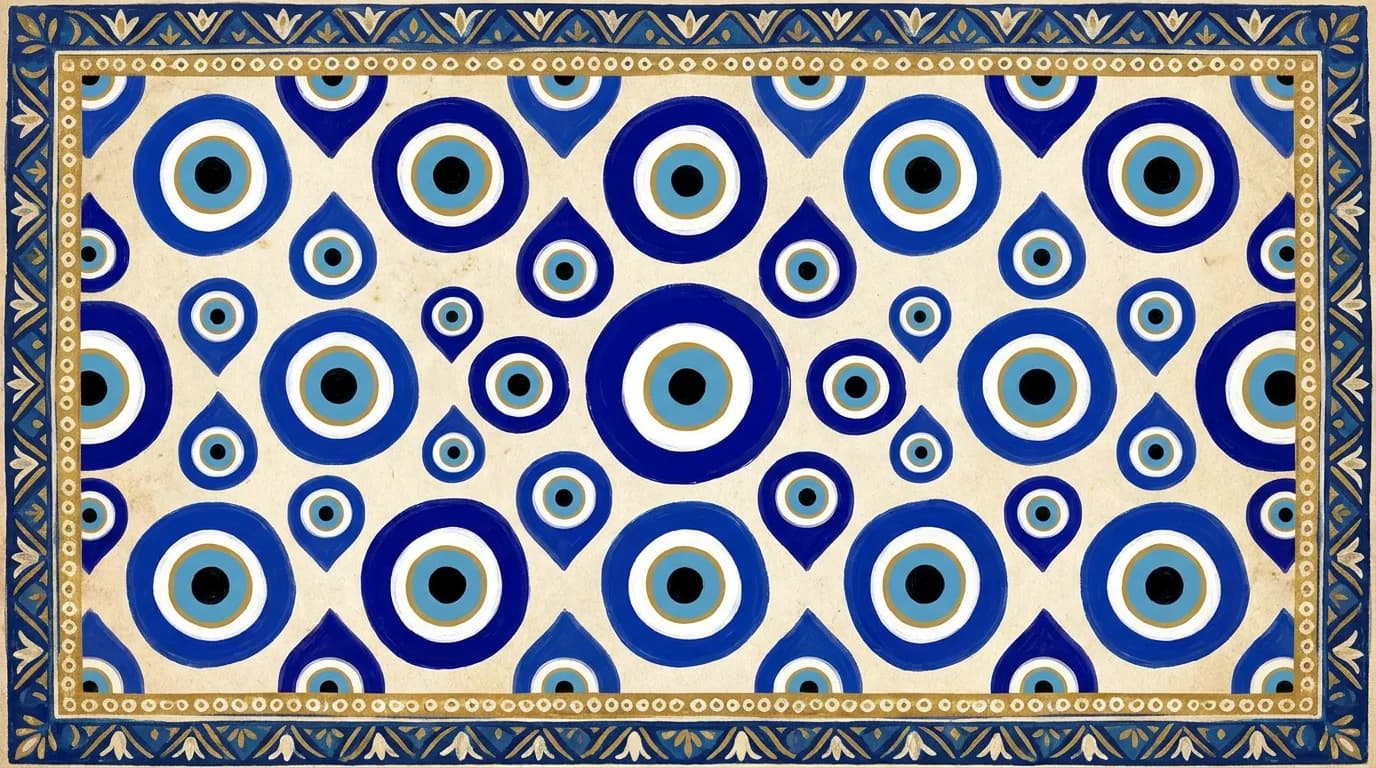
The evil eye charm is a carefully structured symbol — not just a decorative bead. Its concentric circle design — dark centre, white or light iris, blue outer ring — is intended to mimic the structure of a human eye. The logic is a form of 'like repels like': by presenting a watchful eye to the world, the bracelet is believed to look back at the looker, catching the envious gaze and reflecting it before it can settle on the wearer.
| Dark centre (pupil) | Represents the all-seeing gaze — fully alert to incoming negative energy |
| White iris ring | Purity and clarity — the clear boundary between the wearer's energy and incoming negativity |
| Blue outer ring | The reflecting shield — mirrors the malevolent gaze back to sender |
| Smooth glass surface | Acts as a literal mirror-like surface, reinforcing the reflective symbolism |
| Concentric structure | The layers create depth — belief holds that layered defences are stronger |
Why Is the Evil Eye Always Blue?
The blue colour of the traditional nazar kavach connects to several symbolic systems. In the Turkish and Mediterranean nazar bead tradition — from which the Indian glass bead design largely derives — blue (particularly Aegean sea-blue) was the colour of the sky and divine protection. Blue eyes were relatively uncommon in those regions and associated with dangerous 'cold' staring — so a blue eye deflector was a direct confrontation of that gaze.
In Indian Vedic colour symbolism, blue is associated with Shani (Saturn) — a planet linked to karma, justice and protection from malicious forces. Blue also corresponds to the Vishuddha (throat) chakra, which governs speech — significant because buri nazar is often believed to travel on spoken admiration ('wah, kitna pyaara bachcha hai' — how beautiful your child is — accompanied by unspoken envy).
The Evil Eye Across Cultures
The evil eye belief is one of the most widely shared superstitions in human history — anthropologists have documented versions of it in over 40 countries across six continents. The Indian nazar kavach sits within a global family of protective eye symbols.
| Culture | Local name | Traditional form | Shared belief |
|---|---|---|---|
| India | Nazar / Buri nazar | Glass bead, black thread, nimbu-mirchi | Envy transmits negative drishti energy |
| Turkey / Greece | Nazar boncuğu / Matiasma | Blue glass bead (hamsa/nazar bead) | Evil eye from excessive admiration |
| Middle East | Ayn al-hasad | Hamsa hand with eye centre | Jealousy/envy can physically harm |
| Italy | Malocchio | Cornicello horn charm, red thread | Evil eye causes illness and bad luck |
| Latin America | Mal de ojo | Red or black thread bracelet on wrist | Admiration without touching causes harm to infants |
The fact that independently developed cultures across millennia reached similar conclusions about gaze-based harm is one reason nazar kavach practitioners take the belief seriously — it points to a broadly shared human experience, even if the mechanism remains scientifically unverified.
What Is Pran Pratishta and Why It Matters
Pran Pratishta is a Sanskrit term meaning 'life installation' or energisation — a ritual process in which a trained practitioner invokes protective intention into a talisman through mantra, prayer and focused intention. In DivineTatva's process, each evil eye bracelet is passed through this energisation before dispatch, setting a clear sankalp (intention) of nazar deflection and protective watchfulness into the object.
From a scientific standpoint, there is no evidence that objects retain or transmit intentional energy. From a ritual and psychological standpoint, many practitioners find that an energised object — one that was consciously prepared for a specific purpose — supports clearer and more consistent intention-setting when worn. The energisation is an additional layer; the wearer's own sankalp when putting on the bracelet is equally important.
What It Means in Practice to Wear an Evil Eye Bracelet
Wearing an evil eye bracelet is a daily act of intentional protection. Each time you put it on, the traditional gesture is to set a brief sankalp — a mental statement of protective intention. 'This bracelet protects me and my family from buri nazar; may all negative gazes be reflected away.' The bracelet then acts as a tactile anchor for that intention throughout the day — every time you notice it on your wrist, it briefly reinforces awareness of your energetic boundaries.
This is consistent with how ritual objects function across traditions. The meaning is active, not passive — the bracelet does not work in spite of your attention; it works through it. This is why DivineTatva emphasises setting a conscious sankalp rather than simply purchasing and forgetting.
Frequently asked
Last reviewed: 17 May 2026 · Verified by the DivineTatva expert panel
What is the meaning of an evil eye bracelet?
An evil eye bracelet is a protective talisman — called a nazar kavach in India — worn to deflect buri nazar (the malevolent energy of envy or excessive admiration from others). The blue concentric glass eye design is believed to mirror the envious gaze back to the sender before it can affect the wearer's wellbeing, luck or health.
What does nazar kavach mean in English?
Nazar means 'gaze' or 'eye' in Hindi and Urdu; kavach means 'shield' or 'armour.' So nazar kavach translates literally as 'eye shield' or 'gaze protector.' It refers to any talisman used to deflect the harmful energy of buri nazar (the evil eye), whether that is a bracelet, a black thread, a nimbu-mirchi hanging, or an eye-shaped amulet.
Is the evil eye bracelet Hindu or Muslim?
Neither exclusively — it belongs to Indian folk tradition that predates the formal division of religious categories. The belief in buri nazar and protective talismans is shared across Hindu, Muslim, Sikh and secular Indian households. The nazar kavach bracelet in particular crosses religious lines easily, as it is rooted in universal human experiences of envy and the protective instinct, not in any specific scriptural injunction.
Where does the evil eye bracelet design come from?
The modern blue glass concentric-ring evil eye bead design originated in the Turkish and Mediterranean nazar bead tradition (nazar boncuğu in Turkish). It spread globally through trade routes and cultural exchange. India's own nazar kavach tradition — which used black threads, tikka marks and local symbols — absorbed and adapted the glass bead form over the 20th century, integrating it with Vedic energisation practices like Pran Pratishta.
Can I wear an evil eye bracelet with other crystal bracelets?
Yes. The evil eye bracelet pairs naturally with crystal bracelets that align with its protective purpose. Black tourmaline and onyx support its shielding energy. Lapis lazuli complements the throat chakra connection. Clear quartz amplifies intention. Avoid combining it with bracelets that use strongly conflicting intentions — for example, a bracelet set for drawing energy toward you might work against the deflection intention of the nazar kavach.
Does the evil eye bracelet have a religious meaning?
It has a spiritual and folk-ritual meaning that is not tied to a single religion. In Indian tradition, it is used across Hindu, Muslim and secular contexts as a protective gesture rooted in the shared experience of buri nazar. In the Mediterranean and Middle East, similar objects are used across Jewish, Christian and Islamic communities. The bracelet is more accurately described as a pan-cultural protective symbol than a religious one.
What makes DivineTatva's evil eye bracelet different?
DivineTatva's Evil Eye Bracelet uses quality-certified lampwork glass for the focal charm — sharp concentric rings, glass-smooth surface, correct weight. Each piece comes with a per-piece quality certificate. The bracelet is Pran Pratishtha-energised before dispatch, ships with care and replacement guidance, and comes with an honest, belief-based description — no over-promised 'guaranteed' protection. Priced at ₹799 with COD available.
Reviewed by the DivineTatva expert panel
Written and reviewed by DivineTatva's consulting Vedic astrologer. Every piece is lab-certified and energised in our Jaipur atelier. Last updated 2 June 2026.