Karungali Mala Price in India 2026: 6mm vs 8mm vs 10mm & Bracelet Sizing Guide
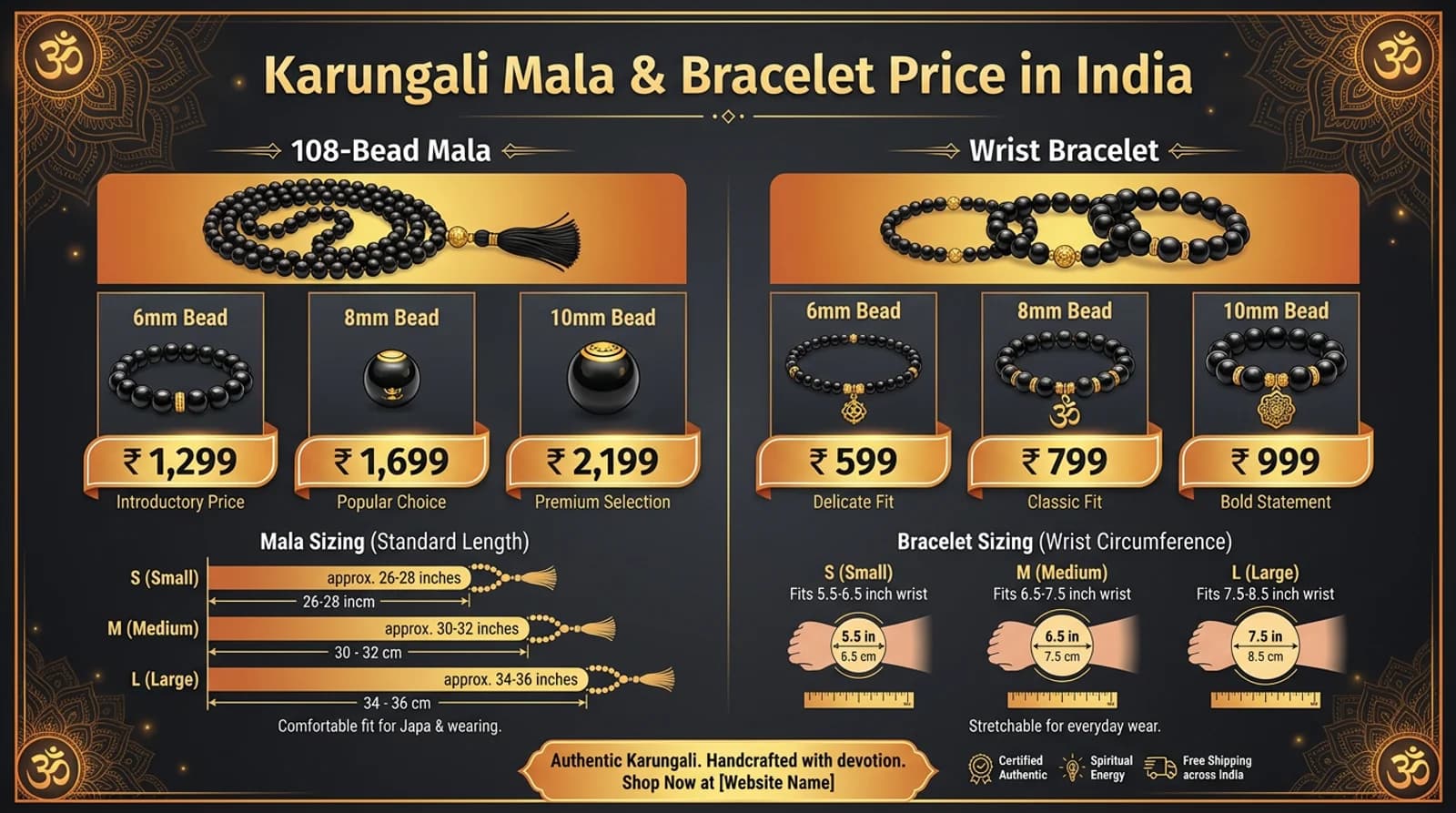
Karungali mala price in India depends mainly on bead size, bead count and certification. A genuine 108+1 bead ebony-wood (Diospyros ebenum) japa mala sits in clear INR bands by 6mm, 8mm or 10mm beads, while stretch bracelets cost less. This guide gives transparent price ranges, wrist-sizing and length numbers, plus where lab certification fits in.
What actually decides a karungali mala's price
Karungali mala price in India is set mainly by four things: bead diameter (6mm, 8mm or 10mm), bead count (a full 108+1 japa mala uses far more wood than a 27-bead or a stretch bracelet), whether the piece is genuine dense ebony heartwood or cheap dyed substitute wood, and whether it ships with a per-piece lab certificate. Hand-finishing and a hand-knotted thread add a little more.
Larger beads need more heartwood and more turning time, so a 10mm mala costs more than the same design in 6mm. Certification and honest sourcing also cost more than an uncertified, possibly dyed piece — which is exactly why a suspiciously cheap 'original karungali mala' is usually the red flag, not the bargain.
| Bead size | Bigger diameter (6→10mm) = more wood = higher price |
| Bead count | 108+1 mala > 54 > 27 > 6mm/8mm bracelet |
| Material grade | Genuine dense ebony heartwood costs more than dyed soft wood |
| Certification | Per-piece lab certificate adds cost and trust |
| Finish | Hand-knotting, oiling and a guru bead add a small premium |
Karungali mala price by bead size (6mm vs 8mm vs 10mm)
Use these as honest 2026 reference bands for genuine, lab-certified karungali in India — not a quote. Street and uncertified pieces can be cheaper, but you are usually paying less for less (dyed or substitute wood, no certificate). Prices move with size and bead count; confirm the live figure and COD on the product page before ordering.
| Piece | Beads | Typical INR band | Best for |
|---|---|---|---|
| 6mm japa mala | 108+1 | ₹600–₹1,200 | Discreet daily wear, slim wrists, fine japa |
| 8mm japa mala | 108+1 | ₹900–₹1,800 | Most popular all-rounder, easy bead-by-bead japa |
| 10mm japa mala | 108+1 | ₹1,400–₹2,800 | Bold look, heavier feel, statement wear |
| 6mm bracelet | ~21–27 | ₹250–₹600 | Everyday slim stack, gifting |
| 8mm bracelet | ~19–23 | ₹350–₹750 | Most popular bracelet, visible grain |
| Mala + 8mm bracelet combo | 108+1 plus band | ₹1,200–₹2,400 | Both intents in one order, best value per piece |
Why the spread inside each band? A plain, single-strand mala sits at the low end; hand-knotted thread, a turned guru/Sumeru bead, oiling and a lab certificate move it up. We keep one consistent price per SKU across India — no inflated 'MRP' theatrics and no ₹99,900-style render bugs.
Mala, bracelet or the combo — which is worth it
A 108+1 mala is the tool for japa (counting mantras bead by bead) and for wearing around the neck. A karungali bracelet is the wear-anywhere option for the wrist — lower cost, lower commitment, easy to gift. Many buyers want both: mala for practice, bracelet for daily wear. That is where a combo earns its keep.
| 108+1 mala | Bracelet | Mala + bracelet combo | |
|---|---|---|---|
| Primary use | Japa + neck wear | Daily wrist wear | Practice + everyday wear |
| Bead count | 108 + 1 guru | ~19–27 (stretch) | Both |
| Typical INR | ₹600–₹2,800 | ₹250–₹750 | ₹1,200–₹2,400 |
| Cost per piece | Mid | Lowest | Lowest combined |
| Best if you | Do mantra counting | Want subtle daily wear | Want both, one order, one cert batch |
No big competitor cleanly owns the combo: mala-only sellers skip the bracelet, bracelet sellers skip japa guidance. Buying the mala and an 8mm bracelet together means one shipment, one COD, and certificates from the same verified batch.
Wrist & mala length sizing (the part most PDPs skip)
For a bracelet, measure your wrist with a strip of paper or a soft tape just below the wrist bone, then add roughly 1.0–1.5 cm for a comfortable (not tight) stretch fit. Bigger beads eat into comfort, so size up a touch in 10mm. For a 108+1 mala, what matters is total loop length and how it sits when worn or held for japa.
- 1Measure your wrist
Wrap paper/tape snugly below the wrist bone and mark where it overlaps. That mark in cm is your base wrist size.
- 2Add ease for stretch fit
Add about 1.0 cm (6mm beads) to 1.5 cm (8–10mm beads) so the band slides on without straining the elastic.
- 3Match to a band size
Use the table below to land on S, M or L. Between sizes, size up — a loose bracelet lasts longer than an over-stretched one.
- 4For the mala, think length
A 6mm 108-bead mala is shorter than a 10mm one. Heavier 10mm beads hang lower; check the loop and hand-held length so japa is comfortable.
| Wrist 14–15 cm | Small — ~6.0–6.3 inch band |
| Wrist 15–17 cm | Medium — ~6.5–7.0 inch band (most adults) |
| Wrist 17–19 cm | Large — ~7.2–7.7 inch band |
| 6mm 108+1 mala | ~Shorter loop, lightest hand-feel |
| 8mm 108+1 mala | ~Mid loop, the popular balance |
| 10mm 108+1 mala | ~Longest loop, heaviest, hangs lowest |
These are guide numbers, not a guarantee of fit — wrist shape and bead batch vary slightly. If you are between sizes or buying as a gift, message us your wrist measurement before dispatch and we will pick the closest band.
Why certified costs a little more — and how COD works
Here is the honest split. Some claims about karungali are materially verifiable; others are traditional belief. Genuine karungali is dense ebony heartwood that sinks in water, feels cool to the touch, has a faint woody (not chemical) smell, and does not bleed dye onto a damp white cloth. These are checkable facts. The idea that it acts as a Shani (Saturn) or Shiva remedy, grounds you, or shields from nazar is traditional Vedic/metaphysical belief, not proven by science — wearers often report calm and focus consistent with intention and ritual, and we never promise a guaranteed outcome.
| Claim | Type | What we say |
|---|---|---|
| Dense ebony heartwood, sinks in water | Verifiable fact | Test it at home |
| Cool to touch, faint woody smell | Verifiable fact | Test it at home |
| No dye transfer on damp white cloth | Verifiable fact | Test it at home |
| Shani / Shiva remedy, grounding | Traditional belief | Honest belief, not proof |
| Protection from nazar / negativity | Traditional belief | Honest belief, not proof |
Every DivineTatva karungali piece ships from Jaipur with a per-piece lab material certificate — a visible certificate image, a batch number and a QR code you can scan to verify, rather than a vague 'Govt. Certified' badge. That verification is part of what you pay for, and it is the difference between a confirmed-ebony piece and a hopeful guess. Cash on Delivery is available across India, with one consistent price per SKU at checkout.
Which hand, and how to wear or do japa
A karungali bracelet is most often worn on the left wrist, the traditional receiving side, though either wrist is acceptable and comfort matters most. A mala is worn around the neck or wound on the right hand for japa. There is no rule barring anyone by gender: women and men can both wear karungali, and there is no fixed 'number of days' you must wear it before it 'works' — wear it as a steady daily practice, not a countdown.
- 1Set an intention
Hold the mala, take a breath, and fix a simple sankalp (intention) or your chosen mantra.
- 2Start at the guru bead
Begin at the bead next to the 109th guru/Sumeru bead, not on it.
- 3Count bead by bead
Use the thumb to draw each bead toward you with the middle finger; recite once per bead. Avoid the index finger by tradition.
- 4Don't cross the guru bead
At 108, do not step over the guru bead — flip the mala and continue back the other way for the next round.
For a bracelet there is no technique to learn — slide it on, ideally left wrist, and wear it daily. None of this is a substitute for medical, financial or professional advice; treat karungali as a supportive ritual object, not a remedy that replaces real help.
Caring for karungali so it stays black and lasts
Karungali is ebony wood, so keep it dry — wipe with a soft cloth and occasionally a drop of coconut or sesame oil to nourish the beads; never soak in water and avoid soap, perfume or chemicals, and store in a cotton pouch. Good care protects both the look and the resale-grade condition of a certified piece.
| Cleaning | Wipe with a soft, dry cloth |
| Conditioning | Occasional drop of coconut or sesame oil on a cloth |
| Never | Soak in water; use soap, perfume or chemicals |
| Storage | Keep in a cotton pouch, away from damp |
| Note | Avoiding water also preserves the no-dye-bleed authenticity test |
Treated this way, a genuine ebony mala keeps its deep natural black and faint woody smell for years. If beads ever look chalky, a light oil wipe restores the sheen — no soaking required.
Frequently asked
Last reviewed: 17 May 2026 · Verified by the DivineTatva expert panel
What is the price of an original karungali mala in India?
In 2026, a genuine lab-certified 108+1 karungali japa mala typically runs about ₹600–₹1,200 in 6mm, ₹900–₹1,800 in 8mm, and ₹1,400–₹2,800 in 10mm. Bracelets sit lower, roughly ₹250–₹750. Bigger beads, full bead counts and per-piece certification raise the price. A suspiciously cheap 'original' mala is usually dyed or substitute wood, so treat very low prices as a warning rather than a deal.
Why is 10mm karungali more expensive than 6mm?
Larger beads use more dense ebony heartwood and take longer to turn and finish, so a 10mm 108+1 mala costs more than the same design in 6mm or 8mm. You are paying for more material, not a different quality of wood. Choose 6mm for discreet daily wear, 8mm as the popular all-rounder, and 10mm for a bolder, heavier piece — the band differences in our guide reflect this.
How do I choose the right karungali bracelet size?
Wrap a paper strip or soft tape just below your wrist bone, read the overlap in centimetres, then add about 1.0 cm for 6mm beads or 1.5 cm for 8–10mm beads for a comfortable stretch fit. Roughly: 14–15 cm wrist = small, 15–17 cm = medium (most adults), 17–19 cm = large. If you are between sizes, size up — a loose band lasts longer than an over-stretched one.
Is a karungali mala-and-bracelet combo better value?
Often, yes. A combo gives you a 108+1 mala for japa and an 8mm bracelet for daily wear in one order, one COD shipment and certificates from the same verified batch, usually around ₹1,200–₹2,400. It works out lower per piece than buying separately, and it covers both practice and everyday wear — which is why many buyers prefer it over a mala-only or bracelet-only purchase.
Does original karungali sink in water, and can I test mine?
Yes. Genuine karungali is dense ebony heartwood that sinks rather than floats, feels cool to the touch, has a faint woody (not chemical) smell, and leaves no colour on a damp white cloth when rubbed. These are the only home tests we recommend. Ignore milk, ghee or 'energy' tests — they prove nothing about the wood. Keep the bead dry afterwards, since soaking is bad for ebony.
Which hand should I wear karungali on, and can women wear it?
A bracelet is traditionally worn on the left wrist, the receiving side, though either wrist is fine and comfort comes first. A mala is worn around the neck or wound on the right hand for japa. Both women and men can wear karungali — there is no gender restriction — and there is no fixed number of days before it 'works'. Wear it as a steady daily practice rather than a countdown.
Are there side effects, and is it certified?
Karungali has no known physical side effects when worn normally; just keep it dry and away from soap, perfume and chemicals to protect the wood. We frame its grounding, Shani-remedy and protection qualities as honest traditional belief, not proven medical or guaranteed outcomes, and not a substitute for professional advice. Every piece ships from Jaipur with a per-piece lab certificate — visible certificate image, batch number and a scannable QR code.
Reviewed by the DivineTatva expert panel
Written and reviewed by DivineTatva's consulting Vedic astrologer. Every piece is lab-certified and energised in our Jaipur atelier. Last updated 14 May 2026.