Karungali Mala Side Effects: The Honest Answer About Ebony Wood
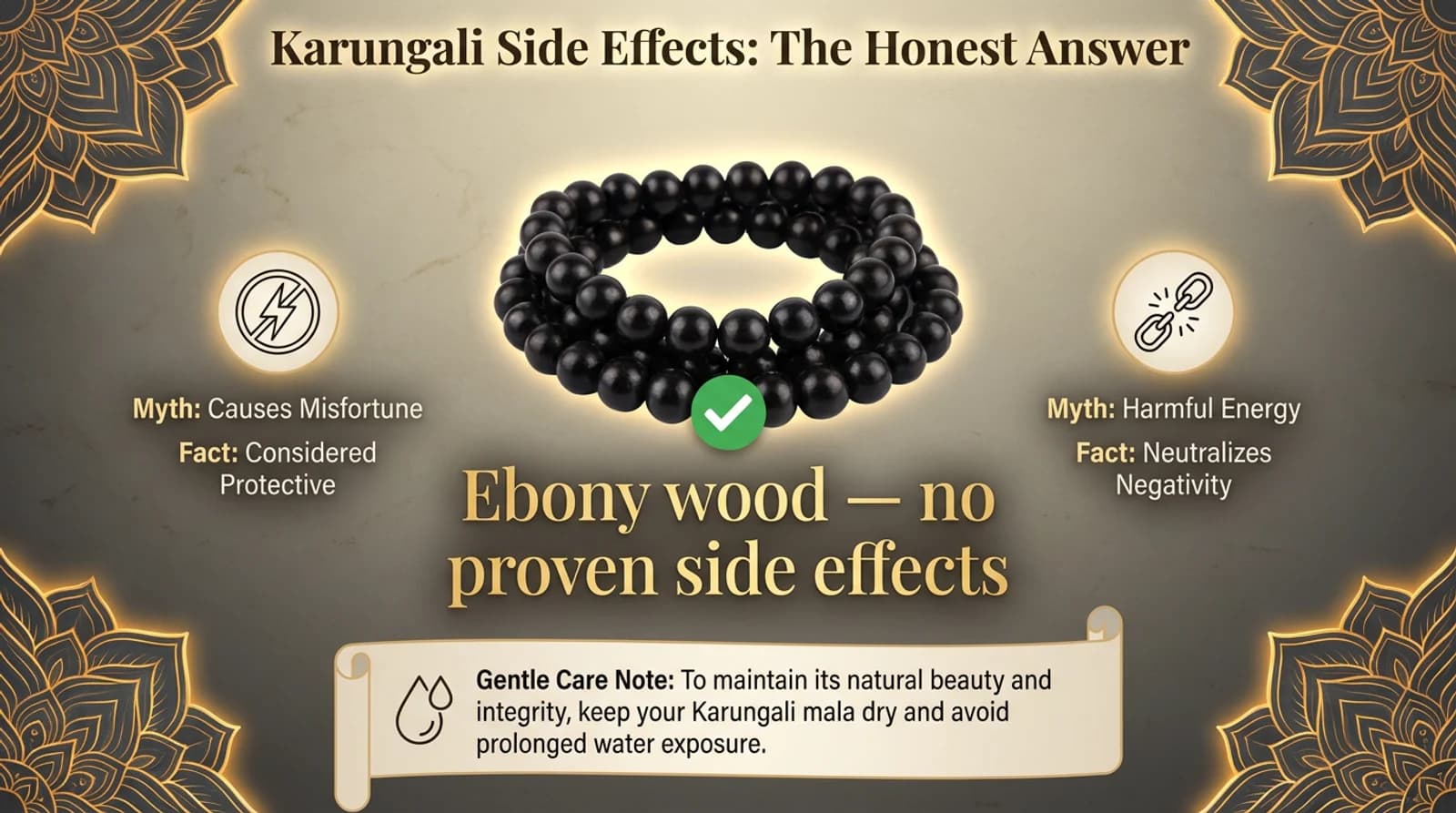
Karungali mala is a japa rosary of 108+1 beads made from genuine ebony heartwood (Diospyros ebenum). Genuine ebony is inert wood with no proven medical side effects. Most worries stem from myths or from fake, dyed or chemically treated beads — not from real karungali itself.
Does Karungali Mala Have Side Effects?
The honest answer: genuine karungali mala has no proven side effects. Karungali is the Tamil name for ebony heartwood (Diospyros ebenum) — a dense, inert black wood. It is not a medicine, a chemical or a magnet, so it cannot harm your body. There is no clinical evidence of physical harm from wearing real ebony beads.
Almost every 'side effect' story you read online falls into one of two buckets. The first is traditional belief about Shani (Saturn) energy and discipline, which is spiritual rather than medical. The second is a genuine reaction — skin irritation, smell, colour transfer — caused by a fake, dyed or chemically coated bead pretending to be karungali. Real ebony does none of these things.
| English name | Ebony wood (Diospyros ebenum) |
| Tamil name | Karungali / Karungali malai |
| What it is | Dense black heartwood, an inert natural material |
| Proven medical side effects | None for genuine, untreated ebony |
| Real cause of complaints | Fake, dyed or chemically treated beads |
| Honest framing | Spiritual remedy by belief; not a medicine or cure |
Separating Verifiable Fact From Tradition
We think the only honest way to discuss side effects is to keep two columns apart: what is materially true about the wood, and what is traditional astrological belief. Fears about karungali almost always come from blurring these two. The table below is our trust line — facts on one side, belief on the other, with nothing dressed up as the other.
| Claim | Status | Honest note |
|---|---|---|
| Karungali is dense ebony heartwood that sinks in water | Verifiable fact | You can test this at home in seconds |
| Real karungali feels cool to the touch and smells faintly woody | Verifiable fact | A chemical or paint smell signals a fake |
| Genuine ebony does not bleed dye onto a damp white cloth | Verifiable fact | Colour transfer means it is dyed, not pure |
| Wearing karungali grounds you and aids meditation | Traditional belief | Many users report calm and focus; consistent with ritual and intention, not proven by science |
| Karungali is a Shani (Saturn) and Shiva remedy that protects from nazar | Traditional belief | A cultural and devotional view, not a medical claim |
| Wearing it wrong causes bad luck or harm | Myth | No evidence; wear it with respect, not fear |
Notice that every genuine risk sits on the 'fact' side and is about the material, while every scary outcome sits under belief or myth. That is the whole point: a real, certified karungali mala carries spiritual meaning by tradition but no bodily side effect. This is not a substitute for medical, financial or professional advice.
Where 'Side Effects' Actually Come From
If someone genuinely experiences a problem, it is almost always a fake or treated bead — not karungali. Cheap 'black' malas are often pale wood, resin or compressed dust dyed jet-black with industrial colour and sealed with varnish. Those coatings, not the wood, are what can irritate sensitive skin or leave marks. Here is how to tell them apart honestly.
- 1Skin marks or staining
Caused by dye transfer from a fake bead, not by ebony. Genuine karungali will not bleed colour onto a damp white cloth when rubbed.
- 2Chemical or paint smell
Real ebony has a faint, dry woody scent. A strong chemical odour means varnish or synthetic coating — a clear fake-bead warning sign.
- 3Bead feels warm and light
Genuine dense ebony feels cool and has weight, and sinks in water. A light, warm, floating bead is usually resin or low-density wood.
- 4Rash on very sensitive skin
Any bracelet worn tight and sweaty can trap moisture. Loosen the fit, keep skin dry, and choose untreated certified beads to avoid coating contact.
This is exactly why we publish a per-piece Jaipur lab material certificate with a batch number and QR verification. You are not trusting a vague 'Govt. Certified' badge — you can confirm your specific mala is genuine ebony before it ever touches your skin. Genuine material is the single best protection against any so-called side effect.
Who Can Wear Karungali Mala?
In tradition, karungali is open to almost everyone. There is no rule barring anyone by gender, and the worry that women cannot wear it is a myth, not a teaching. The honest guidance is about comfort and respect, not restriction. Below is who it suits and the few sensible, non-spiritual cautions.
| Men and women | Both can wear karungali mala or bracelet freely |
| Children | Fine as a bracelet under supervision; avoid 108-bead malas as a choking/tangle risk for toddlers |
| Shani-period seekers | Traditionally worn during Saturn phases for grounding (belief, not a guaranteed fix) |
| Meditators | Suited to japa with 108+1 beads and a Sumeru bead |
| Sensitive skin | Choose certified untreated beads; avoid dyed/coated fakes |
| Medical conditions | The mala treats nothing — follow your doctor, not a bead |
The one belief-based caution some traditions mention is to remove any mala during impure or intimate moments out of respect, and to keep a japa mala used for chanting separate from daily wear. These are devotional preferences, not safety side effects — wear yours in the way that feels respectful to you.
How to Wear Karungali Mala the Right Way
Most 'I wore it wrong' anxiety dissolves once you know the simple convention. In Indian tradition the left wrist is the receiving side, so a karungali bracelet usually goes on the left to draw in grounding, protective energy. For chanting, the technique matters more than the hand.
- 1Bracelet — choose the hand
Wear the 8mm karungali bracelet on the left wrist to receive calming, grounding energy. Wear it on the right if you prefer it to support outward action and discipline.
- 2Mala — set up for japa
Hold the 108+1 mala in your right hand, draping it over the middle finger so the index finger stays clear.
- 3Chant bead by bead
Use the thumb to roll each bead toward you as you complete one mantra repetition, moving away from the Sumeru (109th) bead.
- 4Honour the Sumeru bead
When you return to the Sumeru bead after 108, do not cross it. Flip the mala and continue in the other direction for your next round.
- 5No fixed 'lucky' day count
There is no proven rule that you must wear it for an exact number of days. Many wear it daily; consistency and intention matter more than a magic number.
A karungali mala and bracelet combo is popular because you keep the mala for focused japa and the bracelet for everyday wear — without mixing the two. This is convenience and tradition, not a requirement for any 'effect' to work.
Caring for Karungali — and Buying It Honestly
Because karungali is ebony wood, the only real way to 'damage' it is water and chemicals — which is also how fakes get exposed. Skip the milk, ghee and elaborate soak rituals you see elsewhere; they can harm genuine wood and prove nothing. Here is the honest care routine.
Karungali is ebony wood, so keep it dry — wipe with a soft cloth and occasionally a drop of coconut or sesame oil to nourish the beads; never soak in water and avoid soap, perfume or chemicals, and store in a cotton pouch.
| Practice | Do this | Avoid this |
|---|---|---|
| Cleaning | Wipe with a soft dry cloth | Soaking in water or soap |
| Nourishing | Rare drop of coconut/sesame oil on a cloth | Perfume, sanitiser or chemical sprays |
| Cleansing ritual | Pass through incense smoke or sunlight briefly | Milk/ghee soaks that damage wood and prove nothing |
| Storage | Cotton pouch, away from moisture | Damp bathroom or plastic bag |
| Verifying authenticity | Water-sink + white-cloth rub + smell test | 'Energy' tests that cannot be checked |
Every DivineTatva karungali mala and bracelet is Jaipur-made, lab-certified genuine ebony, sold in INR with COD across India and a visible material certificate carrying a batch number and QR verification. When the wood is real and untreated, the side-effect question answers itself: there is nothing in it to harm you, only a grounding ritual to enjoy with an honest, open mind.
Frequently asked
Last reviewed: 17 May 2026 · Verified by the DivineTatva expert panel
Are there any real side effects of wearing a karungali mala?
Genuine karungali mala has no proven medical side effects. It is inert ebony wood, not a medicine or chemical, so it cannot physically harm you. Any genuine reaction — skin marks, smell, irritation — comes from fake, dyed or chemically coated beads, not from real karungali. Choosing a certified, untreated mala removes that risk almost entirely.
Can wearing karungali mala the wrong way cause bad luck?
No. There is no evidence that wearing it on the wrong hand or for the wrong number of days causes harm or bad luck. That is a myth that creates needless fear. Tradition simply suggests the left wrist for receiving grounding energy and treating the mala with respect. Wear it mindfully, not anxiously — intention matters more than rigid rules.
Can women wear karungali mala?
Yes. Women can wear karungali mala or bracelet freely — the idea that they cannot is a myth, not a genuine teaching. Karungali is open to men, women and children alike. Some devotees prefer to remove any mala during intimate or impure moments out of respect, but this is a personal devotional choice, not a safety rule or side effect.
Why do some people say karungali gave them a rash or stained their skin?
Almost always because the bead was fake. Cheap black malas are pale wood or resin dyed jet-black and sealed with varnish, and those coatings — not ebony — can irritate sensitive skin or transfer colour. Genuine karungali sinks in water and leaves no dye on a damp white cloth. A certified untreated mala avoids this completely.
Does karungali mala really work for Shani and protection?
By tradition, karungali is linked to Shani (Saturn) and Shiva and is believed to ground you and protect from negativity and nazar. Many wearers report feeling calmer and more focused, consistent with ritual, intention and meditation. We share this honestly: it is a belief-based remedy, not a clinically proven treatment, and never a substitute for medical or professional advice.
How many days should I wear karungali mala for results?
There is no proven rule fixing an exact number of days. Some traditions suggest starting on a Saturday linked to Shani, but no magic count is required. Most people wear it daily and find consistency and genuine intention matter far more than any timeline. Treat it as a steady grounding practice rather than a countdown to a guaranteed outcome.
Is it safe to wear a karungali bracelet every day?
Yes, a genuine karungali bracelet is safe for daily wear. The only practical care is keeping it dry — avoid water, soap, perfume and sweat buildup, and loosen a tight fit so skin stays dry. Wipe it with a soft cloth and an occasional drop of coconut or sesame oil. Real ebony is inert, so daily wear carries no medical side effect.
Reviewed by the DivineTatva expert panel
Written and reviewed by DivineTatva's consulting Vedic astrologer. Every piece is lab-certified and energised in our Jaipur atelier. Last updated 14 May 2026.