Karungali Mala Rules: Which Hand to Wear It, How to Hold the Japa Mala and Do's & Don'ts (Men & Women)
Karungali mala (ebony heartwood, Diospyros ebenum) is a 108+1 bead japa mala or stretch bracelet. By common tradition men wear the bracelet on the right wrist and women on the left, while the japa mala is held over the right middle finger and rolled with the thumb, never crossing the Sumeru (guru) bead. These are belief-based customs, not rigid rules.
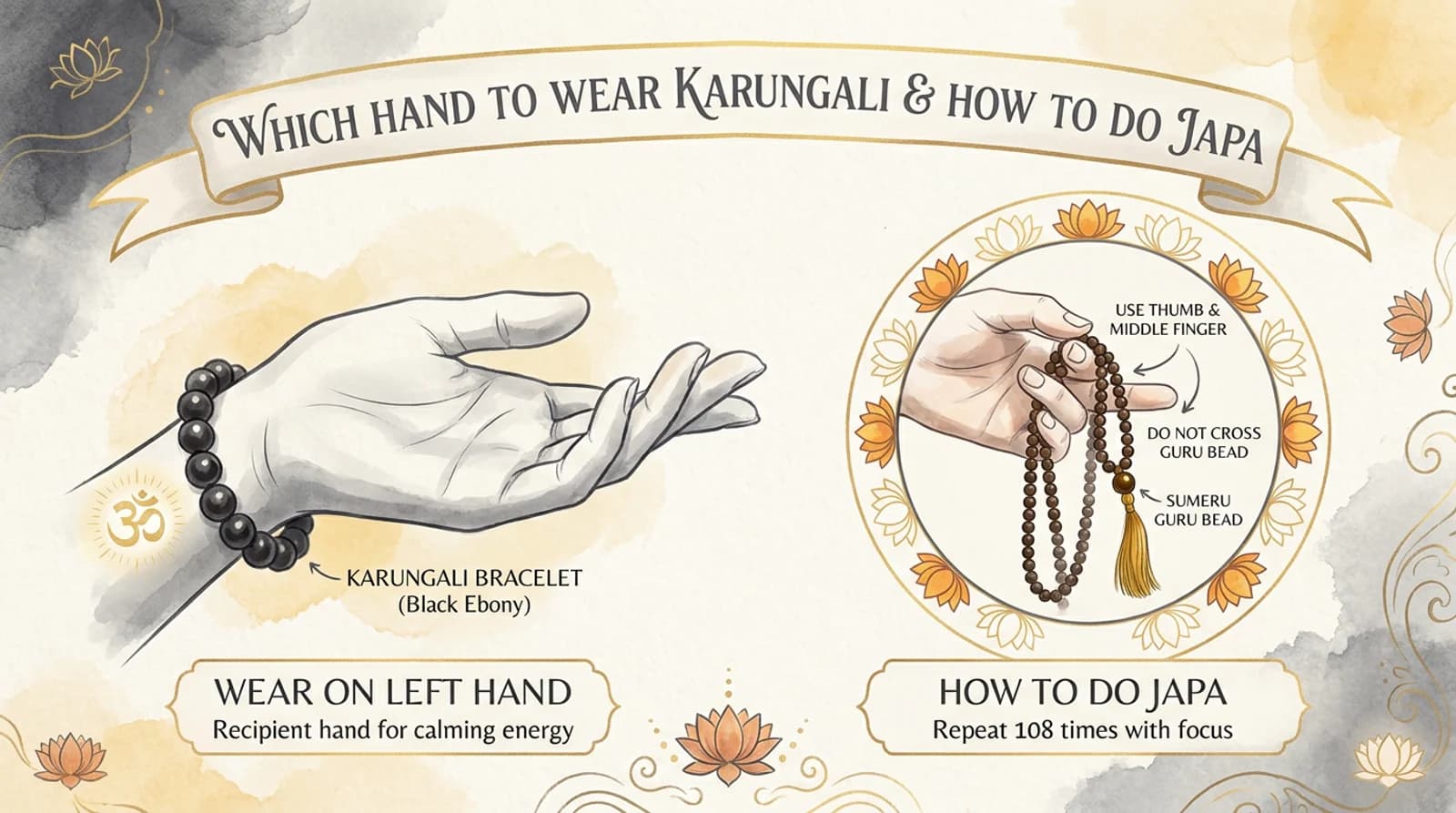
Karungali Mala Which Hand? The Short Version
By common Indian tradition, men wear a karungali bracelet on the right wrist and women on the left, because the left is seen as the receiving side and the right as the giving/active side. The 108+1 bead japa mala is not worn on the wrist at all during practice — it is held in the right hand and rolled bead by bead with the thumb. These are customary, belief-based conventions, not hard rules; comfort and consistency matter more than getting the side perfect.
| Men — bracelet | Right wrist (active/giving side) |
| Women — bracelet | Left wrist (receiving side) |
| Japa mala (108+1) | Held in right hand, not worn on wrist while chanting |
| If unsure | Left wrist is the safe default for most people |
| Sleeping/bathing | Remove the mala; keep ebony away from water |
Karungali is genuine dense ebony heartwood, so the wood is verifiably real even though its Shani/Shiva associations are traditional belief, not proven science. This guide covers the men/women hand conventions, the correct thumb-and-Sumeru japa technique, how long to wear it, and who can wear it — honestly.
Men vs Women: Left or Right Wrist?
Most Indian wearing customs split by giving vs receiving energy rather than by the bead material. The right hand is treated as the active, outward (giving) hand, and the left as the passive, inward (receiving) hand. From this idea comes the widely repeated convention below for a karungali stretch bracelet.
| Wearer | Common bracelet side | Reasoning in tradition |
|---|---|---|
| Men | Right wrist | Right is the active/giving hand; channels intention outward |
| Women | Left wrist | Left is the receiving side; draws calming, protective energy inward |
| Either, for protection from nazar | Left wrist | Receiving side is favoured for absorbing/deflecting negativity |
| Either, when worn as a Shani remedy | Right wrist or left per astrologer | Some astrologers tie Saturn remedies to the right; ask if you follow a chart |
Be aware that traditions are not uniform across India. Some lineages reverse the men/women rule, and many people simply wear the bracelet on the left because it is the non-dominant hand and stays comfortable through daily work. If an astrologer has given you a personalised instruction for your rashi or for a Shani remedy, follow that over any general rule. There is no spiritual penalty for the 'wrong' side — the wood does not change.
For an 8mm karungali bracelet worn purely for grounding and focus, pick the wrist where you will actually keep it on and remember it. A bracelet you wear consistently does more for your routine than one stored in a drawer because you were worried about the side.
Why the Left or Right Side at All?
The left-versus-right idea comes from Vedic and yogic energy mapping, not from the chemistry of ebony. In this framework the left side (Ida) is lunar, cooling and receptive, while the right side (Pingala) is solar, warming and active. A protective, grounding bead like karungali is often placed on the receiving (left) side so its calming influence is 'drawn in.'
We share this as belief and tradition, not as measurable fact. There is no clinical evidence that wrist side changes any physical or psychological effect. What is real is the ritual cue: a bracelet on a chosen wrist becomes a small, repeated reminder of your intention to stay grounded — and that reminder, plus the habit around it, is where most users genuinely report feeling calmer or more focused.
| Left (Ida) | Lunar, cooling, receiving — common for protection/calm |
| Right (Pingala) | Solar, active, giving — common for men and outward intention |
| What science confirms | Wrist side has no proven physical effect; ebony stays ebony |
| What helps in practice | Consistency + a clear intention, on whichever side you keep it |
Holding the 108+1 Bead Mala Correctly
A full karungali japa mala has 108 counting beads plus one larger Sumeru (also called the guru or Meru bead). The Sumeru marks your start and finish point and is never counted or crossed over. During chanting you do not wear this mala on your wrist — you hold and move it through your fingers.
- 1Use your right hand
Drape the mala over the middle finger so the beads hang freely. The middle finger acts as the support post.
- 2Roll with the thumb
Pull each bead toward you with the pad of the thumb, one bead per repetition of your mantra (for Shani, e.g. 'Om Sham Shanaischaraya Namah', or 'Om Namah Shivaya' for Shiva).
- 3Avoid the index finger
Traditionally the index (pointing) finger does not touch the beads while counting; keep it lifted away.
- 4Stop at the Sumeru
When you reach the Sumeru bead after 108 counts, do not cross it. To continue, mentally turn the mala around and go back the other way.
- 5Keep it steady and slow
Match one bead to one full mantra. Aim for an unhurried, even pace rather than speed.
When you are not chanting, you can wrap the 108+1 mala loosely around the wrist or wear it around the neck, but treat the wrist or neck use as carrying/honouring it, not as the counting practice. Because karungali is ebony wood, never let the mala get sweaty-wet during long sessions — wipe it dry afterwards and store it in its cotton pouch.
How to Wear It and How Many Days
There is no fixed 'number of days' before a karungali mala 'activates' — that is a common myth. You can begin wearing or chanting with it the same day. Some people like to set an intention or have it astrologer-energised first; that is optional and belief-based, not required for the wood to be genuine or for you to benefit from the ritual.
| When to start | Same day; no mandatory waiting period |
| Best times to wear | During meditation, work, travel, or whenever you want a grounding cue |
| Take it off for | Bathing, swimming, washing up, heavy sweating, sleep (optional) |
| Water rule | Keep ebony dry — never soak; water and soap damage the finish |
| First-week tip | Wear consistently for a week to build the habit and notice your own response |
Care matters because karungali is ebony wood. Keep it dry — wipe with a soft cloth and occasionally a drop of coconut or sesame oil to nourish the beads; never soak in water and avoid soap, perfume or chemicals, and store in a cotton pouch. Following this keeps the beads black, faintly woody-smelling and intact for years.
If you bought the karungali mala and 8mm bracelet combo, a simple routine is to keep the bracelet on through the day on your chosen wrist and reserve the 108+1 mala for seated japa morning or evening. Each is certified ebony heartwood from the same Jaipur-tested batch, so you can mix and match with confidence.
Who Can Wear It (Men, Women, Beginners)
Karungali has no gender, caste or initiation barrier. Men, women and beginners can all wear the bracelet or use the mala. Women asking 'can women wear karungali mala?' — yes, fully; the only difference tradition suggests is the preferred wrist (often left). There are no proven physical side effects of wearing genuine ebony wood against the skin for most people.
| Question | Honest answer |
|---|---|
| Can women wear it? | Yes — commonly on the left wrist; no restriction |
| Can beginners use the japa mala? | Yes — start with the thumb-and-Sumeru method above |
| Children? | Generally fine as a bracelet; supervise small beads and fit |
| Any real side effects? | None proven; stop if you get skin irritation, as with any worn item |
| Does it 'expire' or need re-energising? | No expiry; re-energising is optional belief, not a requirement |
A few honest cautions: if you have sensitive skin and notice redness, give the wrist a break — this is contact, not 'negative energy.' Do not treat the mala as a substitute for medical, financial or professional advice. For Shani-related concerns, a karungali mala is a traditional remedy people find grounding and reassuring; it is not a guarantee of any outcome, and a qualified astrologer can advise on your specific chart.
Belief vs Evidence: What's Verified, What's Faith
We separate what is materially verifiable about your karungali mala from what belongs to tradition, so you can wear it with clear eyes. The wood is real and testable; the spiritual meanings are sincere belief held by many, not laboratory-proven claims.
| Claim | Status | How you can check |
|---|---|---|
| Genuine dense ebony heartwood | Verifiable | Lab material certificate with batch number and QR |
| Sinks in water (high density) | Verifiable | Drop a bead in water — true ebony sinks |
| Cool to the touch, faint woody smell | Verifiable | Touch and smell — no chemical/plastic odour |
| No dye bleed | Verifiable | Rub on a damp white cloth — no black colour transfers |
| Grounds you / aids meditation | Belief + user-reported | Calm/focus consistent with intention and ritual; not clinical proof |
| Protects from nazar / Shani remedy | Traditional belief | Vedic/astrological tradition; no scientific evidence |
Ignore the milk-soak, ghee-burn and 'energy' tests some sites promote — they do not reliably prove authenticity and can damage the wood. The four verifiable tests above (sink, no dye bleed, cool touch, woody smell) plus our per-piece lab certificate are how you actually confirm a real mala. The which-hand and Shani benefits are offered honestly as tradition, never as a guaranteed result.
Frequently asked
Last reviewed: 17 May 2026 · Verified by the DivineTatva expert panel
Karungali mala which hand should I wear it on?
By common tradition, men wear a karungali bracelet on the right wrist and women on the left, because the left is treated as the receiving side. If you are unsure or have no astrologer's instruction, the left wrist is a safe default for most people. These are belief-based conventions, not rigid rules — the side does not change the wood, so wear it where you will keep it on consistently.
Can women wear a karungali mala?
Yes, fully. There is no gender, caste or initiation restriction on karungali. Women commonly wear the bracelet on the left wrist (the receiving side) and can use the 108+1 japa mala for chanting just like anyone else. The only practical difference tradition suggests is the preferred wrist; the benefits, care and authenticity tests are exactly the same regardless of gender.
Which hand do I hold the 108+1 japa mala in while chanting?
Hold it in your right hand, draped over the middle finger, and roll one bead per mantra toward you with your thumb. Traditionally the index finger stays off the beads. Begin and end at the larger Sumeru (guru) bead and never cross it — when you reach it after 108 counts, turn the mala around and continue back the other way.
How many days should I wear a karungali mala before it works?
There is no mandatory waiting period — that is a myth. You can start wearing the bracelet or using the mala the same day. Some people set an intention or have it astrologer-energised first, which is optional and belief-based. We suggest wearing it consistently for about a week so the habit and your own grounding response have time to settle in.
Does it matter if I wear it on the 'wrong' hand?
No — there is no spiritual penalty and the ebony does not change. The left/right convention comes from Vedic energy mapping (receiving vs giving side), shared as tradition rather than proven fact. If an astrologer gave you a personalised side for your rashi or a Shani remedy, follow that. Otherwise, comfort and consistency matter far more than the exact wrist.
Can I wear the karungali bracelet and mala together?
Yes. A simple routine with the mala-and-bracelet combo is to keep the 8mm bracelet on your chosen wrist through the day and reserve the 108+1 mala for seated japa, held in the right hand. Both are certified ebony heartwood from the same tested batch. Just remove them before bathing and keep the wood dry, as water and soap damage ebony.
Are there any side effects of wearing karungali?
There are no proven physical side effects of wearing genuine ebony wood for most people. If you have sensitive skin and notice redness, give the wrist a break — that is simple contact, not negative energy. Karungali is a traditional grounding and Shani remedy people find reassuring; it is not a substitute for medical, financial or professional advice, and it does not guarantee any outcome.
Reviewed by the DivineTatva expert panel
Written and reviewed by DivineTatva's consulting Vedic astrologer. Every piece is lab-certified and energised in our Jaipur atelier. Last updated 11 October 2026.