Do Navagraha Candles Work? Vedic Ritual vs Modern Science Explained
Do Navagraha candles work? There is no scientific evidence that candles influence planetary forces. In Vedic tradition, fire (Agni) is a divine messenger and the ritual channels focused intention. What practitioners consistently report is reduced anxiety, greater sense of purposeful action, and improved mindset — outcomes rooted in psychology, not astronomy.
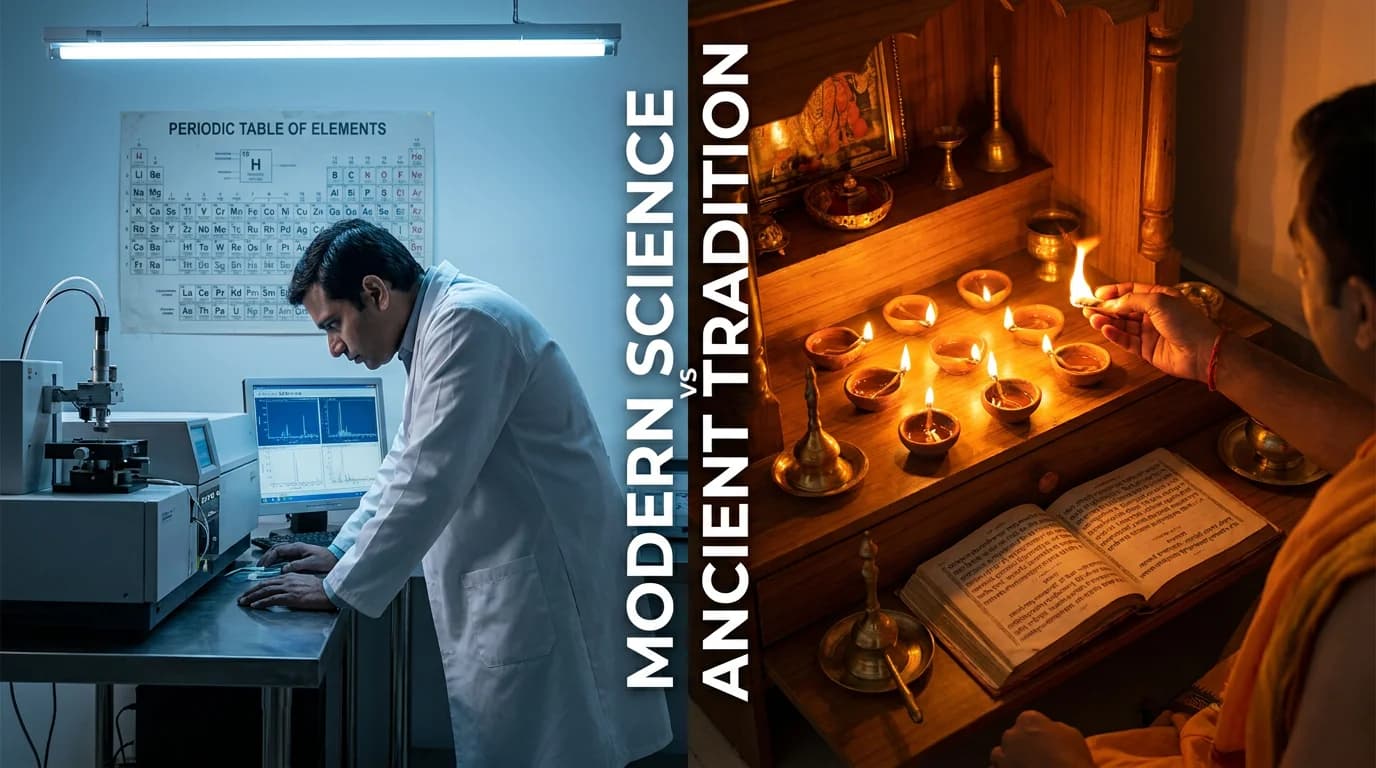
The Honest Answer: What Does the Evidence Show?
There is no peer-reviewed scientific evidence that lighting a candle influences the gravitational, electromagnetic, or any other physical effects of the nine Vedic planets on human life. Navagraha candle ritual belongs to the domain of faith, intention, and cultural practice — not empirical science. DivineTatva is committed to honest framing: this product is a ritual aid for focused devotional practice, not a mechanism for planetary intervention. It is not a substitute for professional astrological advice.
The Vedic Belief Framework: Agni as Divine Messenger
In Vedic cosmology, Agni (fire) holds a unique role: it is the deva-mukha, the mouth of the gods, the universal messenger between the human and divine realms. The Rigveda's opening hymn is addressed to Agni. Yagnas (fire rituals) are the oldest form of Vedic religious practice, predating both temple worship and idol puja.
Within this framework, lighting a candle — particularly one coloured to match a planet's symbolic hue and inscribed with its Beej mantra — is a miniaturised yagna. The practitioner offers their attention, intention, and mantra recitation to Agni, and Agni is believed to carry that offering to the relevant Graha. The planet, pleased by the devotion, is believed to become more favourable in the practitioner's life.
This is a coherent theological framework, not superstition — it has a consistent internal logic supported by millennia of textual tradition. Whether one accepts its cosmological premises is a personal choice of belief. Vedic astrology and the Upaya (remedial) practices it prescribes have been practised continuously in India for at least 2,000 years.
What Psychology Says About Ritual Practice
Contemporary psychology offers a separate but compatible explanation for why rituals produce real results. Research by Cristine Legare (University of Texas) and others shows that rituals — even secular ones — reduce anxiety, increase performance in high-stakes situations, and improve self-regulation. The key mechanism is that ritual creates a structured, intentional mental state that reduces the cognitive noise around the target concern.
For Navagraha candles specifically: the act of choosing the right day, preparing the space, trimming the wick, chanting the mantra, and sitting quietly with the flame requires 30–60 minutes of focused, undivided attention on the planet's domain — career, relationships, finances, or spiritual growth. That focused attention, repeated weekly, influences behaviour. A person who spends every Saturday evening contemplating karmic discipline is more likely to make disciplined choices the following week. The candle is a Dharana (concentration) tool.
Vedic Belief vs Psychological Mechanism: Side by Side
| Aspect of the Ritual | Vedic Belief | Psychological Mechanism |
|---|---|---|
| Colour of candle | Carries the planet's symbolic energy; aligns with tattva | Primes the mind with colour-emotion association; enhances ritual coherence |
| Beej mantra chanting | Sonic vibration reaches the Graha; activates the planet's receptivity | Rhythmic repetition induces relaxed focus (like meditation); reduces cortisol |
| Designated day | Planet's energy is strongest on its day | Weekly scheduling creates consistent intentional practice; habit formation |
| Candle flame (Agni) | Fire as divine messenger carries the offering to the Graha | Flickering flame induces mild meditative state; focus anchoring |
| Ritual instruction card | Provides the correct procedural sequence for effective propitiation | Reduces decision fatigue; structured routine lowers anxiety |
| Snuffer not breath | Breath disturbs the ritual energy and disrespects Agni | Deliberate closure gesture signals end of ritual to brain; completes loop |
| Outcome over time | The Graha becomes more favourably disposed to the practitioner | Repeated focused intention and associated behaviour change produces real-world results |
What Practitioners Report
Across DivineTatva's customer feedback and broader Vedic community forums, practitioners most commonly report: (1) a reduction in anxiety about the target area of life after consistent weekly ritual; (2) a sense of having taken meaningful action, which itself reduces helplessness and passive rumination; (3) improved consistency in positive behaviours related to the planet's domain — for example, those lighting the Budha candle for business communication report being more proactive in follow-up calls and written correspondence; (4) a general sense of structural clarity from having a designated time each week to sit quietly with a specific intention.
None of these reports constitute scientific evidence of planetary influence. They do constitute evidence that the ritual has psychologically meaningful effects on the practitioners who engage with it sincerely. This is why millions of people across India maintain Navagraha practice across generations, independent of whether they hold literal belief in planetary personalities.
Honest Conclusion
Do Navagraha candles work? Yes and no, depending on what you mean by 'work.' They do not work in the sense of physically rerouting planetary forces. They do work in the sense of providing a structured, meaningful, culturally grounded mindfulness and intention practice that has psychologically real effects on practitioners who engage with them consistently and sincerely. If you approach the ritual with genuine focus, the practice will give you something real — not because the planets will rearrange, but because focused, regular intention changes behaviour, and changed behaviour changes outcomes.
This is not a substitute for professional astrological advice. For serious life challenges or significant chart conditions like Kaal Sarp Dosha or Shani Sade Sati, a qualified Jyotishi's guidance is recommended alongside any ritual practice.
Frequently asked
Last reviewed: 17 May 2026 · Verified by the DivineTatva expert panel
Is there scientific proof that Navagraha candles work?
No. There is no peer-reviewed scientific evidence that candles influence planetary energies. The benefits practitioners experience are best explained through psychology: structured mindfulness, focused intention, and consistent ritual practice — all of which have documented positive effects on wellbeing and behaviour.
Then why do so many people use them?
Ritual practice — across all cultures and religions — has powerful psychological benefits: reduced anxiety, increased sense of agency, and improved focus. Navagraha rituals provide all of these within a culturally meaningful Vedic framework. Millions of people use them because they experience real positive effects, even if those effects are psychological rather than astronomical.
Is it hypocritical to sell ritual candles while admitting they don't work scientifically?
No. Most human practices that provide genuine wellbeing benefits — prayer, meditation, gratitude journaling, therapy — are not 'scientific' in the sense of producing measurable, laboratory-verifiable effects on external reality. They work by changing the practitioner's internal state, which then influences behaviour and relationships. Ritual candles belong in this category.
Can Navagraha candles replace medical or psychological treatment?
Absolutely not. They are a complementary spiritual practice, not a treatment for any medical or psychological condition. If you are experiencing mental health challenges, please consult a qualified mental health professional.
What does the Vedic tradition actually claim about how it works?
Vedic tradition holds that Agni (fire) is a divine messenger (deva-mukha) who carries human devotion to the Grahas. The Beej mantra's sonic vibration is believed to activate the planet's receptivity. The coloured candle aligns the ritual visually with the planet's symbolic energy. Together, these create a full-spectrum offering of sight, sound, and intention.
Should I tell my family astrologer that I am using Navagraha candles?
Yes, especially if your astrologer has prescribed specific Upayas (remedies). Some Jyotishis have preferences for which remedies should be combined with which others. Keeping your astrologer informed ensures your practice is consistent with their overall prescription.
Reviewed by the DivineTatva expert panel
Written and reviewed by DivineTatva's consulting Vedic astrologer. Every piece is lab-certified and energised in our Jaipur atelier. Last updated 17 June 2026.