How to Check Original Rudraksha (Nepali & Indonesian): X-Ray, Water & Coin Tests Honestly Explained
An original Nepali Rudraksha is a single dried seed of the Elaeocarpus ganitrus tree from Nepal's Arun Valley whose natural clefts (mukhi) match its claimed count. The only reliable proof is an X-ray showing one internal seed compartment per mukhi line, confirmed by a lab certificate you can verify, not a float or soak test.
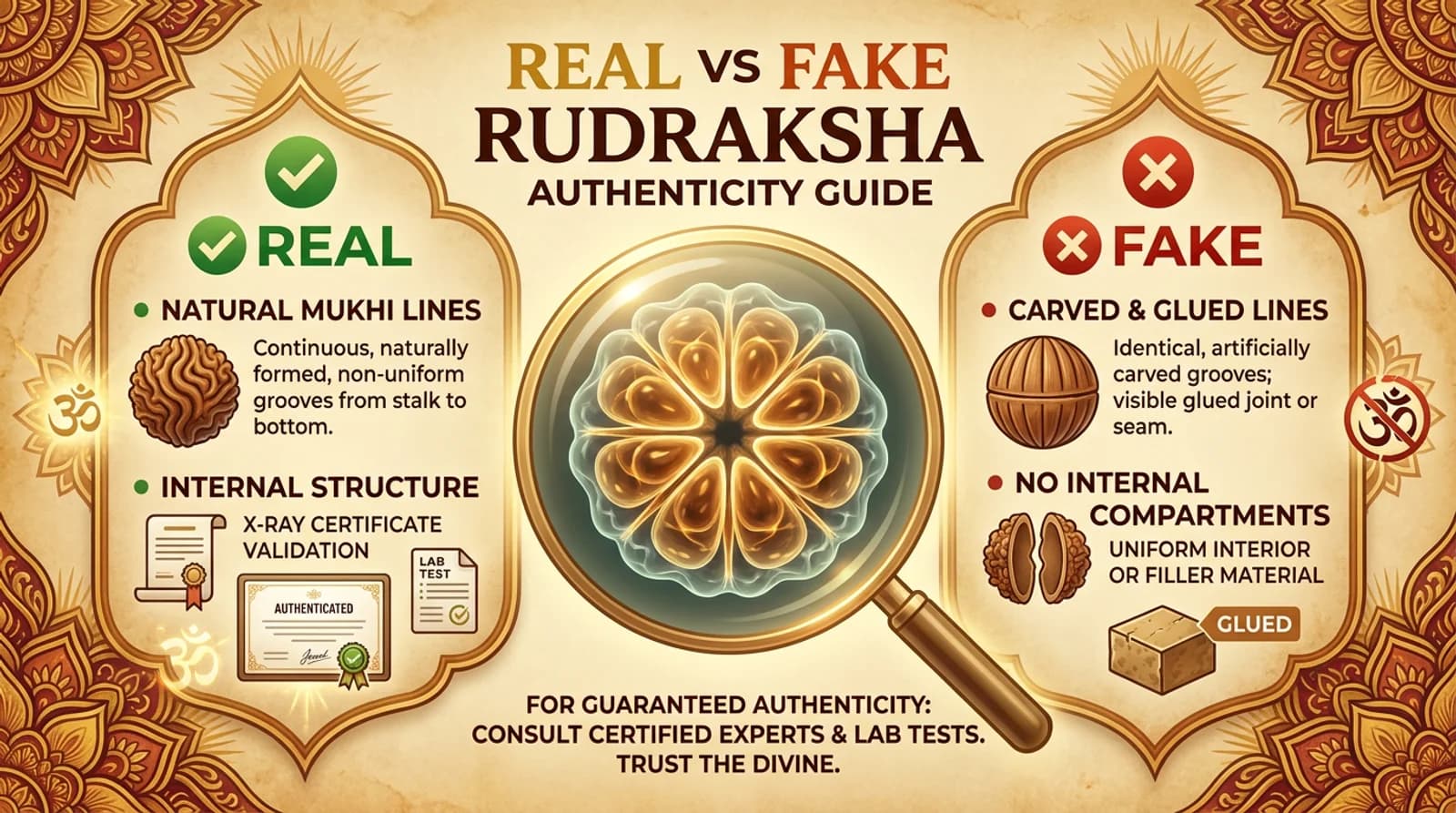
What counts as an original Nepali Rudraksha
An original Nepali Rudraksha is a single, natural, undrilled-or-clean-drilled seed of the Elaeocarpus ganitrus tree grown in Nepal's Arun Valley, whose visible clefts (mukhi) genuinely match its claimed count and whose internal structure confirms it. Authenticity is about three things together: the seed is real (not moulded resin or paste), the mukhi lines run unbroken pole to pole, and the inside holds one seed compartment per mukhi. Anything else, glued faces, carved grooves, or a 5 Mukhi sold as a rare count, is not original.
The name comes from Rudra (Shiva) and Aksha (eye). The two everyday Nepali beads are the 5 Mukhi (Panchmukhi, linked to Jupiter and Shiva) and the 7 Mukhi (Saptamukhi, linked to Saturn and Lakshmi). Nepali beads are larger and deeper-grooved than Indonesian ones, which makes counting mukhi easier but also makes faking the look more profitable, which is exactly why proof matters.
| Botanical name | Elaeocarpus ganitrus |
| Origin (Nepali) | Arun Valley, eastern Nepal |
| Typical size | 18-35 mm (Nepali), 5-15 mm (Indonesian) |
| Defining feature | Natural mukhi clefts, pole to pole |
| Internal proof | One seed compartment per mukhi |
| Common counts | 5 Mukhi, 7 Mukhi |
What an X-ray actually proves (one mukhi = one compartment)
Here is the single fact that settles most disputes: inside a genuine Rudraksha, the number of internal seed compartments (called locules) equals the number of mukhi lines on the surface. A real 5 Mukhi has five compartments; a real 7 Mukhi has seven. You cannot see this from outside, and you cannot fake it with surface carving, because carving extra grooves does not add internal chambers. An X-ray or CT scan is the only test that reads the inside without destroying the bead.
This is why X-ray certification is meaningful where surface tests are not. When a low-mukhi bead is filed or glued to look like a higher, rarer count, the surface may fool the eye, but the X-ray shows the true compartment count underneath. At DivineTatva each bead is X-ray checked so the mukhi you pay for is the mukhi inside the seed, not just what is scratched on top.
| Test | What it checks | Can it be faked | Verdict |
|---|---|---|---|
| X-ray / CT | Internal compartments vs mukhi | Effectively no | Reliable |
| Surface mukhi count | Visible cleft lines | Yes (carving, glue) | Weak alone |
| Float in water | Buoyancy | Yes & natural beads vary | Myth |
| Soak / colour bleed | Dye release | Yes (sealed dyes) | Weak |
| Copper coin spin | Folk magnetism claim | N/A, no real basis | Myth |
The float, soak and coin myths, honestly debunked
The popular home tests circulate because they feel scientific, but none reliably separates real from fake. Use them for curiosity, never as proof of purchase.
- 1The float test is unreliable
People claim a real bead sinks and a fake floats (or the reverse). In truth, buoyancy depends on density, oil content, dryness and trapped air. Genuine beads can float and dense fakes can sink. It proves nothing on its own.
- 2The soak / boil test can mislead
Boiling or soaking to see if colour bleeds assumes all fakes are dyed and all genuine beads are not. Many real beads are lightly oiled or polished, and good fakes use sealed dyes that do not run, so both can pass or fail wrongly.
- 3The copper coin spin has no basis
Balancing a bead between two coins to watch it rotate is folklore, not physics. Rudraksha is not magnetic; any spin is air current or hand tremor, not a sign of energy or authenticity.
- 4Surface counting alone is not enough
Counting visible mukhi is a starting filter, but carved grooves and glued faces defeat it. Always pair a visual count with internal proof.
Bottom line: surface and home tests can flag an obvious fake, but they cannot confirm an original. Only an internal scan plus a verifiable certificate does that.
How to read a genuine lab certificate (and spot a fake one)
We will say plainly what some sellers avoid: lab certificates can be faked, photocopied, or issued by labs that never X-rayed your specific bead. A certificate is only as good as your ability to verify it against the bead in your hand. So treat the document as a claim to check, not a guarantee to trust blindly.
A trustworthy Rudraksha certificate ties one named lab to one specific bead and gives you a way to confirm it. Match every field below against the physical bead and the X-ray image before you accept it.
| Lab name & address | Named, contactable, not blank |
| Unique certificate number | Verifiable via lab site or QR |
| Bead photo & X-ray | Both shown, matching your bead |
| Mukhi count stated | Matches visible & internal count |
| Size in mm | Matches the bead you received |
| Origin (Nepali/Indonesian) | Clearly stated, not vague |
| Date of testing | Present, recent, legible |
| No clinical/medical claims | Spiritual framing only |
Red flags: a certificate with no number, a lab you cannot find or call, an X-ray image that does not match the bead's size or mukhi, or grand medical and money promises printed on the paper. A real certificate proves identity and mukhi count, nothing more, and an honest one will not pretend otherwise. DivineTatva shows the per-bead X-ray and certificate together so you can match seed, scan and paper in one glance.
Nepali vs Indonesian: telling them apart (and why it changes price)
Both are real Rudraksha, but Nepali beads from the Arun Valley are larger with deeper, well-defined mukhi, while Indonesian (Java) beads are small and smooth-grooved. Neither is fake, but a small Indonesian bead sold at Nepali prices is a misrepresentation, so size and groove depth are part of authenticity, not just preference.
| Feature | Nepali | Indonesian (Java) |
|---|---|---|
| Typical size | 18-35 mm | 5-15 mm |
| Mukhi lines | Deep, well-defined | Shallow, fine |
| Surface | Robust, pronounced | Smooth, delicate |
| Common use | Single statement bead | Malas, fine work |
| Price band | Higher per bead | Lower per bead |
| Best for | Daily wear, gifting | Long 108-bead malas |
On price: in India you should expect to pay for size, clarity of mukhi and genuine certification, not for hype. A certified single Nepali 5 Mukhi sits in an accessible band, while higher and rarer mukhi counts cost more because they are scarcer in nature. Be suspicious of a rare count priced like a common one, that gap usually signals a carved or mislabelled bead.
A 7-point checklist before you buy a Nepali Rudraksha
- 1Confirm the species and origin
Ask for Elaeocarpus ganitrus and a stated origin (Nepali Arun Valley vs Indonesian). Vague listings hide mislabelling.
- 2Demand a per-bead X-ray
A generic stock X-ray is not enough. The scan should match your bead's size and mukhi count.
- 3Verify the certificate number
Check it against the issuing lab. No number, no contactable lab, walk away.
- 4Match mukhi inside and out
Visible clefts should equal internal compartments. This is the heart of authenticity.
- 5Check size against the claim
Measure in mm. A 9 mm bead is not a premium Nepali bead, whatever the label says.
- 6Read the claims honestly
Spiritual and ritual benefits are fine; medical or guaranteed-wealth promises are a warning sign.
- 7Confirm India-friendly terms
Look for INR pricing, Cash on Delivery and a clear return window so you can inspect before committing.
If a seller meets all seven, you are buying identity you can verify. DivineTatva beads are Jaipur-dispatched, X-ray certified, COD-friendly and returnable, so the proof travels with the bead. Care once it is yours: wear daily if you like, but keep your Rudraksha dry and avoid soap, detergents or harsh chemicals, which strip its natural oils. Wipe with a soft cloth and apply a light coat of mustard, sesame or olive oil every few weeks to prevent cracking.
Belief vs evidence: what the bead does and doesn't promise
Authenticity and effect are different questions. We can prove what a bead is; we cannot clinically prove what it does. Keeping these separate is how an honest brand earns trust.
| Claim | What tradition says | What evidence shows |
|---|---|---|
| Calm & focus | 5 Mukhi steadies the mind | No clinical proof; many report a calming ritual effect |
| Sade Sati relief | 7 Mukhi eases Shani's pressure | Belief-based; comfort consistent with ritual & intention |
| Protection (buri nazar) | Worn as a shield | Cultural belief, not measurable |
| Authenticity | Genuine mukhi carries the energy | This part is testable, by X-ray & certificate |
| Health/wealth cures | Various folk claims | Not a substitute for medical, financial or professional advice |
So treat the spiritual benefits as belief- and tradition-based, supported by the calm that ritual, intention and daily practice genuinely bring for many wearers, never as guaranteed outcomes. The one thing we will stand behind with paper and an X-ray is identity: that your Nepali Rudraksha is a real seed with the mukhi count you paid for.
Frequently asked
Last reviewed: 17 May 2026 · Verified by the DivineTatva expert panel
How do I identify an original Nepali Rudraksha at home?
Honestly, you cannot fully confirm it at home. Start by checking size (Nepali beads run 18-35 mm) and that mukhi lines run unbroken pole to pole, with no glued faces or carved grooves. But surface checks only flag obvious fakes. True proof needs an X-ray showing one internal compartment per mukhi, plus a verifiable lab certificate. Use home inspection as a filter, not a final answer.
Does the water float test prove a Rudraksha is real?
No. Buoyancy depends on density, oil content, dryness and trapped air, so genuine beads can float and dense fakes can sink. The float test, like the soak and copper-coin tricks, feels scientific but proves nothing reliably. Skip it as proof of purchase and rely on an X-ray plus a checkable certificate instead, which read the bead's actual internal structure.
What does an X-ray of a Rudraksha actually show?
It shows the internal seed compartments, called locules. In a genuine bead the compartment count equals the surface mukhi count, so a real 5 Mukhi has five and a real 7 Mukhi has seven. Carving extra grooves outside cannot add chambers inside, which is why an X-ray exposes carved or glued fakes that fool the naked eye.
Can a Rudraksha lab certificate be faked?
Yes, and we say so plainly. Certificates can be photocopied, numbered fictitiously, or issued without scanning your specific bead. Treat one as a claim to verify, not a guarantee. Confirm the lab is named and contactable, the certificate number checks out, and the X-ray image matches your bead's size and mukhi. A genuine certificate proves identity and mukhi count, nothing more.
What is the difference between Nepali and Indonesian Rudraksha?
Both are real Elaeocarpus ganitrus seeds. Nepali beads from the Arun Valley are larger (18-35 mm) with deep, well-defined mukhi; Indonesian Java beads are small (5-15 mm) and smooth-grooved, ideal for 108-bead malas. Neither is fake, but a small Indonesian bead sold at Nepali prices is misrepresentation, so size and groove depth matter when you pay a premium.
Does a Nepali Rudraksha really work?
It depends what you mean. We can prove what the bead is, by X-ray and certificate, but its spiritual benefits are belief- and tradition-based, not clinically proven. Many wearers report genuine calm and focus, consistent with the steadying effect of ritual, intention and daily practice. Treat it as a supportive spiritual companion, not a substitute for medical, financial or professional advice.
Why is 7 Mukhi linked to Sade Sati and Shani?
In tradition the 7 Mukhi (Saptamukhi) is associated with Saturn (Shani) and Lakshmi, and is worn during Sade Sati for relief from Saturn's pressure. This is a belief-based practice, and any benefit reflects the comfort and focus that ritual and intention bring, not a guaranteed astrological cure. Pair it with patience and practical action, not with claims of guaranteed outcomes.
Reviewed by the DivineTatva expert panel
Written and reviewed by DivineTatva's consulting Vedic astrologer. Every piece is lab-certified and energised in our Jaipur atelier. Last updated 11 October 2026.