5 Mukhi vs 7 Mukhi Rudraksha: Which Should You Wear (and Can You Wear Both)?
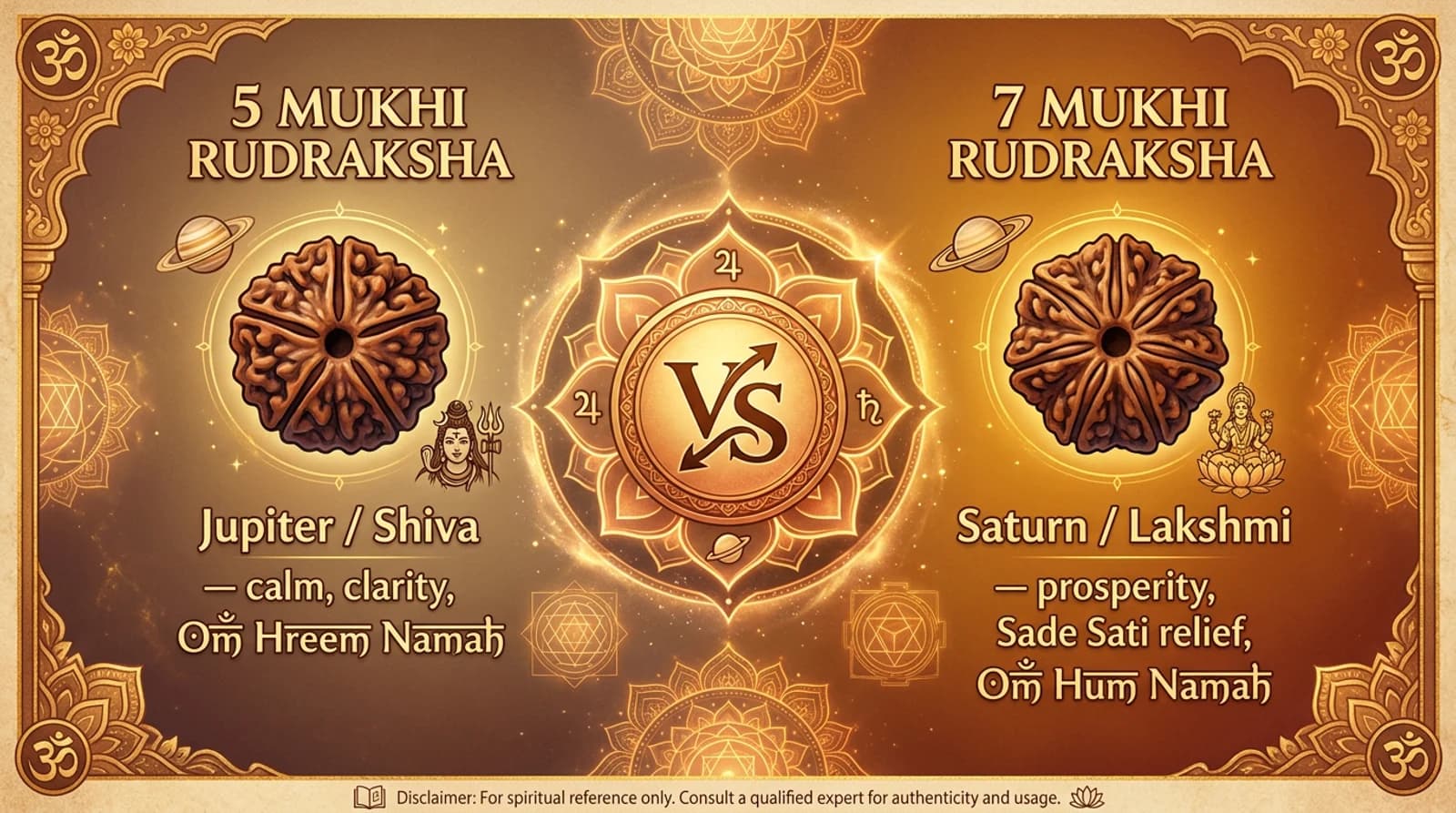
A 5 Mukhi (Panchmukhi) Rudraksha is a single seed with five natural clefts, linked to Jupiter and Shiva for calm and clarity. A 7 Mukhi (Saptamukhi) bead has seven clefts, tied to Saturn and Lakshmi for Sade Sati relief and steady flow. This guide compares both and shows how to wear them together.
5 Mukhi vs 7 Mukhi Rudraksha: The Short Version
A 5 Mukhi (Panchmukhi) Rudraksha is a single Nepali seed with five natural clefts (mukhi), traditionally linked to Jupiter (Guru) and Lord Shiva and worn for calm, focus and general wellbeing. A 7 Mukhi (Saptamukhi) Rudraksha has seven clefts, is linked to Saturn (Shani) and Goddess Lakshmi, and is worn for Sade Sati relief and steady prosperity. Both are dried seeds of the Elaeocarpus ganitrus tree from Nepal's Arun Valley.
If you want one bead for daily calm and clarity, choose 5 Mukhi — it is the most common, most affordable and suits almost everyone. If you are going through Sade Sati or want to soften Shani's pressure on career and money, choose 7 Mukhi. You can also wear both together, and this guide shows exactly how.
| 5 Mukhi (Panchmukhi) | 5 clefts; Jupiter + Shiva; calm, focus, everyone |
| 7 Mukhi (Saptamukhi) | 7 clefts; Saturn + Lakshmi; Sade Sati, prosperity |
| Origin | Nepal, Arun Valley — Elaeocarpus ganitrus |
| Nepali bead size | 18–35 mm with deep, well-defined mukhi lines |
| Certified by | Lab / X-ray for true mukhi (cleft) count |
| Evidence status | Belief-based spiritual tradition; not medically proven |
Planet, Deity & Mantra Contrast
The clearest way to choose between the two is by the planet, deity and beej (seed) mantra each bead is associated with in Vedic tradition. The 5 Mukhi carries a gentle, expansive Jupiter–Shiva energy; the 7 Mukhi carries a disciplined, stabilising Saturn–Lakshmi energy. These associations are traditional and symbolic, not scientifically established.
| Attribute | 5 Mukhi (Panchmukhi) | 7 Mukhi (Saptamukhi) |
|---|---|---|
| Clefts (mukhi) | 5 | 7 |
| Ruling planet | Jupiter (Guru / Brihaspati) | Saturn (Shani) |
| Presiding deity | Lord Shiva (Kalagni Rudra) | Goddess Lakshmi / Saptamatrika |
| Beej mantra | Om Hreem Namah | Om Hum Namah |
| Traditional theme | Calm, knowledge, health, balance | Wealth flow, Sade Sati relief, stability |
| Best suited to | Everyone, all rashis | Those in Shani's phases or seeking prosperity |
| Relative rarity | Most common | Less common, modestly priced up |
A simple way to remember it: 5 Mukhi quietens the mind so you can think clearly, while 7 Mukhi steadies your circumstances so money and effort stop leaking. The universal Rudraksha beej mantra 'Om Namah Shivaya' may be chanted with either bead.
Benefits: What Tradition Says vs What Science Shows
We label every benefit honestly. The wellbeing many wearers report — a sense of calm, focus or protection — is consistent with intention, ritual and the comfort of a daily practice. There is no clinical proof that a rudraksha changes health, planets or finances. Treat it as a meaningful spiritual tool, not a substitute for medical, financial or professional advice.
| Claim | What tradition says | What evidence shows |
|---|---|---|
| 5 Mukhi calms the mind | Jupiter–Shiva energy steadies thought and emotion | Many users report calm; consistent with ritual / placebo, not clinically proven |
| 5 Mukhi supports health & BP | Balances body and mind | No medical evidence; do not stop prescribed treatment |
| 7 Mukhi eases Sade Sati | Softens Shani's 7.5-year pressure | Belief-based; no astronomical or clinical proof |
| 7 Mukhi attracts wealth | Lakshmi energy improves money flow | No financial proof; supports mindset and discipline at best |
| Both protect from buri nazar | Shields from negative energy | Cultural belief; valued as intention, not a measurable effect |
Used this way, both beads are genuinely useful: a tactile anchor for breathing, japa and intention-setting. That honest framing is the point — you wear it for the practice and meaning, and anything beyond that is belief.
Which One Should You Wear?
Pick by your main goal rather than by your rashi alone. The 5 Mukhi is the safe default — gentle, universal, and suitable for children, students and first-time wearers. The 7 Mukhi is more situational and shines when Saturn is prominent in your chart or transit.
- 1Want everyday calm and focus
Choose 5 Mukhi. It suits all rashis and ages, making it the ideal first rudraksha and the most affordable certified Nepali bead.
- 2Going through Sade Sati or Shani Dhaiya
Choose 7 Mukhi. It is the traditional bead for softening Saturn's long pressure phases on career, health and patience.
- 3Want steadier money and effort
Choose 7 Mukhi for its Lakshmi association — paired with real financial discipline, not as a shortcut.
- 4Student, exams or overthinking
Choose 5 Mukhi for clarity and a steady mind during study and high-pressure phases.
- 5Want both clarity and stability
Wear both — see the next section for the correct way to combine 5M and 7M.
| Safest single choice | 5 Mukhi (Panchmukhi) |
| Best for Sade Sati | 7 Mukhi (Saptamukhi) |
| Suits children & students | 5 Mukhi |
| Career & money focus | 7 Mukhi |
| No rashi restriction | Both are widely considered universal |
Can You Wear 5 Mukhi and 7 Mukhi Together?
Yes. The 5 Mukhi and 7 Mukhi are considered compatible because Jupiter (5M) and Saturn (7M) work on different areas — mind and circumstances — without clashing. Wearing both is a common, low-risk combination: the 5 Mukhi keeps you calm while the 7 Mukhi steadies your situation. This is belief-based, not a guaranteed outcome.
- 1Choose your format
Wear them on a single thread, as two pendants, or as a small combination mala. Both certified single beads can sit together.
- 2Use a natural thread
Red or black cotton/silk thread, or a gold/silver cap. Avoid synthetic cords that trap sweat against the seed.
- 3Energise once before first wear
Cleanse and set intention (see how-to-wear). You can chant 'Om Namah Shivaya' for both beads.
- 4Wear daily and consistently
Consistency matters more than count. Keep them dry and oil lightly every few weeks.
If you prefer one bead, start with the 5 Mukhi and add a 7 Mukhi later if you enter Sade Sati or want a prosperity focus. There is no need to over-stack — two well-chosen, certified beads are plenty.
How, Where and When to Wear
Rudraksha is forgiving — there are few hard rules, mostly traditions. The left wrist is considered the receiving side, so a bracelet is often worn on the left; a pendant sits over the heart or throat. Monday (Shiva's day) is a popular day to begin wearing after a simple cleansing and intention.
| Which hand | Left wrist (receiving side) for bracelets |
| As a pendant | Over heart or throat, against skin if you like |
| Best day to start | Monday (Shiva) or any Pradosh / Shivratri |
| Thread | Red/black cotton or silk; or silver/gold cap |
| Beej mantra | Om Namah Shivaya (universal); 108 times to energise |
| To cleanse | Wipe with damp cloth, dry fully, then oil lightly |
To cleanse and energise before first wear: rinse gently or wipe with a soft damp cloth, dry completely, hold the bead, set your intention and chant the beej mantra 108 times. Repeat the cleansing every few weeks. There is no genuine 'side effect' to rudraksha beyond skin irritation if a bead stays damp — keep it dry and clean and it will be comfortable for daily wear.
Authenticity, Price and Care
The single biggest risk is a fake or mislabelled mukhi count. A real Nepali bead is larger (18–35 mm) with deep, clearly separated mukhi lines, while Indonesian/Java beads are smaller (5–15 mm) with shallower lines. Because surface lines can be carved or glued, the only reliable proof of cleft count is an X-ray — which is why every DivineTatva bead ships with a lab/X-ray certificate showing one mukhi equals one internal seed compartment.
| Check | Nepali (genuine) | Watch for |
|---|---|---|
| Size | 18–35 mm | Tiny 5–15 mm beads sold as Nepali |
| Mukhi lines | Deep, well-defined | Shallow or carved-looking grooves |
| Internal proof | X-ray shows matching compartments | No certificate, or generic photocopy cert |
| Certificate | Per-bead lab/X-ray cert | Fake or unverifiable lab claims |
On price: certified single Nepali 5 Mukhi beads are the most affordable; 7 Mukhi sits modestly higher due to relative rarity. DivineTatva prices in INR with Cash on Delivery and transparent returns from Jaipur, so you are not paying USD export markups.
Care (use exactly): Keep your Rudraksha dry and avoid soap, detergents or harsh chemicals, which strip its natural oils. Wipe with a soft cloth and apply a light coat of mustard, sesame or olive oil every few weeks to prevent cracking.
Frequently asked
Last reviewed: 17 May 2026 · Verified by the DivineTatva expert panel
What is the main difference between 5 mukhi and 7 mukhi rudraksha?
The 5 Mukhi (Panchmukhi) has five natural clefts and is linked to Jupiter and Shiva for calm, focus and general wellbeing — the universal everyday bead. The 7 Mukhi (Saptamukhi) has seven clefts and is linked to Saturn and Lakshmi, worn mainly for Sade Sati relief and steady prosperity. In short: 5M quietens the mind, 7M steadies your circumstances. Both are belief-based spiritual tools, not medically proven.
Can I wear 5 mukhi and 7 mukhi rudraksha together?
Yes. They are considered compatible because Jupiter (5M) and Saturn (7M) influence different areas — your mind and your situation — without clashing. Many people wear both on one thread or as two pendants: the 5 Mukhi for calm, the 7 Mukhi for stability. Cleanse and set intention once before first wear, keep them dry, and oil lightly every few weeks. This is a traditional combination, not a guaranteed outcome.
Who should wear 5 mukhi rudraksha?
Almost anyone. The 5 Mukhi is the safe, universal default — suitable for all rashis, children, students and first-time wearers. It is traditionally worn for calm, clarity and balance, and is the most affordable certified Nepali bead. There is no rashi restriction. Wear it for daily focus and intention-setting; treat the wellbeing benefit as a ritual practice, not a clinical or astrological guarantee.
Is 7 mukhi rudraksha good for Sade Sati and Shani?
In tradition, yes — the 7 Mukhi is the classic bead for softening Saturn's pressure during Sade Sati (Saturn's roughly 7.5-year phase) and Shani Dhaiya, and is linked to Lakshmi for steadier money and effort. This is a belief-based spiritual practice with no astronomical or clinical proof. Wear it alongside real planning and discipline, not as a substitute for financial or professional advice.
How do I know my Nepali rudraksha is original?
Genuine Nepali beads are larger (18–35 mm) with deep, well-defined mukhi lines, unlike smaller Indonesian beads (5–15 mm). Because surface clefts can be carved or glued, the only reliable proof of mukhi count is an X-ray. Every DivineTatva bead ships with a per-piece lab/X-ray certificate showing one mukhi equals one internal seed compartment — so you can verify the count rather than take it on trust.
Does rudraksha really work, and are there side effects?
Many wearers report calm, focus or a sense of protection — consistent with intention, ritual and the comfort of daily practice rather than any proven medical or astrological effect. We never over-promise: it is not a substitute for medical, financial or professional advice. There are no real side effects beyond minor skin irritation if a bead stays damp, so keep it dry, clean and lightly oiled.
Which hand should I wear rudraksha on and how do I energise it?
The left wrist is considered the receiving side, so bracelets are usually worn on the left; pendants sit over the heart or throat. Monday (Shiva's day) is a popular day to begin. To energise: rinse or wipe gently, dry fully, hold the bead, set your intention and chant 'Om Namah Shivaya' 108 times. Repeat a light cleansing every few weeks.
Reviewed by the DivineTatva expert panel
Written and reviewed by DivineTatva's consulting Vedic astrologer. Every piece is lab-certified and energised in our Jaipur atelier. Last updated 19 May 2026.