Nepali vs Indonesian Rudraksha: Size, Mukhi Lines, Price & How to Tell Them Apart
Nepali and Indonesian rudraksha are the same species (Elaeocarpus ganitrus) grown in different regions. Nepali beads from the Arun Valley are larger (18-35mm) with deep, well-defined mukhi lines; Indonesian (Java) beads are smaller (5-15mm) and smoother. Indonesian beads are genuine rudraksha, not fakes — they simply differ in size, finish and price.
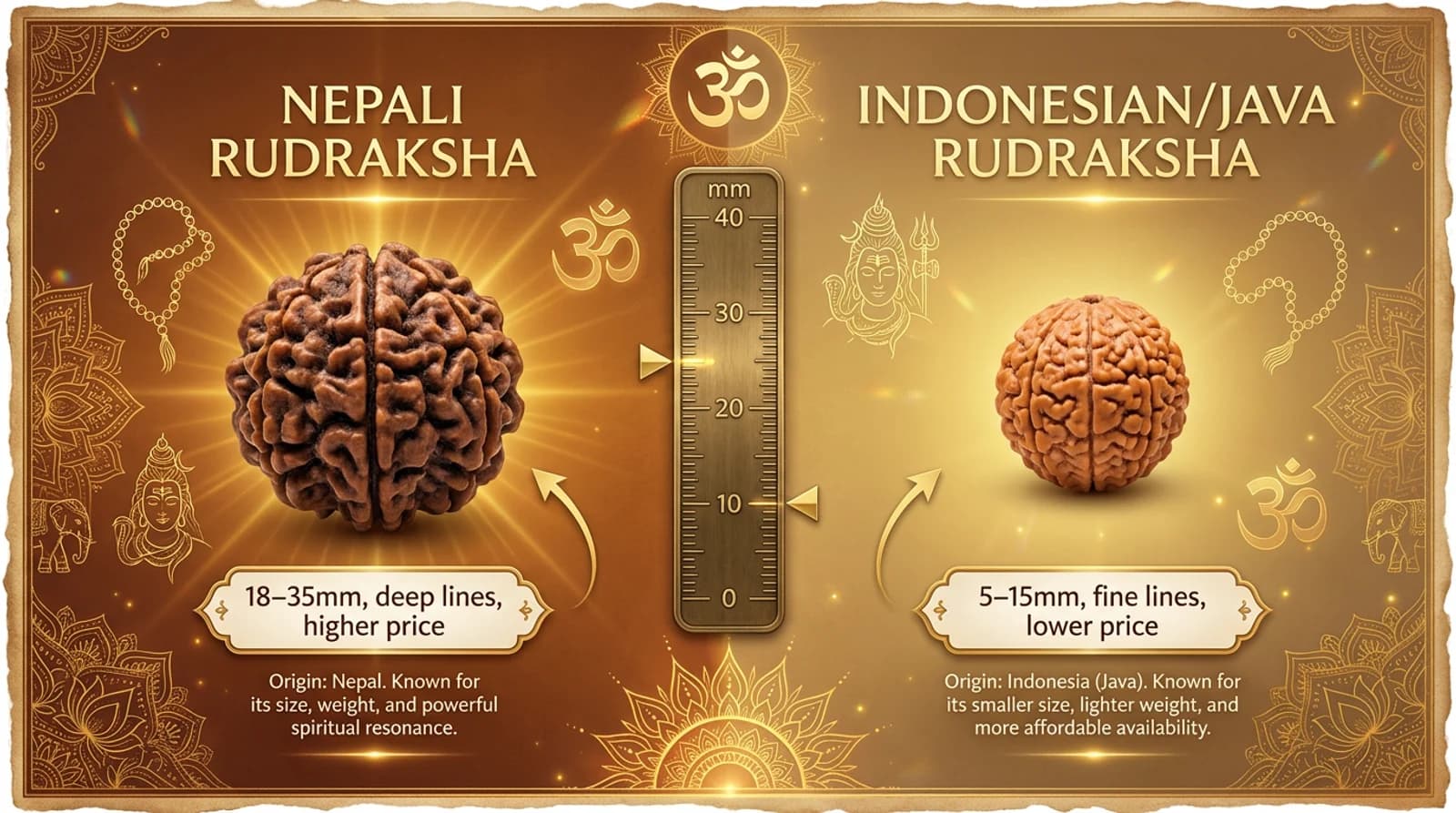
Nepali vs Indonesian Rudraksha: What's Actually Different
Nepali and Indonesian rudraksha are the same seed — Elaeocarpus ganitrus — grown in two different places. Nepali beads come from the Himalayan Arun Valley and are larger (18-35mm) with deep, sharply cut mukhi (cleft) lines. Indonesian or Java beads are smaller (5-15mm), smoother and more uniform. The key honest point: Indonesian beads are real rudraksha, not fakes. They simply differ in size, surface detail and price.
The confusion exists because most product pages quietly sell one or the other without ever naming the origin. A 5 Mukhi sold as a tiny 7mm bead is almost always Indonesian; a chunky 22mm 5 Mukhi with ridged, well-spaced lines is Nepali. Both carry the same mukhi count and the same traditional associations — the difference you pay for is size, definition and rarity, not authenticity.
| Same species? | Yes — Elaeocarpus ganitrus for both |
| Nepali origin | Arun Valley, eastern Nepal (Himalayan belt) |
| Indonesian origin | Java, Indonesia (also called Java beads) |
| Are Indonesian beads fake? | No — they are genuine rudraksha |
| Main practical difference | Size, mukhi-line depth, weight and price |
Side-by-Side: Size, Mukhi Lines, Weight & Price
Here is the comparison every PDP skips. These ranges are typical for single 5 Mukhi and 7 Mukhi beads; individual seeds vary, and a good Nepali bead is judged on clean mukhi lines and a healthy surface, not size alone.
| Feature | Nepali Rudraksha | Indonesian (Java) Rudraksha |
|---|---|---|
| Typical bead size | 18-35 mm | 5-15 mm |
| Mukhi (cleft) lines | Deep, wide, well-defined | Shallow, fine, closely spaced |
| Surface texture | Pronounced ridges and contours | Smoother, more uniform |
| Weight per bead | Heavier (denser, larger) | Lighter (smaller) |
| Colour after wear | Deep reddish-brown | Lighter to mid brown |
| Indicative single-bead price | Higher (rarer, larger) | Lower (abundant, smaller) |
| Best for | Statement single bead, gifting | Malas, daily budget wear |
Notice that neither column says "genuine" or "fake." Both are authentic Elaeocarpus ganitrus seeds. If a seller calls Indonesian beads "fake" to justify a price, that's a marketing line, not a fact. The honest framing is simply Himalayan-grown vs Java-grown.
Why Nepali Rudraksha Costs More
Nepali beads command higher prices for practical, supply-side reasons — not because Indonesian beads are inferior in authenticity. Understanding this helps you spend sensibly rather than overpay on fear.
- 1Larger size is rarer
Bigger seeds with clean, deep mukhi lines occur less often, so they cost more per bead than abundant small beads.
- 2Deeper mukhi definition
Collectors and traditional wearers prize sharply separated clefts, which Nepali beads show more readily — driving demand and price.
- 3Lower yield, higher handling
Arun Valley harvests are smaller and more remote, adding sorting, grading and transport cost before a bead reaches India.
- 4Perceived prestige
Nepali origin carries a premium reputation in the market, which lifts price independent of any measurable spiritual difference.
| Does Nepali "work better"? | No measurable proof; tradition and belief favour size, not outcome |
| Is paying more guaranteed safer? | No — only a lab/X-ray certificate confirms mukhi count |
| Smart-buy rule | Pay for verified mukhi count first, size second |
How to Tell Nepali and Indonesian Apart
You can usually distinguish the two by eye, but origin and mukhi count are only truly confirmed by certification. Use these visual cues as a first filter, then rely on the lab/X-ray report.
- 1Check the size
A bead above ~18mm is likely Nepali; under ~15mm leans Indonesian. Measure across the widest point.
- 2Read the mukhi lines
Trace each cleft from hole to hole. Nepali lines are deep and well-spaced; Indonesian lines are fine and tightly packed.
- 3Feel the weight and surface
Nepali beads feel denser with pronounced ridges; Indonesian beads feel lighter and smoother.
- 4Count mukhis honestly
Surface counting is error-prone. One mukhi = one internal seed compartment, which only an X-ray reliably shows.
- 5Demand the certificate
A per-bead lab/X-ray certificate confirms the true mukhi count and protects you from glued or carved fakes of either origin.
Important honesty note: fakes exist for both Nepali and Indonesian beads — usually a lower-mukhi bead with extra lines glued or carved on. Origin claims and even paper certificates can be faked, which is why DivineTatva shows the actual X-ray image alongside the certificate, so you see the seed compartments yourself.
Which One Should You Buy?
Both are genuine, so the choice is about budget, intended use and personal preference — not about getting "the real one." Use this quick guide.
| If you want... | Choose | Why |
|---|---|---|
| A single statement bead or gift | Nepali | Larger size and deep mukhi lines look and feel substantial |
| A budget daily-wear bead | Indonesian | Genuine rudraksha at a lower price point |
| A 108-bead mala | Indonesian | Smaller, uniform beads sit comfortably and cost less in quantity |
| Maximum mukhi-line clarity | Nepali | Clefts are typically deeper and easier to verify by eye |
| Verified authenticity (either) | Certified bead | X-ray certificate matters more than origin for trust |
Whichever you pick, treat the lab/X-ray certificate as non-negotiable. A certified 5 Mukhi (Panchmukhi) or 7 Mukhi (Saptamukhi) bead is trustworthy whether it grew in Nepal or Java. This is not a substitute for medical, financial or professional advice — it's a spiritual and traditional purchase.
What Tradition Says vs What Science Shows
Rudraksha carries deep meaning in Vedic and Shaivite tradition. We separate that belief from clinical evidence so you can decide with open eyes. None of the spiritual benefits below are medically proven; many wearers do report a genuine calming, focusing ritual benefit consistent with intention and routine.
| Claim | What tradition says | What evidence shows |
|---|---|---|
| 5 Mukhi (Panchmukhi) | Linked to Jupiter/Shiva; worn for calm, focus, clarity | No clinical proof; users often report a calming ritual effect |
| 7 Mukhi (Saptamukhi) | Linked to Saturn/Lakshmi; worn for Sade Sati and Shani relief, abundance | Belief-based; no measured outcome on planetary periods |
| Nepali "more powerful" | Larger Himalayan beads seen as more auspicious | No measurable difference in effect vs Indonesian |
| Daily wear | Steadies mind and supports intention | Plausibly works via routine, mindfulness and placebo, not biology |
Our position: wear rudraksha for the tradition, the ritual and the calm many people feel — not as a treatment. Does rudraksha really work? For many wearers the daily ritual genuinely helps focus and steadiness; we just won't dress belief up as proven science.
How to Wear, Cleanse and Care for Your Bead
Wearing and care are the same whether your bead is Nepali or Indonesian. A 5 Mukhi suits almost everyone; a 7 Mukhi is traditionally chosen during Sade Sati or for Shani-related concerns. There are no harmful physical side effects to wearing rudraksha; if a thread feels tight or the skin reacts, loosen or pause.
| Which hand? | Left wrist is the receiving side; either is acceptable |
| Best day to start | Monday (Shiva) or as your astrologer advises |
| Beej mantra | "Om Hreem Namah" (5 Mukhi); chant with intention while wearing |
| Cleanse & energise | Rinse in clean water, wipe dry, set a clear intention; optionally have it astrologer-energised |
| Who should wear 5 Mukhi? | Generally suitable for all ages and rashis |
Care (use verbatim): Keep your Rudraksha dry and avoid soap, detergents or harsh chemicals, which strip its natural oils. Wipe with a soft cloth and apply a light coat of mustard, sesame or olive oil every few weeks to prevent cracking. Each DivineTatva bead ships from Jaipur with a per-piece lab/X-ray certificate, COD available, and transparent returns.
Frequently asked
Last reviewed: 17 May 2026 · Verified by the DivineTatva expert panel
Is Indonesian rudraksha fake?
No. Indonesian (Java) beads are genuine rudraksha — the same species, Elaeocarpus ganitrus, as Nepali beads. They are simply grown in Java and tend to be smaller (5-15mm) with finer mukhi lines. Any seller who calls them "fake" to justify a higher Nepali price is using marketing language, not fact. Both can be authentic; both can also be faked, which is why a per-bead X-ray certificate matters more than origin.
Why does Nepali rudraksha cost more?
Mainly supply and size. Nepali beads from the Arun Valley are larger (18-35mm) with deeper, well-defined mukhi lines, and big clean beads are rarer. Smaller harvests, remote sourcing and a premium reputation also lift the price. None of this means Nepali beads "work better" — there's no measurable spiritual difference. You're paying for size, definition and rarity, so prioritise a verified mukhi count first and size second.
How do I identify an original Nepali rudraksha?
Start with size (typically above 18mm) and mukhi lines that are deep, wide and well-spaced from hole to hole; the bead feels dense with pronounced ridges. But surface counting is error-prone and origin can be misrepresented. The only reliable proof is a lab/X-ray certificate showing the internal seed compartments — one mukhi equals one compartment. DivineTatva shows the actual X-ray image alongside the certificate so you can verify it yourself.
Which is better, 5 Mukhi or 7 Mukhi rudraksha?
Neither is universally better — they suit different needs. The 5 Mukhi (Panchmukhi), linked to Jupiter/Shiva, is the all-rounder worn for calm and focus and suits almost everyone. The 7 Mukhi (Saptamukhi), linked to Saturn/Lakshmi, is traditionally chosen during Sade Sati or for Shani-related concerns and abundance. These are belief-based associations, not proven outcomes. Choose by intention, and consider an astrologer's guidance for the 7 Mukhi.
Which hand should I wear rudraksha on?
Tradition treats the left wrist as the receiving side, so many wear it there, though either hand is acceptable. A common practice is to start on a Monday (Shiva's day), chant the beej mantra like "Om Hreem Namah" for a 5 Mukhi, and set a clear intention. There are no harmful physical side effects; if a thread feels tight or skin reacts, simply loosen or pause wearing it.
Does rudraksha really work?
Honestly, it depends what you mean. There's no clinical proof that rudraksha changes planetary periods or health, and we won't pretend otherwise. What many wearers do report is a real sense of calm, focus and steadiness — plausibly from the daily ritual, mindfulness and intention rather than biology. Wear it for the tradition and that ritual benefit, not as a substitute for medical, financial or professional advice.
How do I cleanse and care for my rudraksha?
To cleanse and energise, rinse in clean water, wipe dry, and set a clear intention; you can also have it astrologer-energised. For care: keep your Rudraksha dry and avoid soap, detergents or harsh chemicals, which strip its natural oils. Wipe with a soft cloth and apply a light coat of mustard, sesame or olive oil every few weeks to prevent cracking. This keeps both Nepali and Indonesian beads healthy.
Reviewed by the DivineTatva expert panel
Written and reviewed by DivineTatva's consulting Vedic astrologer. Every piece is lab-certified and energised in our Jaipur atelier. Last updated 19 May 2026.