Which Hand to Wear Rudraksha: Men, Women, Finger, Day & Beej Mantra Rules
In Vedic tradition, a Nepali Rudraksha is usually worn on the left wrist or left side of the body, which is believed to "receive" energy while the right "gives." There is no single rigid rule — your goal, comfort and chosen mukhi matter more. This guide covers hand, finger, neck, best day and mantra counts honestly.
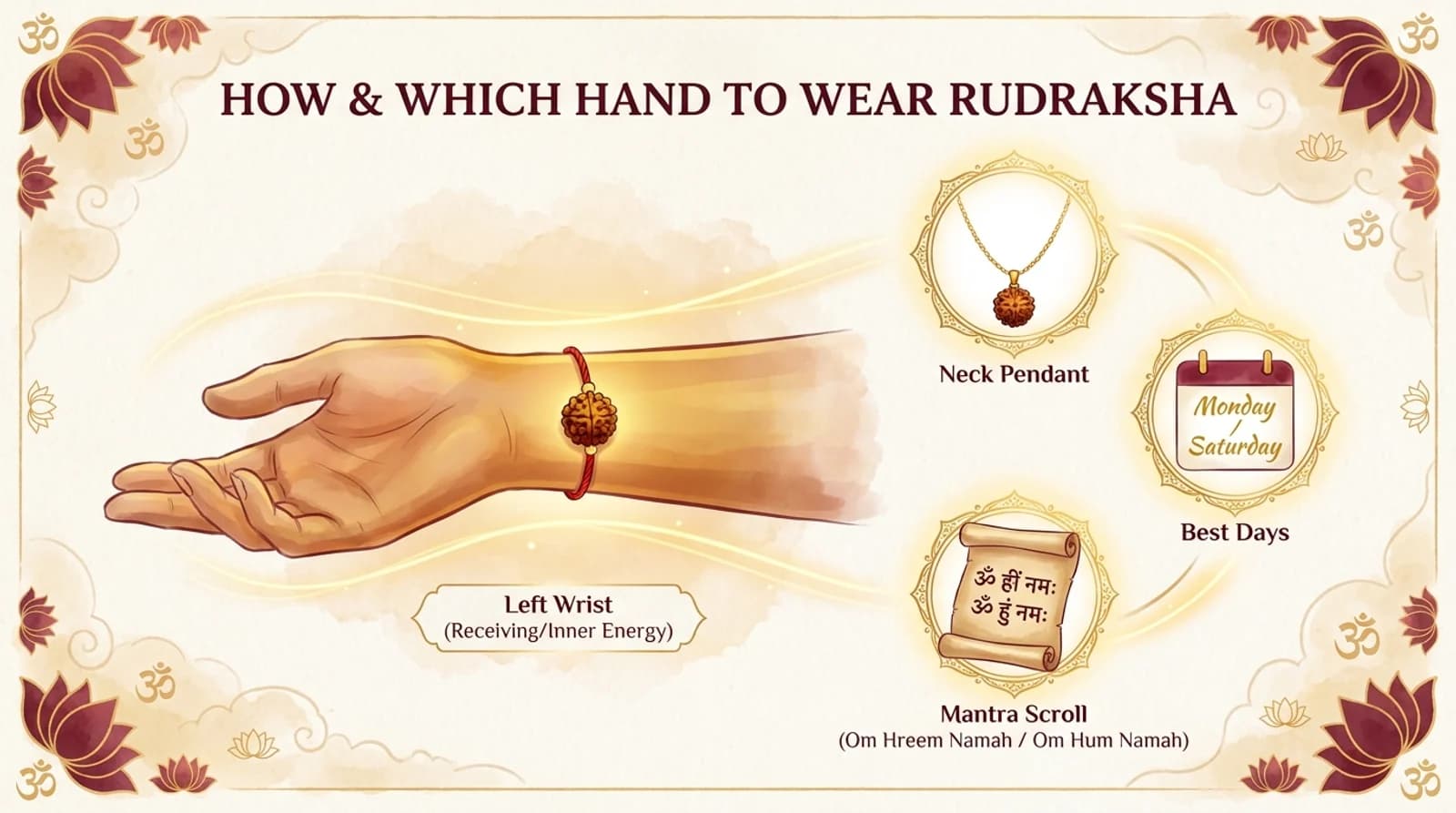
Which Hand to Wear Rudraksha?
In Vedic tradition, a rudraksha is worn on the left side of the body — most often the left wrist — because the left is believed to "receive" subtle energy while the right "gives." If your aim is calm, focus or absorbing a bead's qualities (the usual reason people wear 5 Mukhi or 7 Mukhi), the left wrist is the traditional default. These are belief-based ideas from ritual tradition, not medically proven rules.
That said, there is no scripture that forbids the right hand. Many wearers simply choose the wrist that feels comfortable, or the neck for daily wear. The most repeated guidance is consistency and respect: pick a side, wear it cleanly, and keep it dry. Comfort and your own intention matter more than a rigid left-or-right ruling.
| Traditional default | Left wrist / left side ("receiving" side) |
| Right hand | Allowed; some link it to giving/action energy |
| Neck (mala or single bead) | Always acceptable, for either sex |
| What actually matters most | Cleanliness, consistency, comfort, intention |
| Evidence status | Belief-based Vedic guidance; no clinical proof |
Do Men and Women Wear It Differently?
For everyday spiritual wear, the rules are essentially the same for men and women: left wrist or neck, kept clean and dry. A widely repeated traditional view holds that women may avoid wearing rudraksha against the skin during menstruation, and some remove it while sleeping or bathing. These are customs from ritual purity tradition, not health requirements — follow them if they hold meaning for you, ignore them if they do not.
There is no belief that rudraksha is "only for men" or "only for sadhus." Both 5 Mukhi (Panchmukhi, linked to Jupiter and Shiva) and 7 Mukhi (Saptamukhi, linked to Saturn and Goddess Lakshmi) are worn by all genders. Children and the elderly can wear a single certified bead too. None of these claims are medical advice — a rudraksha is not a substitute for medical, financial or professional guidance.
| Question | Men | Women |
|---|---|---|
| Which hand | Left wrist (default), neck fine | Left wrist (default), neck fine |
| 5 Mukhi suitable | Yes — calm, focus, all-purpose | Yes — calm, focus, all-purpose |
| 7 Mukhi suitable | Yes — Sade Sati / Shani support | Yes — also linked to Lakshmi/abundance belief |
| Special customs | Remove while bathing if preferred | Some avoid skin contact during menstruation |
| Evidence | Tradition + belief, no clinical proof | Tradition + belief, no clinical proof |
Finger, Neck or Wrist — and Which Finger?
A single Nepali Rudraksha can be worn three ways: capped in a pendant on a thread or chain around the neck, threaded as a bracelet on the wrist, or set in a ring. For a single bead, neck and wrist are the most common and the easiest to keep dry. Rings are popular for specific mukhis where people want the bead in contact with a particular finger linked, in astrology, to a planet.
Finger associations come from traditional palmistry-astrology, not science. If you choose a ring, the index finger (Jupiter) is the usual pairing for 5 Mukhi, while the middle finger (Saturn) is often suggested for 7 Mukhi during Sade Sati. Thread colour is also tradition-driven: red or black cotton, or silk, is typical. Use a thread or cap that keeps the bead off direct sweat and water as much as practical.
| Neck | Single capped bead or mala; suits 5 & 7 Mukhi |
| Wrist | Bracelet on left wrist; simple daily option |
| 5 Mukhi ring | Index finger (Jupiter) per tradition |
| 7 Mukhi ring | Middle finger (Saturn) per tradition |
| Thread / metal | Red or black cotton, silk, copper, silver, or gold cap |
| Keep dry | Remove for swimming, long baths, heavy sweat |
Best Day to Wear and the Beej Mantra
Traditionally, Monday (Somvar) — the day of Shiva — is considered the most auspicious day to first wear any rudraksha, and it suits 5 Mukhi especially. For 7 Mukhi, worn for Shani and Sade Sati relief, Saturday (Shanivar) is the usual choice. Festivals like Mahashivratri or Shravan Mondays are favoured first-wear days. None of this is binding; a clean mind and sincere intention matter more than the calendar.
Before first wearing, many people cleanse the bead and chant a beej (seed) mantra to "energise" it. The general rudraksha beej mantra is "Om Hreem Namah," the 5 Mukhi mantra is "Om Hreem Namah," and the 7 Mukhi mantra is "Om Hum Namah." A common practice is to chant the chosen mantra 9, 11 or 108 times while holding the bead. This is a ritual of focus and intention, not a proven mechanism.
| Bead | Best first-wear day | Beej mantra | Typical chant count |
|---|---|---|---|
| Universal / any rudraksha | Monday or Mahashivratri | Om Namah Shivaya | 108 |
| 5 Mukhi (Panchmukhi) | Monday (Shiva) | Om Hreem Namah | 9, 11 or 108 |
| 7 Mukhi (Saptamukhi) | Saturday (Shani) | Om Hum Namah | 9, 11 or 108 |
How to Wear Rudraksha: A Simple Method
You do not need an elaborate ceremony. Here is a clean, practical sequence used by most wearers of a single certified Nepali bead. Treat it as a focusing ritual rather than a magic formula — the calm many people report comes largely from the intention and routine you build around it.
- 1Verify first
Check your bead's X-ray image and certificate so you know the mukhi count is genuine before you wear it.
- 2Cleanse gently
Wipe with a dry or barely damp soft cloth. Avoid soap and chemicals. Some dip briefly in Ganga jal or milk, then pat fully dry.
- 3Pick the day
Choose Monday for 5 Mukhi or Saturday for 7 Mukhi if you want to follow tradition; any quiet morning works otherwise.
- 4Energise with mantra
Hold the bead, set a clear intention, and chant the beej mantra 9, 11 or 108 times.
- 5Wear on the left
Put it on the left wrist or around the neck. Keep the thread comfortable, not tight.
- 6Build a routine
Wear it daily if you like, remove it for baths and swimming, and oil it lightly every few weeks.
Care, Side Effects and Honest Cautions
Rudraksha is a dried seed, so its only real "side effects" are practical. A natural bead can crack if it dries out or gets crushed, and an untreated thread can fray. Some people feel a sensation of warmth or restlessness in the first days of wearing — tradition frames this as adjustment; honestly, it may simply be new-object awareness. If a bead causes any skin irritation, stop wearing it against the skin.
To keep a Nepali Rudraksha healthy: Keep your Rudraksha dry and avoid soap, detergents or harsh chemicals, which strip its natural oils. Wipe with a soft cloth and apply a light coat of mustard, sesame or olive oil every few weeks to prevent cracking. A rudraksha is a spiritual and wellbeing aid based on belief and tradition — it is not a substitute for medical, financial or professional advice, and you should not stop any treatment because you are wearing one.
| Real risks | Cracking if dried out, fraying thread, rare skin irritation |
| Keep dry | Remove for bathing, swimming, heavy sweat |
| Cleaning | Soft cloth only; never soap or chemicals |
| Oiling | Light mustard, sesame or olive oil every few weeks |
| Medical note | Not a substitute for medical or professional advice |
What Tradition Says vs What Science Shows
We label our claims plainly so you can decide for yourself. Vedic and metaphysical tradition assigns rich meaning to which hand, which day and which mantra. Modern evidence does not confirm energy transfer or planetary effects. What is reasonable to expect is the genuine calm, focus and sense of protection that ritual, intention and routine can bring — consistent with how meaningful habits and placebo-supported practices work.
| Claim | What tradition says | What evidence shows |
|---|---|---|
| Left wrist "receives" | Left side absorbs subtle energy | No measurable energy transfer demonstrated |
| Monday / Saturday wearing | Auspicious days for Shiva / Shani | No proven effect; a helpful routine cue |
| Beej mantra energises bead | Activates the bead's power | Focuses the mind; calming, not physical change |
| Calm and focus while wearing | Bead's spiritual influence | Plausible via ritual, intention, placebo |
| Sade Sati / Shani relief (7 Mukhi) | Eases Saturn's hardships | Belief-based; no clinical proof |
Frequently asked
Last reviewed: 17 May 2026 · Verified by the DivineTatva expert panel
Which hand should I wear rudraksha on?
Tradition recommends the left wrist or left side of the body, because the left is believed to "receive" energy while the right "gives." This is belief-based Vedic guidance, not a proven rule. The right hand and the neck are both acceptable. For a single 5 Mukhi or 7 Mukhi Nepali bead, most people pick the left wrist or wear it as a neck pendant — whichever stays comfortable and dry.
Can women wear rudraksha, and is it different from men?
Yes, women can wear rudraksha exactly as men do — left wrist or neck, kept clean and dry. The only common custom is that some women avoid wearing it against the skin during menstruation, a ritual-purity tradition rather than a health rule. Both 5 Mukhi and 7 Mukhi suit all genders. Follow the customs that hold meaning for you and skip the ones that do not.
What is the best day to start wearing rudraksha?
Monday, the day of Shiva, is the traditional first-wear day and suits 5 Mukhi especially. For 7 Mukhi, worn for Shani and Sade Sati, Saturday is preferred. Mahashivratri and Shravan Mondays are favoured festivals. None of this is binding — a clean mind and sincere intention matter more than the calendar. Any quiet morning works if you cannot wait for a specific day.
What is the beej mantra for rudraksha and how many times do I chant it?
The general beej mantra is "Om Namah Shivaya." For 5 Mukhi, "Om Hreem Namah" is common; for 7 Mukhi, "Om Hum Namah." Hold the bead, set an intention, and chant 9, 11 or 108 times before first wearing. This is a focusing ritual, not a proven mechanism — the value comes from the calm and attention it builds, not from any measurable change to the bead.
Does rudraksha have side effects?
As a dried seed, rudraksha has no medical side effects. Practical issues are cracking if it dries out, a fraying thread, or rare skin irritation, in which case stop wearing it against the skin. Some feel warmth or restlessness in the first days; tradition calls this adjustment. Keep it dry, clean it with a soft cloth only, and oil it lightly every few weeks. It is not a substitute for medical advice.
Can I wear rudraksha on a ring, and which finger?
Yes. By tradition the index finger (Jupiter) pairs with 5 Mukhi, and the middle finger (Saturn) with 7 Mukhi during Sade Sati. These finger-planet links come from astrology, not science. A ring keeps the bead in contact with the skin, so choose a setting and metal — copper, silver or gold — that you can keep dry. Neck and wrist remain the simplest options for a single bead.
Do I have to remove rudraksha while sleeping or bathing?
Removing it for bathing and swimming is sensible because soap, shampoo and chlorinated water strip the seed's natural oils and can cause cracking. Sleeping in it is a personal choice — some prefer to remove a wrist bead to avoid snagging the thread. There is no spiritual penalty either way. The practical priority is simple: keep your Nepali Rudraksha dry and clean to make it last.
Reviewed by the DivineTatva expert panel
Written and reviewed by DivineTatva's consulting Vedic astrologer. Every piece is lab-certified and energised in our Jaipur atelier. Last updated 18 May 2026.