Real vs Fake Pyrite Vastu Frame: Embedded Stone vs Painted Gold
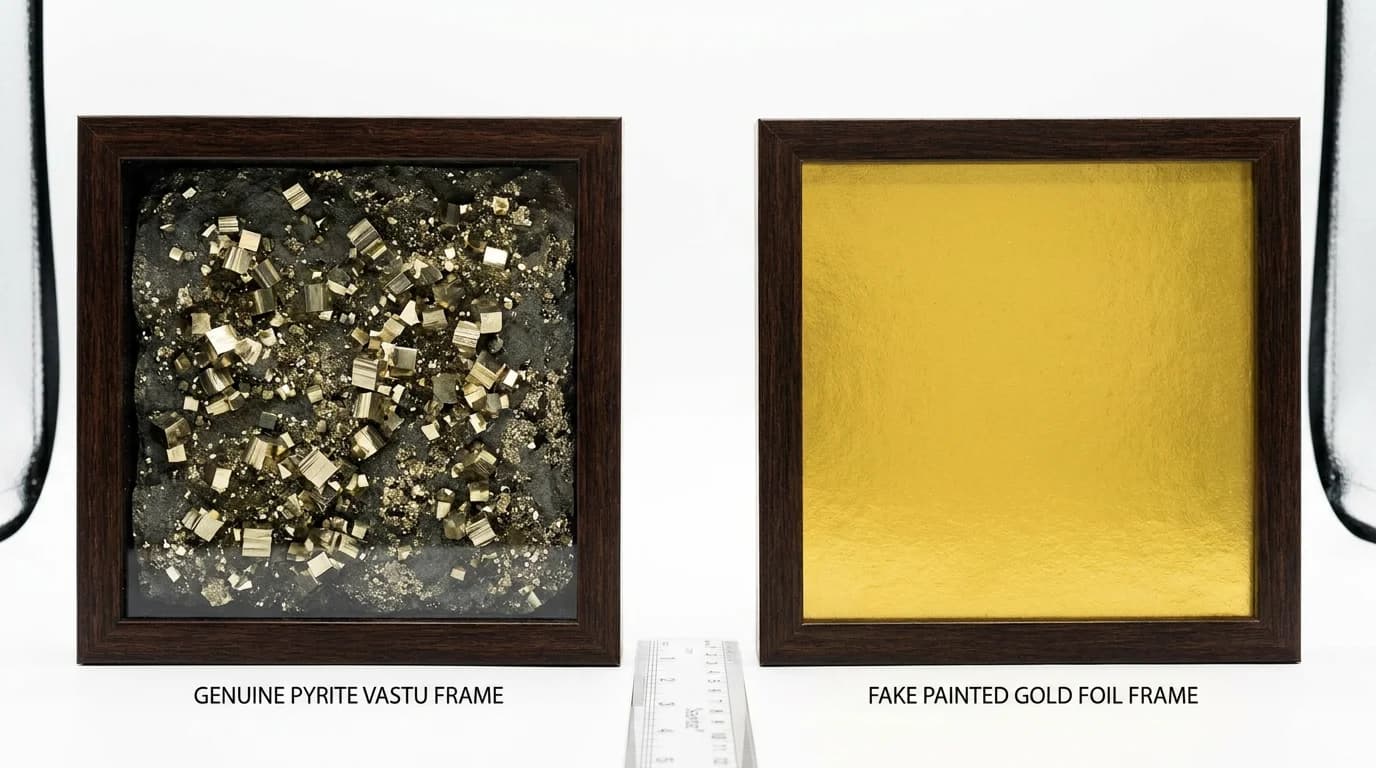
Most pyrite Vastu frames on Indian marketplaces contain no genuine pyrite — only painted resin, gold foil, or iron filings. A real embedded pyrite frame passes five tests: greenish-black streak on ceramic, mirror-bright non-replicable lustre, non-magnetic response, exceptional weight density, and a third-party lab certificate.
Why Genuine Pyrite Matters for a Vastu Remedy
In Vastu Shastra and crystal healing traditions, the energetic properties attributed to a mineral are inseparable from the physical mineral itself. Pyrite's wealth-activating quality is attributed to its specific crystalline structure — isometric cubic FeS₂ — its density, its elemental iron-sulphide composition, and its mirror-like metallic lustre. A painted resin that mimics pyrite's appearance shares none of these physical attributes and therefore, in Vastu tradition, carries none of its energetic qualities. Buying a fake pyrite frame is not simply getting less for your money — it means the Vastu remedy simply does not exist in the object you purchased.
The Indian marketplace for spiritual and Vastu objects is extensive and largely unregulated. Sellers on major e-commerce platforms frequently list 'pyrite frames' that contain gold-painted MDF, resin cast with mineral dust, iron filings in epoxy, or acrylic coated with metallic paint. These can be aesthetically similar to genuine frames at a casual glance — especially in low-resolution product photos. Knowing what to look for protects your investment and ensures the object you bring into your home has genuine mineral content.
| Genuine pyrite mineral | FeS₂ — iron disulphide, cubic crystal system |
| Specific gravity | ~5.0 (very dense — noticeably heavy for size) |
| Streak colour | Greenish-black (not gold — key test) |
| Magnetic? | No — pyrite is non-magnetic |
| Lustre | Metallic, mirror-bright — impossible to replicate with paint at close range |
| Lab verifiable? | Yes — mineral composition testable by XRF or acid test |
5 At-Home Tests to Verify Genuine Pyrite
You do not need a laboratory to perform preliminary verification. These five tests can be done at home with minimal equipment and will identify most fakes conclusively.
- 1Streak test (most reliable)
Scratch the pyrite surface against unglazed white ceramic (the back of a bathroom tile or a porcelain mug base). Genuine pyrite leaves a greenish-black or dark grey-black streak — not gold. Gold-painted resin leaves no meaningful streak or leaves a soft gold smear. This single test eliminates most fakes.
- 2Lustre test (visual)
Genuine pyrite has a brass-to-gold mirror-bright metallic lustre. Hold it under a single-point light source (phone torch or desk lamp) and observe the reflection — it should be sharp, bright, and metallic, not matte or waxy. Resin and paint have a fundamentally different surface quality visible at close range.
- 3Magnetic test
Hold a strong fridge magnet or neodymium magnet near the pyrite cluster. Genuine pyrite is non-magnetic — it will not be attracted to the magnet at all. Some fake frames use iron filings or iron-powder resin to add weight; these attract a magnet noticeably. Note: if the frame has metal mounting hardware, test the mineral portion specifically, away from any metal fixtures.
- 4Weight test
Pyrite has a specific gravity of approximately 5.0 — it is very dense. A frame with genuine embedded pyrite clusters should feel notably heavy for its size. If a frame of similar dimensions to another feels surprisingly light, it likely lacks genuine mineral content. Compare with a known pyrite specimen if possible.
- 5Lab certificate
Request a third-party lab certificate confirming mineral composition. Reputable sellers can provide XRF (X-ray fluorescence) or chemical assay certificates confirming the presence of genuine FeSâ‚‚ pyrite. DivineTatva includes a lab certificate with every pyrite Vastu frame. No certificate = buyer beware.
Common Frauds Sold as Pyrite Vastu Frames in India
Understanding the specific types of fakes helps you assess product listings more critically before purchase — especially when buying online without the ability to physically handle the product.
- 1Gold-painted MDF / plywood
The most basic fraud: the frame's surface is simply painted gold, with no mineral content whatsoever. These are purely decorative art objects — they fail all five tests. Common in ₹200–₹400 listings.
- 2Resin-cast with pyrite dust
A more sophisticated fake: pyrite is crushed to powder and mixed into clear resin, which is then moulded into cluster-shaped forms. These contain trace mineral but not in a crystal structure with energetic properties. They may partially pass the streak test (faint colour) but fail the lustre and weight tests.
- 3Iron filings in epoxy
Heavy, metallic-looking fakes that use iron filings mixed into epoxy resin. These feel heavy (passing the weight test) but are magnetic (failing the magnetic test decisively). The lustre is wrong — matte and granular rather than mirror-bright.
- 4Acrylic with metallic coating
Lightweight, shiny-at-a-distance fakes with an acrylic base and metallic paint sprayed over. Fail the streak test (no streak), weight test (very light), and close-inspection lustre test. Commonly sold as 'crystal look' frames.
- 5Photos of genuine pyrite, different product shipped
The most frustrating marketplace fraud: genuine pyrite cluster photos used for the listing, but a painted resin frame shipped. Always buy from sellers with verified reviews mentioning pyrite mineral quality, and insist on a lab certificate.
Genuine Pyrite vs Common Fakes — Full Comparison
| Test / Feature | Genuine Pyrite Frame | Resin + Pyrite Dust | Iron Filings + Epoxy | Gold-Painted MDF |
|---|---|---|---|---|
| Streak on ceramic | Greenish-black | Faint grey or none | Reddish-brown (iron) | Gold smear / none |
| Lustre | Mirror-bright metallic | Grainy, semi-matte | Granular, matte | Flat gold paint |
| Magnetic? | No | No | Yes (iron content) | No |
| Weight (density) | Very heavy (~5.0 SG) | Medium | Heavy (iron) | Light |
| Lab certifiable | Yes — FeS₂ confirmed | Partially | No (FeS₂ absent) | No |
| Vastu tradition value | Full mineral energy | Minimal | None | None |
| Durability | Decades (kept dry) | 2–5 years | Rusts with moisture | Months–2 years |
| Typical India price | ₹1,099 – ₹5,000+ | ₹500 – ₹900 | ₹400 – ₹800 | ₹200 – ₹500 |
What to Ask Your Seller Before Buying
Before purchasing a pyrite Vastu frame — especially online — ask these questions explicitly. A genuine seller will answer confidently and specifically; a seller of fakes will give vague, evasive, or obviously scripted responses.
- 1Do you provide a lab certificate?
The answer should be yes, with details of the testing laboratory. 'We guarantee genuine pyrite' without a third-party certificate is not equivalent to a certificate.
- 2What is the specific mineral embedded?
The answer should be 'pyrite' or 'iron disulphide (FeS₂)' — not 'golden stone', 'luck crystal', or 'prosperity mineral'.
- 3What is the weight of the frame?
A 12×16 inch frame with genuine embedded pyrite should weigh noticeably more than a similar-sized decorative frame. Ask for the shipping weight — it should reflect mineral density.
- 4Can I see macro/close-up photos of the pyrite surface?
Close-up photos reveal whether the mineral is crystalline (genuine) or granular/painted (fake). Genuine pyrite has visible cubic crystal faces and a mirror-bright metallic sheen even in photos.
- 5Is the pyrite embedded or surface-applied?
Genuine quality frames have pyrite clusters embedded into the frame structure, not glued flat onto the surface. Embedded stones have dimensional depth and are far less likely to chip off in transit.
DivineTatva's Lab Certificate & Authenticity Guarantee
Every DivineTatva pyrite Vastu frame ships with a third-party lab certificate confirming the embedded mineral is genuine pyrite (FeS₂). This is not a branded 'certificate of authenticity' we print ourselves — it is an independent mineral verification document. Our pyrite is sourced through Jaipur's established gemstone and mineral trade network, where provenance and grade are verifiable.
Our frames pass all five authentication tests listed above. We encourage you to perform the streak and weight tests upon arrival — confidence in your purchase is part of what we sell. If for any reason you are not satisfied that the pyrite is genuine, our return policy applies. We have nothing to hide and everything to gain from your trust.
Care reminder: once you have confirmed authenticity, maintain your frame correctly. Dust the frame surface with a dry soft brush or dry microfibre cloth. Never expose to moisture, water spray, or direct prolonged sunlight — UV can fade pyrite's metallic lustre over time. Do not use liquid cleaners or polishes on the pyrite piece. Handle frame edges carefully to avoid chipping embedded pyrite clusters.
| Certificate type | Third-party mineral verification (not self-issued) |
| Mineral confirmed | Pyrite — FeS₂ (iron disulphide) |
| Source | Jaipur gemstone trade network, Rajasthan |
| Tests passed | Streak, lustre, magnetic, weight, lab certificate |
| Return policy | Applies if mineral authenticity is disputed |
| COD available | Yes — pan-India |
Frequently asked
Last reviewed: 17 May 2026 · Verified by the DivineTatva expert panel
How can I tell if my pyrite Vastu frame is fake without a lab?
The streak test is the most reliable at-home method: scratch the pyrite on the unglazed back of a ceramic tile. Genuine pyrite leaves a greenish-black streak, not gold. Also check weight (genuine pyrite is very dense), magnetism (genuine pyrite is non-magnetic), and close-range lustre (mirror-bright, not matte or waxy).
Does a lab certificate guarantee the pyrite is genuine?
A third-party lab certificate (such as XRF mineral analysis) confirming FeSâ‚‚ composition is strong evidence of genuineness. A certificate issued by the seller themselves without third-party verification is less reliable. Always check whether the certificate names an independent testing laboratory.
Is pyrite that has been crushed into resin still energetically valid in Vastu?
Vastu Shastra tradition holds that the crystalline mineral structure is integral to pyrite's energetic properties. Crushing pyrite to powder and mixing it into resin destroys the crystal structure. Most Vastu practitioners would not consider crushed pyrite in resin an equivalent remedy to embedded genuine pyrite clusters.
Why does genuine pyrite leave a greenish-black streak — not gold?
Pyrite's streak colour reflects the colour of the powdered mineral, which differs from its surface lustre. The metallic gold-brass surface lustre is a structural property of the intact crystal; when powdered, pyrite reveals its true chemical colour — a dark grey-green. This is one of the most reliable mineralogical tests for distinguishing pyrite from gold-painted materials.
Is it safe to scratch my pyrite frame for the streak test?
You can perform the streak test on a small inconspicuous area of an embedded cluster — press the crystal edge gently against the back of a porcelain tile. It leaves a small mark on the tile, not the pyrite itself (since pyrite, at Mohs hardness 6–6.5, is harder than ceramic). The frame's aesthetic is unaffected by a careful test.
Can iron-filing fakes corrode or rust?
Yes. Iron filings in epoxy resin are prone to oxidation — especially in humid conditions (monsoon season in India). You may notice dark orange-brown rust spots appearing over months. Genuine pyrite also contains iron but in a stable sulphide compound — it does not rust in normal indoor conditions, though sustained moisture exposure should still be avoided.
Reviewed by the DivineTatva expert panel
Written and reviewed by DivineTatva's consulting Vedic astrologer. Every piece is lab-certified and energised in our Jaipur atelier. Last updated 10 June 2026.