Raw Pyrite Crystal Benefits, Where to Place & Why It Can't Touch Water
Raw Pyrite (FeS2) is a natural iron-sulfide crystal prized in Vastu and crystal tradition for wealth energy. This guide covers its mineral properties, North-zone placement, the chemistry behind its water sensitivity, how to cleanse safely, and how to tell real specimens from chalcopyrite or painted resin.
- What Is Raw Pyrite?
- Raw vs Polished Pyrite
- Wealth Benefits: Vastu and Crystal Tradition
- Where to Place Raw Pyrite
- Real vs Fake vs Chalcopyrite
- The Moisture Danger: Chemistry Explained
- How to Cleanse Without Water
- Does It Actually Work? Honest Answer
- Sizing Guide
- How to Activate Your Pyrite
- Price Guide India 2026
- The DivineTatva Difference
What Is Raw Pyrite? The FeS2 Crystal Explained
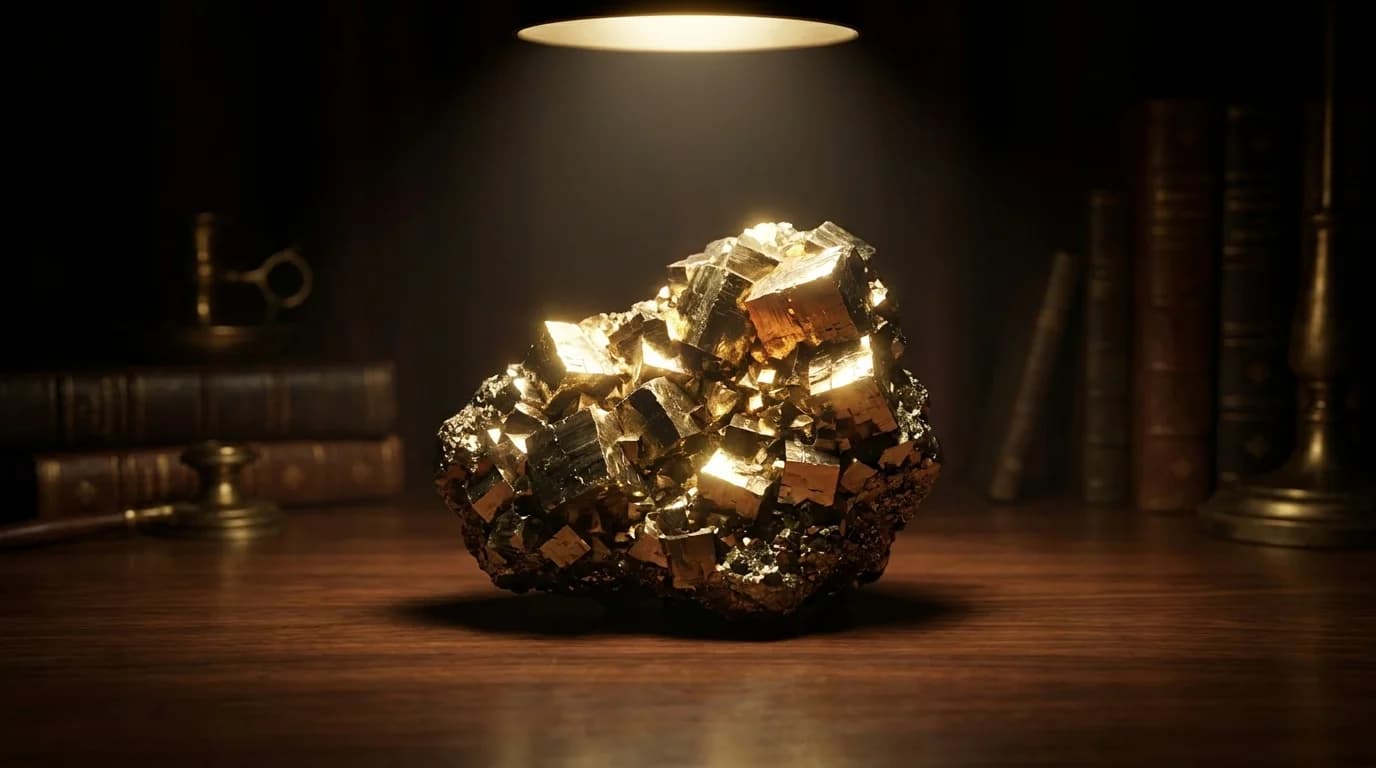
Raw Pyrite (iron pyrite, FeS2) is a naturally occurring iron-sulfide mineral that crystallises in the isometric (cubic) system, producing the sharp, mirror-bright cubes, pyritohedra, and clustered masses that make it instantly recognisable. It forms in sedimentary, metamorphic, and hydrothermal environments and is mined commercially in Peru, Spain, Russia, and parts of India. Its metallic gold-silver lustre earned it the folk name Fool's Gold, though it is chemically and structurally nothing like gold.
| Chemical formula | FeS2 (iron disulfide) |
| Crystal system | Isometric / cubic |
| Lustre | Metallic, gold to silver-gold |
| Hardness (Mohs) | 6-6.5 |
| Specific gravity | 4.9-5.2 |
| Streak | Greenish-black to black |
| Common forms | Cubes, pyritohedra, framboids, massive clusters |
| Major sources | Peru, Spain, Russia, China, India |
Raw vs Polished Pyrite: Why the Rough Specimen Is Preferred
Polishing pyrite removes the natural crystal faces — the flat, mirror-like facets that define its cubic structure. In both crystal-healing and Vastu tradition, these intact faces are considered energetically significant: they reflect and amplify rather than diffuse. Raw clusters also present multiple crystal terminations, each acting as a separate emission point. Practically, raw specimens are lower cost per gram since no lapidary labour is involved.
| Feature | Raw Cluster | Tumbled Stone | Pyrite Bracelet |
|---|---|---|---|
| Crystal faces intact | Yes | No (abraded) | No |
| Multiple terminations | Yes | No | No |
| Surface area exposed | High | Low | Very low |
| Vastu desk/altar use | Ideal | Adequate | Wearable only |
| Price per gram | Low | Medium | High (craft premium) |
| Water sensitivity risk | High — never rinse | Very high — surface cracks | High — metal setting reacts |
Wealth Benefits: What Vastu Shastra and Crystal Tradition Say
In Vastu Shastra, the North direction is governed by Kuber, the treasurer of the gods and deity of wealth and abundance. Placing a raw pyrite cluster in the North zone of a home, office, or study room is a classical Vastu prescription for activating financial flow. The metallic lustre of pyrite is symbolically associated with gold, solar energy, and material prosperity across multiple traditions — from European folk alchemy to Andean shamanic practice, where Peruvian pyrite cubes were used as divination mirrors.
In modern crystal-healing frameworks, pyrite is assigned to the Solar Plexus chakra (Manipura), the energy centre governing confidence, willpower, and the capacity to act on financial opportunities. Practitioners say it counters energy of financial stagnation, self-doubt, and procrastination.
DivineTatva's position: these are belief traditions with deep cultural roots. No peer-reviewed clinical evidence demonstrates that pyrite affects finances or chakras. We present these frameworks accurately and leave the choice to you.
- 1Kuber North-zone activation
Place in the North sector of your space to align with Vastu wealth direction.
- 2Solar plexus confidence
Used in crystal practice at the Manipura chakra to support willpower.
- 3Financial stagnation protection
Traditional belief: pyrite's reflective surface deflects energy of lack.
- 4Abundance altar focal point
Paired with green aventurine and citrine on a wealth altar.
- 5Office desk prosperity
Front-left desk placement per Vastu for career and income growth.
- 6Cash box energiser
Small specimen inside a cash box or locker is a common North Indian practice.
Where to Place Raw Pyrite Crystal at Home and Office
The primary rule in Vastu is North zone placement — the direction of Kuber and the flow of wealth energy. Within the North zone, front-left of a desk (as you sit facing your work) is considered the power position. A cash box, locker, or account register in the North zone is a classic secondary placement. Avoid South wall, bathroom, or any area near water features.
| Location | Zone/Position | Vastu Logic | Notes |
|---|---|---|---|
| Home office desk | Front-left corner | Kuber North — career wealth | Keep away from glass of water |
| Living room | North wall shelf | Wealth sector activation | Pair with green plant |
| Cash box / locker | Inside or on top | Direct Kuber energising | Small 80-150g specimen ideal |
| Bedroom | North or East nightstand | Acceptable; avoid South | Not near humidifier |
| Kitchen | Avoid | Near moisture, steam | Pyrite oxidises rapidly |
| Bathroom | Never | Water damage certain | Will discolour and corrode |
| South wall | Avoid | Opposes Kuber direction | Counterproductive per Vastu |
Real vs Fake Pyrite: Chalcopyrite, Painted Resin and Marcasite
Three stones or materials are commonly misidentified as or sold as pyrite: (1) Chalcopyrite (peacock ore), a copper-iron sulfide with rainbow iridescence very different from pyrite's uniform gold; (2) Painted resin or plaster clusters, factory-made fakes with metallic gold spray; (3) Marcasite, a true polymorph of FeS2 with orthorhombic crystal structure, distinguishable only by X-ray diffraction or specific gravity. Knowing the tests saves you money.
| Property | Real Pyrite | Chalcopyrite | Gold Quartz | Painted Resin |
|---|---|---|---|---|
| Colour | Pale brass-gold, uniform | Iridescent rainbow | Yellow gold in white matrix | Uniform sprayed gold |
| Crystal habit | Sharp cubes / pyritohedra | Massive, no cubic faces | Anhedral gold in quartz | No crystal structure |
| Streak | Greenish-black | Greenish-black | Yellow (gold) | Colour of paint |
| Hardness | 6-6.5 (scratches glass) | 3.5-4 (copper coin scratches it) | 2.5 (gold) | 1-2 (fingernail scratches) |
| Weight (heft) | Heavy, SG ~5 | Heavy, SG ~4.2 | Variable | Light, hollow feel |
| Warmth to touch | Cold (mineral) | Cold (mineral) | Cold | Warms quickly (plastic/resin) |
| Price signal | Rs 300-3000 for 100-300g | Should be cheaper | Much more expensive | Under Rs 100, too perfect |
The Moisture Danger: Why Raw Pyrite Cannot Touch Water
This is the single most important care fact for any pyrite owner. Raw pyrite reacts with atmospheric oxygen and water to produce iron hydroxide (rust) and sulfuric acid — a process known in conservation as pyrite disease or pyrite decay. The reaction pathway is: FeS2 + O2 + H2O produces iron oxyhydroxide (rust) and sulfuric acid (H2SO4). Museum conservators worldwide document collections destroyed by this reaction: specimens crumble from the inside out, staining display cases and nearby objects with yellow-orange rust and acid residue.
The reaction accelerates dramatically in humid conditions, and even a brief rinse under tap water initiates it. Salt water used in crystal cleansing is far more aggressive — sodium chloride acts as an electrolyte, speeding ionic transfer and worsening both the oxidation and the acid formation. This is why salt-water cleansing, standard practice for quartz or amethyst, is categorically dangerous for pyrite.
| Reaction name | Pyrite oxidation / pyrite disease |
| Reactants | FeS2 + O2 + H2O |
| Products | Iron oxyhydroxide (rust) + sulfuric acid (H2SO4) |
| Risk from tap rinse | High — initiates surface oxidation |
| Risk from salt water | Severe — electrolyte accelerates reaction |
| Risk from steam/humidity | Moderate to high over time |
| Museum impact | Major collections damaged; documented by Getty Conservation Institute |
| Safe humidity range | Below 60% RH indoors |
How to Cleanse Raw Pyrite Without Water
Energetic cleansing of pyrite must be entirely dry. The three accepted methods in crystal-healing practice are: smoke cleansing with incense (dhoop, loban, or sage), sound vibration (a singing bowl, bell, or tuning fork held near the specimen), and placement on selenite overnight. Dry full-moonlight placement on a windowsill is also acceptable, provided no dew or condensation can reach the specimen.
- 1Dry soft-bristled brush
Dust accumulated particles with a clean, dry brush — never add moisture.
- 2Microfibre cloth wipe
For metallic surfaces, a dry microfibre removes fingerprint oils gently.
- 3Compressed air (camera bulb)
Blow dust from crystal crevices without touching or wetting.
- 4Incense smoke (dhoop/loban)
Pass the specimen slowly through smoke 3-7 times for energetic reset.
- 5Singing bowl / bell
Place pyrite near the bowl rim and strike — let sound waves pass through.
- 6Selenite charging plate
Rest pyrite on a selenite slab or in a selenite bowl overnight.
- 7Dry moonlight
Indoor windowsill only — never outside where dew can form.
Does Raw Pyrite Actually Work? Our Honest Answer
There is no peer-reviewed scientific evidence that raw pyrite influences financial outcomes, chakra energy, or measurable physiological states. The wealth and confidence associations are cultural and spiritual traditions — real and valuable to millions of people, but not validated by controlled studies.
What is documented: pyrite's geology, its cubic crystal habit, its occurrence across cultures as a symbolic object of value (Inca mirrors, European alchemical texts, Vedic Vastu prescriptions). These traditions reflect genuine human experience of intention-setting and environmental design. Many buyers find that placing a pyrite cluster on their desk creates a tangible reminder of financial goals — a form of environmental anchoring that has psychological backing even if the crystal itself is inert.
DivineTatva sells lab-certified natural specimens with accurate mineral identification. We do not guarantee financial outcomes. We do guarantee the stone is what we say it is.
Sizing Guide: Which Weight Is Right for Your Space
| Weight | Approx Size | Best For | DivineTatva |
|---|---|---|---|
| 30-80g | Golf ball or smaller | Pocket carry, gift, small altar | Not stocked |
| 80-150g | Large egg | Desk corner, cash box, travel altar | Entry range |
| 150-300g | Fist-sized | Office desk centrepiece, living room shelf | Main stock (Rs 499) |
| 300-500g | Two fists | Large altar, boardroom desk, vastu installation | Premium range |
| 500g+ | Display specimen | Retail display, large Vastu installations | Special order |
For a standard home-office desk, a 150-300g specimen is the most practical: visible without dominating the workspace, heavy enough to have presence, light enough to reposition when cleaning. DivineTatva's Rs 499 listing covers this range with lab certification included.
How to Activate Your Raw Pyrite Crystal
Activation in the Hindu-Vedic tradition means setting a clear intention (sankalp) with the stone under auspicious conditions, so it becomes linked to a specific purpose rather than sitting as an inert object.
- 1Choose an auspicious time
Dhanteras, Akshaya Tritiya, or any Thursday or Friday morning are considered optimal.
- 2Clean your space
Wipe the placement area dry. Place the pyrite on a clean red or yellow cloth.
- 3Smoke cleanse the specimen
Pass loban or dhoop incense smoke around the crystal 7 times, moving clockwise.
- 4Set your sankalp
Hold the crystal in both hands, close your eyes, and state your specific financial intention clearly — not 'I want money' but a concrete, timebound goal.
- 5Chant the mantra
Recite 'Aum Shreem Hreem Kleem Mahalakshmiyei Namah' 11 or 108 times while holding the crystal.
- 6Place in North zone
Set the activated crystal at its permanent North-zone location — front-left of desk or inside cash box.
- 7Monthly maintenance
On the first Thursday of each month, repeat the smoke cleanse and silently restate your sankalp.
Raw Pyrite Price in India 2026: What to Expect by Size and Grade
| Weight Range | Market Price (INR) | Grade Indicators | Certificate? |
|---|---|---|---|
| 30-80g | Rs 80-200 | May lack cubic habit clarity; tourist grade | Rarely |
| 80-200g | Rs 200-500 | Decent lustre; clusters common | Occasionally |
| 100-300g (DivineTatva) | Rs 499-999 | Lab-certified; cubic habit; Peruvian or Spanish origin | Yes, included |
| 300-600g | Rs 1000-3000 | Premium display grade; strong cubic faces | Ask before buying |
| 600g+ | Rs 3000+ | Collector/display specimen grade | Specialist dealers only |
Key price factors: (1) weight — the dominant variable; (2) crystal habit clarity — sharp, well-defined cubic faces command a premium; (3) lustre — bright, mirror-like surfaces vs dull or oxidised patches; (4) origin — Peruvian pyrite is prized for its perfect cubic crystals, Spanish for large framboid clusters; (5) certification — a lab certificate verifying FeS2 composition adds Rs 50-200 to cost but is the only real proof of authenticity.
The DivineTatva Difference: Lab Certified, Jaipur Sourced
DivineTatva operates from Jaipur — India's gemstone capital — with access to certified gemological testing facilities. Every raw pyrite cluster we sell is individually checked for: (1) mineralogical identity (FeS2 confirmed, not chalcopyrite or painted resin); (2) weight accuracy (stated range verified); (3) structural integrity (no hairline fractures that accelerate oxidation). We ship with COD availability across India and include care instructions printed on every package. Our Rs 499 specimens carry a full lab certificate at no extra charge.
Frequently asked
Last reviewed: 17 May 2026 · Verified by the DivineTatva expert panel
Can I put raw pyrite in water to cleanse it?
No — never. Raw pyrite (FeS2) reacts with water and oxygen to produce iron hydroxide (rust) and sulfuric acid. Even a brief rinse initiates this reaction, which causes the specimen to crumble and discolour. Use incense smoke, sound vibration, or a selenite plate instead.
Which direction should raw pyrite face in Vastu?
Place it in the North zone of your home or office — the direction governed by Kuber, the Vedic deity of wealth. Front-left of a desk (as you sit) within the North zone is considered the power position. Avoid South, bathroom, or any damp area.
Is raw pyrite the same as Fool's Gold?
Yes. Pyrite earned the folk name Fool's Gold because its metallic brass-gold lustre tricked prospectors who mistook it for actual gold. Chemically it is iron disulfide (FeS2), with a hardness of 6-6.5 and a greenish-black streak — both very different from real gold.
How do I tell real pyrite from chalcopyrite?
Chalcopyrite shows rainbow iridescence (peacock colours) on its surface and is softer (3.5-4 on Mohs scale — a copper coin scratches it easily). Real pyrite is uniformly gold-brass, forms sharp cubic or pyritohedral crystals, and has hardness 6-6.5. A copper coin scratch test is the quickest field check.
Does pyrite actually attract wealth?
This is a belief rooted in Vastu Shastra and crystal-healing tradition, not scientifically validated. There is no peer-reviewed evidence that pyrite affects financial outcomes. Many people find it a useful focal point for intention-setting around financial goals. DivineTatva does not guarantee any outcome — only specimen authenticity.
What size raw pyrite should I buy for my desk?
A 150-300g specimen (roughly fist-sized) is ideal for a standard desk — visible and present without dominating the workspace. If you intend to place it inside a cash box or a small altar, an 80-150g piece is more practical. For a large boardroom or Vastu installation, 300-500g is preferred.
Can I keep raw pyrite in the bedroom?
Yes — on the North or East nightstand. Avoid placing it near a humidifier, air cooler, or any water source. The South side of the bedroom is not recommended per Vastu. Some crystal practitioners advise against keeping pyrite in the bedroom if you are sensitive to energising stones.
How often should I cleanse my pyrite crystal?
Once a month is the standard recommendation, or whenever you feel the stone has absorbed stagnant energy. The easiest method is placing it on a selenite plate overnight. You can also use loban/dhoop smoke or a singing bowl. Never use salt water, running water, or any liquid.
What is the mantra for activating raw pyrite?
The mantra most commonly used with pyrite in Lakshmi-Kuber tradition is 'Aum Shreem Hreem Kleem Mahalakshmiyei Namah', recited 11 or 108 times. Chant while holding the specimen and visualising your specific financial intention. Thursday or Friday morning is the preferred time.
Is DivineTatva's raw pyrite lab certified?
Yes. Every specimen is verified by a Jaipur gemological lab for FeS2 mineral identity, correct weight, and structural integrity. The certificate is included with your order at no extra cost, and COD is available across India.
Reviewed by the DivineTatva expert panel
Written and reviewed by DivineTatva's consulting Vedic astrologer. Every piece is lab-certified and energised in our Jaipur atelier. Last updated 12 June 2026.