Raw Pyrite Crystal Care: Why It Can't Touch Water & How to Clean Safely
Raw pyrite (FeS2) cannot touch water — not tap water, not salt water, not steam. The reason is chemistry: FeS2 + O2 + H2O produces iron hydroxide (rust) and sulfuric acid, a reaction museum conservators call pyrite disease. This guide covers safe dry cleaning, safe energetic cleansing, and the complete list of what to never do.
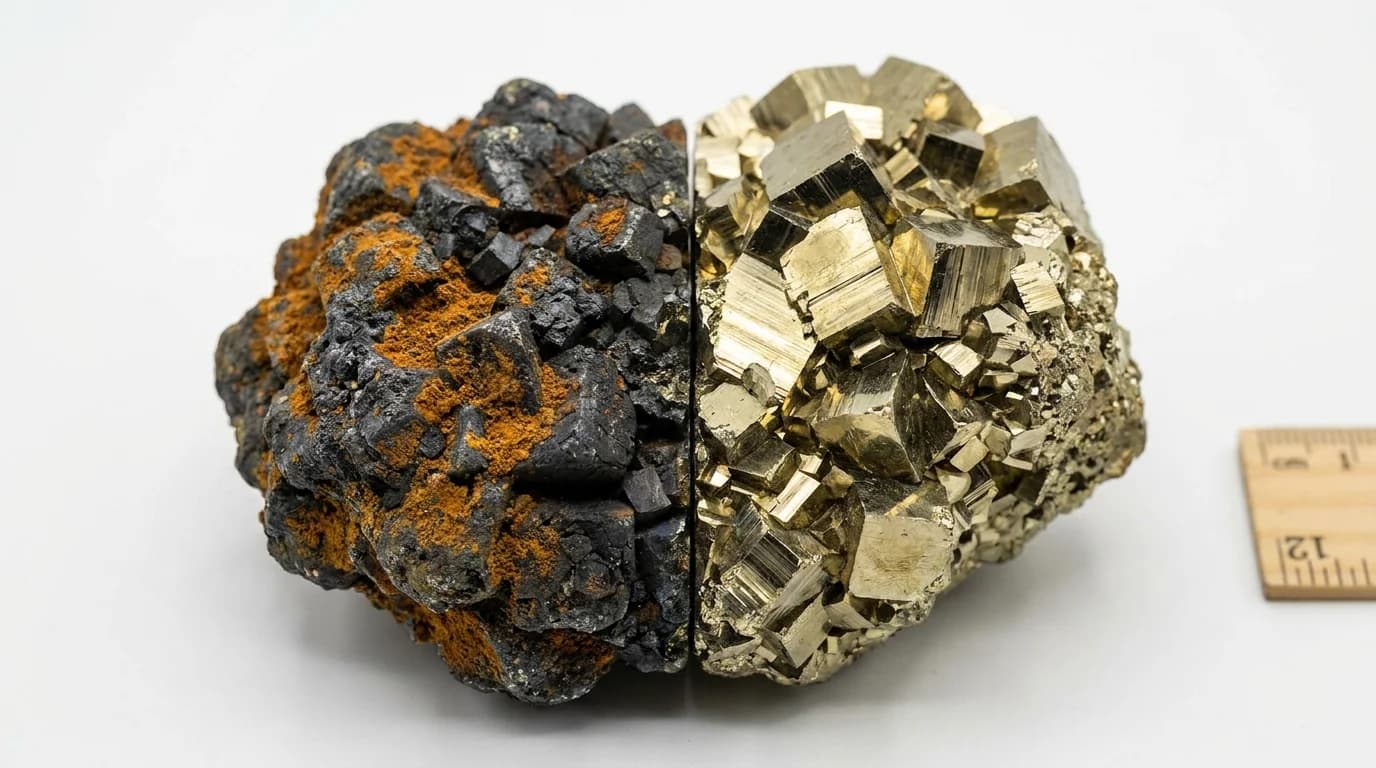
Why Raw Pyrite Cannot Touch Water: The FeS2 Oxidation Reaction
Raw pyrite (FeS2, iron disulfide) reacts with atmospheric oxygen and water to produce iron oxyhydroxide (rust) and sulfuric acid (H2SO4). This is the fundamental reason pyrite cannot be rinsed, soaked, or exposed to moisture. The reaction is not reversible — once begun, it continues until the specimen is destroyed or dried and stabilised in very low humidity. The sulfuric acid produced is corrosive to surfaces beneath the specimen, and the rust formation causes the crystal structure to crumble from the inside.
| Reaction | FeS2 + O2 + H2O produces iron oxyhydroxide and H2SO4 |
| Trigger | Any combination of liquid water or high humidity with oxygen |
| Products | Iron oxyhydroxide (orange-brown rust) + sulfuric acid |
| Reversible? | No — once oxidation begins, it cannot be undone |
| Rate accelerator | Salt water (electrolyte), heat, high humidity above 60% RH |
| Safe humidity | Below 60% RH; below 50% RH for long-term storage |
| Museum term | Pyrite disease / pyrite decay |
| Surface damage | Sulfuric acid stains and corrodes shelves, display cases, paper beneath specimen |
Pyrite Disease: Documented Destruction in Museum Collections
The phenomenon is so well documented in the natural history museum world that it has its own name: pyrite disease (also pyrite decay). Major natural history collections — including institutions studied by the Getty Conservation Institute — have lost significant pyrite specimens to this reaction. Specimens stored in humid basement vaults for decades have been found crumbled to orange powder, having generated enough sulfuric acid to stain surrounding fossil specimens, cardboard trays, and wooden drawers. This is not a theoretical risk.
Museum conservators now store pyrite specimens in sealed microenvironments with silica gel desiccant to keep relative humidity below 40%. For home display, the precautions are simpler: keep the specimen in a dry indoor room, away from humidifiers, water features, and kitchen steam, and never clean with any liquid.
How to Physically Clean Raw Pyrite Without Water
Dust with a dry soft-bristled brush only — never rinse, soak, or expose to moisture. Raw Pyrite (iron sulfide, Fool's Gold) oxidises rapidly in water, forming sulfuric acid that damages the specimen and discolours surfaces beneath. Display in a dry indoor environment away from humidity and direct rain. For energetic cleansing, use incense smoke (dhoop/loban), sound vibration (singing bowl), or place on selenite overnight — never salt water.
- 1Dry soft-bristled brush
Use a clean, dry watercolour brush or soft toothbrush to sweep dust from crystal faces and crevices. The primary physical cleaning tool.
- 2Microfibre cloth (dry)
For the smooth metallic faces, a dry microfibre cloth lifts fingerprint oils and dust without abrasion or moisture.
- 3Compressed air / camera bulb
A rubber air bulb blows dust from deep crevices without any contact or moisture.
- 4Avoid loose cotton wool
Cotton fibres can catch on crystal edges and leave residue. Use a brush with bound bristles only.
- 5Clean the surface beneath
Wipe the shelf or coaster under the pyrite with a dry cloth periodically. Orange-brown staining beneath means the specimen has begun oxidising.
How to Energetically Cleanse Raw Pyrite Without Salt Water
Standard crystal-cleansing methods include water rinsing, salt water soaking, and burying in earth — all of which are harmful for pyrite. The three safe energetic cleansing methods are: smoke (incense, dhoop, loban, sage), sound vibration (singing bowl, bell, tuning fork), and selenite contact (a selenite plate or bowl left in contact with pyrite overnight).
| Method | Safe for Pyrite? | How to Do It | Frequency |
|---|---|---|---|
| Dry soft brush | Yes — physical cleaning only | Sweep dust with dry soft brush | As needed |
| Incense smoke (dhoop/loban) | Yes — safe and traditional | Pass specimen through smoke 3-7 times clockwise | Monthly or as needed |
| Sound vibration (singing bowl) | Yes — fully safe | Place near bowl rim, strike, let sound pass through | Monthly |
| Selenite plate/bowl | Yes — fully safe | Rest pyrite on selenite overnight | Monthly |
| Dry moonlight (indoor) | Yes — windowsill only | Place on dry windowsill during full moon overnight | Monthly |
| Running water | Never | — | Never |
| Salt water | Never — extremely damaging | — | Never |
| Salt burial | Never — humidity wicks into crystal | — | Never |
| Steam cleaner | Never | — | Never |
| Wet cloth wipe | Never | — | Never |
What to Never Do With Raw Pyrite
- 1Never rinse under tap water
A single rinse begins the oxidation reaction. The damage may not be visible immediately but will develop over weeks.
- 2Never soak in salt water
Salt (NaCl) is an electrolyte that dramatically accelerates the FeS2 oxidation reaction. Salt-water cleansing destroys pyrite faster than plain water.
- 3Never place near a humidifier
Ambient mist from a humidifier builds up moisture on crystal surfaces. High ambient humidity above 60% RH alone can cause slow oxidation.
- 4Never store in a bathroom
Steam, condensation, and high humidity make bathrooms the worst possible environment for pyrite.
- 5Never bury in earth or salt
Soil moisture and salt both attack pyrite. Burial cleansing methods are not appropriate for this mineral.
- 6Never clean with any liquid product
No crystal-cleaning sprays, essential oil dilutions, or jewellery cleaners — all contain water or solvents that damage pyrite.
- 7Never use ultrasonic cleaners
Ultrasonic cleaners use water — the water alone is disqualifying.
- 8Never place outdoors
Rain, dew, and outdoor humidity will destroy a specimen within weeks. Always display indoors in a dry environment.
Long-Term Storage and Display Tips for Raw Pyrite
For display, a wooden shelf or natural stone surface in a dry indoor room is ideal. If you live in a high-humidity climate (coastal areas, monsoon-prone regions), place a small packet of silica gel desiccant near the specimen during the monsoon months — the same precaution used by museum conservators.
| Ideal indoor humidity | Below 60% RH; below 50% for storage |
| Monsoon precaution | Silica gel packet near specimen |
| Display surface | Wood or natural stone — avoid metal trays that can hold condensation |
| Storage wrap | Dry acid-free tissue + sealed bag + silica gel |
| Warning sign | Orange-brown dust or staining beneath specimen = oxidation has started |
| Action if oxidising | Move to lower-humidity room; do not wet; consider conservation wax for very valuable specimens |
Frequently asked
Last reviewed: 17 May 2026 · Verified by the DivineTatva expert panel
What happens if raw pyrite gets wet?
Water triggers the reaction FeS2 + O2 + H2O, producing iron hydroxide (rust) and sulfuric acid. The specimen begins to crumble and turns orange-brown, and the sulfuric acid can stain and corrode any surface beneath it. A brief rinse initiates the process — it may not be visible immediately but will develop over weeks.
Can I use salt water to cleanse pyrite energy?
Absolutely not. Salt water is the most damaging thing you can expose pyrite to. Sodium chloride acts as an electrolyte that dramatically accelerates the oxidation reaction. Salt-water cleansing — standard for quartz or amethyst — is categorically dangerous for pyrite. Use incense smoke, sound, or selenite instead.
How do I remove dust from raw pyrite safely?
Use a dry soft-bristled brush (watercolour brush or soft toothbrush) to sweep dust from crystal faces and crevices. For fingerprints on smooth faces, a dry microfibre cloth works well. A rubber air bulb (camera lens type) blows dust from deep crevices. Never add any moisture.
Can I put raw pyrite in the bathroom for display?
No. The bathroom is the worst possible environment for pyrite. Steam, condensation, and sustained high humidity will begin the oxidation reaction within days. Display pyrite only in dry indoor rooms — study, office, living room, or bedroom.
How do I energetically cleanse raw pyrite without water?
Three safe methods: (1) Incense smoke — pass the specimen through dhoop or loban smoke 3-7 times clockwise. (2) Sound vibration — place near a singing bowl and strike it, letting the sound waves pass through the crystal. (3) Selenite plate — rest the pyrite on a selenite slab overnight. Never use salt water, running water, or earth burial.
What is pyrite disease?
Pyrite disease is the term museum conservators use for the progressive oxidation of pyrite specimens caused by humidity and oxygen. The reaction produces sulfuric acid and iron oxyhydroxide (rust), which cause specimens to crumble and stain surrounding objects. Major natural history collections have lost significant specimens to this process.
How do I know if my pyrite has started oxidising?
Look for orange-brown dust or staining on the surface of the specimen or on the shelf beneath it. A faint sulfurous odour (rotten egg smell) is another early sign. If you notice these, move the specimen to a lower-humidity room immediately and place silica gel nearby. Do not add any moisture.
Reviewed by the DivineTatva expert panel
Written and reviewed by DivineTatva's consulting Vedic astrologer. Every piece is lab-certified and energised in our Jaipur atelier. Last updated 13 June 2026.