Real vs Fake Pyrite: Pyrite vs Chalcopyrite & Painted Resin Tests
Three materials are routinely sold as or confused with raw pyrite: chalcopyrite (peacock ore) with its rainbow iridescence, painted resin clusters with sprayed metallic gold, and marcasite (FeS2 polymorph). This guide walks through five field tests to separate the real from the fake before you buy.
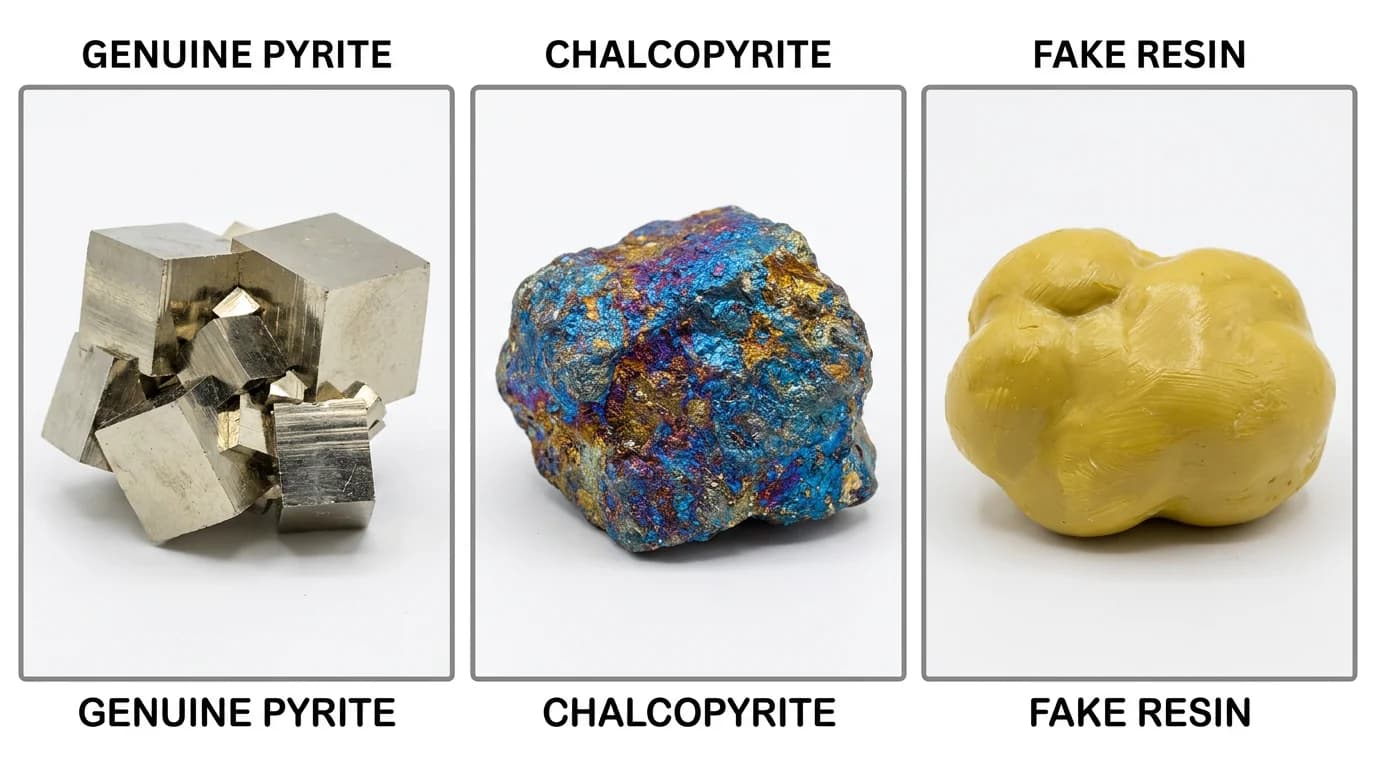
The Three Materials Most Often Confused With or Sold as Raw Pyrite
Real pyrite (FeS2) has three common impostors in the Indian crystal market: (1) Chalcopyrite (CuFeS2), a copper-iron sulfide sometimes called peacock ore for its vivid rainbow iridescence — beautiful, but not pyrite; (2) Painted resin or plaster clusters, factory-made with metallic gold spray paint, sold cheaply at tourist stalls; (3) Marcasite, a true polymorph of FeS2 with identical chemistry but orthorhombic crystal structure, indistinguishable without lab equipment.
| Confuser 1 | Chalcopyrite (CuFeS2) — rainbow iridescent, softer |
| Confuser 2 | Painted resin / plaster — no crystal structure, warm to touch |
| Confuser 3 | Marcasite — same chemistry, different structure, lab test needed |
| Real pyrite tells | Cubic crystals, pale brass-gold (not rainbow), hardness 6-6.5 |
| Easiest quick test | Copper coin scratch test (coin scratches resin and chalcopyrite, not pyrite) |
| Definitive test | XRD or specific gravity for marcasite; streak and hardness for others |
Pyrite vs Chalcopyrite (Peacock Ore): How to Tell Them Apart
Chalcopyrite (CuFeS2) is a copper-iron sulfide that forms in massive or botryoidal habits rather than sharp cubic crystals. Its most distinctive feature is surface iridescence — under light it displays blues, purples, pinks, greens, and golds simultaneously (hence 'peacock ore'). Real pyrite does not do this. Pyrite's surface is uniformly pale brass-gold to silver-gold, with no colour play.
Hardness is the definitive field test: chalcopyrite is 3.5-4 on the Mohs scale, which means a copper coin (hardness ~3.5) will scratch it. Real pyrite at 6-6.5 cannot be scratched by a copper coin, a steel knife, or even a steel file. Run the coin firmly across an inconspicuous edge and inspect under good light.
| Chalcopyrite colour | Rainbow iridescence — blues, purples, greens, gold together |
| Pyrite colour | Uniform pale brass-gold to silver-gold |
| Chalcopyrite hardness | 3.5-4 (copper coin scratches it) |
| Pyrite hardness | 6-6.5 (copper coin cannot scratch it) |
| Crystal habit | Chalcopyrite: massive/botryoidal. Pyrite: sharp cubes/pyritohedra |
| Streak | Both give greenish-black — not useful to distinguish these two |
How to Detect Painted Resin or Plaster Fake Pyrite Clusters
Painted resin and plaster fakes are common in tourist markets and low-price online listings. They are made by pouring resin or plaster into a mould, allowing it to set in a rough cluster shape, then spray-painting with metallic gold paint. The result can look convincing in photographs but fails every physical test.
- 1Scratch with copper coin
A copper coin (hardness 3.5) scratches resin/plaster instantly. Real pyrite at 6-6.5 shows no mark.
- 2Hold under light at an angle
Real pyrite has distinct flat cubic faces with sharp edges. Resin fakes show rounded, blob-like bumps with no geometric regularity.
- 3Feel the temperature
Mineral pyrite feels cold to the touch. Resin and plastic warm up in your hand quickly.
- 4Check the weight
Pyrite has specific gravity ~5 — it feels surprisingly heavy for its size. Resin/plaster fakes feel noticeably light or hollow.
- 5Look at the base edge
Where the base of the cluster was in the mould, resin fakes often show a flat mould-line and paint peeling at edges.
- 6Price check
If a 'pyrite cluster' is priced under Rs 100-150 for a fist-sized specimen, it is almost certainly resin. Real pyrite of that size costs Rs 300 minimum from any honest source.
Pyrite vs Marcasite: The Polymorph Problem
Marcasite is a true polymorph of pyrite — identical chemical formula (FeS2) but a different crystal structure (orthorhombic rather than isometric/cubic). It has similar lustre and colour to pyrite. Marcasite is less stable, oxidises even faster than pyrite, and has a tendency to crumble over time. Telling them apart requires X-ray diffraction (XRD) or precise specific gravity measurement.
For practical purposes: if a specimen has clear cubic crystal habit (sharp flat faces in cube or pyritohedron form), it is almost certainly pyrite, not marcasite. Marcasite tends to form radiating, spear-shaped, or cockscomb habits. If you are buying an investment-grade specimen, request lab verification specifically confirming isometric crystal system (pyrite), not orthorhombic (marcasite).
Five Field Tests You Can Do Before You Buy
- 1Crystal habit (visual)
Look for sharp, flat cubic or pyritohedral faces with geometric regularity. No cubic faces = suspect chalcopyrite or resin.
- 2Colour uniformity
Real pyrite is uniform pale brass-gold. Rainbow/iridescent = chalcopyrite. Overly perfect bright gold = painted.
- 3Copper coin scratch test
Press a copper coin firmly on an edge. Scratches easily = resin or chalcopyrite. No mark = likely real pyrite.
- 4Heft test
Real pyrite feels heavy for its size (SG ~5). Light or hollow feel = resin.
- 5Temperature test
Hold for 10 seconds. Still cold = mineral. Warms up = resin/plastic.
Pyrite vs Chalcopyrite vs Gold Quartz vs Resin: At a Glance
| Property | Real Pyrite | Chalcopyrite | Gold in Quartz | Painted Resin |
|---|---|---|---|---|
| Colour | Uniform pale brass-gold | Rainbow iridescent | Yellow gold in white/grey matrix | Uniform sprayed gold |
| Crystal habit | Sharp cubes / pyritohedra | Massive, no cubic faces | Anhedral blebs in quartz | No crystal structure, blob-like |
| Hardness (Mohs) | 6-6.5 | 3.5-4 | 2.5 (gold) | 1-2 |
| Copper coin scratch | No scratch | Scratches easily | Scratches easily | Deep scratch immediately |
| Heft | Very heavy (SG ~5) | Heavy (SG ~4.2) | Very heavy (SG ~15-19 for gold) | Light (SG ~1.2-1.5) |
| Temperature | Cold, slow to warm | Cold, slow to warm | Cold | Warms quickly |
| Streak on porcelain | Greenish-black | Greenish-black | Yellow/gold | Paint colour |
| Price (100-200g) | Rs 200-500 | Rs 100-300 | Rs 5000+ | Under Rs 100-150 |
| Certificate available | Yes from reputable sellers | Sometimes | Yes (assay) | No |
Frequently asked
Last reviewed: 17 May 2026 · Verified by the DivineTatva expert panel
What is the easiest way to tell real pyrite from fake at home?
The copper coin scratch test is the simplest. Press a copper coin firmly on an edge of the specimen. Real pyrite (hardness 6-6.5) shows no scratch. Painted resin or plaster fakes scratch immediately. Chalcopyrite (hardness 3.5-4) also scratches. Additionally, real pyrite feels cold and very heavy for its size — resin warms up in your hand.
Is chalcopyrite the same as pyrite?
No. Chalcopyrite (CuFeS2) is a copper-iron sulfide, while pyrite (FeS2) is iron disulfide — different minerals with different chemistry. Chalcopyrite's rainbow iridescence (peacock colours) is its signature tell. Pyrite has uniform pale brass-gold colour with no colour play. Chalcopyrite is also significantly softer (3.5-4 vs 6-6.5).
Can painted resin pyrite pass as real in online photos?
Yes — in photographs, well-made resin fakes can look convincing. The tells become obvious only in person: they feel light and warm, have rounded blob-like bumps rather than flat cubic faces, and scratch immediately with a copper coin. Always buy from sellers who provide lab certificates or have a clear return policy.
What is marcasite and is it the same as pyrite?
Marcasite is a polymorph of pyrite — same chemical formula (FeS2) but a different crystal structure (orthorhombic vs cubic). It looks similar but is less stable and oxidises faster. Telling them apart requires X-ray diffraction. If cubic crystal habit is clearly visible, it is almost certainly pyrite, not marcasite.
Does real pyrite have cubic crystals?
Yes — the cubic crystal habit is pyrite's most reliable visual identifier. Look for sharp, flat, geometric faces in cube or pyritohedron (12-sided) shapes. These faces will catch light and reflect it cleanly. Chalcopyrite and resin fakes do not show this cubic geometry.
How can I verify pyrite from an online seller in India?
Ask for a lab certificate specifying the mineral as FeS2 (iron disulfide), the crystal system as isometric/cubic, and the specimen weight. DivineTatva includes this certificate with every order. Also check that the seller offers COD or easy returns — it signals confidence in their product.
Why is Peruvian pyrite considered the best quality?
Peruvian pyrite from the Huanzala and Quiruvilca mines produces the world's most perfectly cubic crystals — sharp, flat-faced cubes with exceptional mirror-bright lustre. This perfect cubic habit is prized by both collectors and Vastu/crystal practitioners. Spanish pyrite produces large framboid clusters; Chinese pyrite is often more massive with less defined faces.
Reviewed by the DivineTatva expert panel
Written and reviewed by DivineTatva's consulting Vedic astrologer. Every piece is lab-certified and energised in our Jaipur atelier. Last updated 13 June 2026.