Rose Quartz Bracelet Price in India: What's Fair vs a Red Flag
A rose quartz bracelet is a stretchable band of natural pink quartz (silicon dioxide) beads, traditionally linked to love, compassion and the Anahata heart chakra. In India a genuine, lab-certified piece usually costs a few hundred to a couple of thousand rupees, depending on bead size, clarity and certification, not a few rupees.
What a rose quartz bracelet is (and what you're paying for)
A rose quartz bracelet is a stretchable band of natural rose quartz beads, the pink variety of quartz (silicon dioxide). In Indian crystal tradition it is worn to support self-love, emotional healing and calmer relationships, and is linked to the Anahata (heart) chakra. When you buy one, you are paying for the stone's authenticity, bead quality and certification, not just a colour.
Honest framing matters here. These love and heart-chakra benefits come from Vedic and metaphysical tradition plus personal belief. They are experiential, not medically proven. Many wearers report a sense of calm, warmth or focus consistent with intention, ritual and the placebo response. A rose quartz bracelet is a wellbeing and intention aid, not a treatment, and not a substitute for medical, financial or professional advice.
| Material | Natural rose quartz (silicon dioxide), pink quartz variety |
| Look | Pale, milky, slightly cloudy pink, never candy-bright |
| Tradition | Love, compassion, self-love, Anahata (heart) chakra |
| Evidence status | Traditional and experiential, not clinically proven |
| Common bead sizes | 6mm, 8mm, 10mm |
| Made in | Jaipur, Rajasthan gemstone hub |
Rose quartz bracelet price in India: what's fair
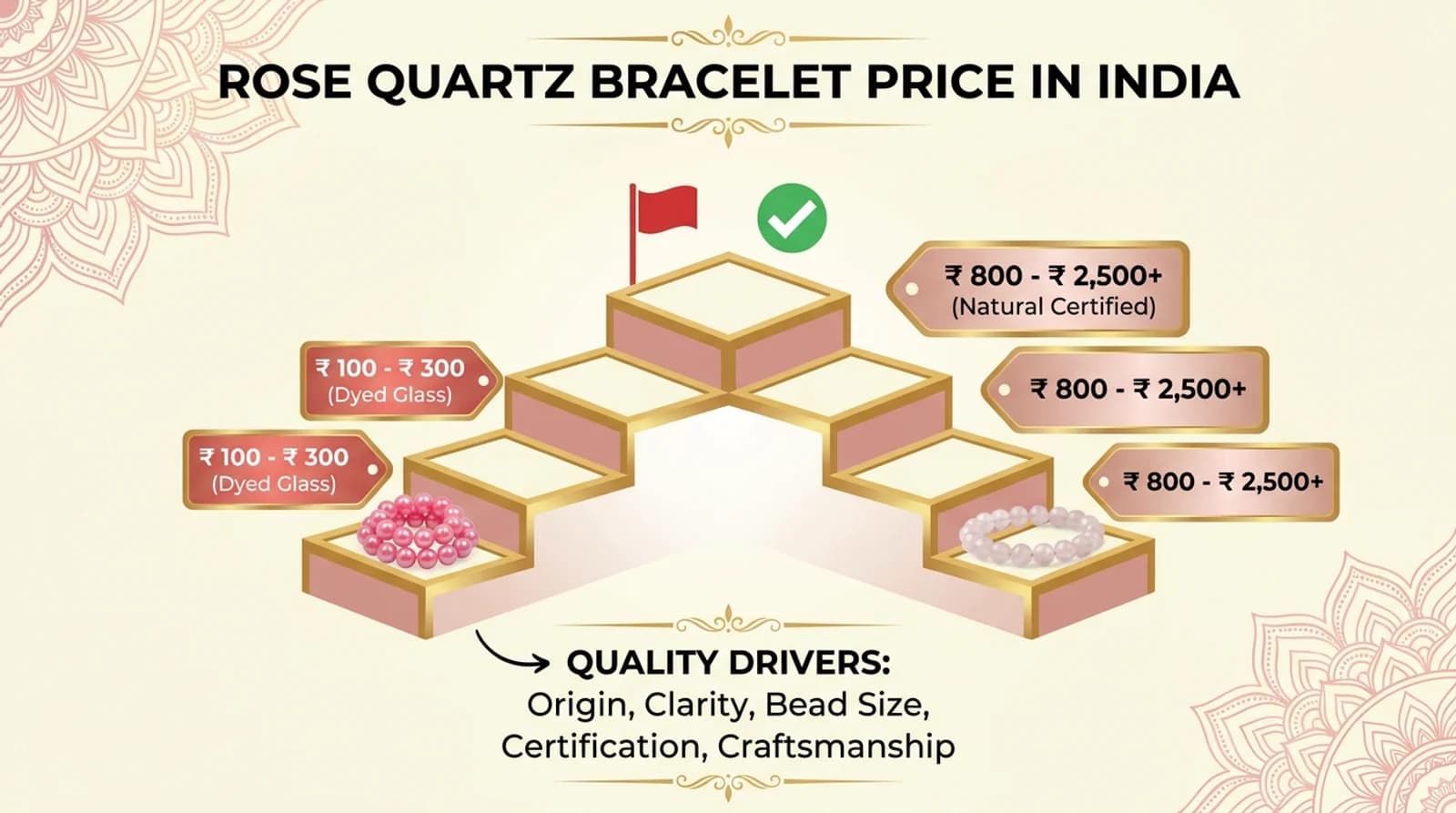
There is no single fixed rate, but genuine natural rose quartz bracelets sit in a sensible band. Most certified single-stone bracelets fall between roughly 300 and 2,000 INR, with price rising for larger beads, cleaner colour, AAA-grade clarity and an included per-piece lab certificate. Prices below this band for a 'natural' stone are the main warning sign.
| Plain 6mm, uncertified | Around 200-500 INR |
| 8mm, certified single stone | Around 500-1,200 INR |
| 10mm or AAA clarity, certified | Around 1,000-2,000 INR |
| Designer or combination bracelet | 1,500 INR and up |
| Suspicious candy-pink 'natural' under 150 INR | Likely dyed glass or pink agate |
Treat these as honest guide ranges, not promises. Genuine pricing reflects natural stone supply, hand-finishing and certification. If a seller offers AAA, certified, large-bead rose quartz at a throwaway price, the maths usually does not add up, and the stone, the certificate or both are not what they claim.
What actually moves the price up or down
Five things explain almost every honest price difference between two real rose quartz bracelets. Knowing them lets you judge whether a higher price is justified or whether a cheap one has quietly cut a corner that matters.
- 1Bead size
Larger beads use more rough stone. A 10mm bracelet costs more than a 6mm one for the same quality.
- 2Colour and clarity
Even, milky pink with few cracks is graded higher than dull, heavily fractured or patchy stone.
- 3Authenticity grade
Genuine natural quartz costs more than dyed glass, pink agate or reconstituted powder passed off as rose quartz.
- 4Certification
A named, viewable per-piece lab certificate adds real cost and real trust, because the lab actually tests the stone.
- 5Sourcing and finishing
Jaipur, Rajasthan provenance, hand-knotting and quality elastic add durability you feel over months of daily wear.
A fair price is simply these factors stacked honestly. A red-flag price is when a listing claims the top of every factor, AAA, large, certified, natural, yet charges less than an uncertified plain bracelet should cost.
Why suspiciously cheap candy-pink bracelets are a warning
The single biggest red flag is colour married to price. Genuine rose quartz is pale, milky and slightly cloudy. If a bracelet is bright, uniform, candy-pink and translucent like a boiled sweet, and it is also very cheap, you are most likely looking at dyed glass or dyed pink agate, not natural rose quartz.
| Signal | Genuine rose quartz | Likely dyed glass or fake |
|---|---|---|
| Colour | Pale, milky, soft pink | Vivid, even candy-pink |
| Clarity | Cloudy, natural veils and cracks | Glassy clear or full of round air bubbles |
| Price | In the fair INR ranges above | Far below natural, suspiciously cheap |
| Sunlight | Can fade slowly over time | Dye may bleed or fade fast, or never fades because it is glass |
| Certificate | Named, viewable lab report per piece | No certificate, or a vague '100% certified' badge only |
None of this means every cheap bracelet is a scam, but cheap plus candy-pink plus no certificate is the combination to avoid. You are buying the stone, not the marketing photo, and over-saturated product images are exactly how imitations are made to look appealing online.
Real vs fake: simple checks before you pay
You can sanity-check authenticity without a lab, though only a certificate is conclusive. These quick tests catch the most common fakes and pair naturally with COD, where you inspect before you commit.
- 1Look at the colour
Real rose quartz is soft and milky. Candy-bright uniform pink suggests dye or glass.
- 2Check for cloudiness
Natural stone has internal veils and a slightly cloudy body. Perfectly clear, bubble-filled beads point to glass.
- 3Feel the temperature
Quartz feels cool to the touch and warms slowly. Glass and plastic warm up faster.
- 4Inspect for bubbles
Round trapped air bubbles are a glass giveaway. Quartz shows cracks and mineral wisps instead.
- 5Read the certificate
A named lab report confirming natural rose quartz, not a generic badge, is the only definitive proof.
For a fuller, photo-backed walkthrough of these tests, see our dedicated real vs fake guide. The short version: if colour, clarity, price and certificate all agree, you are almost certainly holding the genuine stone.
Where COD and certification earn their value
In India, cash on delivery and a real certificate are the two features that turn 'cheaper' into 'better value'. COD lets you inspect the bracelet at your door before paying, so colour and clarity checks happen with the stone in hand. A named, per-piece lab certificate proves the stone is natural rose quartz, not dyed glass.
| COD | Inspect colour, clarity and beads before you pay |
| Lab certificate | Named, viewable report per order confirming natural rose quartz |
| Provenance | Jaipur, Rajasthan gemstone-hub sourcing |
| Sizing | 6mm, 8mm, 10mm plus a wrist-measurement guide |
| Returns | Clear policy if the piece is not as described |
This is the honest difference between a vague '100% certified' badge and a certificate you can actually open and read. Paying slightly more for a verifiable stone, COD and a clear return policy usually costs less than replacing a cheap fake that fades, bleeds dye or simply isn't quartz.
Smart-buyer checklist and how to wear it
Bring the price guide and authenticity checks together with one short checklist, plus the basics of wearing and caring for your bracelet so it lasts.
- 1Match price to claims
Use the INR ranges above. Reject AAA, certified, large-bead stone offered at throwaway prices.
- 2Judge the colour
Choose pale, milky pink. Walk away from candy-bright, glassy, bubble-filled beads.
- 3Demand a real certificate
Insist on a named, viewable lab report, not a generic badge.
- 4Pick your size
Use a wrist-measurement guide; 8mm suits most adults, 6mm for slim wrists, 10mm for a bolder look.
- 5Use COD if unsure
Inspect at delivery so authenticity checks happen before payment.
On wearing: many wearers choose the left wrist as the receiving side to invite calm and self-love, and rose quartz is gentle enough for daily wear. Set a simple intention as you put it on. It supports a mindset, it does not replace medical, financial or relationship advice.
Care is simple and protects both the stone and your money. Keep your rose quartz bracelet dry: remove it before bathing, swimming, perfume or lotion, and wipe with a soft cloth. Recharge occasionally on selenite or under moonlight, and avoid prolonged direct sunlight, which can fade the natural pink.
Frequently asked
Last reviewed: 17 May 2026 · Verified by the DivineTatva expert panel
What is a fair rose quartz bracelet price in India?
Most genuine, certified natural rose quartz bracelets fall between roughly 300 and 2,000 INR, depending on bead size, clarity and whether a per-piece lab certificate is included. Plain uncertified 6mm bracelets sit lower, while 10mm or AAA-clarity certified pieces sit higher. Anything claiming AAA, large and certified natural stone for under 150 INR is usually dyed glass or pink agate, not real rose quartz.
Why are some rose quartz bracelets so cheap?
Suspiciously cheap bracelets, especially bright candy-pink ones, are often dyed glass, dyed pink agate or reconstituted powder rather than natural rose quartz. Genuine stone, hand-finishing and lab certification all cost money, so a price far below the fair range usually means a corner has been cut on authenticity or certification. Cheap plus candy-pink plus no certificate is the combination to avoid.
How do I know my rose quartz bracelet is original?
Genuine rose quartz is pale, milky and slightly cloudy, never candy-bright and glassy. Quick checks include colour, internal cloudiness, a cool touch and the absence of round air bubbles, which signal glass. The only conclusive proof is a named, viewable lab certificate confirming natural rose quartz. Buying with COD lets you run these checks in hand before you pay.
Does an 8mm rose quartz bracelet cost more than 6mm?
Yes, usually. Larger beads use more rough stone, so for the same quality and certification an 8mm bracelet costs more than a 6mm one, and 10mm costs more again. Bead size is one of the clearest honest price drivers, alongside colour, clarity, authenticity grade and certification. Choose size for fit and look; 8mm suits most adult wrists.
Is a lab certificate worth paying extra for?
For a stone where dyed glass imitations are common, yes. A named, per-piece lab certificate confirms the bracelet is natural rose quartz, not dyed glass or agate, and is far stronger than a vague '100% certified' badge. Paying slightly more for a verifiable certificate, COD and a clear return policy usually costs less than replacing a cheap fake later.
Does a rose quartz bracelet actually work?
Its love, self-love and heart-chakra benefits come from Vedic and metaphysical tradition plus personal belief, and are experiential rather than medically proven. Many wearers report calm, warmth or focus consistent with intention, ritual and the placebo response. Treat a rose quartz bracelet as a wellbeing and intention aid, not a treatment, and not a substitute for medical, financial or professional advice.
How should I care for my rose quartz bracelet?
Keep your rose quartz bracelet dry: remove it before bathing, swimming, perfume or lotion, and wipe with a soft cloth. Recharge occasionally on selenite or under moonlight, and avoid prolonged direct sunlight, which can fade the natural pink. Simple care protects both the stone's colour and the value of your purchase, keeping the bracelet looking soft and milky for years.
Reviewed by the DivineTatva expert panel
Written and reviewed by DivineTatva's consulting Vedic astrologer. Every piece is lab-certified and energised in our Jaipur atelier. Last updated 21 March 2026.