Do Rudraksha Bracelet Benefits Actually Work? Tradition vs Evidence
A rudraksha bracelet is a wrist strand of natural Rudraksha seeds — the dried fruit-stones of the Elaeocarpus ganitrus tree — each marked with natural mukhi line-faces and linked in tradition to Lord Shiva, calm and protection. This guide separates what tradition says from what evidence shows, and what we can actually certify.
What a Rudraksha Bracelet Actually Is
A rudraksha bracelet is a wrist strand of natural Rudraksha seeds — the dried fruit-stones of the Elaeocarpus ganitrus tree — strung on thread or elastic, often paired with an Om or Panchtatva (five-element) charm in gold-plated metal caps or a traditional mauli thread base. Each bead shows natural mukhi line-faces; 5 mukhi is the most common and most worn.
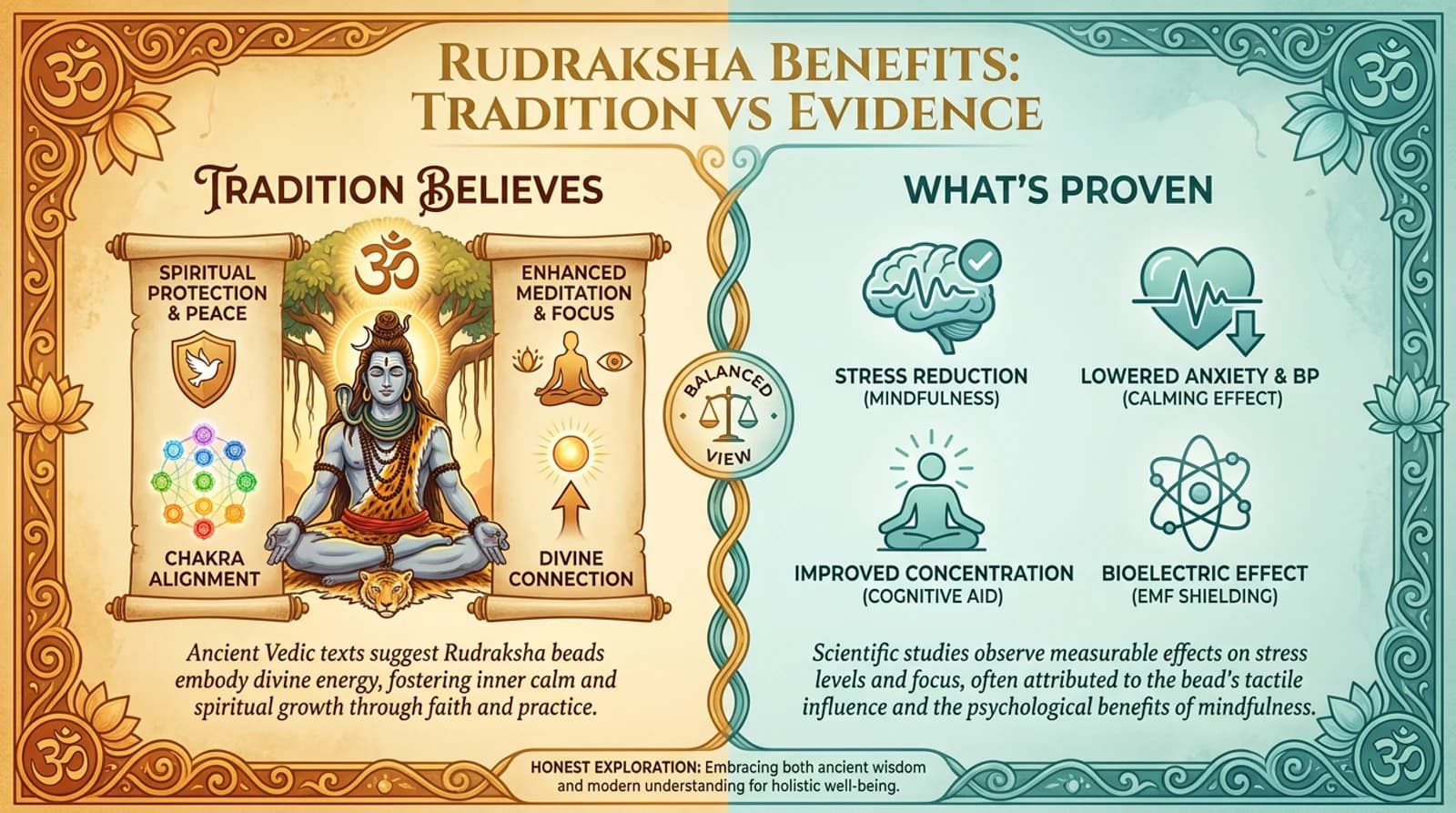
In Vedic and metaphysical tradition, Rudraksha is associated with Lord Shiva and is worn for calm, focus and protection. That is the belief layer. Separately, what a lab can verify is physical: the species, the mukhi count and the origin (Nepali vs Indonesian). This page keeps those two layers clearly apart so you know exactly what you are buying.
| Botanical source | Elaeocarpus ganitrus seed (fruit-stone) |
| Most common type | 5 mukhi (panchmukhi) — five natural line-faces |
| Designs here | Plain, Om charm, Panchtatva/elemental, rudraksha + pyrite |
| Base options | Gold-plated metal caps or traditional thread (mauli) |
| Origin we stock | Nepali (larger, deeper grooves) — stated on certificate |
| Tradition links to | Lord Shiva; calm, focus, protection |
| What we certify | Species, mukhi count, origin via lab/X-ray |
Tradition Says, Evidence Shows, We Certify
Most sellers state rudraksha benefits as plain fact with no disclaimer. We do it differently. There are three honest layers to any claim: what tradition teaches, what peer-reviewed evidence actually shows, and what an independent lab can certify. Holding these apart is how you judge any spiritual product fairly — and it is the core of how we earn your trust.
| Claim | Tradition says | Evidence shows | What we certify |
|---|---|---|---|
| Calm & focus | Rudraksha steadies the mind and aids meditation | No clinical proof; wearers report calm consistent with ritual, routine and placebo | Nothing — this is a belief/experience benefit, not a lab fact |
| Protection (buri nazar) | Shields the wearer from negative energy | No measurable evidence; comfort comes from intention and habit | We cannot certify protection — only that the bead is genuine |
| Authenticity | A real Rudraksha carries the energy | Authenticity is a physical, testable property | Yes — species, mukhi count and origin via lab/X-ray |
| Health cures | Various traditional health associations | No proof; not a substitute for medical advice | Nothing — we make no medical claim |
Bottom line: we will never tell you a bead cures, attracts money or guarantees outcomes. What we will guarantee — in writing, on a QR-verifiable certificate — is that your bead is an authentic Rudraksha of the stated mukhi and origin. The benefits you may feel come from the grounding ritual of mindful wearing; the authenticity comes from the lab.
The Benefits, Framed Honestly
People wear a rudraksha bracelet for real reasons — they just are not the reasons most ads imply. The documented effects are behavioural: a physical cue on the wrist that prompts a pause, a breath, a moment of intention. That is genuinely useful, and we would rather explain it truthfully than over-promise.
- 1A grounding ritual
Touching the beads becomes a cue to slow down — a tactile anchor many wearers use before meetings, prayer or sleep. The benefit is the habit, not magic.
- 2The comfort of routine
Putting it on each morning and setting an intention is a small, repeatable ritual; consistency is what most people actually feel as 'it works'.
- 3A symbol you connect with
For devotees of Shiva, the Om or Panchtatva charm carries meaning. Meaning supports focus and calm — through belief, not proven biology.
- 4A conversation and identity piece
It marks intention publicly and gently. For many men and women that sense of identity is part of why it helps them stay grounded.
None of this is a substitute for medical, financial or professional advice. If you feel calmer or more focused while wearing it, that experience is real and valid — we simply will not dress it up as clinical proof, because there is none.
Who Can Wear It, and How to Wear It Right
Rudraksha is traditionally considered suitable for nearly everyone — men and women, any rashi — because, unlike gemstones, it is not tied to a single planet. 5 mukhi in particular is regarded as the universal, no-restriction bead. There are no astrological bars to wearing it; the few cautions are practical, not mystical.
| Question | Traditional guidance | Practical note |
|---|---|---|
| Which hand? | Left wrist for receiving calm inward; right is also fine | Wear it wherever it stays comfortable and dry |
| Men or women? | Both — Rudraksha is gender-neutral | Choose bead size and a gold or thread base to taste |
| Daily wear? | Yes, it can be worn daily | Just remove before bathing, swimming and heavy sweat |
| Any restriction? | 5 mukhi has no rashi or caste restriction | People with very sensitive skin should watch for thread irritation |
| Children / elderly? | Generally considered fine | Use a secure size; supervise small children |
To wear it: set it on a clean wrist, optionally chant 'Om Namah Shivaya' a few times as a simple intention-setting ritual, and keep it for everyday use. There is no compulsory ceremony required to start — the certificate confirms what it is; the intention is yours to add.
Original vs Fake — and Why the Certificate Matters
The biggest real worry with rudraksha is not whether it 'works' — it is whether it is real. Fakes are commonly carved from betel nut or moulded resin, or beads are passed off as a higher mukhi than they are. A few traditional checks help at home, but only a lab can settle species, mukhi count and origin with certainty.
| Natural mukhi lines | Real lines run end-to-end and are uneven; fakes look too perfect or carved |
| Surface & grain | Genuine seeds show natural pores and irregular grooves |
| Float/water test | Folk test only — unreliable; sinking or floating proves little on its own |
| Mukhi count | Best confirmed by X-ray of internal seed chambers, not by eye |
| Origin | Nepali beads are typically larger with deeper grooves than Indonesian |
| Our proof | Free, QR-verifiable lab/X-ray certificate stating species, mukhi and origin |
Home tests are a useful first filter, but they are not proof — which is exactly why we attach a free lab certificate to every piece. It explicitly names the species (Elaeocarpus ganitrus), the mukhi count and whether the bead is Nepali or Indonesian, and you can verify it by QR. We state origin as a feature, not a secret. That transparency is the honest answer to the 'real vs fake' fear that vague '100% certified' badges leave open.
Daily Wear, Cleansing and Long-Term Care
Rudraksha is an organic seed, so it lasts longest when kept dry and lightly oiled. 'Cleansing' here means two simple things: practical hygiene (keeping it dry and clean) and, if you wish, a personal energising ritual — neither is a magic step, and both are entirely optional.
Care: Keep your Rudraksha bracelet dry: remove it before bathing, swimming or heavy sweat, and avoid soap, perfume and chlorinated water. Oil the beads with a little sandalwood or coconut oil occasionally, keep any gold-plating and pyrite completely dry, and store in a soft cloth pouch.
- 1Keep it dry
Take it off before bath, swim or workout. Water and sweat slowly soften organic seeds and dull gold-plating and pyrite.
- 2Oil occasionally
A drop of sandalwood or coconut oil rubbed in every few weeks keeps the beads dark and prevents cracking.
- 3Energise if you wish
Many wear it after a Monday or a simple 'Om Namah Shivaya' intention; this is belief-based ritual, not a requirement for it to be genuine.
- 4Store soft and dry
Keep it in the cloth pouch away from heat. Avoid harsh chemical cleaners entirely.
Frequently asked
Last reviewed: 17 May 2026 · Verified by the DivineTatva expert panel
Do rudraksha bracelet benefits actually work?
Honestly: there is no peer-reviewed proof that Rudraksha delivers supernatural benefits. What is real and documented is the grounding ritual of mindful wearing — a tactile cue that prompts pause, breath and intention. Many wearers report calm, focus and a sense of protection consistent with routine and belief. We never over-promise, and a rudraksha bracelet is not a substitute for medical, financial or professional advice.
Which hand should I wear a rudraksha bracelet on?
Tradition favours the left wrist as the receiving side — drawing calming energy inward — but the right is also considered fine. Practically, wear it on whichever wrist keeps it comfortable and, importantly, dry. There is no strict rule that makes one hand 'wrong'; comfort and keeping the beads away from water and sweat matter more than side.
Can I wear a rudraksha bracelet daily?
Yes. 5 mukhi Rudraksha has no rashi or caste restriction and is traditionally worn every day. The only real cautions are practical: remove it before bathing, swimming or heavy sweat, and keep it away from soap, perfume and chlorinated water. Oil the beads occasionally and store them dry, and a daily-worn bracelet will stay healthy for years.
How do I know my rudraksha bracelet is original?
Home checks help — natural mukhi lines run end-to-end and are uneven, and genuine seeds show irregular pores and grooves. But float tests and visual checks are not proof. The only reliable confirmation of species, mukhi count and origin is a lab/X-ray certificate. Every DivineTatva bracelet ships with a free, QR-verifiable certificate naming the species, mukhi count and whether the bead is Nepali or Indonesian.
Are there any side effects of wearing rudraksha?
Rudraksha itself is an inert organic seed and is generally considered safe for daily wear by men and women of any rashi. The only practical issues are skin sensitivity to a thread or metal cap, or the beads softening if repeatedly soaked. There are no proven medical effects, good or bad — so it should never replace medical advice or prescribed treatment.
What is the difference between Nepali and Indonesian rudraksha?
Nepali Rudraksha beads are typically larger with deeper, more pronounced grooves, while Indonesian beads are smaller and smoother. Both can be genuine Elaeocarpus ganitrus; the difference is size, grain and price, not authenticity. We stock Nepali beads and state the origin explicitly on the certificate, so you are never guessing what you paid for.
How do I cleanse or energise a rudraksha bracelet?
Cleansing means two simple things. Practical care: keep it dry, wipe gently, oil with a little sandalwood or coconut oil occasionally, and store in a cloth pouch. Optional ritual: many wear it after setting an intention or chanting 'Om Namah Shivaya', often on a Monday. The ritual is belief-based and entirely optional — it does not change whether the bead is genuine.
Reviewed by the DivineTatva expert panel
Written and reviewed by DivineTatva's consulting Vedic astrologer. Every piece is lab-certified and energised in our Jaipur atelier. Last updated 23 May 2026.