Real vs Fake Rudraksha Bracelet: 6 Tests (X-Ray, Water, Mukhi-Line) + Free Lab Certificate
An original rudraksha bracelet is a strand of genuine Elaeocarpus ganitrus seeds, each showing natural mukhi (face) lines, verified by lab or X-ray testing rather than home tricks. Most "tests" you read about are unreliable; the only conclusive proof is a certificate stating species, mukhi count and origin.
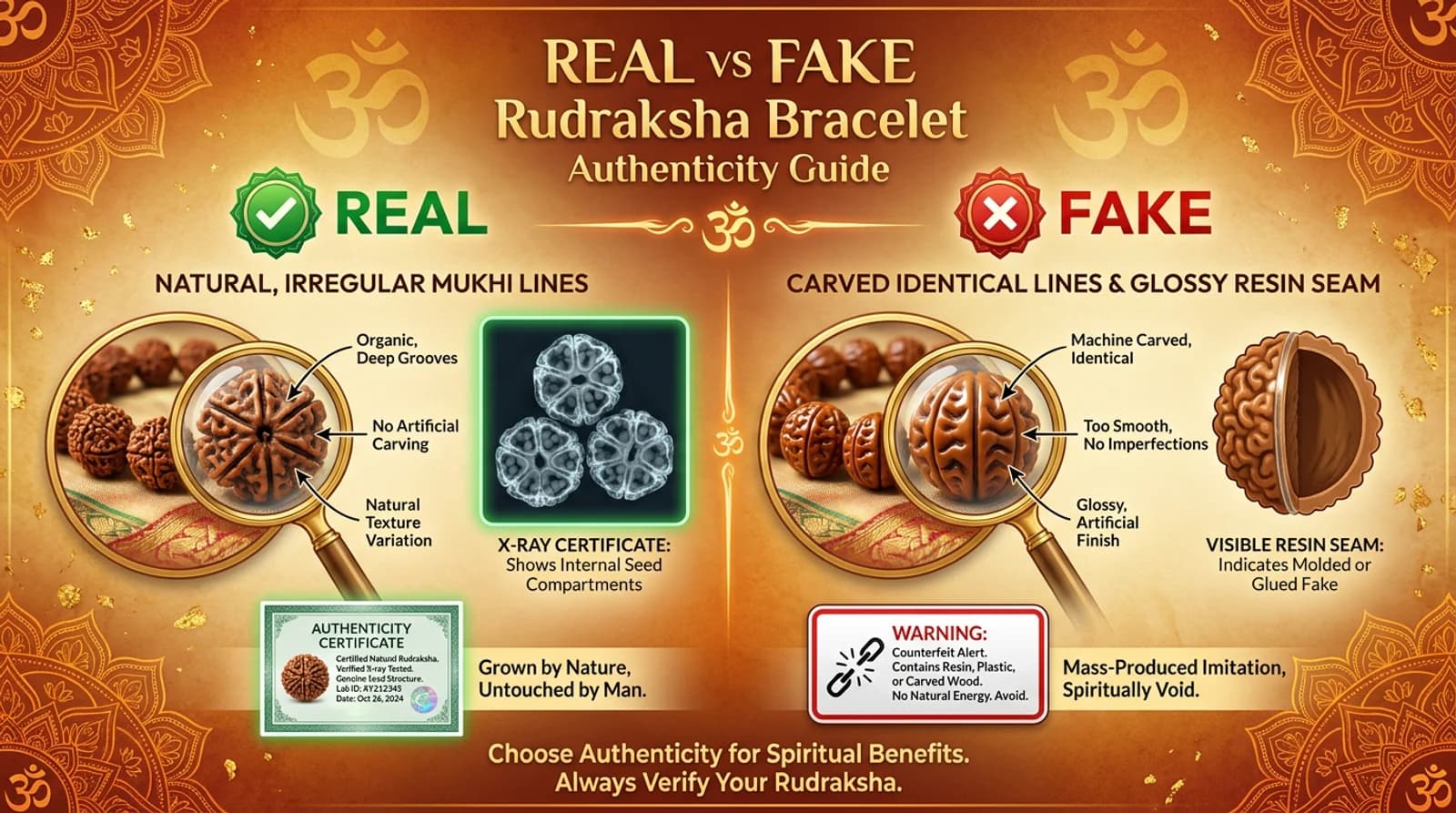
What Makes a Rudraksha Bracelet 'Original'?
An original rudraksha bracelet is a wrist strand of real Elaeocarpus ganitrus seeds — the dried fruit-stones of the rudraksha tree — each carrying natural vertical mukhi (face) lines running pole to pole. "Original" means three things together: the right species, the stated mukhi count (commonly 5 mukhi), and an honest origin (Nepali or Indonesian). Anything else is decoration.
Notice what is not on that list: magical powers. Tradition links rudraksha to Lord Shiva, calm, focus and protection, and many wearers report those benefits. But peer-reviewed proof of supernatural effects is lacking — the documented gains are the grounding ritual of mindful wearing and the comfort of routine. So when we say a bracelet is genuine, we mean its material, mukhi and origin are verifiable, not that it performs miracles. This is not a substitute for medical, financial or professional advice.
| What is certifiable | Species, mukhi count, origin (lab/X-ray) |
| What is belief-based | Calm, focus, protection, Shiva connection |
| Most common bead | 5 mukhi (panchmukhi) Nepali or Indonesian |
| Natural marker | Vertical mukhi lines, irregular surface, real pores |
| Conclusive proof | QR-verifiable lab certificate, not home tests |
The 6 'Real vs Fake' Tests — and Which Actually Work
Search results are full of home tests promising to expose fakes in seconds. Most are folklore. Here is each one rated honestly: what it claims, what it really tells you, and how reliable it is. Only two are genuinely conclusive — and one of those you cannot do at home.
| Test | What it claims | Honest verdict | Reliable? |
|---|---|---|---|
| X-ray / CT scan | Reveals internal compartments matching mukhi count | Gold standard — counts true internal seed chambers, exposes glued fakes | Yes — conclusive |
| Lab certificate | States species, mukhi, origin | Conclusive when issued by a real gemmological lab with QR check | Yes — conclusive |
| Water sink/float | Real sinks, fake floats | Myth — many genuine beads float and many fakes sink; depends on density & oil | No |
| Boil / hot water | Fake fades or dissolves glue | Destructive and unreliable; can damage a real bead too | No |
| Copper coin spin | Bead rotates between two coins if real | Pure folklore; rotation is just balance, not authenticity | No |
| Mukhi-line scratch | Real lines are continuous clefts, not painted | Useful clue, not proof — skilled fakes carve convincing lines | Partly |
Bottom line: the water test, boiling and the copper-coin spin prove nothing — we mention them only to retire them. The mukhi-line check is a helpful first glance. The only definitive answers come from X-ray imaging and an accredited lab certificate, which is exactly why we issue one with every bracelet.
Reading the Mukhi Lines With Your Own Eyes
Mukhi ("faces") are the natural clefts running from the top hole to the bottom hole of each bead. A 5 mukhi bead has five such lines dividing it into five segments. You can learn a lot in good light with a magnifier before any lab is involved — just treat it as a clue, not a final ruling.
- 1Count the deep lines
Follow each cleft pole-to-pole. They should be continuous and reach both holes — broken or painted-on lines that stop short suggest carving.
- 2Check the surface texture
Genuine rudraksha has an irregular, knobbly surface with real micro-pores. Glassy-smooth, perfectly uniform beads are usually moulded resin or betel-nut.
- 3Look at the mukhi junctions
Where lines meet near the holes, real beads show natural tissue, not a seam or mould line running around the bead.
- 4Compare bead to bead
On a natural strand, no two beads are identical in size, colour or line spacing. Suspiciously matched beads point to mass-moulded fakes.
- 5Inspect the holes
Drilled holes on real seeds show fibrous, woody interior walls — not the smooth bore of plastic or the white pith of betel-nut.
Even after all this, a careful workshop can carve extra lines onto a low-mukhi bead to sell it as a rarer, pricier count. That is why eye inspection narrows the odds but only X-ray, which counts the internal compartments, settles a disputed mukhi number for certain.
Common Fakes, Fillers and Half-Truths
"Fake" is rarely a single thing. Most problem bracelets fall into a few honest categories — from outright resin copies to genuine beads sold with an inflated mukhi claim. Knowing the type helps you ask the right question of the seller.
| Moulded resin / plastic | Lightweight, glassy, identical beads with painted lines |
| Betel-nut (supari) carved | Carved nut faked into rudraksha; white pith inside the hole |
| Bonded / glued bead | Two halves stuck together to fake a higher mukhi count |
| Mukhi inflation | Real bead, but carved or mislabelled as a rarer count |
| Origin swap | Indonesian beads sold as premium Nepali (or vice-versa) |
| Wax / oil dressing | Heavy oiling to darken cheap beads and hide a smooth surface |
None of these are exposed by floating a bead in water. The first three usually show up under X-ray; mukhi inflation needs an internal compartment count; and origin can only be honestly stated by the seller and recorded on a certificate. We list Nepali vs Indonesian on the certificate itself rather than leaving it vague — origin transparency is a feature, not fine print.
The Free, QR-Verifiable Lab Certificate
Every DivineTatva rudraksha bracelet ships with a free lab certificate you can verify by scanning a QR code. It does not say "100% certified" and leave it there — it names the species, the mukhi count and the origin, so the dominant "is this real?" fear is answered on paper, not by trust alone.
| Detail | Vague 'certified' seller | DivineTatva certificate |
|---|---|---|
| Species named | Often not stated | Elaeocarpus ganitrus, stated |
| Mukhi count | "As shown" | Verified count printed |
| Origin | Hidden or implied | Nepali or Indonesian, stated |
| Verification | No way to check | Scan QR to confirm record |
| Test method | Unspecified | X-ray / lab-based |
| Cost | Sometimes paid add-on | Free with every bracelet |
A certificate proves material, mukhi and origin — the things that can be tested. It does not certify spiritual benefit, and we will not pretend otherwise. That honesty is the point: you get a verifiable authenticity record and a clear, traditional-belief framing, so you know exactly what you are paying for.
Buying Checklist and Honest Price Guide
Before you check out anywhere, run this quick list. It protects you from both crude fakes and the pricing theatre — the "Rs 99,900 MRP, 60% off" anchoring — that some sellers use to make a cheap bead feel premium. Fair, stable INR pricing is a trust signal in itself.
- 1Ask for the certificate first
A genuine seller states species, mukhi and origin and lets you verify it. "100% certified" with nothing to scan is not proof.
- 2Confirm the mukhi count in writing
For a 5 mukhi (panchmukhi) bracelet, the listing and certificate should both say 5 mukhi, not just "rudraksha".
- 3Check origin is stated
Nepali beads are larger and pricier; Indonesian are smaller and value-friendly. Both are genuine — vagueness is the warning sign.
- 4Be wary of huge fake discounts
Inflated MRP with a dramatic cut is a marketing trick, not a saving. Compare the actual price you pay.
- 5Match design to honesty
Gold-plated Om caps, Panchtatva charms or rudraksha-and-pyrite combos are fine — as long as the rudraksha itself is certified.
| Indonesian 5 mukhi bracelet | Smaller beads, most affordable certified entry |
| Nepali 5 mukhi bracelet | Larger, premium beads, higher price |
| Gold-plated Om / Panchtatva | Adds metal-cap or charm cost over plain thread |
| Rudraksha + pyrite combo | Wealth-design pairing, priced by pyrite quality |
| Thread (mauli) base | Traditional, lowest-cost finish |
| Payment in India | Transparent INR, COD available, Jaipur-made |
Caring for Your Certified Bracelet
Good care keeps a real bracelet looking real — neglected beads dry out and crack, while a soaked gold-plated cap tarnishes and starts to look like a cheap fake. The routine is simple and protects both the seed and any metal or pyrite accents.
Keep your Rudraksha bracelet dry: remove it before bathing, swimming or heavy sweat, and avoid soap, perfume and chlorinated water. Oil the beads with a little sandalwood or coconut oil occasionally, keep any gold-plating and pyrite completely dry, and store in a soft cloth pouch.
| Daily wear | Fine for most people; left wrist is the traditional receiving side |
| Cleanse / energise | Wipe dry, optional incense or a short intention/mantra — belief-based, not chemical |
| Avoid | Soap, perfume, chlorine, prolonged water, harsh scrubbing |
| Oil occasionally | A drop of sandalwood or coconut oil to prevent drying |
| Store | Soft cloth pouch, away from moisture and heat |
Frequently asked
Last reviewed: 17 May 2026 · Verified by the DivineTatva expert panel
How can I identify an original rudraksha bracelet at home?
You can narrow it down but not confirm it. In good light with a magnifier, check that each bead has continuous mukhi lines reaching both holes, an irregular knobbly surface with real pores, and fibrous woody walls inside the drill hole. Beads should vary slightly from one another. These are clues, not proof — only an X-ray and a lab certificate stating species, mukhi count and origin are conclusive.
Does the water test really tell real from fake rudraksha?
No. The popular "real sinks, fake floats" test is a myth. Whether a bead sinks depends on its density, how dry or oiled it is, and trapped air — not on authenticity. Genuine beads often float and convincing fakes often sink. Treat the water test as folklore; rely on X-ray imaging or a verifiable lab certificate instead.
Why does the lab certificate matter more than home tests?
Because it tests what can actually be verified. An accredited lab uses X-ray and gemmological methods to confirm the species (Elaeocarpus ganitrus), count the internal compartments for the true mukhi number, and record the origin. Our certificate states all three and is QR-verifiable, so you are not relying on a seller's word or a kitchen trick. It certifies authenticity, not spiritual benefit.
Is a Nepali rudraksha bracelet more 'original' than Indonesian?
No — both are genuine Elaeocarpus ganitrus. The difference is size and price: Nepali beads are larger and command a premium, while Indonesian beads are smaller and more affordable. Neither is fake. What matters is that the origin is honestly stated on the certificate rather than left vague, since some sellers pass Indonesian beads off as premium Nepali.
Can a fake have carved mukhi lines that look real?
Yes, and this is the trickiest case. A skilled workshop can carve extra lines onto a low-mukhi bead to sell it as a rarer, pricier count, or carve betel-nut to mimic rudraksha. Surface inspection can miss this. Only an X-ray, which counts the bead's internal seed compartments, reliably settles a disputed mukhi number, which is why we X-ray and certify rather than rely on the eye.
Will an original rudraksha bracelet give me the benefits people describe?
Honestly, we can't promise that. Tradition links rudraksha to Lord Shiva, calm, focus and protection, and many wearers report feeling calmer or more focused. But peer-reviewed proof of supernatural effects is lacking — the documented benefit is the grounding ritual of mindful wearing. A certificate guarantees the bead is genuine, not that it changes your luck. This is not a substitute for medical, financial or professional advice.
How much should a genuine certified rudraksha bracelet cost?
It varies by origin and design rather than by hype. Indonesian 5 mukhi beads are the most affordable certified entry, Nepali beads cost more for their larger size, and gold-plated Om, Panchtatva or rudraksha-and-pyrite designs add metal or stone cost. Be cautious of inflated MRP with dramatic "60% off" discounts — compare the actual INR price you pay, and check it includes a verifiable certificate.
Reviewed by the DivineTatva expert panel
Written and reviewed by DivineTatva's consulting Vedic astrologer. Every piece is lab-certified and energised in our Jaipur atelier. Last updated 24 May 2026.